
Cover Image Source: This combination of pictures created on May 14, 2020 shows recent portraits of China’s President Xi Jinping (L) and US President Donald Trump.(Photo by Dan Kitwood and Nicholas Kamm / various sources / AFP)
The U.S. and China have come a long way from their tit-for-tat triple digit tariff impositions in the short space of a few months. Indeed, their bilateral trade negotiations appear to be on a stabilizing and constructive track.
On May 12, in Geneva, the Trump administration suspended 24 percentage points of its 34% reciprocal tariff on China for 90 days – in effect, bringing down the tariff rate on China to 30% (10% reciprocal tariffs + 20% fentanyl-related tariffs). Given pre-existing tariffs and exclusions, the average de facto tariff rate today is in the 45% range. For its part, China reduced its countermeasures tariff to 10% and promised to facilitate the flow of export-controlled rare earth elements (REE) and neodymium magnets.
On June 9-10, in London, the two sides fixed their disagreement on the (slow) flow of Chinese REEs and magnets and agreed on a plan to ease reciprocal export controls. Following the speeding-up of issuance of temporary rare earth export licenses for U.S. non-defense sector companies, Washington released its own hold on China-bound chip design software, jet engine parts and components, and ethane shipments over the subsequent weeks. More notably, the Trump administration reversed course and allowed Nvidia and Advanced Micro Devices (AMD) to sell their export-controlled H20 and MI308 chips, respectively, to China (the two companies will share 15% of these China chip-sales revenues with the US government).
On July 28-29, in Stockholm, the two sides agreed to extend their 90-day tariff pause in principle for a further 90 days in order to finalize a bilateral deal. Beijing sought to remove the 20% fentanyl levy too but was unsuccessful. The two sides also widened the aperture of their conversation to cover relevant macroeconomic issues. It bears remembering that during the final year of the Biden administration, the two sides had established dedicated workstreams on: (a) an Intensive Exchange on Balanced Growth in the Domestic and Global Economies under the aegis of their bilateral Economic Working Group, and (b) Joint Cooperation and Exchange on Anti-Money Laundering under their Financial Working Group.
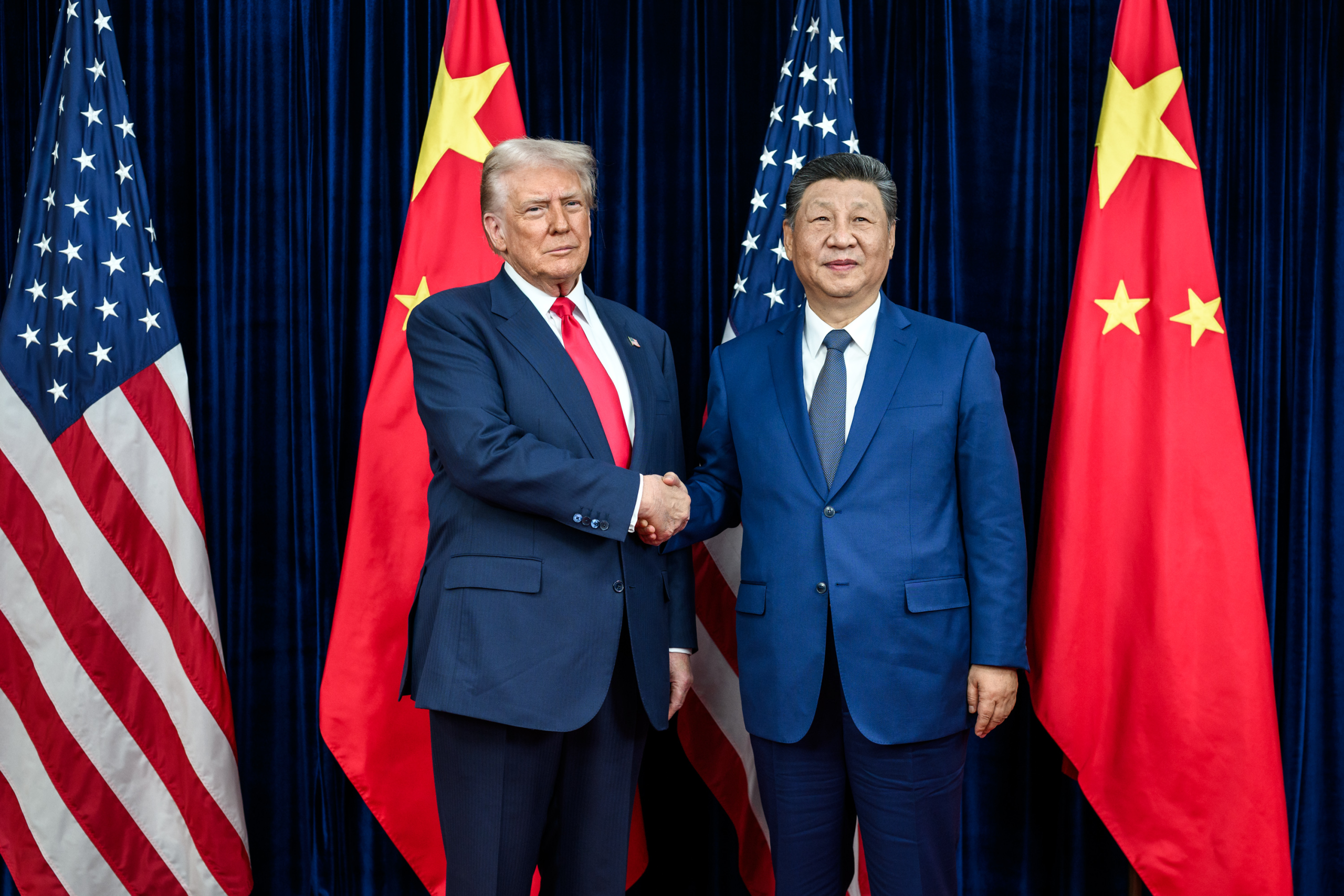
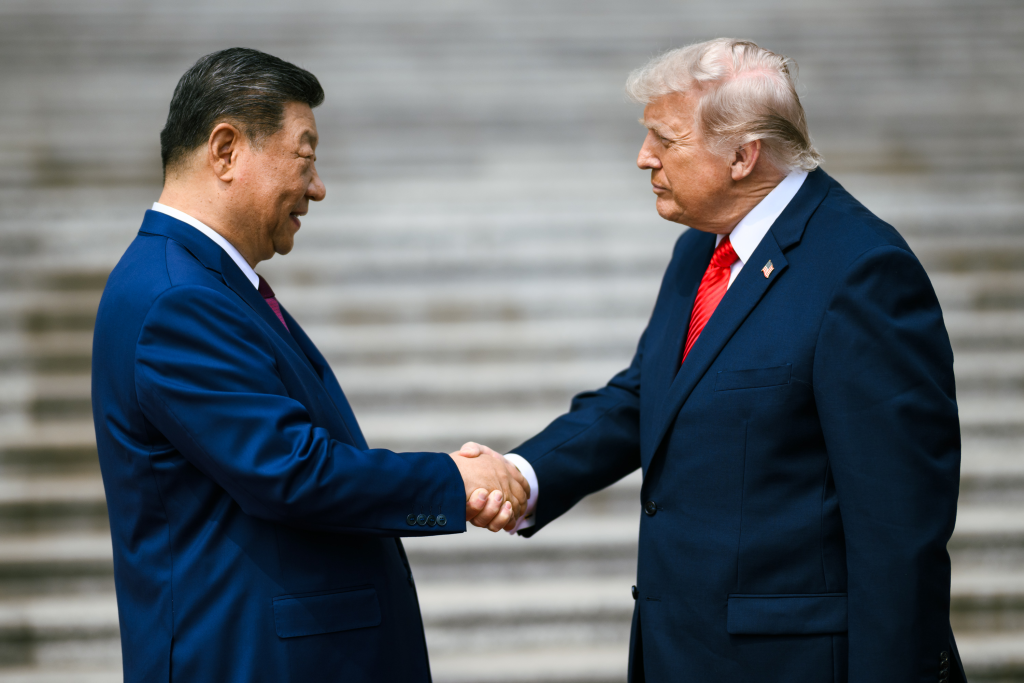
And finally on August 11, the two sides extended their 90-day pause for another 90 days to work out a trade deal. The deadline now is November 10, 2025. With the 47th ASEAN Summit and Related Summits due to be held from October 26-28 in Malaysia and the APEC Economic Leaders Meeting on October 31 in South Korea, and with both presidents Xi and Trump expected in principle to attend, the chances of a first meeting between the two in late-October – either in Kuala Lumpur, Gyeongju or Beijing (or another Chinese city) – appear propitious. The meeting could serve as an action-forcing opportunity to memorialize a trade agreement in advance of the November 10 deadline.
The formal talks aside, there has been a good deal of positive signaling by both sides, and especially by China, over the past two months.
Looking ahead, the broad outlines of a U.S.-China trade (and tech.) deal can be glimpsed on the horizon. President Trump is invested in bringing home a numerically large, managed market purchases agreement on the lines of the U.S.-China Phase One deal of January 2020. He has long viewed the Chinese consumption market as a sort of gold mine for American agriculturalists, aircraft manufacturers and energy exporters, and vented anger at President Biden’s failure to follow through and hold Beijing’s feet-to-the-fire on implementing the deal. Under the Phase One deal, Beijing had agreed to expand purchases of U.S. goods and services by $200 billion, including $32 billion of additional agricultural goods purchases, over a two-year period from Jan. 2020 through Dec. 2021. There are good reasons to believe that large market purchases-based targets are already under discussion between the two sides. Extending China’s temporary 6-month easing of rare earth mineral and magnet flows is an important secondary priority for Trump too.
For his part, President Xi is invested in bringing home a relaxation of U.S. export controls on advanced node chips, specifically later-generation high bandwidth memory (HBM) chips, which are critical to both AI model training and are a key component of advanced computing integrated circuits. Staying in the slipstream of their American peers on AI is a more important near-term priority than the longer-term goal of chip self-sufficiency. In his final major chip regulation of December 2024, President Biden had export-controlled these HBM chips, after having spent the better part of the previous two years (i.e., from October 2022 on) restricting chip sales on the logic side. China had responded at the time with its own controls on gallium, germanium and superhard dual-use items. It is most unlikely that Trump will accede to Xi’s request on relaxing later-generation HBM chips (earlier generation HBMs can be sold in China subject to conditions), for doing so would amount to effectively helping Huawei displace Nvidia – which bundles HBM memory directly with advanced logic chips – and Samsung in China’s AI marketplace within a shorter space of time. On the other hand, it is well-conceivable that Trump could allow Nvidia to sell a customized – albeit slightly downgraded – chip based on its advanced Blackwell architecture, stripped of certain HBM functionality. Trump is already testing these waters, having greenlighted the sale to China of Nvidia’s H20 AI processor based on its older Hopper architecture and teased the possibility of approving chips based on Nvidia’s newer Blackwell architecture. A material reduction in U.S. tariffs, especially the removal of the 20% fentanyl tariff, is an important secondary priority for Xi too.
Putting it all together, then, the obvious question that arises is this: Can the two sides strike up a framework agreement based on some formulation of vastly expanded Chinese market access in exchange for mutual tariff reductions as well as a U.S. relaxation of export controls on advanced (although not leading edge) AI chips, that is timed to coincide with a prospective Trump-Xi summit during the last week of October? And the sale/divestiture of TikTok US could be the cherry on top. With a U.S.-specific clone of the recommendation algorithm expected to be ready prior to the September 17 deadline when TikTok’s third 90-day extension period lapses, the removal of the export control hold maintained by Beijing on the algorithm remains among the last few obstacles to be cleared. There could yet be many-a-slip between the cup and the lip as the two sides try to hash out a reciprocally beneficial bargain. But the chances of a crisp late-October deal should not be discounted either.

Renewing Sino-American bonds of contact, commerce and civility