

The Fujian (Type 003) is China’s third aircraft carrier and the most advanced warship ever constructed for the People’s Liberation Army Navy. Officially launched on June 17, 2022, it is the first Chinese carrier to be equipped with a catapult-assisted take-off but arrested recovery (CATOBAR) system, employing the electromagnetic catapults (EMALS). With a full-load displacement exceeding 80,000 tons and a flat, expansive flight deck, the Fujian represents a generational leap in China’s naval aviation and forward deployment capabilities. The Fujian’s catapult system enables the launch of multiple types of heavier fixed-wing aircraft such as fighter jets, airborne early warning, control (AEW&C) planes, and support aircrafts, greatly expanding operational reach. Such systems have marked a significant difference in comparison with China’s earlier carriers that employed ski-jump ramps, which would limit the aircraft’s adaptation, take-off weight, and operational range. Further, the Fujian’s larger-sized flight deck and hanger bay, in comparison with China’s previous aircraft carriers, would also allow more aircrafts to be stored onboard while at sea, significantly boosting the durability and flexibility of flight operations.
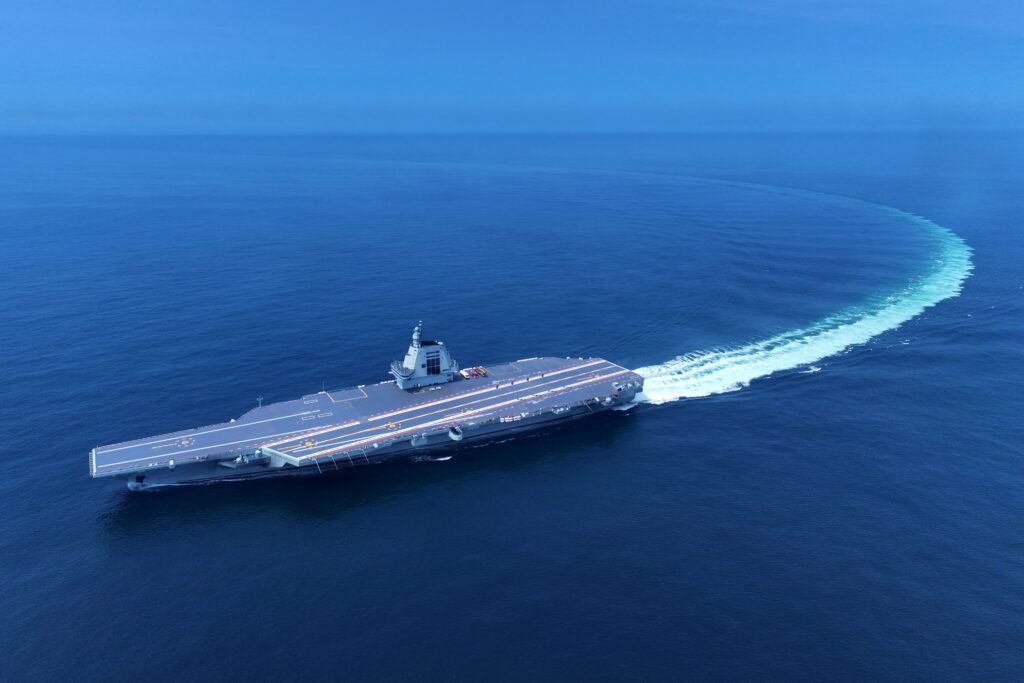
Since the ship’s launch, the Fujian has experienced a continuous set of mooring and sea trials. Over the past two months, the process has advanced significantly toward entering service, with the 8th sea trial and operational preparations being conducted. On August 4, the Xinhua News Agency stated that the commissioning process of the aircraft carrier is in the final stage. It has also mentioned that China has “completely mastered the technologies of the new CATOBAR system”. All such messages would indicate that the Fujian is going to be commissioned soon.
Simultaneously, the development of the naval air wing for the Fujian has also witnessed significant progress. In the Zhuhai airshow in November 2024, the Chinese Navy unraveled its new J-15 T Fighter that mounted with the adaptational modifications specifically for the catapult-launching system. On the other hand, the new 5th generation fighter J-35 has also shown signs of readiness of carrier-based operations, as well as the new KJ-600 early warning aircraft. With these programs progressing as the aircraft carrier enters service, the operational capabilities would be built rapidly.
The Fujian’s commissioning will significantly elevate China’s combat capabilities at sea. With its advanced CATOBAR system, the ship can support more diverse mission profiles and higher sortie-generation rates than its predecessors. This allows the Chinese Navy to operate with greater range and endurance, thereby enhancing its ability to sustain combat operations in far-seas environments. Such improvements translate into a more credible and persistent Chinese naval presence across the region.
These enhanced capabilities have direct implications for the regional security landscape. In the South China Sea and the Western Pacific, the Fujian would provide China with the means to maintain a continuous and more capable carrier presence. This not only reinforces China’s maritime claims but also creates a stronger deterrent against challenges from other actors, including the power projection of the United States. Strategically, the Fujian narrows one of the most visible technological gaps between China and the United States, introducing a new variable into Washington’s force planning. While it will not overturn U.S. naval dominance in the near term, it does compel the U.S. to reconsider whether its current deployment pattern—typically maintaining a single carrier strike group in the Indo-Pacific—might not be sufficient enough to uphold its current level of deterrence and regional influence. In the South China Sea, it strengthens China’s ability to deter challenges from other claimants and from external powers such as the United States, whose freedom of navigation operations (FANOPs) and deepening security cooperation with other regional states have at times heightened tensions. However, by making escalation more costly, the Fujian could discourage unilateral moves that risk destabilizing the region. In this sense, its presence functions as both a deterrent and a stabilizer. It can make the potential competitors rethink before deploying more forces with intentions of escalation. From this perspective, this aircraft carrier is not solely a tool of competition, but part of a broader dynamic in which China’s growing capabilities shape the choices of regional states and the strategic environment in the Indo-Pacific.
Noticeably, the overinterpretation on the Fujian’s role as being directed at potential conflicts across the Taiwan strait would be misleading. The Fujian’s design and purpose extend well beyond a Taiwan contingency. Its main emphasis on sustained far-seas aviation operations indicate that it is built for long-term power projection rather than short, localized campaigns. From a strategic perspective, the Fujian should be better understood as part of China’s broader naval transformation toward a blue-water force. By expanding operational reach across multiple theaters, the Fujian helps ensure that China is not confined to coastal defense but is instead capable of sustaining influence and protecting interests on a much larger scale.
This Spotlight was originally released with Volume 4, Issue 8 of the ICAS MAP Handbill, published on August 25, 2025.
This issue’s Spotlight was written by Letong Qian, Part Time Research Assistant Intern.

Maritime Affairs Program Spotlights are a short-form written background and analysis of a specific issue related to maritime affairs, which changes with each issue. The goal of the Spotlight is to help our readers quickly and accurately understand the basic background of a vital topic in maritime affairs and how that topic relates to ongoing developments today.
There is a new Spotlight released with each issue of the ICAS Maritime Affairs Program (MAP) Handbill – a regular newsletter released the last Tuesday of every month that highlights the major news stories, research products, analyses, and events occurring in or with regard to the global maritime domain during the past month.
ICAS Maritime Affairs Handbill (online ISSN 2837-3901, print ISSN 2837-3871) is published the last Tuesday of the month throughout the year at 1919 M St NW, Suite 310, Washington, DC 20036.
The online version of ICAS Maritime Affairs Handbill can be found at chinaus-icas.org/icas-maritime-affairs-program/map-handbill/.