
Maritime Affairs Program (MAP) Handbill Spotlight
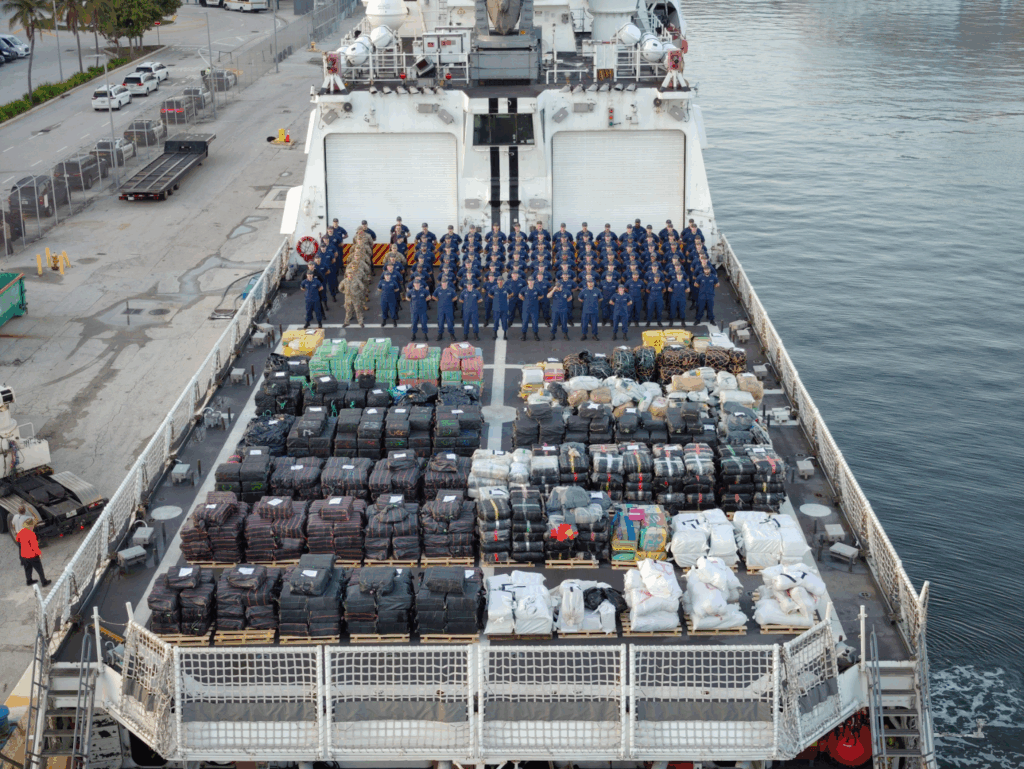
Counter Narcotic Operations in the Caribbean Sea

Yilun Zhang
September 30, 2025
Issue Background
Since the 1980s, Washington has framed Latin America’s drug trade as both a domestic crisis and a strategic security threat. Counter-narcotics operations have long provided the rationale for U.S. military and intelligence presence in the Caribbean and beyond. Under President Trump, this logic has been elevated: the “war on drugs” is presented not just as law enforcement but as a pillar of national defense and regional order.
At the same time, U.S. anxiety has been compounded by China’s growing commercial footprint in the hemisphere. Chinese-backed port developments in South America, though primarily designed for trade, are increasingly portrayed in Washington as carrying potential dual-use risks. The intersection of narcotics enforcement and infrastructure concerns reflects a deeper strategic unease—fears that unchecked flows of drugs and the expansion of foreign-controlled maritime assets could erode U.S. dominance in its own neighborhood.
Recent Events
Under the Trump Administration, Washington has begun to actively reinforce its own presence across the Caribbean and Latin America. Over the past two months, U.S. military and law enforcement agencies have intensified anti-narcotic operations in the Caribbean, including multiple strikes on suspected smuggling vessels and the deployment of Naval warships, Marine units, and even the F-35 fighter jets to Puerto Rico. These operations align with a recent report on the White House’s new National Security Strategy, which places greater emphasis on homeland security above any other regions or domains.
This approach has generated tensions with regional actors. Venezuela has responded by deploying Iranian-provided missile boats, a symbolic but pointed signal of resistance. Meanwhile, concerns about legality and proportionality of U.S. strikes have been raised by neighboring states, highlighting the risks of escalation embedded in this new operational model.
Keep In Mind
Although the immediate framing is counter-narcotics, the deeper context is also the long-term contest for influence between Washington and Beijing. China’s role in Latin America remains rooted in infrastructure, financing, and port development, providing critical capital for governments facing economic and budgetary constraints. The U.S., by contrast, is projecting its presence through security operations, alliance-building, and regulatory initiatives.
For decades, Latin America has been a strategic backwater for U.S. policymakers, who assumed Washington’s geographic proximity and political relationships were sufficient to anchor its influence. China’s growing economic footprint in the region—particularly through trade, infrastructure, and port development—has challenged this assumption. Several large-scale Chinese investments in port terminals across South America have triggered concerns in Washington. While these projects are commercially justified within the framework of the Belt and Road Initiative (BRI), U.S. analysts worry they could be leveraged for dual-use purposes, offering Beijing potential logistical footholds in the Western Hemisphere.
For regional states, the calculus is pragmatic: rejecting Chinese capital without equivalent alternatives from the U.S. is politically and economically untenable. Unless Washington can match China’s scale of infrastructure investment, its warnings about strategic vulnerabilities may lack resonance. Ultimately, the issue of ports symbolizes more than logistics—it encapsulates the evolving U.S.–China rivalry in Latin America, where influence is contested not just through ships and bases, but through capital, credibility, and long-term presence.
This Spotlight was originally released with Volume 4, Issue 9 of the ICAS MAP Handbill, published on September 30, 2025.
This issue’s Spotlight was written by Yilun Zhang, ICAS Research Associate.

Maritime Affairs Program Spotlights are a short-form written background and analysis of a specific issue related to maritime affairs, which changes with each issue. The goal of the Spotlight is to help our readers quickly and accurately understand the basic background of a vital topic in maritime affairs and how that topic relates to ongoing developments today.
There is a new Spotlight released with each issue of the ICAS Maritime Affairs Program (MAP) Handbill – a regular newsletter released the last Tuesday of every month that highlights the major news stories, research products, analyses, and events occurring in or with regard to the global maritime domain during the past month.
ICAS Maritime Affairs Handbill (online ISSN 2837-3901, print ISSN 2837-3871) is published the last Tuesday of the month throughout the year at 1919 M St NW, Suite 310, Washington, DC 20036.
The online version of ICAS Maritime Affairs Handbill can be found at chinaus-icas.org/icas-maritime-affairs-program/map-handbill/.