ICAS Maritime Affairs Handbill (online ISSN 2837-3901, print ISSN 2837-3871) is published the last Tuesday of the month throughout the year at 1919 M St NW, Suite 310, Washington, DC 20036.
The online version of ICAS Maritime Affairs Handbill can be found at chinaus-icas.org/icas-maritime-affairs-program/map-handbill/.
Chinese and Philippine ships collide near disputed shoal in South China Sea
September 16 – AP News
[China, Phillippines]
On September 16, China’s Coast Guard accused a Philippine ship of deliberately ramming one of its vessels near Scarborough Shoal, The Philippines denied and accused Chinese Coast Guard of using water canons that damaged its ship and injured a crew member.
US condemns Beijing’s South China Sea ‘nature reserve’ plan
September 13 – Al Jazeera
[United States]
On September 13, the U.S. and Philippines condemned China’s plan to establish a 3,500-hectare nature reserve at Scarborough Shoal, calling it coercive and illegal under international law. Analysts said the move could test Manila’s resolve, while recent Philippine drills with Australia and Canada signaled regional resistance.
China approves nature reserve at contested Scarborough Shoal
September 10 – South China Morning Post
[China]
China approved a national nature reserve at the disputed Scarborough Shoal to reinforce its South China Sea claims. The move over Scarborough Shoal comes months after China published a set of geographic coordinates for the feature, seeking to reinforce its claim of sovereignty.
Philippine Navy strengthens fleet with new warship
September 10 – Maritime Fairtrade
[Phillippines]
The Philippine Navy welcomed the arrival of its newest warship, a guided missile frigate of the Malvar class, as the country continues to push for technological advancement and modernization. The constructions of these warships derive from the Horizon 2 initiative, which focuses on the enhancement of Philippine military defense capabilities.
Philippines opens forward base near Taiwan
September 2 – Maritime Fairtrade
[China, Philippines]
This week the Armed Forces of the Philippines (AFP) opened its newest operation base as part of enhancing Manila’s defense position amid regional tensions. The timing of this base comes at a time when China has intensified its military presence within the South China Sea and across the Taiwan Strait. In cooperation with Washington under the Enhanced Defense Cooperation Agreement (EDCA), the Philippines has continued to build up its defenses and sought to strengthen alliances.
China’s military, coast guard patrol disputed South China Sea atoll
August 29 – The Straits Times
[China, Phillipines]
Since the beginning of August, China’s coast guard has increased patrols within the contested Scarborough Shoal region, vowing to protect China’s territorial sovereignty and interests. China has sent both its navy and air forces to patrol the water and airspace, contributing to further regional tensions.
Regional Focus: Rising Tensions at Scarborough Shoal and the Philippines’ Expanding Defense Posture
The past month’s developments around the Scarborough Shoal highlight a broader trajectory of increasing contestation layered with diplomatic signaling and military adjustments. While recent moves—ranging from Beijing’s designation of a nature reserve to maritime run-ins with Philippine vessels—have drawn international headlines, the deeper trend lies in how both China and the Philippines are recalibrating their approaches to maritime presence and alliance management.
For Beijing, the designation of a marine reserve and expanded patrols illustrate a multi-pronged approach that blends environmental governance with operational activity. Such measures provide both a narrative of stewardship and a demonstration of continued presence, reinforcing sovereignty claims without relying solely on direct confrontation. By integrating law, regulation, and daily patrols, China is shaping an environment where its role as a rule-maker is steadily normalized.
For Manila, the trajectory has moved toward embedding national defense upgrades within alliance frameworks. New naval assets and forward bases established under the Enhanced Defense Cooperation Agreement with Washington reflect not only capacity building but also a strategy of deterrence through partnerships. These steps highlight how Manila’s security calculus is increasingly tied to external actors, widening the role of allies such as the United States, Japan, and Australia in day-to-day maritime dynamics.
Overlaying these developments is the broader U.S.–China competition. While Beijing focuses on maintaining presence and extending regulatory authority, Washington’s support for Manila signals its intent to keep alliances central to regional order. The Philippines thus becomes both a frontline claimant and a bridge for U.S. influence. This interplay creates a more structured competitive environment: the South China Sea is not just contested waters, but also an arena where two major powers test the balance between institutional authority and alliance credibility.
U.S. military in the Caribbean an ‘illegal’ threat, Venezuela tells UN General Assembly
September 27 – PBS News
[Venezuela, United States, United Nation]
On Friday, Venezuela Minister of the People’s Power for Foreign Affairs, Yvan Gil Pinto, addressed the United Nations General about the buildup of U.S. presence in the Caribbean. He refers to these operations as an illegal threat and attack on Venezuelan sovereignty. This response comes in tandem with Venezuelan President Nicholas Maduro’s rejection of the country’s involvement within these drug trade routes and vow to defend Venezuelan sovereignty against U.S. aggression.
US Coast Guard seizes 5 tons of narcotics worth over $64.5 million in Caribbean Sea bust
September 25 – ABC News
[United States]
Throughout August and September, the U.S. Coast Guard reportedly seized over five tons of narcotics, including 8,700 pounds of cocaine worth an estimated $64.5 million in the Caribbean Sea. These operations are a result of the Coast Guard carrying out increased counter-drug and alien interdiction operations to reduce and disrupt the shipments of drugs arriving to the U.S. by sea.
Panama Canal Opens ‘NetZero’ Transit Slot for Green Ships
September 23 – gCaptain
[Panama Canal]
The Panama Canal is launching their “NetZero Slot” initiative that is designed for low-emission vessels and will reserve weekly transit capacity for ships meeting environmental criteria. Starting October 3, this system will begin awarding these special transit slots compared to their usual auction-based system. This initiative is a result of the Panama Canal’s commitment for net-zero emissions by 2050.
White House Releases Video of Third Caribbean Boat Strike
September 22 – Maritime Executive
[Carribean, United States]
On Friday, the U.S. announced a third strike on another suspected smuggling vessel in the Caribbean, killing the three people on board. Similar to the previous two attacks, this operation was carried out by drone without prior boarding or attempts at arrest. These strikes continue to cause concern for fishermen and other countries within the area.
U.S. Adds Destroyer to Caribbean Sea, 8 Surface Warships in Region
September 22 – USNI News
[United States]
The USS Stockdale joined other guided-missile destroyers and cruisers operating within the Caribbean Sea as part of the Trump Administration’s approach to counter drug shipments and operations. Along with the Coast Guard, these vessels have carried out strikes on suspected cartel boats and many have raised questions about these strikes violating international law.
US strike sinks another Venezuelan boat, killing three as Maduro vows to resist
September 16 – France 24
[Venezuela, United States]
On Monday, a U.S. strike on an alleged drug trafficking boat from Venezuela killed three people, as Venezuelan President Nicolas Maduro vowed to resist US aggression. These strikes started earlier this month and raise questions about the legality of these actions taken by the U.S. within international waters.
Coast Guard Caribbean Anti-Trafficking Missions Continue as Military’s Role is Redefined
September 9 – USNI News
[United States, Venezuela]
On September 9, U.S. Coast Guard anti-trafficking operations in the Caribbean continued alongside an expanded U.S. military presence, following a September 2 strike that killed 11 suspected Venezuelan traffickers linked to Tren de Aragua. Multiple U.S. Navy warships and Marine units have been deployed to support interdiction missions, though questions remain over the legal justification for using military force against drug cartels.
Venezuela Deploys Iranian Missile Boats to Fend Off U.S. Navy
September 7 – The Maritime Executive
[Venezuela, United States]
In response to an increased presence of the US Navy within the Caribbean, the Venezuelan Navy has reportedly deployed some of the vessels provided to them by Iran several years ago. These ships are equipped with missiles that were manufactured as a copy of the Chinese C-704 missiles, however they are believed to not pose a high threat level to the U.S. Navy warships.
U.S. sending 10 fighter jets to Puerto Rico for operations targeting drug cartels
September 5 – CBS News
[Puerto Rico, United States]
The US sent 10 F-35 fighter jets to participate in operations regarding drug crackdowns within the Caribbean. This deployment comes in tandem with Trump’s push for the use of the U.S. military to combat cartels and the drug trade.
Rubio Flies to Mexico for Security Talks Amid Trump Pressure Campaign
September 2 – The New York Times
[Mexico, United States]
U.S. Secretary of State Marco Rubio made a trip to Mexico to continue talks regarding long term trust, cooperation and collaboration between the U.S. and its Latin American partners. Rubio met with both President Claudia Sheinbaum and other Mexican officials pushing for enhanced security cooperation and deeper economic ties that contribute to the broader US strategy with Latin America and the Caribbean.
Regional Focus: Expanding U.S. Footprint in the Caribbean and Latin America
Recent weeks have illustrated how Washington is positioning the Caribbean as both a security front line and a gateway to broader influence in Latin America. What began as stepped-up counter narcotic operations in the Caribbean has steadily evolved into a multi-dimensional strategy combining military deployments, law enforcement missions, economic, and environmental initiatives. Together, these moves signal a renewed U.S. effort to treat the region not as a peripheral concern but as a central theater of strategic engagement.
On the security front, continuous sinking of vessels suspected of smuggling boats, reinforced by U.S. Navy deployments and the stationing of F-35 fighter jets in Puerto Rico, point to a shift in how Washington addresses transnational crime along its Southern border. By blurring the line between law enforcement and military operations, the U.S. is redefining its toolkit for countering non-state actors. This approach has immediate tactical effects but also generates broader debates over legality, proportionality, and the risks of escalation with regional governments such as Venezuela and Cuba, who have long been on the forefront opposing U.S. influence in the region. Even if the practical threat remains limited, the symbolism reinforces a narrative of resistance against U.S. pressure.
Parallel to these security measures, U.S. diplomacy has intensified. Secretary of State Marco Rubio’s visits to the region underscored the White House’s emphasis on ensuring enduring U.S. influence in the region. By pursuing long-term cooperation in both security and trade, Washington is seeking to institutionalize partnerships across Central and South America, in an area where they increasingly worry about China’s growing influence.
Gaza Aid Flotilla Reports Drone Attacks in International Waters
September 24 – The Maritime Executive
[Gaza, Israel]
The Global Sumud Flotilla has reported another round of drone harassment while attempting to break the siege on Gaza. The activist vessels were hit by flash-bang grenades and other munitions while in international waters. The Israeli government claims that the Flotilla is orchestrated by Hamas and has called for the fleet to divert from their planned course. The activists deny these claims and accuse Israel of organizing these drone strikes to stop the flotilla from its mission.
Singapore Selects P-8 Poseidon As Next Maritime Patrol Aircraft
September 11 – Naval News
[Singapore, U.S., Indo-Pacific]
On September 10, Singapore announced it will procure four Boeing P-8 Poseidon aircraft to replace its Fokker 50 fleet, marking the first phase of a broader modernization of its maritime security capabilities. The decision was conveyed by Defense Minister Chan Chun Sing during a meeting with U.S. Defense Secretary Pete Hegseth at the Pentagon, where both sides reaffirmed their bilateral defense partnership.
B-2 Stealth Bomber Sinks Target in Anti-Ship Weapon Test
September 10 – USNI News
[Norwegian Sea, U.S., Norway]
On September 3, a U.S. Air Force B-2 Spirit stealth bomber, supported by Norwegian F-35A and P-8A aircraft, sank a maritime target in the Norwegian Sea using the Air Force Research Laboratory’s QUICKSINK precision-guided bomb. The demonstration validated the bomber’s maritime strike role and marked the latest step in integrating anti-ship munitions amid rising naval challenges from Russia and China.
U.S. Destroyers, Norwegian Navy surveilled by Russia in High North
September 9 – USNI News
[France, Germany, Norway, Russia, U.S.]
On September 8, Norwegian officials reported that Russian ships and an aircraft shadowed a U.S.-Norwegian Surface Action Group conducting exercises in the Barents Sea. The group, part of the USS Gerald R. Ford Carrier Strike Group, included U.S., Norwegian, French, and German vessels, with Norwegian commanders noting the Russian monitoring was professional and in line with existing agreements.
Coast Guard Deploys Icebreaker Healy to Respond to Chinese Ships near Alaska
September 4 – USNI News
[United States, China]
In early September, two Chinese research ships were seen operating over the U.S. Arctic Extended Continental Shelf. In response the Coast Guard Arctic District deployed a vessel to monitor both Chinese ships. This marks the second time in recent weeks that Chinese vessels are reported within the region with the U.S. Coast Guard stating that they will continue to monitor the activity as the Arctic zone grows in global competition.
G20 Summit Forces S. Africa to Cancel Naval Drills with China and Russia
September 7 – The Maritime Executive
[South Africa, United States, China, Russia]
South Africa postponed a naval exercise with China and Russia that was originally scheduled in November, which would be at the same time as the G20 summit hosted by South Africa. This naval exercise (EX MOSI) takes place every two years between the BRICS partners, which originally started out as an economic cooperation, but is expanding towards defense.
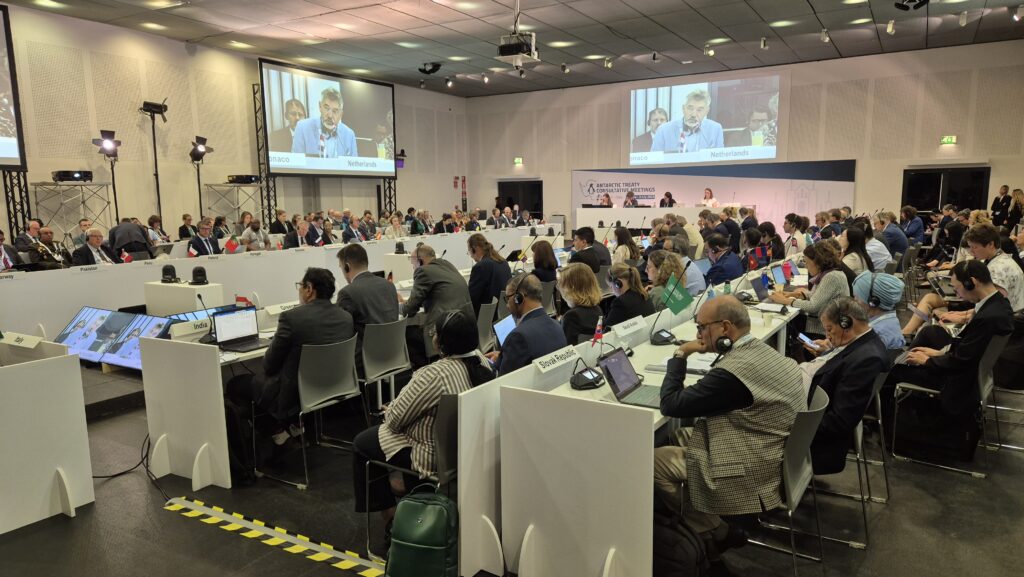
The Antarctic Treaty System (ATS) has long served as the cornerstone of Antarctic governance, designed to preserve the continent for peaceful purposes, scientific cooperation, and environmental protection. Established with the entry into force of the Antarctic Treaty in 1961, and later expanded through instruments such as the 1991 Protocol on Environmental Protection to the Antarctic Treaty (Madrid Protocol) and the 1980 Convention on the Conservation of Antarctic Marine Living Resources (CAMLR Convention), the ATS embodies a unique model of international collaboration in a geopolitically sensitive region.
Yet, the same consensus-based decision-making mechanism that has safeguarded inclusivity and equality among states has also revealed constraints. The ability of a single party to withhold agreement—effectively exercising a veto—has at times delayed or blocked measures aimed at advancing conservation, resulting in a persistent conflict between the principles of protection and the interests of utilization.
This analysis focuses on this institutional dilemma by examining developments in the past five years within two key fora of the ATS: the Antarctic Treaty Consultative Meetings (ATCM) and the Commission for the Conservation of Antarctic Marine Living Resources (CCAMLR). By analyzing selected cases—including the debates over Marine Protected Areas (MPAs), the failed renewal of krill management measures, and the uneven progress on tourism regulation versus species protection—this analysis highlights the dynamics of consensus, veto power, and the limits of implementation within the ATS.
Key Meetings and Institutional Developments
2016–2017: The Ross Sea MPA as a “High Point” of Consensus
The adoption of the Ross Sea Region Marine Protected Area (RSR-MPA) in 2016 marked one of the most significant achievements of the ATS in recent decades. Covering 1.55 million km², it was established through Conservation Measure 91-05 under CCAMLR and entered into force in December 2017. The decision demonstrated the potential of the consensus system to deliver meaningful outcomes when political will and scientific evidence converge, even after years of negotiations and repeated stalemates. In this instance, consensus operated as an enabling mechanism, showing that when interests align, the unanimity rule can produce ambitious conservation outcomes.
2021–2024: Stalled MPA Proposals and Veto Politics
Since the Ross Sea breakthrough, subsequent attempts to establish new MPAs—particularly in East Antarctica, the Weddell Sea, and the Antarctic Peninsula (D1 area)—have consistently failed. From 2021 to 2024, China and Russia have withheld consensus on new MPAs and the renewal of krill management measures within CCAMLR, but their underlying rationales show subtle differences.
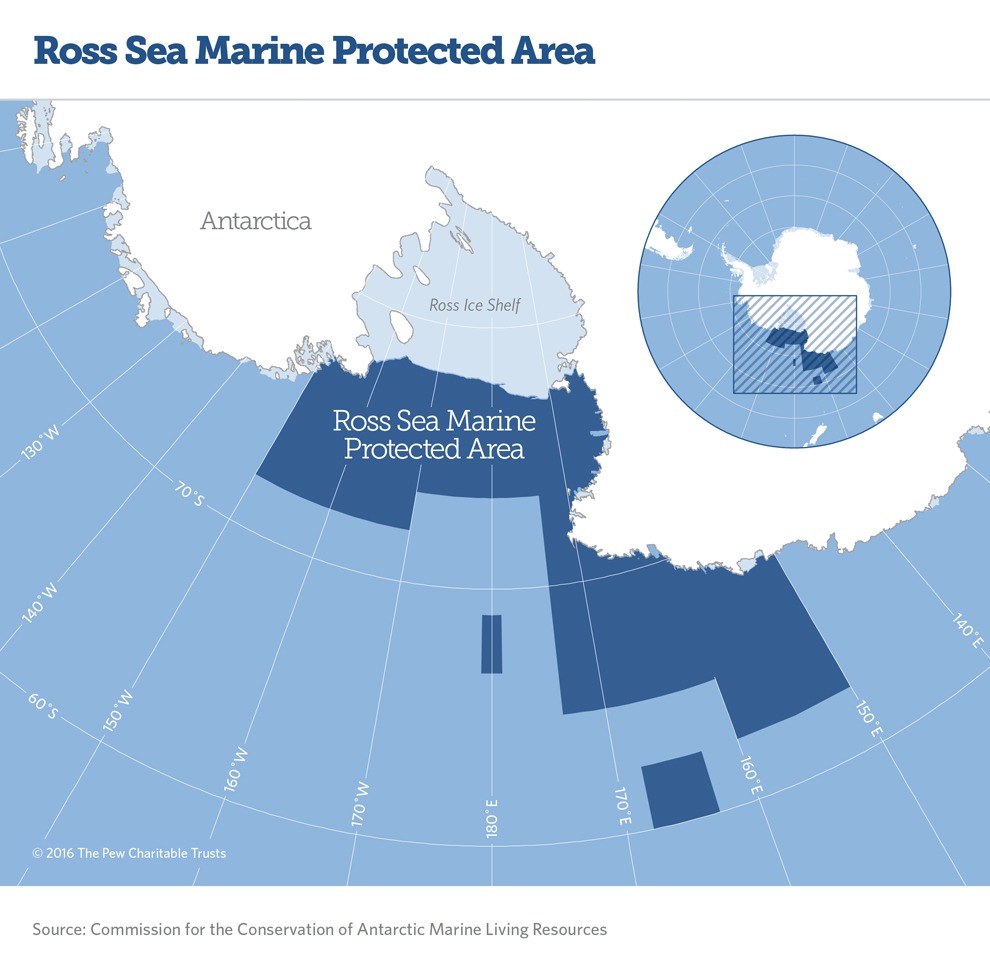
Both states emphasize the lack of sufficient scientific justification and the potential economic costs of restrictions on krill fisheries, which are central to their national interests. China tends to frame its objections around data gaps, precautionary measures it deems premature, questions of fairness in burden-sharing, and concerns over monitoring and enforcement capacity, reflecting its broader emphasis on food security and aquaculture. Russia, while also citing scientific uncertainty, often couches its opposition in more strategic and legal terms, portraying restrictions as threats to sovereign rights, future resource access, or challenges to its geopolitical flexibility.
In contrast to the success of the Ross Sea MPA, these outcomes show how the same mechanism can act as a constraint when political and economic interests diverge. This dynamic underscores both the inclusivity of the system and the difficulties it encounters in achieving agreement on new initiatives.
2023 ATCM: Climate Declaration without Binding Commitments
At the 45th Antarctic Treaty Consultative Meeting (ATCM-45) in Helsinki (May–June 2023), parties adopted a declaration acknowledging the systemic impacts of climate change on the Antarctic and Southern Ocean. While the declaration carried political weight by placing climate change firmly on the ATS agenda, it contained no binding obligations or specific regulatory measures. Instead, it called for continued research, information-sharing, and voluntary actions by states. This outcome illustrates the ATS’s preference for consensus-based instruments that build common understanding and political alignment, but stop short of enforceable commitments. In contrast to the stalemates in CCAMLR over MPAs and krill management, the climate declaration demonstrates how “soft consensus” allows progress on shared concerns, even if such measures remain largely symbolic and non-binding.
2024 CCAMLR: The Collapse of CM 51-07 and the D1 MPA
At CCAMLR-43 in Hobart (October 2024), proposals for the D1 MPA and the renewal of Conservation Measure 51-07—a mechanism designed to spatially distribute krill fishing and avoid concentrated depletion—were blocked. The expiration of CM 51-07 created a regulatory gap, allowing krill fishing without spatial distribution limits, while the failure of the D1 MPA reinforced the pattern of stalemate. These outcomes were described by conservation groups as a “step backwards” for Southern Ocean protection.
Placed alongside earlier successes such as the Ross Sea MPA, the 2024 stalemates underscore the variability of consensus: it can yield major conservation advances under favorable conditions, yet also sustain prolonged deadlock when interests remain divided.
2024-2025 ATCM: Tourism Regulation Advances, Emperor Penguin Protection Stalls
At ATCM-46 in Kochi (May 2024) and ATCM-47 in Milan (June–July 2025), Parties advanced non-binding frameworks to address the governance challenges posed by expanding human presence in Antarctica. In 2024, a new framework to regulate tourism and other non-governmental activities was approved, and in 2025, additional general and site-specific visitor guidelines were adopted. Both initiatives relied on voluntary implementation and self-regulation, underscoring the ATS’s reliance on “soft law” approaches that can move forward when broadly recognized.
By contrast, proposals to designate the Emperor Penguin (Aptenodytes forsteri) as a specially protected species under Annex II of the Madrid Protocol failed to secure consensus at both meetings, despite strong scientific evidence of the species’ vulnerability to climate change. In 2025, as a partial step, the Committee for Environmental Protection (CEP) encouraged further development of a Specially Protected Species Action Plan and requested updated scientific assessments from the Scientific Committee on Antarctic Research (SCAR). Taken together with the 2023 climate declaration, these outcomes highlight a persistent pattern in ATS decision-making: “soft consensus” enables incremental regulatory progress, while initiatives requiring stricter, enforceable commitments continue to face resistance.
Caught in the Net: The D1 MPA and Krill Fisheries
The proposal for the D1 MPA, covering parts of the Antarctic Peninsula, was advanced by the European Union and later supported by the United States and other like-minded members. The initiative aimed to balance ecological conservation with sustainable use of marine living resources. By setting aside critical feeding and breeding grounds for penguins, seals, and whales, while still allowing regulated fishing in certain zones, the D1 MPA was designed to embody CCAMLR’s ecosystem-based management principle and to contribute to the global 30×30 conservation goal.
Krill fisheries are central to this debate. Antarctic krill (Euphausia superba) form the foundation of the Southern Ocean food web and are simultaneously the focus of growing commercial demand, particularly from China, Russia, and other major fishing nations. Both states have questioned the scientific sufficiency of evidence presented for new MPAs, warning against what they view as overly precautionary restrictions on fishing rights.
In detailed submissions, China (SC-CAMLR-43/05) suggested alternative revisions to krill management, including reallocation of catch limits and seasonal closures, while Russia (CCAMLR-43/24) argued that changes to CM 51-07 were inconsistent with its legal framework and stressed that existing measures already embodied precaution.
The requirement for unanimity prevented adoption of both the D1 MPA and the renewal of CM 51-07, creating what observers described as a “governance vacuum” and prompting questions about CCAMLR’s ability to manage krill fisheries in an increasingly competitive geopolitical context. The D1 MPA debate illustrates this structural vulnerability: although a strong majority—including the EU, U.S., Australia, and New Zealand—supported the proposal, China and Russia withheld agreement. In such cases, the consensus principle, originally designed to safeguard equality among parties, allows a small minority to block measures when strategic or economic interests diverge.
The lapse of CM 51-07, which had regulated the spatial distribution of krill catches in Area 48 to prevent localized depletion, further underscored the limitations of the consensus model by removing key safeguards on fishing practices. These outcomes highlight both the inclusivity and the constraints of consensus decision-making, while raising broader concerns about CCAMLR’s credibility as a conservation body and the resilience of the ATS in a more competitive geopolitical environment. As CCAMLR struggled with stalemates over binding conservation measures, the ATCM was simultaneously addressing a different set of governance challenges, particularly those associated with the rapid growth of tourism.
Soft Consensus in Practice: Tourism Rules vs. Penguin Protection
Tourism has become one of the fastest-growing human activities in Antarctica, raising concerns about cumulative environmental impacts and governance gaps. Because the issue was widely recognized and carried broad consensus, progress at ATCM-46 was relatively swift. The resulting framework, however, remains largely “soft law” in nature—relying on voluntary implementation by states and self-regulation by tour operators rather than binding obligations.
In contrast, the same meeting failed to agree on listing the Emperor Penguin as a specially protected species under Annex II of the Madrid Protocol. Experts presented compelling scientific evidence of the species’ vulnerability to climate change and declining breeding habitats, yet consensus could not be reached, exposing a persistent gap between science and political decision-making.
The juxtaposition of these two outcomes illustrates the dual nature of consensus within the ATS. Tourism regulation advanced as a form of soft consensus, producing a general framework but without binding enforcement, while the attempt to protect the Emperor Penguin showed how consensus falters when hard legal obligations are required. This contrast highlights how the ATS can deliver broadly acceptable, non-binding measures but struggles to adopt initiatives that demand robust, enforceable commitments.
Institutional Dynamics in Practice: Inclusivity vs. Effectiveness
The consensus principle has long been celebrated as a defining feature of the ATS. It guarantees equality among parties by ensuring that no decision can be taken without the agreement of all consultative members. Yet this inclusivity comes at a price. As the case studies on MPAs, krill management, and species protection demonstrate, the consensus rule often translates into a veto power exercised by a minority of states, creating persistent deadlock and limiting the system’s ability to respond to emerging challenges.
The trajectory of decision-making further reveals an imbalance. Non-binding policy declarations and voluntary frameworks—such as agreements on climate declarations or tourism management—tend to pass with relative ease. By contrast, initiatives requiring stricter, legally binding obligations—such as the establishment of new MPAs or the protection of the Emperor Penguin—regularly encounter resistance. This pattern demonstrates the ATS’s tendency to produce “soft consensus” while struggling to achieve “hard execution,” a dynamic that raises questions about the system’s effectiveness as a conservation regime.
These dynamics are increasingly shaped by broader geopolitical rivalries. Whereas the ATS was historically envisioned as a sanctuary for scientific collaboration, it now also functions as an arena for strategic competition. China and Russia have opposed certain conservation measures they regard as constraining fishing opportunities or strategic flexibility, though their motivations are not always identical. By contrast, the United States and the European Union have generally supported expansive protection initiatives as part of their environmental leadership. The result is a polarization that mirrors global power politics, leaving the ATS more exposed to external rivalries than in the past.
Conclusion
The consensus mechanism remains the cornerstone of the ATS, safeguarding equality among states and ensuring that all parties have a voice in decision-making. Yet as the preceding analysis shows, its application has revealed growing strains when environmental imperatives collide with divergent resource interests and geopolitical competition. The central challenge is to preserve the legitimacy of consensus while ensuring that the system can act effectively when urgent conservation measures are required.
Meeting this challenge will require innovation. Possible steps include strengthening the role of scientific advisory processes to provide more authoritative evidence, enhancing transparency in negotiations to build trust, and experimenting with incremental or hybrid mechanisms that retain inclusivity but reduce the scope for persistent vetoes. Such measures could help reconcile inclusivity with effectiveness, enabling the ATS to adapt to rising environmental and political pressures.
The upcoming CCAMLR-44 in October 2025, expected to revisit proposals on the D1 MPA and krill fishery management, will provide an early test of whether Parties can move beyond recent stalemates. Looking further ahead, the 2048 review of the Madrid Protocol’s mineral provisions looms as a critical inflection point, when debates over resource exploitation may intensify. How the ATS navigates these challenges will determine whether it can continue to uphold its mandate as the foundation of Antarctic governance in the decades to come.
This issue’s Spotlight was written by Nong Hong, Executive Director at ICAS.
Since the 1980s, Washington has framed Latin America’s drug trade as both a domestic crisis and a strategic security threat. Counter-narcotics operations have long provided the rationale for U.S. military and intelligence presence in the Caribbean and beyond. Under President Trump, this logic has been elevated: the “war on drugs” is presented not just as law enforcement but as a pillar of national defense and regional order.
At the same time, U.S. anxiety has been compounded by China’s growing commercial footprint in the hemisphere. Chinese-backed port developments in South America, though primarily designed for trade, are increasingly portrayed in Washington as carrying potential dual-use risks. The intersection of narcotics enforcement and infrastructure concerns reflects a deeper strategic unease—fears that unchecked flows of drugs and the expansion of foreign-controlled maritime assets could erode U.S. dominance in its own
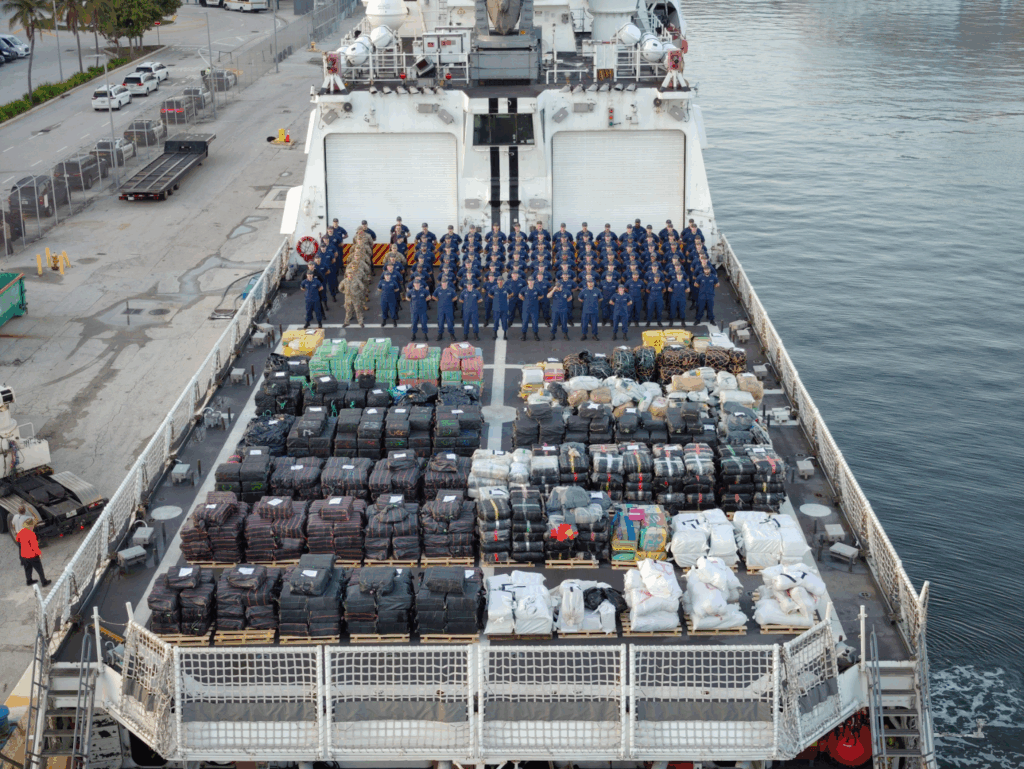
Under the Trump Administration, Washington has begun to actively reinforce its own presence across the Caribbean and Latin America. Over the past two months, U.S. military and law enforcement agencies have intensified anti-narcotic operations in the Caribbean, including multiple strikes on suspected smuggling vessels and the deployment of Naval warships, Marine units, and even the F-35 fighter jets to Puerto Rico. These operations align with a recent report on the White House’s new National Security Strategy, which places greater emphasis on homeland security above any other regions or domains.
This approach has generated tensions with regional actors. Venezuela has responded by deploying Iranian-provided missile boats, a symbolic but pointed signal of resistance. Meanwhile, concerns about legality and proportionality of U.S. strikes have been raised by neighboring states, highlighting the risks of escalation embedded in this new operational model.
Although the immediate framing is counter-narcotics, the deeper context is also the long-term contest for influence between Washington and Beijing. China’s role in Latin America remains rooted in infrastructure, financing, and port development, providing critical capital for governments facing economic and budgetary constraints. The U.S., by contrast, is projecting its presence through security operations, alliance-building, and regulatory initiatives.
For decades, Latin America has been a strategic backwater for U.S. policymakers, who assumed Washington’s geographic proximity and political relationships were sufficient to anchor its influence. China’s growing economic footprint in the region—particularly through trade, infrastructure, and port development—has challenged this assumption. Several large-scale Chinese investments in port terminals across South America have triggered concerns in Washington. While these projects are commercially justified within the framework of the Belt and Road Initiative (BRI), U.S. analysts worry they could be leveraged for dual-use purposes, offering Beijing potential logistical footholds in the Western Hemisphere.
For regional states, the calculus is pragmatic: rejecting Chinese capital without equivalent alternatives from the U.S. is politically and economically untenable. Unless Washington can match China’s scale of infrastructure investment, its warnings about strategic vulnerabilities may lack resonance. Ultimately, the issue of ports symbolizes more than logistics—it encapsulates the evolving U.S.–China rivalry in Latin America, where influence is contested not just through ships and bases, but through capital, credibility, and long-term presence.
This issue’s Spotlight was written by Yilun Zhang, Research Associate at ICAS.
Government Releases & Other Press Statements
Analyses & Opinions
Other Research
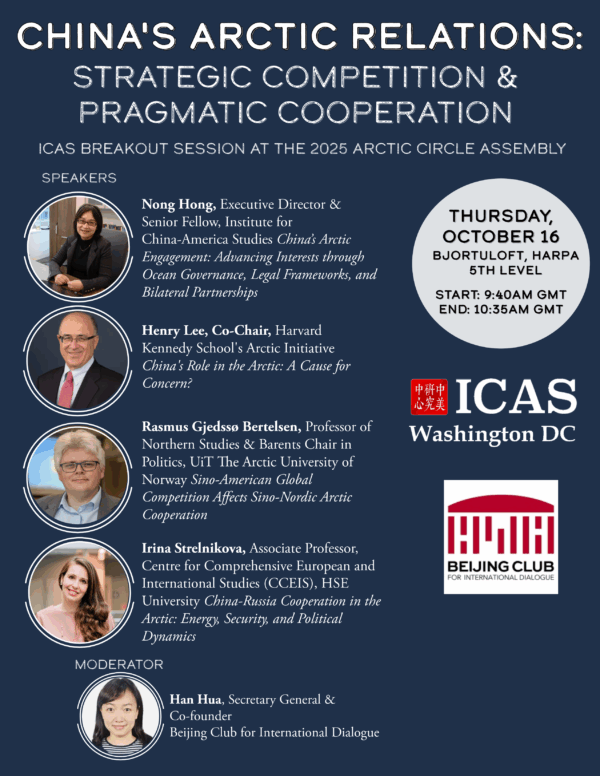
On October 16, ICAS will be hosting a breakout session along with the Beijing Club for International Dialogue at the 2025 Arctic Circle Assembly in Reykjavik, Iceland.
The session, moderated by Han Hua, the Secretary General and Co-founder of the Beijing Club, will feature ICAS Executive Director Nong Hong, Henry Lee, Co-Chair of the Harvard Kennedy School’s Arctic Initiative, Rasmus Gjedssø Bertelsen, Professor of Northern Studies and Barents Chain in Politics at UiT the Arctic University of Norway, and Irina Strelnikova, Associate Professor for the Centre for Comprehensive European and International Studies (CCEIS) at HSE University.
Can Multilateralism Survive Deep Seabed Mining Race?
By Nong Hong
September 26, 2025
The deep seabed is becoming a new arena of great power competition. China has consolidated its role as the largest contractor in the International Seabed Authority, while the United States, under President Donald Trump, is moving toward unilateral licensing. These developments highlight the growing tension between national approaches and multilateral governance.
In 2025, the debate has intensified. The ISA confronts the expiry of its “two-year rule,” obliging it to consider exploitation applications even without a completed Mining Code. Pacific Island states — alarmed by potential ecological destruction — have spearheaded calls for a moratorium, supported by the European Union and environmental NGOs. Yet their voices are often drowned out by the strategic imperatives driving major powers which increasingly frame the seabed as a strategic reservoir of critical minerals essential for clean energy, advanced manufacturing and defence supply chains.
What Scarborough nature reserve plan means for South China Sea
By Nong Hong
September 24, 2025
China’s decision to establish a national nature reserve at Scarborough Shoal – known as Huangyan Island in China and Panatag Shoal in the Philippines – has hit regional headlines as the plan involving the contested South China Sea feature swiftly became a diplomatic flashpoint.
Approved by China’s State Council and announced by the National Forestry and Grassland Administration, the plan covers some 3,500 hectares of ecologically sensitive reef and waters, divided into “core” and “experimental” zones. China frames it as part of efforts to protect biodiversity, ensure the sustainable use of marine resources and meet international conservation commitments…
Gray Zones, Missiles, Shadow Fleets, and Cyber Threats: The New Maritime Disorder
By Nong Hong
September 5, 2025
The oceans are once again at the center of global turbulence. In just the past few weeks, Taiwan accused mainland China of violating international law by drilling for oil and gas near the Pratas Islands, commercial shipping in the Red Sea faced renewed missile threats from Yemen’s Houthi rebels, cyber-attacks and shadow fleets in Europe’s maritime infrastructure exposed the fragility of undersea cables and shipping networks, all alongside a resurgence of old-fashioned competition over resources and maritime activities. These incidents, scattered across different seas, converge on a common theme: maritime security and governance are under duress.