
ICAS Bulletin (online ISSN 2836-3418, print ISSN 2836-340X) is published every other week throughout the year at 1919 M St NW, Suite 310, Washington, DC 20036.
The online version of ICAS Bulletin can be found at chinaus-icas.org/bulletins/.
– On November 3, Chinese Ambassador Xie Feng urged the United States to avoid Beijing’s “four red lines,” which include Taiwan, democracy & human rights, China’s political system, and development rights, to preserve the Trump-Xi trade truce, warning that disputes over tariffs, technology, and Taiwan would lead to a dead end.
– U.S. and Chinese negotiators reached a preliminary framework agreement on October 26 in Malaysia prior to President Trump’s meeting with President Xi. The agreement suspended Trump’s 157% tariffs with both sides signaling progress.
– Chinese Vice Premier He Lifeng visited Malaysia from October 24–27 for ASEAN and met with U.S. Treasury Secretary Scott Bessent and Trade Representative Jamieson Greer to address rising tensions in trade between China and the U.S., and to set up the framework for the Trump–Xi summit on October 30 in South Korea.
– U.S. and Japan signed a critical minerals and rare earths agreement on October 27, as the two sides vowed to take bilateral ties into a “new golden age”.
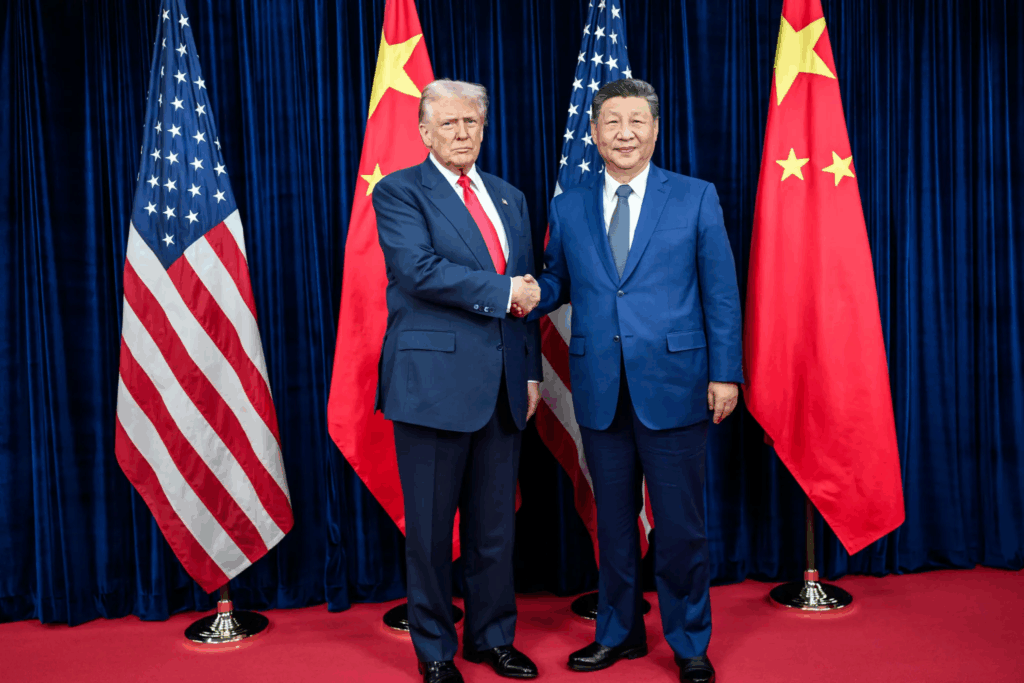
– On October 30, President Xi, Trump, and their aides held a meeting of 1 hour and 40 minutes in Busan, Korea during the APEC Summit.
– The U.S.-China deal decreased tariffs to China from 57% to 47% in exchange for Beijing curbing fentanyl exports, resumed Chinese purchase of U.S. soybeans, and China pausing its rare earth export controls.
– China will issue general licenses allowing shipments of key metals like gallium and germanium to U.S. users in response to the U.S. suspending its “entity list”,which U.S. officials have used to target individual Chinese companies with export restrictions beyond chip curbs, for 1 year.
– The U.S. reduced its fentanyl tariffs from 20% to 10%, with a bilateral understanding of deepening cooperation on cracking down on chemical precursors.
– Both sides agreed on October 30 to drop the tit-for-tat port fees that began on October 14 for one year.
– U.S. Treasury Secretary Bessent said on October 30 that China agreed to buy 12 million metric tons of U.S. soybeans through January and 25 million tons annually for the next three years, calling the deal a restoration of normal trade.
– China made its first but minor U.S. soybean purchases of the season ahead of the Trump-Xi summit, consisting of about 180,000 metric tons.
– Bessent welcomed the agreement but warned that China remains an unreliable partner, while both governments called the Trump-Xi deal a short-term truce that stabilizes relations without resolving deeper disputes.
– During the talk, Trump and Xi discussed China’s access to U.S.-made semiconductors, including Nvidia’s AI chips but not its newest Blackwell model. The two sides did not discuss the Taiwan issue.
– President Trump on October 30 also said China agreed to increase purchases of U.S. energy, including a potential “very large scale” oil and gas deal in Alaska.
Associated News References:
“China Urges US to Avoid ‘Red Lines’ After Reaching Trade Truce,” Bloomberg, November 3
“China to Suspend Some Rare-Earth Curbs and US Chip Firm Probes,” Bloomberg, November 2
“Trump shaves China tariffs in deal with Xi on fentanyl, rare earths,” Reuters, October 30, 2025
“China to buy 12 million metric tons of US soybeans this season, Bessent says,” Reuters, October 30
“Trump Says China to Purchase More US Energy, Touts Alaska Deal,” Bloomberg, October 30
“Key issues at Trump-Xi talks in South Korea,” Reuters, October 30
“US, China to Suspend Reciprocal Port Fees By One Year,” Bloomberg, October 30
“US Delays 50% Sanctions Rule for China’s Rare-Earth Reprieve,” Bloomberg, October 30
“Exclusive: China buys US soybean cargoes ahead of Trump-Xi meet, sources say,” Reuters, October 29
“As Trump-Xi trade talks near, investors turn to history as a guide,” Reuters, October 28
“Japan’s new leader tries to charm Trump with gold, golf and deal on rare minerals,” Washington Post, October 28
“US and China have reached a framework agreement on trade ahead of Trump-Xi meeting. Here’s what we know,” CNN, October 27, 2025
“Trump arrives in Asia for week of key talks — including with China’s Xi,” ABC News, October 25
“China confirms US trade talks to be held in Malaysia from Friday,” Reuters, October 23, 2025
– China and ASEAN signed an upgraded free trade agreement (FTA) on October 28, the last day of the ASEAN summit, deepening regional economic integration.
– Premier Li Qiang presented the FTA as an alternative to U.S. President Trump’s protectionist policies while urging unity over confrontation amid ongoing tensions in the South China Sea. However, Philippine President Ferdinand Marcos Jr. warned that cooperation cannot coexist with coercion amid South China Sea tensions.
– On October 26, President Trump began his weeklong tour in Asia, he attended ASEAN in Malaysia and APEC in Korea, he also visited Japan in between.
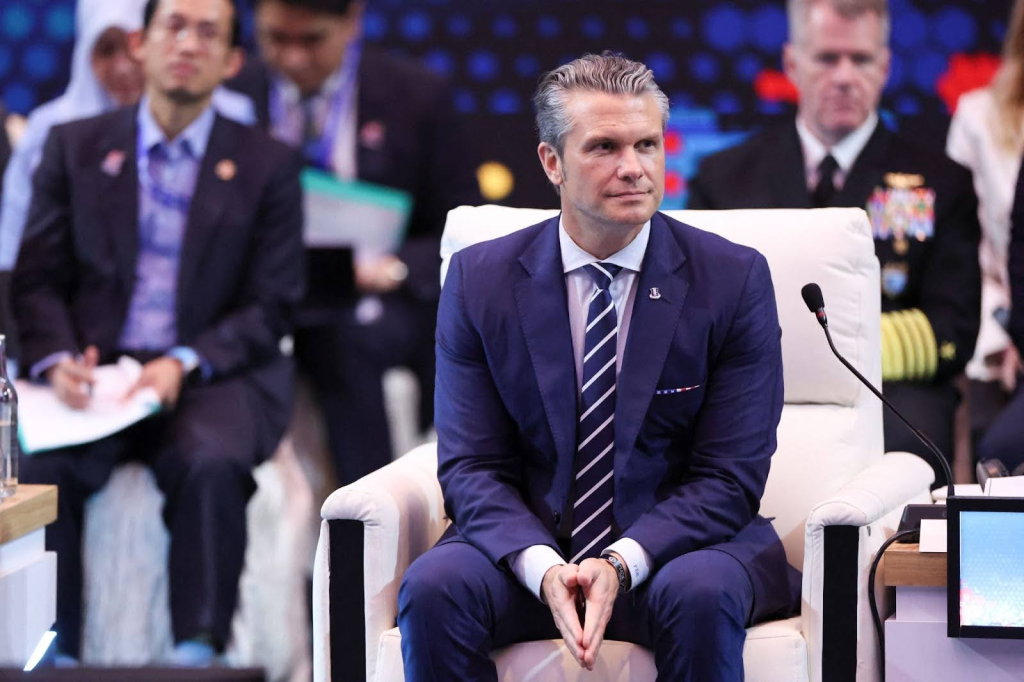
– U.S. Defense Secretary Pete Hegseth on October 31 met with Chinese Defense Minister Dong Jun in Kuala Lumpur during ASEAN to express concern over China’s growing military activity near Taiwan and the South China Sea, while Dong urged Washington to oppose Taiwan independence and avoid provocation, marking the first high-level U.S.-China defense talks since the Trump-Xi summit aimed at easing broader tensions.
– On October 31, President Xi Jinping pledged China’s commitment at the APEC summit of defending global free trade and multilateralism, positioning Beijing as a champion of cooperation while urging regional unity.
– On the same day, President Xi also warned Asia-Pacific nations against siding with the U.S., urging them to “resist unilateral bullying” and strengthen supply chains.
– President Xi proposed on November 1 a global organization to govern artificial intelligence at the APEC summit, positioning China as an alternative to the U.S. in setting AI and trade rules. Xi called for making AI a “public good for the international community,” as APEC leaders adopted declarations on AI and green technology cooperation.
– On the same day, Asia-Pacific leaders wrapped up the APEC summit in South Korea with a joint declaration emphasizing trade resilience and shared benefits, as President Xi proposed a World Artificial Intelligence Cooperation Organization and announced China will host APEC 2026 in Shenzhen.
– At the ASEAN defense ministers’ meeting in Malaysia, U.S. Defense Secretary Hegseth urged Southeast Asian nations to build a unified maritime surveillance network using unmanned technologies to counter China’s growing aggression in the South China Sea while warning that Beijing’s dominance threatened regional sovereignty.
– One day after his warning to Southeast Asian nations to resist China’s “destabilizing” actions in the South China Sea, defense Secretary Hegseth posted on social media that Washington and Beijing would reopen military communication channels, and described relations as the best they’ve ever been.
Associated News References:
“US and China agree to set up direct military communication channels, Hegseth says,” Associated Press, November 2
“Hegseth Pushes Asean Unity Against Beijing in South China Sea,” Bloomberg, November 1
“China’s Xi pushes for global AI body at APEC in counter to US,” Reuters, November 1
“Asia-Pacific leaders call for shared trade benefits as APEC summit wraps up,” Reuters, November 1
“Xi Delivers Veiled Warning to Nations Not to Take the U.S.’s Side,” The New York Times, October 31
“Hegseth Voices Serious Concern Over China’s Naval Activity Near Taiwan,” Bloomberg, October 30
“China pitches itself as alternative to US protectionism after signing expanded ASEAN free trade pact,” Associated Press, October 28
– On October 28, Nvidia CEO Jensen Huang praised President Trump’s policies for reviving U.S. manufacturing, touting the company’s Arizona-made Blackwell AI chips and new partnerships with major U.S. firms, while urging Trump to help resolve China export restrictions ahead of the upcoming Trump-Xi meeting that could determine Nvidia’s access to the Chinese market.
– Prior to meeting with Chinese President Xi Jinping on October 30, President Trump rejected Nvidia CEO Huang’s request to allow exports of the company’s advanced Blackwell AI chips to China after top advisers, including Secretary of State Marco Rubio, warned of national-security risks. President Trump avoided the topic during his summit with President Xi.
– After the Trump-Xi summit on October 30, Beijing agreed to end antitrust and anti-dumping investigations targeting U.S. chipmakers such as Nvidia and Qualcomm, while the U.S. will pause new reciprocal tariffs and extend tariff exclusions under Section 301.
– On November 1, China lifted the export ban on Nexperia’s Chinese facilities to resume shipments, easing semiconductor supply chain concerns affecting U.S. automakers.
– On November 2, Nexperia’s China unit said it has sufficient wafer inventory and contingency plans to maintain chip supplies despite its Dutch parent halting shipments on October 26, while also accusing the parent company of fabricating payment claims as Beijing and Washington move to ease restrictions following the recent Trump-Xi trade truce.
– EU Trade Commissioner Maros Šefčovič said on November 3 that talks between the Netherlands and China over Nexperia were making progress toward restoring semiconductor supply chains. Yet, on the following day China’s commerce ministry criticized the Netherlands for worsening the Nexperia dispute by maintaining its restrictions and warned that Dutch interference was hurting the global semiconductor supply chain.
– The European Commission said it welcomed China’s engagement with EU companies to resume partial chip flows, calling it a constructive step that averted a worst-case disruption and pledged continued efforts to achieve lasting stability in the chip supply chain without export barriers.
– On November 2 President Trump said during a television interview that the U.S. would let China buy only less-advanced chips other than Blackwell while Nvidia continued lobbying for partial market access.
Associated News References:
“China Slams Dutch for Hard Line in Standoff Over Nexperia,” Bloomberg, November 4
“EU sees time and space to find Nexperia solution, with worst-case avoided,” Reuters, November 4
“EU’s trade chief sees progress in Nexperia talks,” Reuters, November 3
“Trump Officials Torpedoed Nvidia’s Push to Export AI Chips to China,” The Wall Street Journal, November 3
“Nexperia China Says It Has Enough Stock Despite Supply Halt,” Bloomberg, November 2
“US to announce Nexperia’s China facilities will resume shipments, source says,” Reuters, November 1
“Nvidia’s Huang downplays concerns over selling AI chips to Beijing: It has ‘plenty’ of its own,” CNBC, November 1
“Nvidia Uncertain if Return to China Is Closer After Trump-Xi Meeting,” The New York Times, October 31
“Despite expectations, Trump did not discuss Nvidia’s Blackwell chip with Xi,” Reuters, October 30
“Nvidia CEO Praises Trump in MAGA-Themed Speech Ahead of Trade Talks,” The Wall Street Journal, October 28
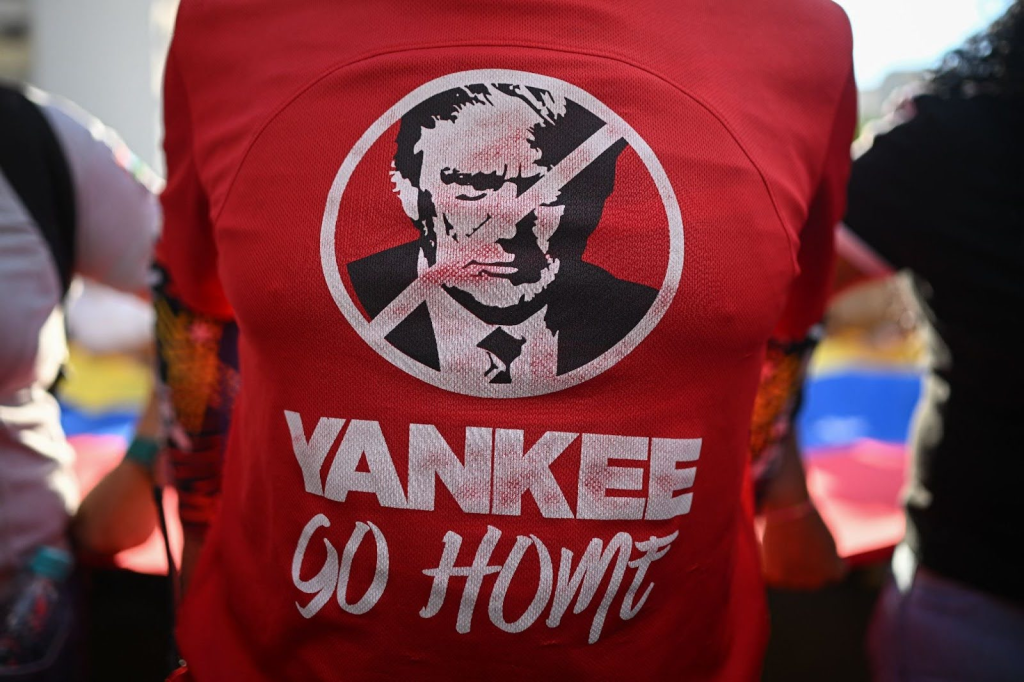
– On November 2, President Trump told CBS’ 60 Minutes he doubts the U.S. will go to war with Venezuela despite a major military buildup in the Caribbean, saying recent strikes on drug boats were “about many things” as Caracas accused Washington of fabricating a new conflict.
– Russia condemned the U.S. for what it called “excessive military force” in the Caribbean amid ongoing strikes on alleged Venezuelan drug boats, expressing support for President Maduro and warning against escalation as Caracas reportedly sought military aid from Moscow and Beijing.
– On November 2, President Trump said U.S. troops “could be” deployed to Nigeria, warning of possible military action if the government “continues to allow the killing of Christians.” Nigerian President Tinubu rejected Trump’s claims as inaccurate, stressing his administration protects freedom of religion for all faiths.
– Venezuelan President Maduro sought military aid from Russia, China, and Iran amid a U.S. buildup in the Caribbean, requesting radars, missiles, and aircraft repairs to counter what he called U.S. aggression. Moscow expressed cautious support, while Beijing and Tehran were also approached for expanded cooperation.
– On October 29, President Trump ordered the Pentagon to resume nuclear weapons testing “on an equal basis” with other nations, ending the U.S. moratorium in place since 1992.
– On October 30, President Trump ordered the U.S. military to restart nuclear weapons testing after a 33-year halt, citing China’s and Russia’s programs as justification. The move, announced ahead of his meeting with Xi Jinping, drew swift criticism from Democrats and concern from the U.N. & global nonproliferation advocates, with Moscow and Beijing urging Washington to maintain the moratorium.
– On October 23, President Maduro appealed for peace, urging “No crazy war, please!” after President Trump confirmed he had authorized covert operations against Venezuela. The plea came amid expanding U.S. naval deployments and growing fears of direct confrontation.
Associated News References:
“Trump says he doubts US will go to war with Venezuela,” BBC, November 3
“Russia Warns US Over Military Buildup Against Venezuela,” Newsweek, November 3
“Trump doesn’t rule out US troops on the ground in Nigeria over claims of ‘killing of Christians’,” ABC News, November 2
“As U.S. ramps up pressure, Venezuela pleads with Moscow and Beijing for help,” The Washington Post, October 31
“Trump orders Pentagon to start testing nuclear weapons ‘on an equal basis’ with other countries,” NBC News, October 30
“Trump tells Pentagon to resume testing US nuclear weapons,” Reuters, October 30
“Maduro Reacts to Trump’s Threat To Strike in Venezuela,” Newsweek, October 24
– On October 28, China released its 15th Five-Year Plan draft, excluding electric vehicles from its list of strategic industries for the first time in over a decade. The plan shifts focus toward quantum technology, bio-manufacturing, hydrogen energy, and nuclear fusion, as Beijing seeks to address EV overcapacity and guide more “rational” industrial development.
– On October 23, China outlined key goals for its upcoming Five-Year Plan, vowing to “greatly increase” technological self-reliance while maintaining manufacturing’s role in the economy. The plan emphasizes advanced industries like semiconductors and AI, aims to boost domestic demand, and signals a cautious shift back toward development over security as Beijing seeks stability ahead of new U.S. trade talks
– On November 2, a private survey showed China’s manufacturing activity expanded less than expected in October, with the RatingDog PMI slipping to 50.6 amid falling export orders and weak external demand. Analysts said trade uncertainty and slowing momentum highlight the need for further policy support as the year ends.
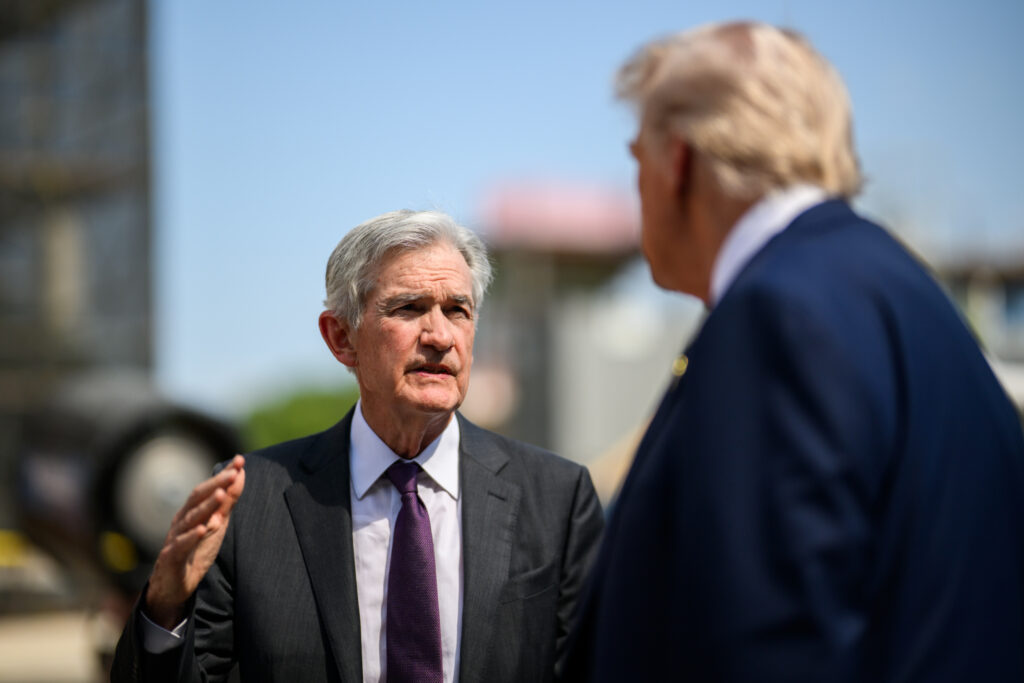
– Following the Federal Reserve’s October 29 meeting, Chair Jerome Powell said another rate cut in December was “not a foregone conclusion,” even after a 25-basis-point reduction. The Fed’s caution reflects limited data from the U.S. government shutdown, lingering inflation, and divided views among policymakers.
Associated News References:
“China’s Factory Activity Growth Slowed, Private Survey Shows,” Bloomberg, November 2
“Fed adds wrinkle for markets with December cut now in doubt,” Reuters, October 30
“China excludes EVs in latest five-year plan as industry grapples with oversupply,” Reuters, October 28
“China Deepens Push for Tech Self-Reliance Ahead of US Talks,” Bloomberg, October 23
“China’s new five-year plan sharpens industry, tech focus as US tensions mount,” Reuters, October 23

“Estonia FM urges China to join US, European pressure on Putin,” Reuters, November 5
“Starbucks once seemed unstoppable in China. Its US owner is now giving up control,” CNN, November 5
“China poses ‘very significant’ challenge to German brands, BMW leader says,” Reuters, November 5
“Chinese astronauts’ return to Earth delayed over fears spaceship damaged by debris,” CNN, November 5
“Yuan Demand in Global Trade Spurs Ebury to Boost China Hires,” Bloomberg, November 4
“Sinopec Said in Talks to Merge with China’s Aviation Fuel Giant,” Bloomberg, November 3
“Chinese buyers purchase Brazilian soybeans as prices ease over US-China trade thaw,” Reuters, November 3
“US, China agree to open direct military hotline after Xi-Trump summit,” Fox News, November 2
“Gold Hovers Around $4,000 as Traders Weigh US-China Trade Truce,” Bloomberg, October 31
“Soy Sees Biggest Monthly Gain Since 2020 as China Buys Cargoes,” Bloomberg, October 30
“Copper Nears Record as US-China Optimism Adds to Supply Woes,” Bloomberg, October 27
Summaries for the ICAS 2025 Annual Conference are now available!
On Thursday, October 30, 2025, ICAS hosted its 2025 Annual Conference in-person at the Georgetown Marriott Hotel in Washington, D.C. This year’s conference, subtitled “Charting the Future: U.S.–China Relations in an Era of Global Realignment,” which included a Keynote, two expert panels and a Luncheon Speech. We are grateful to all of our expert participants and supporters who helped make this year’s conference both productive and engaging!

Not China’s Fault: America’s Auto Dilemma
By Yilun Zhang, Zhangchen Wang
October 24, 2024
Executive Summary
The U.S. auto industry faces a structural crisis that cannot be explained away by simply citing foreign competition as a scapegoat. Decades of prioritizing SUVs and pickup trucks left Detroit unprepared for the global pivot to smaller, more efficient vehicles before an even more revolutionary turn towards electrification that paves ways towards future intelligent driving. While Tesla demonstrates that American firms can succeed in electrification, its success is not replicable at scale given its unique global supply chain combination that is no longer feasible in an era of retreat from globalization. For U.S. automakers, the central challenge is not American demand for newer and better cars but capacity: the U.S. lacks the production scale and industrial depth needed to compete with Europe, Japan, Korea, and especially China, which is usually, conveniently, and inaccurately cited as the one to blame for America’s industrial decline.
China, APEC must pursue openness, cooperation
By Sourabh Gupta
October 30, 2025
China and the Asia-Pacific Economic Cooperation forum share much in common.
Forty-seven years ago, China’s economic reform program was founded on the principles of openness and step-by-step, pragmatic integration within regional and global supply chains.
The “big bang” approach to reform was eschewed and pro-reform constituencies were cultivated to ensure that the consensus for reform was broad, deep and durable…
Ocean Governance in the Arctic: Balancing the Three Cs—Competition, Cooperation, and Conservation
By Nong Hong
October 28, 2025
As global ocean change accelerates, from rising sea levels to shifting trade routes, the Arctic has emerged as both a barometer and a battleground for how humanity manages shared spaces. Once seen as remote and inhospitable, the Arctic Ocean now stands at the nexus of science diplomacy, maritime governance, and great-power politics. Questions that once belonged to scientific circles—who governs the Arctic, how its resources are managed, and how its ecosystems are protected—have moved to the forefront of international discourse. Against this backdrop, the 2025 Arctic Circle Assembly convened, providing a vivid window into how nations and institutions seek to reconcile competition, cooperation, and conservation in one of the planet’s most rapidly transforming regions…
The Price of Docking Costs Trade Stability
By Yilun Zhang
October 27, 2025
Within days of Washington unveiling its long-expected port fee for Chinese-linked vessels, Beijing answered with reciprocal fees on U.S.-flagged ships calling at Chinese terminals. On paper, the numbers are already appalling. The U.S. is estimated to collect an annual tariff bill of $34 million. In practice, the move is also a sharp reminder that the most operational layers of global trade—pilots, berths, quay cranes, invoices—are now fair game in a contest that once played out at higher altitudes. The U.S.-China trade dispute is increasingly turning into a structural clash that puts global supply chain stability at high risk…
APEC needs an external rebalancing makeover
By Sourabh Gupta
October 23, 2025
A widely expressed sentiment at the inaugural Asia-Pacific Economic Cooperation (APEC) Ministerial Meeting in Canberra in November 1989 was that preserving and improving the multilateral trading system was key to the region’s economic success, and that this success benefited the world too.
If it is to remain central to regional and global success, APEC must now reach beyond its familiar trade and investment liberalisation and inclusion remit and serve as the premier Asia Pacific forum — and catalyst — for coordinating the reduction of the region’s external imbalances.
On Tuesday, November 4, 2025, Senior Fellow Sourabh Gupta was interviewed by CGTN’s The Hub on U.S.-China relations post Xi-Trump meeting.
On Monday, November 3, 2025, Advisory Board Member Gordon Houlden was quoted by China Daily on President Xi’s Keynote at the APEC Summit .
On Monday, November 3, 2025, Distinguished Fellow Denis Simon was quoted by China Daily on President Xi’s Keynote at the APEC Summit .
On Saturday, November 1, 2025, Senior Fellow Sourabh Gupta was interviewed by CGTN’s Dialogue on Trump-Xi summit.
On Friday, October 31, 2025, Senior Fellow Sourabh Gupta was interviewed by CNA’s ‘Morning First’ on Trump-Xi meeting in Busan.
On Thursday, October 30, 2025, Senior Fellow Sourabh Gupta was quoted by The South China Morning Post on Trump-Xi Summit.
On Tuesday, October 28, 2025, Research Associate Yilun Zhang was interviewed by GDToday on China’s 15th Five-Year Plan..