
ICAS Maritime Affairs Handbill (online ISSN 2837-3901, print ISSN 2837-3871) is published the last Tuesday of the month throughout the year at 1919 M St NW, Suite 310, Washington, DC 20036.
The online version of ICAS Maritime Affairs Handbill can be found at chinaus-icas.org/icas-maritime-affairs-program/map-handbill/.
USS George Washington Enters South China Sea
November 21 – USNI News
[United States, Philippines, Japan, China]
On November 17, the USS George Washington entered the South China Sea through the Luzon Strait, keeping a continuous United States carrier presence in the region as the Nimitz Strike Group left after major trilateral exercises with Japan and the Philippines near the Scarborough Shoal. The operations, which also include salvage efforts for two crashed United States aircraft, have triggered protests from Beijing and increased Chinese naval and coast guard activity around the shoal.
US-Philippine task force to reestablish South China Sea ‘deterrence’
November 21 – DefenseNews
[United States, Philippines, China]
The United States and the Philippines announced the formation of a new joint task force to strengthen deterrence against Chinese pressure in the South China Sea, with officials saying it will allow faster, real-time coordination between the two militaries. Analysts note the task force could significantly boost operational responsiveness, though it may also prompt sharper Chinese countermeasures.
Nimitz Strike Group Drills Near Scarborough Shoal with Philippines, Japan
November 18 – USNI News
[United States, Philippines, Japan]
The Nimitz Carrier Strike Group joined Philippine and Japanese vessels in the South China Sea, marking Washington’s largest show of force near Scarborough Shoal in years. The warships and cutters practiced maritime domain awareness activities and anti-submarine warfare. In response, the PLA Southern Theater Command claims it scrambled a bomber formation amid the drills. This comes following a series of maritime incidents between China and other nations within the South China Sea region.
Jaishankar calls for global cooperation on maritime security at G7 meet
November 13 – Hindustan Times
[India, G7, Saudi Arabia]
On November 12, Indian External Affairs Minister S. Jaishankar attended the G7 Foreign Ministers’ Outreach Session on Maritime Security in Niagara, where he emphasized India’s MAHASAGAR maritime outlook, the need for trusted and diversified sea lanes, and stronger coordination to protect critical maritime and undersea infrastructure. He highlighted piracy, smuggling, and IUU fishing as growing threats and reaffirmed India’s role as a first responder in the Indo-Pacific through humanitarian assistance, disaster response, and logistics cooperation.
U.S. Marines Deploy Drone Unit to Philippines to Patrol Over South China Sea
November 13 – USNI News
[United States, Philippines, South China Sea]
A unit of drones was deployed by the U.S. Marine Corps to support Philippine maritime security efforts in the South China Sea. This deployment and increased surveillance assistance follows a series of increasing incidents between the Philippine and Chinese forces in the South China Sea. This deployment not only enhances U.S.-Philippine security cooperation, but also demonstrates a heightened commitment of the U.S. to South China Sea security concerts.
China Suspends Port Fees On U.S.-Linked Vessels For A Year Following Trade Truce
November 10 – Marine Insight
[China, United States]
On November 10, China announced a one-year suspension of port fees imposed on U.S.-linked vessels in response to Washington’s move to pause similar fees on Chinese ships. This suspension follows the meeting between Presidents Xi Jinping and Donald Trump and marks an important shift to the easing of tensions between the two countries.
Chinese Navy Takes Aircraft Carrier Fujian Into Active Service In Hainan
November 7 – Naval News
[China]
On November 5, the Chinese Navy (PLAN) commissioned the third aircraft carrier, Fujian (18) into active service. Fujian is China’s first “supercarrier” and is the first in its fleet to be equipped with electromagnetic catapults, a capability previously held only by the United States. This carrier will operate under the PLA’s Southern Theatre Command.
Philippines boosts deterrence in South China Sea by tripling its patrol area
November 4 – South China Morning Post
[Phillippines, South China Sea]
The Philippines has tripled its area of patrol in the South China Sea, reflecting a move by Manila made in response to Beijing’s recently declared marine protected area at Scarborough Shoal. This expansion reflects efforts to improve the coordination of the Philippines military and navy under the newly formed National Maritime Council.
Malaysia urges ASEAN to expand defense cooperation in cyberspace
October 31 – Arab News
[Malaysia, United States, China]
Malaysia’s defense minister, Mohamed Khaled Nordin, is calling for the members of ASEAN to extend their security partnerships from the high seas to cyberspace. Nordin reaffirmed ASEAN’s commitment to maritime security and highlighted regional security threats as areas of necessary cooperation between the nations.
U.S. Unveils Philippine Task Force to Deter Chinese Coercion
October 31 – USNI News
[Philippines, United States]
U.S. and Philippine defense secretaries have unveiled a task force designed to deter Chinese coercion in the South China Sea and enhance defense cooperation between the two nations. Both the United States and the Philippines outlined their concerns about the South China Sea and particularly noted the recent developments with the Scarborough Shoal. This task force is the latest initiative in countering China’s efforts over several disputed maritime areas in the South China Sea.
Maritime developments across the Indo-Pacific this month reflect a clear acceleration of U.S.-Philippine security cooperation as both countries respond to intensifying Chinese pressure in the South China Sea. Washington has expanded its operational footprint through the deployment of a Marine Corps drone unit to bolster Philippine maritime surveillance, the launch of a new bilateral task force aimed at deterring Chinese coercion, and major Nimitz Carrier Strike Group exercises near Scarborough Shoal with Philippine and Japanese vessels. These moves coincide with Manila’s decision to triple its patrol area in reaction to China’s newly declared marine protected zone around Scarborough Shoal, demonstrating a more assertive Philippine posture under its National Maritime Council.
Regional actors beyond the U.S.–Philippine alliance are also shaping the maritime landscape. India used the G7 Foreign Ministers’ Outreach Session to emphasize its MAHASAGAR maritime outlook, calling for trusted and diversified sea lanes, stronger coordination to protect critical undersea infrastructure, and deeper cooperation to combat piracy, smuggling, and IUU fishing. Japan, meanwhile, condemned a Chinese diplomat’s threatening remarks toward Prime Minister Takaichi following her comments on Taiwan, underscoring Tokyo’s heightened sensitivity to regional coercion and its growing willingness to publicly confront Beijing.
China continues adjusting its own strategic position. Beijing commissioned its first indigenous “supercarrier,” the Fujian, into active service under the PLA Southern Theatre Command, signaling long-term investment in power projection capabilities.
These overlapping developments reinforce the South China Sea as the most active and contested maritime arena in the Indo-Pacific. U.S.–Philippine coordination is emerging as the central pillar of regional deterrence, supported by expanding cooperation with Japan and growing diplomatic alignment among key Indo-Pacific partners. At the same time, persistent tensions over Taiwan, major-power naval modernization, and competing visions for regional order continue to shape decision-making across the region. Collectively, the events of this period illustrate a maritime environment defined by sharper strategic competition, more frequent operational deployments, and the steady entanglement of security, diplomacy, and economic statecraft.
Suez Canal Ready To Receive Mega Container Ships With Transit Of Two Giant Vessels
November 17 – marineinsight
[Suez Canal]
The Suez Canal Authority (SCA) reaffirmed its readiness to handle mega-container ships after two large CMA CGM vessels safely transited the canal on the same day. Officials said improving stability in the Red Sea could bring more shipping back to the canal and noted that the SCA is working with major carriers to support a gradual return.
November 14 – CBS News
[Iran, United States, United Arab Emirates, Marshall Islands, Israel]
On November 14, Iranian forces seized the Marshall Islands–flagged tanker Talara while it transited the Strait of Hormuz, redirecting it into Iranian territorial waters in the first such interdiction since April 2024.. The U.S. monitored the takeover, which comes amid heightened Iranian warnings following the June war with Israel and rising regional maritime tensions.
Russia Suspends Red Sea Base Plans as Sudan War Rages
November 13 – Maritime Executive
[Russia, Red Sea]
Russia has suspended its long-planned naval base project in Port Sudan due to the country’s escalating civil war and security risks, ending Moscow’s hopes for a Red Sea foothold. The move reflects both Sudan’s unstable conditions and Russia’s own strained naval resources amid the war in Ukraine.
Yemen, UK Strengthen Security Coordination to Combat Smuggling and Maritime Threats in the Red Sea
November 12 – Yemen Online
[Yemen, United Kingdom]
Yemen and the UK held a high-level meeting in Aden on November 12 to strengthen joint maritime security coordination, focusing on countering smuggling networks and rising threats to Red Sea shipping linked to Houthi activity. The talks support the broader Yemen Maritime Security Partnership launched in September, aimed at rebuilding Yemen’s Coast Guard capacity through long-term international funding and training.
Red Sea Shipping Faces Uncertain Future as Houthi Ceasefire Brings Hope—and Caution
November 11 – gCaptain
[Red Sea]
After nearly two years of attacks, The Houthis announced a suspension of maritime operations in the Red Sea. This suspension marks a significant shift following the ceasefire between Israel and Hamas, however experts warn that a return to normalcy remains far from certain. The conditional nature of the suspension adds a layer of uncertainty with maritime security experts urging operators to proceed with caution.
November 6 – Shipping Telegraph
[Suez Canal]
The Suez Canal Authority (SCA) is pushing to bring back shipping lanes after a notable increase in vessel traffic. They are engaging with 20 major shipping companies, encouraging trial voyages and highlighting recent improvements to safety and infrastructure within the Suez Canal. Many representatives from major shipping lines and agencies expressed their optimism about the Canal’s performance.
China’s Navy Stages Show of Force Near Red Sea
November 5 – Newsweek
[China, Red Sea]
China has assembled two flotillas near the Red Sea as it continues an escort mission to safeguard international sea lanes and regional peace and stability. This mission emphasizes China’s expanding naval reach beyond the Pacific and internet to project power in key maritime flashpoints.
Suez Canal chief calls for shipping comeback as Red Sea crisis ends
November 4 – TradeWinds
[Suez Canal]
After the fragile ceasefire between Israel and Hamas, the chairman of the Suez Canal Authority (SCA) said that he sees signs of improvement for traffic through the Suez Canal. In October, the canal saw its highest monthly reading since Houthi attacks on commercial ships within the region. However, researchers and analysts have seen no tangible improvement in traffic figures with many shipping companies opting to avoid Houthi danger through circumventing Africa.
Recent developments in the Red Sea corridor highlight a cautious but potential recovery in maritime activity in the region. Central to this shift is the recent announcement by the Houthi rebels signaling their halt of attacks on commercial shipping the Red Sea amid a fragile Gaza ceasefire. In a letter from the Houthi military leadership, the group emphasized that while current operations would cease, hostilities would resume if there is resumed aggression towards Gaza. This conditional suspension underscores the uncertainty and delicate peace that continues to shape geopolitics.
This suspension of attacks from the Houthis has seen immediate economic and geopolitical effects. According to the Suez Canal Authority (SCA), there have been signs of improvement for traffic within the region and revenues rose an estimated 14% compared to the same period from last year. This past month, the Suez Canal has seen an increased number of vessels pass through, the highest since the region entered crisis mode in late 2023. Despite this, many companies and experts remain cautious. The Houthis’ statement is not formal and unconditional. Their pledge hinders on the future of the Israel-Gaza conflict and the ceasefire, suggesting that this pause in attacks could be temporary. Therefore, while some companies return to the Suez Canal, many operators continue to reroute their vessels around Africa’s Cape of Good Hope and insurance costs remain elevated.
The broader regional context adds further to the complexity of this situation. Iran’s recent ship seizure highlights the unpredictability of regional maritime security. This marks their first seizure since April 2024, increasing concerns regarding the safety of shipping vessels and routes within the Red Sea. Additionally, Russia’s naval ambitions have faced setbacks due to suspended plans in Sudan over the country’s escalating civil war and Ukraine war. Russia’s strategic interests within the Red Sea corridor remain significant and could be an area of potential security risk in the future.
This development offers both opportunity and risk for future geopolitical tensions within the region. The SCA has invited 20 major shipping companies to conduct trial voyages to rebuild trust through viewing the improvement in safety and infrastructure within the canal. For the rest of the maritime community, the resumption of safe passage depends not only on whether the Houthi leaders choose to reengage their attacks but also the broader regional context.
Russia Proposes Cooperation with India to Develop Shipbuilding Industry
November 18 – Maritime Executive
[Russia, India]
Ahead of a planned visit from President Putin to India scheduled for next month, Russian officials launched talks touching on many issues for potential cooperation. They highlighted the opportunities for enhanced bilateral cooperation in the civil maritime sector, which would range from shipbuilding to port infrastructure and maritime logistics.
Morocco, Spain Navies Conduct Joint Exercises to Strengthen Maritime Security
November 17 – Morocco World News
[Morocco, Spain]
Morocco and Spain conducted joint naval exercises in the Strait of Gibraltar and the Alboran Sea under NATO’s SeaGuardian Operation, using coordinated maneuvers and inspection drills to strengthen maritime security and counter terrorism-related threats. The exercises highlighted growing bilateral defense cooperation and support for securing critical shipping routes.
Draft Continuing Resolution to Reopen the Government Includes $1B for Navy Shipbuilding
November 12 – USNI News
[United States]
The resolution slated to reopen the federal government after the longest shutdown in U.S. history includes more than $1 billion for half a dozen Navy shipbuilding programs. Under this resolution, the Defense Department cannot spend this money on new-start programs but is meant to finish ships already under contract.
6 Dead in Weekend Strikes on Suspected Narco Boats in Eastern Pacific
November 10 – USNI News
[United States, Pacific]
U.S. forces carried out two strikes on suspected narco-trafficking boats in the Eastern Pacific on November 9, killing six people in the latest escalation of a campaign that has conducted 19 strikes since September. The Pentagon says the vessels were linked to designated terrorist organizations, though the legality of the broader operation is facing bipartisan scrutiny.
Russia’s LNG ‘Dark Fleet’ Returns to Norwegian Waters As Winter Closes Northern Sea Route
November 10 – High North News
[Russia, Arctic]
As winter approaches and sea ice closes the Northern Sea Route, “dark vessels” are returning to the Norwegian and Barents Seas. In recent days, several sanctioned LNG carriers en route to Russia’s Arctic are set to use Norwegian waters to reach their destinations. These uninsured and underinsured vessels within the shadow fleet have become a major safety concern within the Arctic and around the world.
Pakistan Navy ship in Bangladesh after over 50 years
November 10 – The Economic Times
[Pakistan, Bangladesh]
On November 7, a Pakistan Navy ship arrived at Bangladesh’s Chattogram Port marking the first occurrence since 1971. This development comes amid a turnaround in bilateral ties after two decades of hostility between the two countries. According to the Bangladesh Navy, this visit is expected to strengthen friendly relations between the two.
Pakistan Navy ship visits Maldives as part of regional maritime security cooperation
November 9 – Arab News
[Pakistan, the Maldives]
A Pakistani Navy ship arrived in the Maldives during an overseas deployment aimed at fostering regional maritime security cooperation. The Pakistani naval and diplomatic leaders held meetings and conducted a joint exercise with the Maldives Coast Guard. These visits reflect the strong bilateral relations between the two countries and enhance the cooperation of naval forces.
Pirates board tanker off Somalia in biggest escalation since 2024
November 6 – Reuters
[Somalia, European Union, Japan]
On November 6, pirates boarded a Malta-flagged tanker off the coast of Somalia following a burst of armed attacks on vessels within the region. This activity of pirates has reignited concerns over the safety of shipping lanes used to transport critical energy and goods to global markets.
Portuguese Navy Carries Out Long Range Drug Bust in Mid-Atlantic
November 5 – Maritime Executive
[Portugal]
Portugal’s navy seized a drug-trafficking semi-submersible in the mid-Atlantic and found more than 1700 kilos of cocaine abroad. The makeshift vessel was not seaworthy enough to tow back to land and sank after the operation. This marks the second long-distance semisubmersible drug bust by the Portuguese Navy this year.
Summit in the North: Agreed on Enhanced Partnership with Ukraine
November 5 – High North News
[Norway]
Eleven defense ministers from the Joint Expeditionary Force (JEF) met in Bodo, Norway and agreed to form an “Enhanced Partnership” with Ukraine. This agreement enables faster and more coordinated military cooperation with each other. This agreement is a historic step to significantly strengthen Ukraine’s relationship with Northern European allies.
Ports Emerge as Critical Element of Continental Security
November 4 – Africa Defense Forum
[Cameroon, Morocco, Kenya]
African analysts warn that weak port security is fueling trafficking, illegal fishing, and other sea crimes costing the continent up to $50 billion a year. Morocco and Cameroon have shown that upgraded surveillance and security systems can reduce theft and improve port operations, prompting IMO-led efforts to expand similar measures across key ports in East and West Africa.
Russia Boosts Nuclear Fleet With Launch of Khabarovsk Submarine
November 3 – High North News
[Russia]
Russia officially launched its new nuclear-powered submarine, marking a major step in the country’s ongoing naval modernization program. Russian Defence Minister Andrei Belousov described the launch as a significant milestone for the Russian Navy through enhancing maritime border security.
When delegates convened in Hobart this October for the 44th Meeting of the Commission for the Conservation of Antarctic Marine Living Resources (CCAMLR), expectations were high. Many hoped that years of negotiation would finally deliver breakthroughs on long-awaited marine protected areas (MPAs)—the Weddell Sea MPA (championed by the EU and Norway), the East Antarctic MPA (advanced by Australia, the EU, and Norway), and the Antarctic Peninsula MPA (jointly proposed by Chile and Argentina)—as well as on enhanced krill-management measures. Yet the meeting concluded without substantive agreements.
Divergent national priorities, procedural rigidity, and persistent geopolitical undercurrents once again stalled long-debated conservation proposals. What was anticipated to signal renewed momentum in Antarctic environmental leadership instead exposed the institutional fatigue and political fragility underlying today’s global ocean governance.
For over four decades, the Antarctic Treaty System (ATS) has stood as a model of cooperative restraint, a regime where sovereignty disputes are frozen, militarization is prohibited, and science serves as the foundation of decision-making. But the Hobart deadlock shows that even this exemplar of consensus diplomacy is straining under contemporary pressures. The 2025 CCAMLR session laid bare the new collision between science, economics, and geopolitics in governing the planet’s last great commons.
The Consensus Paradox
The ATS and CCAMLR were built on the ideal of consensus, intended as a safeguard against domination by powerful states. In practice, however, unanimity has increasingly functioned as a veto mechanism. At the 2025 meeting, none of the three pending MPA proposals advanced, and efforts to strengthen krill-fishery regulation or protect vulnerable marine ecosystems likewise stalled.
This paralysis is not unique to the Antarctic. A similar pattern is visible at the International Seabed Authority (ISA), where negotiations over a deep-sea “Mining Code” remain deadlocked, exposing the tension between exploitation and environmental protection. Even the newly entered-into-force UN Agreement on Biodiversity Beyond National Jurisdiction (BBNJ), hailed as a landmark for global ocean governance after surpassing sixty ratifications in 2025, now faces its own challenge: translating ambitious commitments into effective, science-based implementation among a diverse group of states.
What once served as a foundation for inclusive governance has, in many institutions, evolved into a procedural rigidity that limits timely and evidence-based decision-making.
Science vs. Sovereignty
The Scientific Committee of the Commission for the CCAMLR has presented compelling evidence that rapid warming and shrinking sea-ice are destabilizing key Southern Ocean ecosystems. Krill, the cornerstone of Antarctic food webs, are shifting southwards, disrupting penguin and whale populations and altering predator–prey dynamics. Yet when science collides with politics, data often take a back seat.
Several fishing nations, including major krill-harvesting states such as Norway, China, and South Korea, have emphasized the growing economic importance of krill for aquaculture feed and omega-3 pharmaceuticals, arguing that existing controls are adequate for sustainability (Oceanographic Magazine). Conservation groups, including the Antarctic and Southern Ocean Coalition (ASOC) and the World Wide Fund for Nature (WWF), counter that precaution must prevail until the ecological effects of climate change are better understood. ASOC has cautioned that the combination of rapid environmental change and expanding industrial krill fishing is increasingly straining the limits of ecosystem-based management.
Their message is clear: the pace of environmental transformation in Antarctica is outstripping the capacity of the existing institutional regime to respond. Without a renewed balance between scientific evidence and political will, even the world’s most sophisticated conservation regime risks falling behind the very ecosystems it was created to protect.
Although the 2025 CCAMLR meeting ultimately failed to secure consensus on MPAs or enhanced krill-fishery regulations, delegates did agree to several incremental but meaningful measures. One standout outcome was the adoption of new rules on transshipment: members committed to maintaining a publicly accessible list of all vessels operating in the Southern Ocean. This procedural advance, though less dramatic than an MPA breakthrough, demonstrates that even amid deep national divisions, the Antarctic governance system can still make progress on transparency and compliance.
Geopolitics Returns to the Ice
The impasse in Hobart also reflected a broader geopolitical division within CCAMLR. Delegations from Russia and China, both major krill-harvesting nations, reiterated longstanding objections to new MPAs on the ground that that proposals lacked sufficient scientific justification and risked impairing access to marine resources. Meanwhile, countries including European Union member-states, New Zealand and Australia advanced more robust conservation measures, linking ecosystem protection to long-term fishing sustainability.
Rather than indicating a breakdown in cooperation, the stalemate highlights how Antarctic decision-making is now being influenced by global strategic and economic currents. As geopolitical competition intensifies elsewhere, the Antarctic’s long-standing cooperative traditions are subject to greater strategic scrutiny, underscoring that even this region is not entirely insulated from shifting global dynamics.
Climate Change and the Institutional Lag
Climate change is reshaping the Southern Ocean faster than governance can respond. The Madrid Protocol on Environmental Protection (1991) was visionary in declaring Antarctica a “natural reserve devoted to peace and science,” yet its architects did not foresee the accelerating loss of sea ice, shifting krill populations, or cascading ecosystem effects now documented by CCAMLR scientists.
At the 2025 CCAMLR meeting, the Scientific Committee presented compelling evidence of these transformations, urging members to integrate climate adaptation into fisheries management and conservation planning. Several delegations, including the European Union, New Zealand, and Australia, supported proposals to formalize climate considerations within CCAMLR’s decision-making structure. However, consensus could not be reached, leaving what environmental observers called a widening “governance gap” between scientific urgency and political will.
This gap reflects a deeper institutional lag within the ATS, which still lacks an integrated framework for climate adaptation, carbon accounting, or resilience planning. The issue is gaining new urgency as the world approaches 2048–the year when the Madrid Protocol, including its ban on mineral resource activities, becomes open for review after fifty years. Without demonstrable progress in climate-responsive governance, that review could reignite debates over resource use in a rapidly warming Antarctic, placing additional strain on the continent’s long-standing conservation paradigm.
The stalemate also undermines broader global targets such as the “30 × 30” initiative to protect 30 percent of the ocean by 2030. If Antarctica, often regarded as the most protected region on Earth, cannot meet that benchmark, it raises doubts about the international community’s ability to safeguard marine ecosystems elsewhere, from the high seas to the deep seabed.
Lessons from Hobart and the Future of Ocean Governance
The outcome of the 2025 CCAMLR meeting offers lessons that extend well beyond Antarctica. First, multilateralism requires procedural renewal. Consensus should not equate to paralysis, and as the BBNJ Agreement moves toward implementation, states must explore decision-making thresholds that preserve minority protections without enabling single-state vetoes.
Second, science must reclaim its central place in decision-making. Independent scientific panels, transparent data-sharing systems, and joint ecosystem-monitoring mechanisms are essential tools for depoliticizing conservation. The Arctic Council’s agreement on scientific cooperation demonstrates what is possible when states commit to evidence-driven governance.
Third, legitimacy is fundamental to durable conservation. When negotiations appear opaque or largely shaped by commercial interests, public trust erodes. Broader participation—from observers, NGOs, and indigenous representatives—and mandatory publication of meeting records would strengthen transparency and accountability across polar and ocean governance institutions.
Viewed in this broader context, the 2025 CCAMLR session is not simply a setback but a stress test for global commons governance. It reveals a deeper challenge: institutions founded in the late twentieth century are increasingly ill-equipped for twenty-first-century realities of climate urgency, technological acceleration, and renewed geopolitical rivalry.
Antarctica remains a symbol of what international cooperation can achieve. Yet a symbol alone is no longer enough. As governments prepare for the 2026 CCAMLR session, the task is not only to protect krill, penguins, or marine ecosystems, but to demonstrate that collective governance remains viable in an age of fragmentation. The future of ocean stewardship—from the deep seabed to the polar regions—may depend on whether the international community can rediscover, in Hobart, what it found in 1959: the commitment to place science, peace, and shared responsibility above short-term gain.
This issue’s Flagship Analysis was written by Nong Hong, Executive Director at ICAS.
Maritime transportation is central to global commerce, carrying more than 80 percent of traded goods worldwide. To provide coherent and uniform oversight for this international system, the International Maritime Organization (IMO) was established under the United Nations framework to develop global rules for international shipping in 1958. The IMO now includes 175 member states and serves as the central venue where governments negotiate binding regulations on ship safety, pollution control, and maritime governance.
Because most commercial shipping operates across multiple jurisdictions, the IMO plays a critical international coordination role. Decisions adopted by IMO may attain legal binding forces upon acceptance by its member states, a feature that endows it with a rare and robust form of regulatory authority within the international system. Its rulemaking process allows states to harmonize standards globally, preventing fragmented national regulations and ensuring that vessels from different fleets operate under common technical and environmental requirements. The combination of legal capability, treaty-based authority, and near-universal participation has positioned the IMO as one of the few international organizations able to shape operational and commercial practices across an entire global industry.
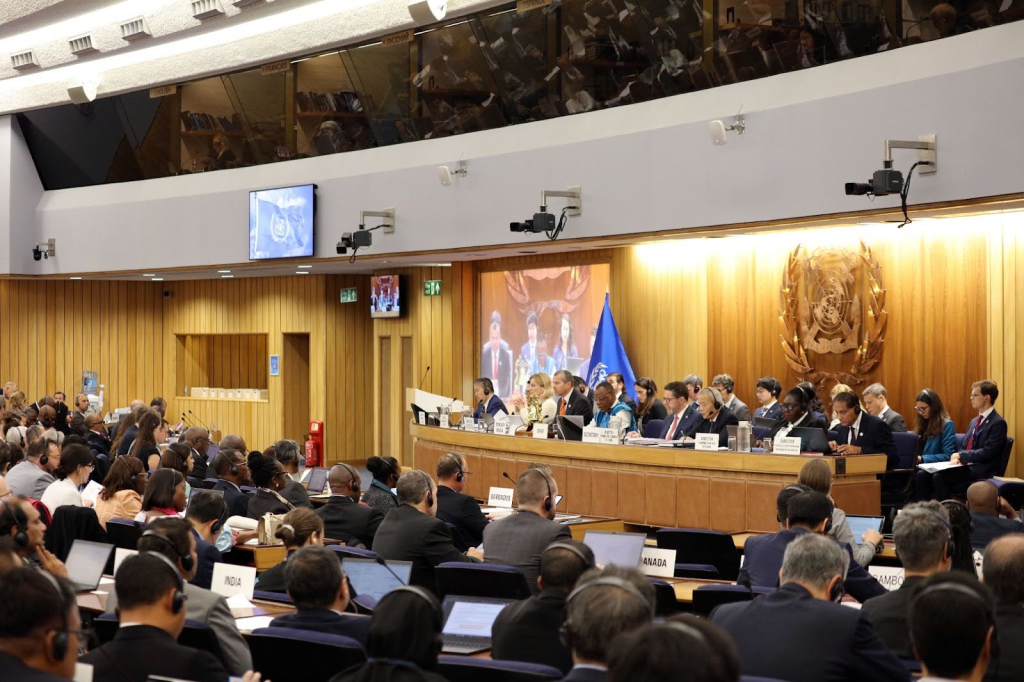
The global maritime shipping industry is increasingly acknowledged as a critical challenge in combating climate change. It emits more than 0.86 gigatonnes of CO₂ per year and contributes to roughly 10% of transport-related emissions globally. Despite improvements in energy efficiency, absolute emissions have continued to rise due to increases in shipping demands, and the need for stronger emission reduction action is like never before. In 2018, the organization adopted its initial greenhouse gas emission reduction strategy, which called for reducing the sector’s carbon intensity by at least 40 percent by 2030 and set an ambition to cut total greenhouse gas emissions by 50 percent by 2050. The strategy also introduced the first mandatory energy-efficiency measures for ships, covering both new vessels and the existing fleet. This framework was significantly strengthened in 2023, when member states agreed to a revised GHG Strategy that set a net-zero target for international shipping “by or around 2050,” alongside indicative checkpoints of at least 20 percent emission reductions by 2030 and 70 percent by 2040, and a requirement that zero or near zero-emission fuels represent at least 5 percent of marine energy use by 2030. The 2023 Strategy also launched the development of mid-term measures combining a global fuel-intensity standard and a maritime GHG pricing mechanism.
Building on the aforementioned commitments, the IMO advanced a more comprehensive regulatory package in April 2025—commonly referred to as the proposed Net-Zero Framework—which sought to combine a global fuel-intensity standard with a pricing mechanism and a dedicated decarbonization fund. The proposal combined a global marine fuel-intensity standard with a market-based compliance mechanism designed to curb emissions from ships of 5,000 gross tons and above. These vessels account for roughly 85 percent of global maritime emissions. Under the draft text, ships exceeding the annual emissions limit would purchase Remedial Units or pay a carbon fee, while more efficient vessels could earn compensation for emission reductions. Revenues were also slated to flow into a new IMO Net-Zero Fund projected to raise $11–12 billion annually between 2028 and 2030, supporting alternative-fuel infrastructure, vessel retrofits, and capacity-building in developing and small-island states.
However, despite broad expectations that approval would be a formality, delegates unexpectedly voted to defer adoption of the Net-Zero Framework by one year during the second extraordinary session of the Marine Environment Protection Committee in October 2025. The United States and Saudi Arabia led the opposition, following public statements by President Trump rejecting what he called a “global green new scam tax on shipping.”
Several maritime nations—including many EU member states and Pacific Island countries—expressed disappointment, and they noted that many countries had been ready to adopt the rules and the delay creates a sense of failure. Nevertheless, key leaders remain optimistic about the future of the emission package. IMO Secretary-General Arsenio Dominguez said at COP30 in Brazil that he is confident countries can still reach an agreement on a carbon fee for shipping and pledged to continue campaigning for the framework despite the temporary setback. He believes that IMO is learning from the failure and will not stop here. Dutch climate envoy Prince Jaime likewise underscored the importance of maintaining constructive engagement over the coming year to build consensus ahead of the next round of negotiations.
The one-year postponement of the Net-Zero Framework carries significant negative momentum for maritime decarbonization. The delay reintroduces uncertainty for the private sector by disrupting investment planning and slowing capital flows into alternative-fuel infrastructure. Companies that had already begun integrating carbon-pricing assumptions into charterparties, fuel-supply agreements, and ship-management contracts now face costly revisions, as provisions drafted around an expected 2027–2028 compliance timeline no longer align with regulatory reality and may need to be renegotiated again once the framework returns in 2026.
The postponement also compresses the IMO’s emissions-reduction timeline. Under the schedule envisioned when member states negotiated the package in April 2025, mid-term measures were expected to enter into force within two to three years of adoption, placing the first compliance period in the late 2020s. With the framework now unlikely to begin its first cycle before 2028 or 2029, both fuel-intensity limits and emissions-pricing obligations will come online later than planned, narrowing the available window for progress toward the framework’s mid-2030s milestones. Meanwhile, the deferred vote delays the allocation of the proposed IMO Net-Zero Fund—projected to raise $11–12 billion annually between 2028 and 2030—creating additional challenges for developing countries and small island states that rely on early assistance to manage transition costs and climate vulnerability. This funding was intended to support alternative-fuel bunkering infrastructure, energy-efficiency retrofits, and capacity-building programs; losing even a single year of financing slows these efforts and widens the gap between states with the means to transition and those without.
Nevertheless, although the delay underscores the uncertainty and political fragility surrounding global maritime climate governance, the broader direction of the transition remains unchanged. IMO leadership and supportive member states maintain that negotiations will resume in 2026, suggesting that while regulatory certainty has slipped, the long-term shift toward a global emissions framework for shipping remains firmly on the horizon.
This issue’s Spotlight was written by Zhangchen Wang, Research Associate at ICAS.
Government Releases & Other Press Statements
Analyses & Opinions
Other Research
Marco Volpe on the Arctic: Italy
November 12, 2025
ICAS conducted its seventh Arctic-focused ICAS Expert Voices Initiative (EVI) interview series with Mr. Marco Vulpi, a PhD candidate at the University of Lapland and visiting researcher with the Arctic Centre’s international relations team. The discussion examined Italy’s evolving role in the Arctic, emphasizing its science-driven engagement since becoming an Arctic Council observer in 2013, Italy’s longstanding research presence through the Dirigibile Italia station in Svalbard, and its expanding scientific diplomacy and multilateral cooperation. The conversation also explored Italy’s forthcoming Arctic strategy, which is expected to balance continuity in scientific research with greater attention to security dynamics, climate impacts, and shifting geopolitical conditions following the war in Ukraine. Additional themes included Italy’s energy and industrial interests in the High North, its alignment with EU Arctic priorities, its partnerships with Nordic states, and how Arctic actors perceive the engagement of non-Arctic observers such as China, Japan, and South Korea.