
Close Encounters in the Gulf: Why Rules and Communication Matter

Cover Image Source: “HMS Middleton in the Strait of Hormuz” by Defence Imagery, CC BY-SA 2.0
- Maritime Studies
- Global
On February 3, two reported encounters—one in the air domain near a U.S. carrier and another involving a merchant vessel in the Strait of Hormuz—were widely framed as fresh indicators of rising friction between the United States and Iran. Read together, they offer a useful reminder of a recurring dynamic in Gulf security: close-range interactions at sea and in the air are seldom “just” tactical. They are also signals about resolve, operational boundaries, red lines, and negotiating posture. Precisely because signaling is often the point, however, misinterpretation can become the trigger. When drones and fast boats operate at close range, ambiguity can grow faster than commanders can confirm intent. Even when neither side seeks escalation, compressed timelines and incomplete information narrow decision space, making outcomes depend heavily on judgment under pressure rather than deliberate strategy.
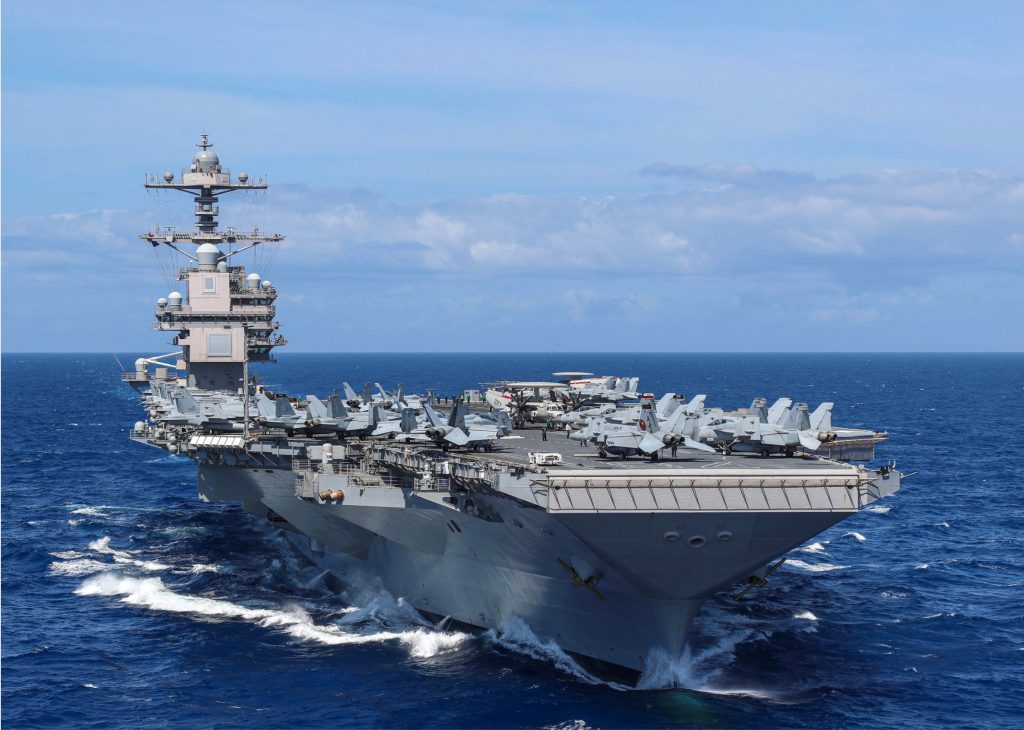
Uncrewed systems are well suited to maritime signaling because they are inexpensive, easy to deploy repeatedly, and often leave room for ambiguity about intent. That makes them a convenient way to test how an adversary will react without immediately putting higher-value assets at risk. Yet these same attributes can complicate crisis management. A drone closing on a high-value warship can be read in multiple ways: as routine surveillance, a political signal, a test of defensive responses, or the opening move in a harassment episode. If warnings are issued and the drone continues to close, defenders may treat the uncertainty itself as a risk—especially when the asset in question is a carrier and the costs of a mistaken judgment could be high. This is consistent with U.S. official accounts describing the shootdown as a defensive measure to protect the ship and its personnel.
The practical implication is that thresholds matter. In many Gulf incidents, the central question is not whether either party wants conflict, but where each side sets its threshold for decisive action and how clearly that threshold is communicated. When thresholds are unclear, one side may believe it is engaging in calibrated signaling while the other perceives a dangerous approach requiring immediate neutralization. This is a classic pathway from signaling to spiraling dynamics, where each action is interpreted through worst-case assumptions and subsequent moves are shaped less by intention than by fear of vulnerability.
The reported harassment of a U.S.-flagged tanker near the Strait highlights another persistent feature of regional security: commercial shipping can become an arena for strategic messaging. Advisories from the United Kingdom Maritime Trade Operations (UKMTO) and reporting by maritime consultancies typically describe these encounters in operational terms—where they occurred, whether small craft were involved, and whether boarding was attempted. Their wider significance, however, lies in the setting: incidents in or near key chokepoints inevitably carry implications for control, access, and deterrence. In narrow, high-traffic waters, even brief encounters can send outsized signals because they touch the core of regional energy flows and global commercial confidence.
For coastal states, interactions with vessels near sensitive waters can be framed domestically as sovereignty enforcement or deterrence. For extra-regional navies, escorts and defensive air support can be presented as measures to protect international commerce and freedom of navigation. In legal terms, the Strait of Hormuz is widely discussed as an international strait, and the United Nations Convention for the Law of the Sea (UNCLOS) transit passage framework remains a central reference point in policy debates—though key actors differ on its scope and legal basis, including Iran’s more contested view of transit passage. Politically, competing accounts can harden quickly into paired oppositions: “lawful transit” versus “unauthorized entry,” “harassment” versus “warning,” “defensive protection” versus “provocation.” Once these narratives lock in, each side’s room to de-escalate can shrink, because any restraint risks being portrayed as weakness.
A neutral reading is that the shipping lane’s strategic value makes it especially prone to “performative security,” where even small actions are designed to be seen and interpreted. Even limited encounters can move markets by increasing perceived risk premiums, reflected in higher insurance costs, rerouting decisions, and delays. Those market signals can then shape political responses, reinforcing a feedback loop in which economic sensitivity amplifies security anxieties, and security incidents intensify political pressures. This dynamic is particularly strong in the Gulf, where chokepoint geography compresses space and time and the consequences of disruption are quickly priced in by global markets.
Several reports placed the incidents against a broader diplomatic backdrop, alongside public statements and indications of contacts involving senior envoys. Diplomacy can reduce risk, but it can also create incentives for signaling. When talks are anticipated, parties may try to shape the bargaining environment by projecting firmness, reassuring domestic audiences, or highlighting operational reach. This can produce a familiar paradox: messages that underscore openness to negotiation coexist with military postures and tactical encounters that signal readiness to act. The combination is not inherently inconsistent—deterrence often relies on that duality—but it raises the premium on careful crisis communication, because misread signals can collide with fragile political timelines and domestic expectations.
Clearer guardrails would help reduce escalation risk in the Gulf without requiring either side to concede its core positions. At a minimum, risk reduction improves when operational communication is standardized and predictable—consistent with the logic of safe navigation reflected in the COLREGs and, in the Strait context, the broader expectation that passage should not be unnecessarily impeded under the UNCLOS Part III framework. In practice, this means reliable radio protocols, clear warning procedures, and predictable maneuver practices that minimize ambiguity in close approaches. Stability also benefits from shared expectations for encounters near commercial traffic, because when merchant vessels are involved the costs of miscalculation are externalized beyond the immediate parties. Finally, post-incident transparency—prompt factual clarification about time, location, and the sequence of warnings and responses—can reduce the space for rumor-driven escalation even when political narratives remain contested. None of these steps requires strategic alignment. They are compatible with both deterrence and diplomacy because they aim to prevent accidental escalation rather than settle underlying disputes.
The February 3 episodes underscore that maritime and aerial signaling in the Gulf is likely to persist, particularly while broader political disagreements remain unresolved. The central challenge is to ensure that signaling does not become self-fulfilling escalation. That requires encounters that are legible, with clear thresholds, clear warnings, and credible off-ramps. In an environment where seconds can matter, rules and procedures are not abstractions. They are the practical infrastructure of restraint.
If the aim of both deterrence and diplomacy is ultimately a form of stability that the parties can tolerate, lowering the temperature of tactical interactions—especially around high-value naval assets and commercial chokepoints—remains a shared interest, even amid enduring disagreement.

US and China must team up to keep maritime trade routes free and safe