

February 20, 2026
Volume 6
Issue 4
ICAS Trade ‘n Tech Dispatch (online ISSN 2837-3863, print ISSN 2837-3855) is published about every two weeks throughout the year at 1919 M St NW, Suite 310, Washington, DC 20036.
The online version of ICAS Trade ‘n Tech Dispatch can be found at chinaus-icas.org/icas-trade-technology-program/tnt-dispatch/.
What's Been Happening
-1-
U.S. Pushes Forward with Trade Deals, Seeking One with China Amid Uncertainty
-1-
In One Sentence
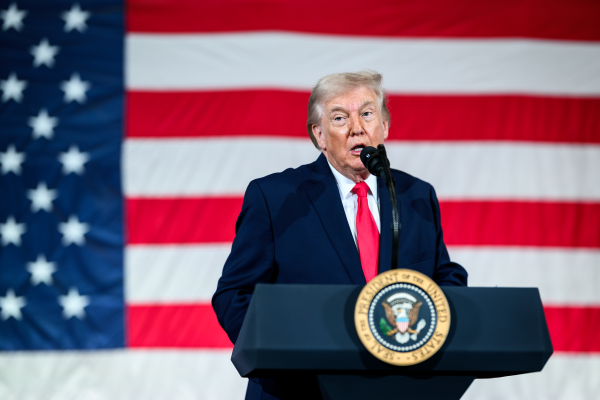
- President Xi held a phone call with President Trump on February 4 as preparation for his visit to China planned during the first week of April.
- The U.S. and India reached an interim trade agreement on February 5 that lifts certain U.S. national security tariffs on Indian steel, aluminum, copper derivatives, and aircraft parts in exchange for India reducing tariffs and non-tariff barriers on U.S. goods and committing to $500 billion in U.S. purchases over five years, as both sides pursue a broader bilateral trade pact.
- On February 10, the European parliamentary lawmakers agreed to a common position on the EU-U.S. trade deal, setting in motion the European legislative process to implement the agreement.
- South Korea’s parliament voted on February 9 to form a special committee to discuss legislation tied to Seoul’s $350 billion investment commitments in the U.S. after Trump threatened additional tariffs over delay in implementation of the agreement.
- The Trump administration announced $36 billion in Japanese investments across three U.S. projects as part of the first phase of a planned $550 billion package in exchange for 15% tariffs.
- On February 9, Bangladesh signed a trade deal with the U.S., finalizing a tariff rate of 19% on Bangladeshi imports and also securing exemptions for textiles manufactured with American yarn.
- The U.S. finalized a trade agreement with Argentina in early February, slashing reciprocal tariffs on hundreds of products and securing preferential market access for American exports.
- After months of negotiations, the U.S. and Ecuador have “substantially concluded negotiations” on a trade agreement, with the USTR saying the deal will be announced in the “coming weeks.”
- On February 6, Trump signed an executive order threatening to impose additional tariffs on countries that “directly or indirectly” trade with Iran, expanding its maximum pressure strategy against Tehran.
- The U.S. and Taiwan signed a reciprocal trade agreement on February 12 that lowers U.S. tariffs on Taiwanese goods.
Mark the Essentials
- The Trump administration has paused several proposed tech security measures targeting Chinese firms, including bans on telecom operations and equipment sales, ahead of the April summit with President Xi.
- The Pentagon briefly added Alibaba, BYD, Baidu, and TP-Link to its list of companies aiding China’s military (the 1260H list), but quickly withdrew the updated list without explanation.
- China expressed its firm opposition to the U.S. arms sale to Taiwan prior to the Trump-Xi call. During the phone call, President Xi made it clear that “the Taiwan question is the most important issue in China-U.S. relations” and must “handle the issue of arms sales to Taiwan with prudence”. The issue could lead to the cancellation of President Trump’s visit in April. Trump noted that he was discussing potential future U.S. arms sales to Taiwan with President Xi and would decide soon.
- Out of the three projects involving Japanese investments, $33 billion would be spent on the construction of a natural gas power plant in Portsmouth, Ohio, dubbed to be the largest natural gas power plant in the world.
- According to the trade deal with Bangladesh, the country will provide preferential market access for U.S. industrial and agricultural goods and ease non-tariff barriers by accepting American vehicle safety and emissions standards.
- Similarly, the agreement with Argentina will also eliminate tariffs on many U.S. goods, including medicines, medical devices, and chemicals, with both sides agreeing to cooperate on enforcing export controls on sensitive dual use items and enhance engagement in combating unfair trade practices of third countries.
- Earlier in November, the U.S. and Ecuador had signed a framework agreement, expanding preferential market access for America’s agricultural exporters and lowering tariff and non-tariff barriers.
- Trump’s Executive Order on Iran did not specify a tariff rate, though he had earlier threatened 25% additional tariffs on Iranian trade partners, with the White House saying he is holding Iran “accountable for its pursuit of nuclear capabilities, support for terrorism, ballistic missile development, and regional destabilization.”
- The U.S. trade deal with Taiwan also expands market access for U.S. industrial and agricultural exports, and commits Taiwan to stronger alignment with Washington on export controls, investment security, labor, environmental and supply chain resilience measures. Large chip manufacturing investments are also envisaged.
Keeping an Eye On…
Plans are formulating to lock down the timing of President Trump’s state visit to China as well as craft a set of deliverables for the occasion. The visit is expected to take place either during the first week or during the last week of April. Key principals involved, Treasury Secretary Scott Bessent and Vice-Premier He Lifeng, are expected to meet during the first week of March to craft a set of deliverables, following their globe-spanning set of meetings in Geneva, London, Stockholm, Madrid, and Kuala Lumpur. Beijing seeks to extend the bilateral trade and tech détente beyond the November 2026 deadline while Washington seeks major market purchases in return to slash the bilateral trade deficit.
At this time, the détente blessed by Trump and Xi in late-October appears to be holding up well. China has suspended its retaliatory tariffs on a swath of U.S. agricultural products; removed 15 U.S. companies from its (Export Control) Control List and an additional 10 from its Unreliable Entity List (UEL); paused its special port charges on U.S. ships; lifted its export bans on gallium, germanium, antimony, and superhard materials as well as on Nexperia’s legacy chips; and export controlled 13 precursor chemicals used in the manufacture of fentanyl. For its part, the U.S. has maintained the suspension of its elevated reciprocal tariffs on imports from China, halved its fentanyl-linked tariffs on China, paused the implementation of its Chinese vessels-related port fees and related shipbuilding measures, and suspended its export control ‘50% Affiliates Rule’. In the months since, the pace of implementation has been stepped up with Chinese buyers maintaining their cadence on U.S. soybeans purchases and batches of rare earth elements (REE) export “general licenses” being issued by China’s Commerce Ministry. The U.S. has shelved a number of key technology security measures for the time being and green-lighted the sale of Nvidia’s H200 AI chip, a vastly superior improvement from an AI training and inference perspective over Nvidia’s previously export-decontrolled H20 chip. Chinese regulators approved a first batch of licenses for H200 chip imports in late-January.
Preparations are also underway within the Beltway to thwart the outcomes of the summit and possibly the very holding of the summit itself. Late last week, the U.S. Department of War added Alibaba, retail and ecommerce giant, BYD, world’s biggest EV maker, WuXi AppTech, a rising Chinese biotech company, RoboSense, an AI and robotics technology firm, and Baidu, the search engine, to its 1260H “Chinese Military Companies” list, only to withdraw the list soon after. If the reposted list keeps these additional listings, it will cast a pall over the Trump visit. The 1260H list’s implications may be primarily reputational but it can also have a material impact from a procurement and licensing standpoint, given the list’s proximity to the U.S. Export Administration Regulations’ “military end-user” designation. Of a more damaging nature is the news that the administration is piecing together another massive arms package for Taiwan after announcing a record $11 billion package this past November. The package is slated to include advanced command and control systems, including the Integrated Battle Command System (IBCS), for Taiwan’s air-defenses as well as its envisioned multi-layered T-Dome system. The news of the arms sales, like the 1260H additions, has been walked back too, if only to manage the optics of Trump’s April visit.
Neither development bodes well; the Pentagon is determined to throw a wrench into U.S.-China relations. While Trump will almost certainly make it to China in April, the deliverables may turn out to be on the underwhelming side. If there is one lesson that the Chinese have learnt from the First Trump Administration is that it is their actions, not the president’s words, that matter. And they will downsize their expectations and offerings commensurately.
Expanded Reading
-
Trump claims he’s ‘talking’ about Taiwan arms sales with China’s Xi, The Japan Times, February 17, 2026
-
Trump Hails Japan’s First Batch of U.S. Investments, The New York Times, February 17, 2026
-
US Briefly Names Alibaba, Baidu as Firms Aiding China’s Military, Bloomberg, February 13, 2026
-
Exclusive: Trump pauses China tech bans ahead of Xi summit, Reuters, February 12, 2026
-
U.S. signs trade deal with Taiwan, lowering tariffs to 15%, while Taipei to boost American goods purchases, CNBC, February 12, 2026
-
India Garment Exporters Uneasy as Trump Sweetens Bangladesh Terms, Bloomberg, February 11, 2026
-
South Korea parliament forms committee to fast-track US investment legislation, Reuters, February 9, 2026
-
Trump threatens tariffs for countries trading with Iran, BBC, February 7, 2026
-
US, India unveil interim trade framework, move closer to broad pact, Reuters, February 6, 2026
-
Argentina and US sign a major trade deal to slash tariffs and boost a political alliance, Associated Press, February 5, 2026
-
Trump and China’s Xi speak by phone ahead of Beijing trip, Politico, February 4
-
Trump reports ‘excellent’ call with Xi on trade, Taiwan, The Hill, February 4
On the Hill
Legislative Developments
- Six Republicans joined House Democrats to pass the resolution H.J. Res. 72 sponsored by Gregory Meeks (D-NY) to repeal President Trump’s emergency tariffs on Canada, though it faces a likely presidential veto.
- Sens. Catherine Cortez Masto (D-NV) and Jerry Moran (R-KS) introduced a bipartisan bill directing USTR to prioritize travel and tourism in the upcoming USMCA review by creating a trilateral working group with Canada and Mexico to strengthen cross-border cooperation and support the U.S. travel industry.
- Rep. Linda Sánchez (D-CA) and Rep. Mike Turner (R-OH) introduced the “Respect NATO Allies Act” to require congressional approval before the president can impose or alter tariffs on NATO allies, aiming to protect U.S. alliances and reassert Congress’s constitutional authority over trade.
Hearings and Statements
- On February 9, leaders of the House Foreign Affairs and China select committees, including Brian Mast (R-FL) and John Moolenaar (R-MI), wrote to Secretary of State Marco Rubio and Commerce Secretary Howard Lutnick to press allies to impose countrywide export controls on semiconductor manufacturing equipment to curb China’s access to advanced AI chip tools.
- On February 5, the House Judiciary Committee opened a formal investigation into South Korean regulators over actions lawmakers say “discriminate against” U.S. tech firms, issuing a subpoena to NYSE-listed Coupang and regulators over Seoul’s crackdown after a massive data breach.
- Two senior Democrats, Sen. Ron Wyden (D-OR.) and Sen. Chris Van Hollen (D-MD.), criticized the Trump administration’s handling of tariff exemptions, telling USTR Jamieson Greer and Commerce Secretary Howard Lutnick in a letter that certain companies received relief “through an opaque process that appears to favor the politically connected” and “has opened the door to corruption and economic harm.”
- Five Midwestern Democratic senators, led by Senator Gary Peters (D-MI), told the U.S. Trade Representative Jamieson Greer in a February 11 letter to use the USMCA review process to strengthen U.S. manufacturing and labor standards, and address Chinese EV competition, urging it to “focus on structural improvements that bolster domestic manufacturing.”
- Republicans on the Senate Finance Committee, including Chair Mike Crapo (R-ID), signaled strong support for continuing the nearly six-year-old USMCA, with Crapo emphasizing that “Mexico and Canada are two of our most important trading partners.”
Expanded Reading
Sánchez, Turner introduce bill requiring congressional approval for tariffs on NATO allies, Linda Sanchez, February 12, 2026
Senate Republicans rally behind USMCA even as Trump’s support wavers, Politico, February 12, 2026
Meeks’ Resolution Terminating Trump Tariffs on Canada Passes House, House Foreign Affairs Committee, February 11, 2026
Ahead of USMCA Review, Peters Leads Colleagues in Calling on Top U.S. Trade Representative to Prioritize Protecting American Manufacturing Jobs, Gary Peters, February 11, 2026
Chairman Mast, Ranking Member Meeks Lead Letter Pledging Bipartisan Support for Strengthening Export Controls on Chipmaking Tools, House Committee on Foreign Affairs, February 9, 2026
Cortez Masto, Moran Introduce Legislation to Boost Tourism Between United States, Mexico, and Canada, Catherine Cortez Masto, February 5, 2026
Congress targets South Korean regulators over ‘discriminatory’ treatment of US tech companies, House Judiciary Committee, February 5, 2026
Van Hollen, Wyden Question Trump Administration Over Secret Process for Tariff Cuts that Favor Politically Connected Companies Over Small Businesses, Chris Van Hollen, February 4, 2026