

President Donald Trump delivers his State of the Union address, Tuesday, February 24, 2026, on the House floor of the U.S. Capitol in Washington, D.C. (Official White House Photo by Daniel Torok)
The second half of 2025 confirms that China policy has become structurally embedded within the legislative agenda of the 119th Congress. Although overall bill introduction slowed markedly following the August recess and the 43-day government shutdown, China-referencing measures constituted a higher proportion of total legislation than in the first half of the year.
The FY2026 National Defense Authorization Act (NDAA) stands as the most consequential vehicle through which Congress embedded long-duration competition logic into statute. By institutionalizing military AI deployment and oversight, codifying outbound capital controls through the COINS framework, and extending national security scrutiny into biotechnology infrastructure via the BIOSECURE Act, lawmakers constructed a layered architecture of technological acceleration, capital discipline, and sectoral securitization that will outlast short-term diplomatic cycles.
Second-half proposals shifted from headline tariff escalation toward enforcement harmonization, capital monitoring, export control modernization, and midstream supply chain resilience.
Taiwan remains a legislative anchor. Even as executive rhetoric emphasized trade stabilization following the Busan summit, lawmakers embedded deterrence architecture into statute.
In response to Beijing’s calibrated export licensing during the 2025 trade disputes, Congress moved to accelerate offshore extraction, rebuild domestic refining capacity, and strengthen allied mineral partnerships. These technocratic proposals align with—but do not depend upon—executive initiatives such as Project Vault, signaling bipartisan recognition that supply chain asymmetry must also be addressed through long-term capacity reconstruction.
While the White House emphasizes negotiation leverage and commercial recalibration, Congress increasingly codifies guardrails around export controls, outbound investment, semiconductor policy, Taiwan contingency planning, and mineral security.
As midterm electoral incentives intensify and expectations surrounding potential high-level summits evolve, Congress is unlikely to retreat from its hardened posture. Even if diplomatic tone oscillates, the legislative architecture of competition—now layered across defense, capital, technology, and contingency planning—suggests that U.S.–China rivalry is becoming less episodic and more structurally codified.
Since the end of the August recess, the legislative tempo of the 119th Congress has slowed markedly in aggregate output. Yet its attention to China has not receded.
As of December 31, 2025, a total of 17,978 bills and resolutions had been introduced, compared to 12,624 as of July 31. Only 5,354 additional legislative items were introduced between August and December—a clear contraction relative to the first seven months of the year. In quantitative terms, legislative productivity decelerated.
This slowdown unfolded against the backdrop of the 43-day government shutdown from October 1 to November 12—the longest in U.S. history. Legislative maneuvering was dominated by domestic budgetary confrontation and procedural brinkmanship. In structural terms, Congress’s operational capacity narrowed.
Within this compressed legislative environment, however, China-related measures remained proportionally resilient. Of the 5,354 items introduced between August and December, 365 referenced China. Of these, 337 were sponsored by Republicans and 28 by Democrats. While this partisan imbalance reflects Republican control of both chambers, it also underscores a broader political dynamic: amid domestic turbulence, Republican lawmakers sustained outward-facing strategic initiatives, whereas Democratic engagement in foreign policy legislation contracted as attention concentrated on fiscal governance and other domestic agenda.
Measured as a percentage of total introduced legislation, China-related bills accounted for a higher share in the second half of 2025 than in the first. This proportional persistence is analytically significant. Even during institutional disruption and fiscal crisis, China did not fall from Congress’s strategic agenda.
More consequential than volume, however, is the qualitative evolution observable in the second-half docket.Throughout 2025—particularly amid the April-November U.S-China trade disputes—Congress advanced proposals across established domains of competition: export controls, capital screening, Taiwan security coordination, and supply chain resilience. Between August and December, legislative activity became more operationally targeted and more directly responsive to unfolding executive diplomacy.
The repeated intensification and deescalation of economic friction during summer 2025, followed by rhetorical stabilization at the October 30 Busan summit between President Trump and President Xi, created a recalibration moment. Rather than merely reinforcing long-standing competitive postures, however, lawmakers in their limited time increasingly moved to codify safeguards, embed statutory guardrails, and narrow discretionary space in anticipation of potential executive flexibility.
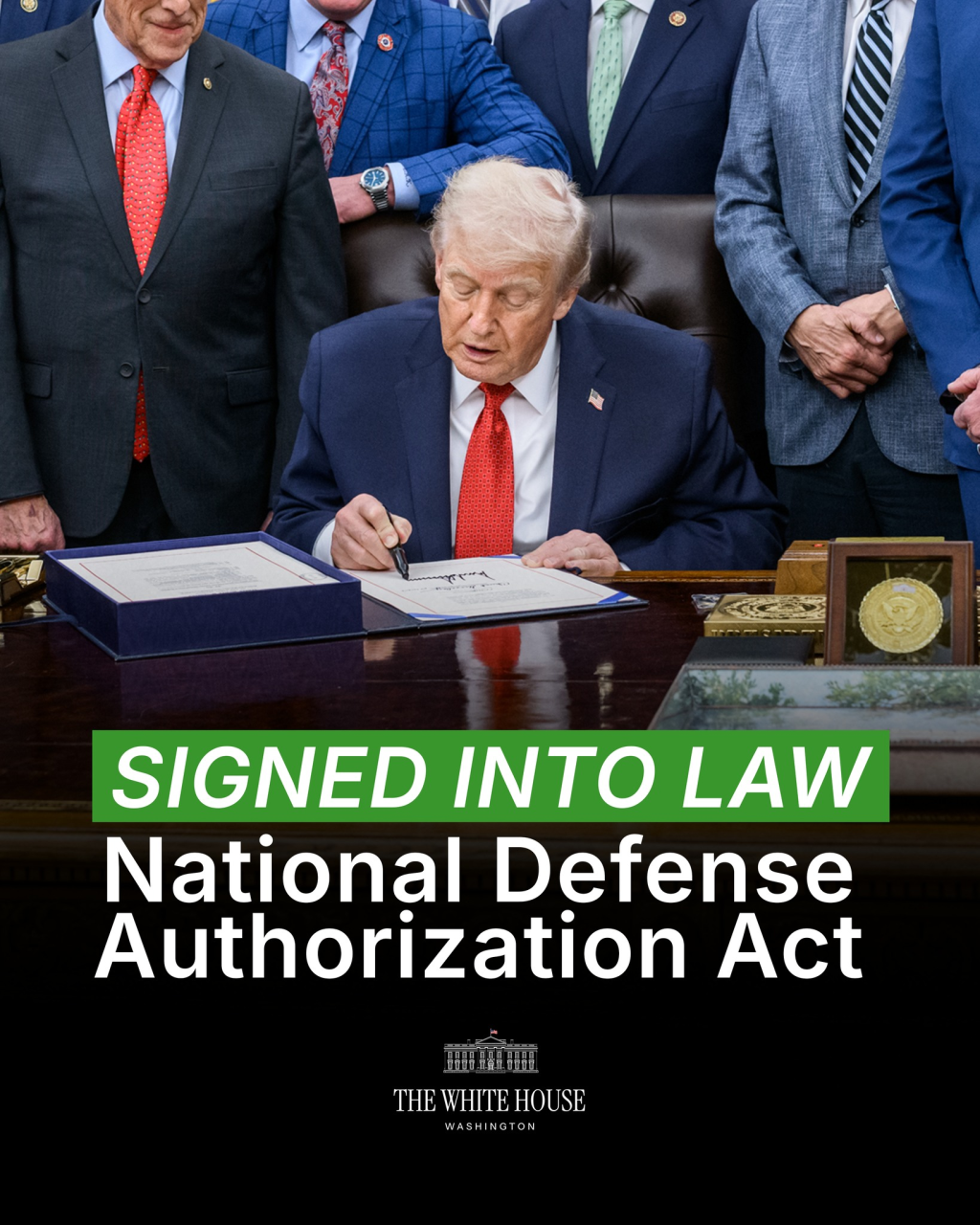
Enacted in December amid domestic political turbulence and legislative slowdown, the NDAA—by virtue of its must-pass status—became the principal vehicle through which Congress embedded long-duration competition logic into statutory defense, technology, and geoeconomic frameworks. While many standalone China-related measures stalled at early procedural stages, the 2026 NDAA ensured that structural elements of strategic rivalry advanced irrespective of broader legislative underperformance.
Artificial intelligence occupies a central position within the Act for the very first time. Rather than isolating AI as an innovation initiative, the 2026 NDAA integrates it across operational, industrial, intelligence, and procurement domains. Provisions mandate AI deployment in predictive maintenance, logistics optimization, supply chain monitoring, financial auditing, munitions manufacturing automation, and intelligence system interoperability.
This cross-functional embedding reflects a congressional judgment that AI is no longer an experimental capability but core infrastructure. The legislation signals that technological competition with China will hinge less on discrete innovation breakthroughs and more on systemic adoption across defense institutions.
Acquisition and organizational reforms further reinforce this orientation. Alternative software testing pathways, expanded authority for the Department of Defense’s chief technology officer, and mandated structural reviews within the Office of the Secretary of Defense collectively aim to compress the cycle from research and development to operational deployment.
The underlying premise is institutional velocity. Technological leadership, in Congress’s framing, depends not only on inventing next-generation capabilities but on integrating them faster and more consistently than strategic competitors. The 2026 NDAA thus legislates speed—not merely capability. The Act requires comprehensive AI assessment frameworks, risk-based testing standards across intelligence community elements, enhanced reporting on autonomous weapons deployment, and strengthened congressional visibility into legal review processes. While executive rhetoric during 2025 frequently emphasized urgency—at times framing rapid deployment as essential to deterrence—the statutory architecture embeds compliance, accountability, and procedural discipline.
Congress appears intent on ensuring that velocity does not eclipse control. In this respect, the 2026 NDAA reflects an institutional instinct to anchor AI expansion within guardrails that outlast shifting executive priorities.
Cybersecurity provisions deepen this layered approach. Department-wide AI security standards, mandatory protections within procurement contracts, and expanded authorities for the National Security Agency’s AI Security Center recognize that AI represents both competitive advantage and vulnerability surface. Protection against model theft, data poisoning, adversarial manipulation, and supply chain compromise is treated as integral to deployment architecture rather than secondary compliance requirement.
Beyond innovation and oversight, the 2026 NDAA advances targeted disentanglement measures that directly implicate China.
Section 6604 restricts use of DeepSeek’s application across intelligence community systems. Section 1532 extends similar prohibitions within the Department of Defense and directs review of broader restrictions on AI systems linked to adversary jurisdictions. These provisions establish an expanding presumption: AI models originating from strategic competitors are incompatible with U.S. national security environments.
Section 842 phases in procurement restrictions on batteries whose components or technologies derive from foreign entities of concern—including major Chinese firms. This affects not only conventional defense hardware but AI-enabled drones, robotics, and autonomous systems reliant on advanced energy supply chains.
The phased implementation timeline acknowledges transition costs and industrial dependencies, yet it embeds a long-term trajectory toward structural separation. Disentanglement, in this framing, is gradual but directional.
Rather than isolating AI as a research priority, Congress integrates it into predictive maintenance systems, logistics optimization, munitions manufacturing automation, financial auditing processes, intelligence analysis interoperability, and supply chain monitoring. AI is treated not as an experimental add-on but as foundational infrastructure within the defense enterprise.
This cross-functional integration reflects a congressional judgment that strategic competition with China will hinge less on isolated technological breakthroughs and more on institutional adoption velocity. In this framing, the question is not merely who invents first, but who integrates faster and more coherently across defense systems.
The incorporation of the S.3555 Comprehensive Outbound Investment National Security (COINS) framework marks another structural frontier: capital flows themselves.
The significance of this shift lies in institutional authority. Export controls restrict physical technology transfer. Outbound investment controls constrain financial capital, managerial expertise, and ecosystem integration that could enable parallel technological development abroad. Together, they form a layered geoeconomic architecture that links defense authorization directly to capital discipline.
These legislative developments unfolded amid fluid executive approaches to AI export controls, including reported approval of Nvidia’s H200 chip sales to China. While the 2026 NDAA does not directly override licensing discretion, its structure signals congressional intent to preserve foundational guardrails irrespective of short-term diplomatic cycles.
By embedding outbound investment restrictions within the NDAA, Congress transforms capital from a neutral economic instrument into a governed strategic variable. The move represents a conceptual evolution in U.S.–China competition. Whereas export controls regulate the transfer of tangible technology and hardware, outbound investment controls regulate the transfer of intangible ecosystem support—financial capital, managerial expertise, joint venture participation, and long-term equity exposure that can enable parallel technological advancement abroad.
The statutory integration of COINS shifts oversight from executive-led regulatory experimentation toward legislative codification. In previous years, outbound investment screening operated primarily through executive order and regulatory development, subject to revision or recalibration. By incorporating COINS language into must-pass defense authorization legislation, Congress anchors capital discipline within recurring statutory authority. The architecture becomes harder to unwind and more politically costly to dilute.
The sectors targeted—artificial intelligence, advanced semiconductors, quantum computing, and related high-performance technologies—mirror the core technological domains identified across defense and industrial policy debates. Yet the mechanism differs fundamentally from export controls. Rather than blocking shipment of goods, COINS seeks to limit the enabling environment that allows strategic competitors to scale innovation ecosystems.
This distinction matters.
Export controls operate at the border. Capital controls operate within corporate governance structures, venture financing channels, and institutional portfolio allocation. By constraining outbound equity investment, joint development financing, and certain cross-border funding arrangements, Congress is addressing a perceived vulnerability revealed over the past decade: that U.S. capital markets and investment vehicles can inadvertently support capacity building in sectors deemed strategically sensitive.
Incorporating COINS into the NDAA thus extends competition from goods to capital allocation decisions. It reflects congressional judgment that financial interdependence is not merely an economic relationship but a potential vector of strategic leakage.
Notably, the framework does not mandate wholesale financial disengagement. It does not sever portfolio investment broadly, nor does it prohibit all forms of corporate interaction. Instead, it establishes screening requirements, notification obligations, and prohibitions in narrowly defined technology domains. The structure is selective rather than comprehensive—directional rather than immediate.
This calibrated design serves two purposes. First, it minimizes systemic disruption to U.S. capital markets. Second, it embeds a long-term trajectory toward controlled separation in frontier sectors without triggering abrupt financial dislocation.
The legislative significance lies less in immediate transaction volume than in institutional permanence. Once codified within the NDAA, outbound investment screening becomes part of the annual defense authorization cycle. Even if executive administrations adjust regulatory interpretation, the statutory mandate persists unless affirmatively amended by Congress.
This dynamic introduces a subtle inter-branch dimension.
The executive branch retains discretion in implementation, licensing, and enforcement prioritization. But by legislating capital controls in tandem with export controls and procurement restrictions, Congress narrows the space for purely transactional recalibration in trade negotiations. Capital, once framed as leverage, is now increasingly framed as structural constraint.

Beyond artificial intelligence and capital controls, the 2026 NDAA incorporates another consequential pillar of structural competition: the S.3469 BIOSECURE Act of 2025. Its inclusion signals that congressional conceptions of strategic rivalry have moved beyond traditional defense hardware and semiconductor supply chains into the domain of biotechnology infrastructure and biological data governance.
At its core, the BIOSECURE framework restricts federal procurement, contracting, and grant funding from flowing to “biotechnology companies of concern” (BCCs). The prohibition extends not only to direct purchases of biotechnology equipment or services, but also to contracts with entities that rely on such equipment or services in performance of federal work. In effect, the Act embeds supply chain exclusion logic into life sciences procurement and federally funded research ecosystems.
The scope of covered biotechnology equipment is deliberately expansive. It encompasses not only laboratory instruments or sequencing platforms, but also software, digital components, data storage, transmission services, and consulting arrangements tied to biological materials and multiomic data. By defining the relevant ecosystem broadly, Congress avoids limiting restrictions to physical hardware and instead captures the informational and analytical layers of biotechnology infrastructure.
Designation authority rests primarily with the Office of Management and Budget (OMB), drawing upon interagency recommendations. Companies listed under the Department of Defense’s Section 1260H “Chinese military companies” framework may be designated as BCCs if they are determined to be involved in biotechnology equipment or services. OMB may also independently designate entities subject to the control or direction of foreign adversaries where national security risks are identified—particularly those linked to military or intelligence affiliations or the transfer of sensitive multiomic data.
Importantly, the enacted version of BIOSECURE does not statutorily name specific firms. Instead, it establishes a dynamic designation process subject to periodic review, removal petitions, and interagency input. This procedural architecture reflects a shift from targeted sanction toward regulatory institutionalization. Biotechnology competition is no longer addressed through episodic naming-and-shaming; it is embedded into an evolving administrative framework capable of expansion.
The Act includes phased implementation and grandfathering provisions. Existing contracts are generally afforded a transition window, and restrictions take effect only after formal regulatory updates to the Federal Acquisition Regulation (FAR). These delayed effective dates indicate congressional awareness of supply chain complexity and pharmaceutical dependency. At the same time, the phased structure does not dilute the long-term trajectory: federal life sciences procurement will gradually decouple from designated foreign biotechnology ecosystems.
One of the most consequential clarifications concerns the intersection with Medicare Part B and Medicaid reimbursement. Earlier legislative drafts risked unintentionally disrupting pharmaceutical reimbursement eligibility if manufacturers were unable to maintain required federal supply schedule contracts due to BIOSECURE restrictions. The enacted version includes a “deeming” mechanism preserving reimbursement eligibility where compliance failures stem solely from BIOSECURE prohibitions. This revision underscores that Congress seeks to constrain biotechnology procurement without destabilizing domestic healthcare financing systems.
The strategic significance of BIOSECURE extends beyond procurement mechanics. It represents a conceptual expansion of national security into the life sciences domain. Multimonic data, genetic sequencing infrastructure, contract research services, and bio-manufacturing capacity are now treated as potential vectors of geopolitical vulnerability. Just as semiconductor supply chains were securitized in prior legislative cycles, biotechnology ecosystems are being incorporated into the broader architecture of strategic competition.
Through BIOSECURE, Congress signals that strategic rivalry with China is no longer confined to defense platforms and advanced computing. It now encompasses biological data governance, pharmaceutical supply chains, and research infrastructure—domains previously treated as commercially globalized and politically insulated.
The second half of 2025 also witnessed a discernible refinement—rather than expansion—of Congress’s approach to economic competition with China. If the first half of the year was dominated by tariff escalation and headline confrontation, the latter half reflects a legislature that increasingly viewed the trade war not as an endpoint, but as a stress test.
The 2025 U.S.-China trade disputes exposed structural vulnerabilities in enforcement mechanisms, financial exposure, and industrial dependencies. President Trump’s mega tariffs, while politically visible and symbolically forceful, revealed their limitations. They function as blunt instruments. Their effectiveness depends significantly on American resilience against Chinese retaliatory leverage, which was proved uneven during the 2025 confrontation.
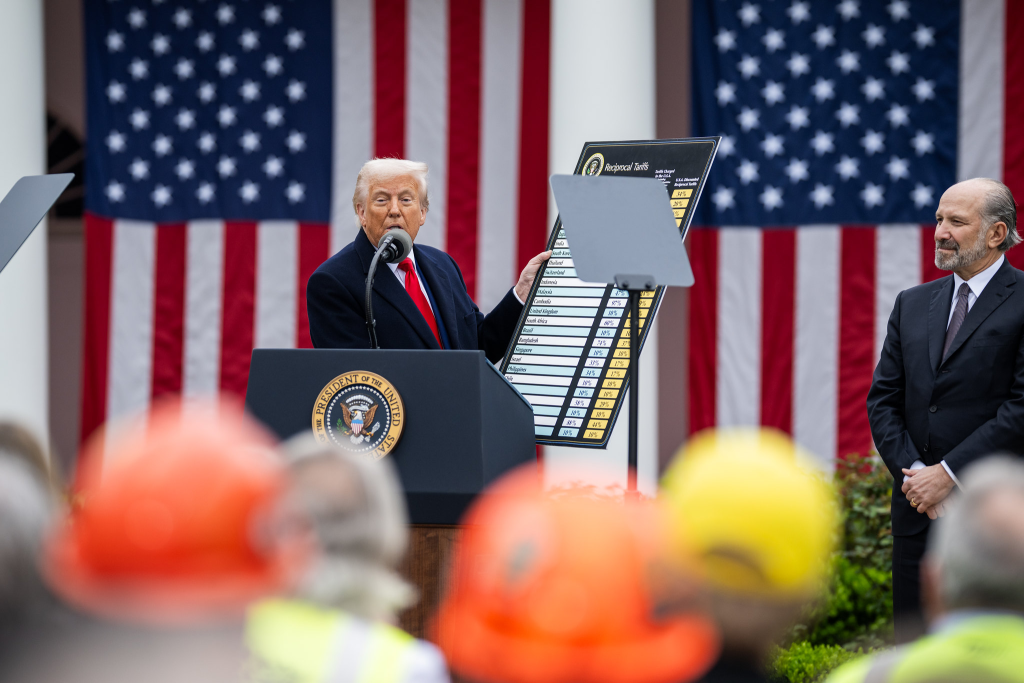
By August, congressional proposals began shifting from declaratory decoupling language toward procedural reinforcement. The objective was not simply to raise tariff levels, but to prevent circumvention and institutionalize enforcement discipline.
H.R.4978, the Secure Trade Act, and S.2861, the Protecting the USMCA from Harmful Chinese Investment Act, exemplify this transition. Both measures directly address third-country routing and supply chain circumvention risks. Lawmakers increasingly recognized that tariff regimes can be diluted through transshipment, investment routing, and value-added processing within partner economies. The specific attention to North American supply chains underscores concern that Chinese capital or production networks could indirectly access U.S. markets through USMCA channels.
Rather than escalating tariff rates further, these proposals seek to tighten the compliance architecture itself—embedding harmonized enforcement expectations among trade partners. Economic competition is thus reframed not as punitive escalation, but as systemic enforcement management. Closing loopholes, standardizing screening procedures, and aligning jurisdictional compliance become central pillars of policy.
Financial interdependence continued to emerge as a new tool for reducing interdependence.
S.2563, the Global Investment in American Jobs Act of 2025, along with H.R.7075 and S.3640, expands Treasury oversight of cross-border capital flows and mandates enhanced risk assessment mechanisms. Importantly, these proposals do not mandate abrupt capital disengagement. Instead, they institutionalize monitoring frameworks capable of mapping exposure in real time.
This marks a conceptual evolution. Earlier congressional debates centered on discrete transactions—Chinese acquisitions of farmland, technology firms, or sensitive infrastructure. The second-half proposals broaden the aperture to encompass portfolio flows, structured investments, minority stakes, and broader ecosystem participation. Capital screening is increasingly treated as dynamic risk management rather than episodic intervention.
The legislative message is clear: financial interconnectedness can amplify vulnerability during escalation cycles. Therefore, exposure must be mapped, monitored, and preemptively managed—even absent immediate crisis.
Sector-specific legislation further illustrates this granular turn.
S.2986, the American Medicine Safety and Security Act, responds to pharmaceutical and medical supply chain vulnerabilities revealed during tariff volatility. H.R.5544, the Ejiao Act of 2025, while narrower in scope of the donkey industry, signals congressional willingness to intervene even in niche commodity streams where concentration risk or asymmetric supply chains could create leverage.
These measures demonstrate that economic security is no longer confined to flagship industries such as semiconductors or electric vehicles. It extends into midstream industrial inputs, specialty goods, and industrial subcomponents—areas that rarely dominate headlines but can exert disproportionate leverage during trade confrontations.
This infrastructure-oriented mindset reflects an increasingly systemic view of economic statecraft. Lawmakers are not simply seeking to block imports; they are attempting to map and manage the connective tissue of interdependence itself.
Semiconductor and advanced technology legislation reinforced structural constraints in parallel.
H.R.5022, the No Advanced Chips for the CCP Act of 2025, codifies stricter prohibitions on advanced semiconductor exports. H.R.5287, the China Advanced Technology Monitoring Act, enhances interagency oversight and coordination mechanisms governing sensitive technology transfers. H.R.4920, the BIS IT Modernization Act, strengthens enforcement capacity within the Bureau of Industry and Security—recognizing that export control regimes are only as effective as the administrative infrastructure enforcing them.
The timing of these bills is analytically significant. Reports that the administration had considered approving selective sales of Nvidia AI chips to China, in hope for a transactional deal on agricultural purchases and rare earths export, generated visible unease among lawmakers. For the executive branch, calibrated licensing flexibility may serve trade stabilization objectives, industrial export interests, or negotiation leverage. For many members of Congress, however, semiconductor export controls represent structural pillars of long-term competition. They are foundational constraints—not tactical bargaining instruments.
In this sense, second-half semiconductor proposals function as legislative anchoring mechanisms. Even if the executive branch exercises waiver authority or regulatory discretion, Congress signals its intent to preserve the core architecture of export control regimes through statutory reinforcement and enhanced oversight mandates.
Taken together, the economic docket of the second half of 2025 reflects a legislature that has internalized key lessons from the year’s trade confrontation:
Perhaps most importantly, this evolution reveals a subtle divergence in strategic temperament between Congress and the White House.
The Trump administration’s economic posture emphasizes negotiation leverage, tariff calibration, and industrial revival framed through commercial metrics. Its approach is transactional, adaptive, and oriented toward maximizing bargaining flexibility.
Congress, by contrast, increasingly emphasizes procedural codification. Its instinct is to embed competition logic into monitoring regimes, enforcement frameworks, reporting mandates, and statutory triggers that are less easily adjusted through executive discretion.

Taiwan remained one of the most consistent—and politically resonant—China-related themes in legislation introduced between August and December 2025. Yet what distinguishes the second-half docket is not merely continuity of attention, but the increasingly operational and contingency-driven character of congressional proposals.
This persistence is particularly striking against the broader diplomatic backdrop. Following the Busan summit between President Trump and President Xi, executive rhetoric shifted toward economic recalibration and strategic flexibility. Taiwan, notably, received comparatively muted treatment in the administration’s new Defense Strategy. While the White House emphasized preventing war over Taiwan while pursuing trade stabilization and commercial recalibration with the Mainland, Congress legislated as if cross-Strait instability remained a live structural risk.
Legislative actions between August–December 2025, reflects a movement toward pre-legislated contingency architecture—embedding forward planning and automatic triggers into statutory frameworks.
H.R.4860, the U.S.–Taiwan Defense Innovation Partnership Act, exemplifies this transition. Rather than focusing narrowly on discrete arms sales, the bill directs the Department of Defense to formalize structured cooperation with Taiwan’s defense industrial base. Joint research initiatives, co-production pathways, and technological integration mechanisms aim to embed Taiwan within elements of U.S. defense planning infrastructure itself. The underlying premise is clear: in a potential cross-Strait crisis, resilience would depend less on episodic weapons transfers and more on sustained interoperability, industrial coordination, and supply chain integration.
S.2669 reinforces this institutional orientation by mandating formal reporting on Taiwan-related contingency planning within the Department of Defense. This is not reactive legislation triggered by crisis; it institutionalizes forward planning. By requiring recurring assessments, Congress ensures that cross-Strait scenarios remain embedded in routine oversight processes rather than activated only during moments of escalation.
H.R.5180 strengthens defense coordination language within authorization frameworks, reinforcing military planning channels and strategic alignment. Meanwhile, S.2884, the China Military Power Transparency Act of 2025, expands reporting requirements on People’s Liberation Army modernization trends and cross-Strait force balance metrics. Transparency in this context serves dual functions: informational oversight for Congress and signaling for deterrence. By requiring structured assessments of Chinese capabilities, lawmakers embed analytical continuity into the institutional apparatus.
Beyond military planning, Congress advanced economic deterrence mechanisms explicitly tied to Taiwan contingencies.
H.R.4848 and its Senate companion S.2646 provide for termination of the U.S.–China Income Tax Convention in the event of aggression involving Taiwan. This approach moves beyond rhetorical condemnation and into pre-coded economic consequences. Rather than relying on ad hoc executive sanction packages, Congress seeks to hardwire financial triggers into statute—reducing ambiguity about economic retaliation pathways.
S.2722, the Taiwan Energy Security and Anti-Embargo Act of 2025, anticipates blockade or coercive energy disruption scenarios. The bill establishes coordination mechanisms designed to bolster Taiwan’s energy resilience under crisis conditions, including contingency supply planning and emergency logistics frameworks. This expands deterrence logic into infrastructure preparedness. Security is framed not solely in military hardware terms, but in supply chain continuity and civilian resilience.
Several additional proposals situate Taiwan within broader technological sovereignty debates. Measures that integrate Taiwan’s semiconductor ecosystem into U.S. industrial strategy reflect recognition that cross-Strait stability is inseparable from global chip supply chain continuity. Taiwan’s central role in advanced semiconductor fabrication makes it both a geopolitical flashpoint and a technological linchpin. Legislative attention to semiconductor cooperation therefore carries layered implications: deterrence reinforcement, industrial alignment, and supply chain stabilization.
This posture operates in quiet contrast to executive messaging in late 2025. While the administration prioritized trade stabilization and framed competition largely in commercial and industrial terms, Congress continued embedding cross-Strait preparedness into statutory frameworks.
In effect, Taiwan-related legislation in the second half of 2025 functions as a pre-legislated response script.
By embedding automatic economic consequences, formalized defense-industrial cooperation, contingency reporting requirements, and infrastructure resilience planning into statutory law, Congress raises the political and legal costs of deviation for any future administration. This does not eliminate executive maneuver space—but it does make oscillation more visible, more constrained, and more politically costly.
Critical mineral legislation introduced between August and December 2025 was numerically modest compared to trade, semiconductor, or Taiwan-related measures. Yet in strategic terms, these proposals may prove among the most structurally consequential initiatives of the second half of the year.
The significance lies not in volume, but in timing—and in diagnosis.
Before April 2025, as tariff retaliation intensified, Beijing demonstrated how calibrated export licensing and regulatory tools could function as instruments of economic signaling.
China’s dominance in rare earths is not defined solely by extraction volume. It is rooted in decades-long accumulation of refining, separation, and chemical processing infrastructure. Even when raw materials are mined in Australia, Africa, or North America, processing frequently routes through Chinese facilities before entering global manufacturing chains. This midstream concentration creates a form of leverage that does not require overt embargo. The moves were incremental but effective: they injected uncertainty into downstream industries in the United States.

Congressional responses in the second half of 2025 reflect a sober recognition of this structural vulnerability.
H.R.4018 seeks to accelerate offshore mineral exploration and extraction within U.S. jurisdiction. By proposing streamlined permitting pathways, improved interagency coordination, and regulatory harmonization, the bill attempts to shorten the development cycle for seabed mineral projects. Its Senate counterpart, S.2860, the Revitalizing America’s Offshore Critical Minerals Act—similarly emphasizes federal coordination, geological mapping, and expedited environmental review mechanisms. Together, these proposals signal congressional willingness to expand the geographic and geological scope of domestic sourcing rather than remain confined to terrestrial deposits.
But extraction alone does not resolve leverage.
S.2839, the Restoring American Mineral Security Act of 2025, focuses on rebuilding domestic refining and processing capacity. This emphasis is critical. Without midstream separation and chemical conversion infrastructure, expanded extraction would merely shift raw ore dependency without addressing the central chokepoint. By prioritizing refining capacity, Congress acknowledges that mineral security requires vertical integration across the value chain rather than incremental diversification at its upstream edge.
More recently into 2026, H.R.7037, the Developing Overseas Mineral Investments and National Security Act, extends this logic outward. The bill directs federal agencies to strengthen mineral partnership frameworks with allied producers and to support financing mechanisms that reduce reliance on Chinese-controlled processing networks. Development finance tools, export credit support, and multilateral coordination are positioned as instruments to construct parallel supply ecosystems. In effect, Congress is attempting to rewire mineral supply geography over the long term.
Unlike broader decoupling rhetoric in other domains, second-half mineral legislation is infrastructure-driven and technocratic in tone. It avoids sweeping prohibitions or headline-grabbing sanctions. Instead, it concentrates on capacity expansion, regulatory reform, financing architecture, and allied coordination. This reflects a practical assessment: rare earth leverage cannot be neutralized through tariffs or retaliatory measures alone. It requires capital-intensive, multi-year industrial reconstruction.
Importantly, these legislative initiatives unfolded before—but align closely with—the administration’s subsequent announcement of Project Vault in early 2026. Project Vault’s $12 billion commitment to strategic mineral stockpiling and capacity development builds upon the same structural diagnosis embedded in congressional proposals: that mineral resilience must be institutionalized rather than improvised during a crisis.
The parallelism is notable.
Whereas Project Vault represents executive mobilization and strategic stockpiling, Congress’s second-half legislative docket reflects regulatory scaffolding and supply chain reconstruction. Both branches responded to the same leverage episode revealed during the 2025 trade confrontation, yet they approached the problem through distinct institutional pathways.
The executive branch emphasizes reserve-building and rapid mobilization capacity.
Congress emphasizes statutory frameworks, permitting reform, vertical integration, and allied network-building.
This convergence does not eliminate broader divergence between Congress and the White House in other domains. However, rare earth legislation represents one of the clearest areas in 2025 where institutional diagnosis aligned—even if execution strategies differ.
More broadly, mineral legislation illustrates a transformation in how Congress conceptualizes economic competition.
Rare earths are no longer treated as environmental policy questions, commodity cycles, or niche industrial inputs. They are framed explicitly as instruments of geopolitical bargaining power. The events of 2025 reinforced that supply chain interdependence can function asymmetrically, with leverage concentrated at midstream nodes invisible to conventional trade metrics.
Congress’s response seeks to reduce that asymmetry over the long term.
In absolute legislative terms, the 119th Congress underperformed during the second half of 2025. Floor time was constrained by fiscal brinkmanship, prolonged shutdown pressures, and persistent domestic political turbulence. Most China-related measures introduced between August and December remain at early procedural stages.
Measured purely by enactment statistics, the record appears thin.
Yet reduced legislative throughput does not equate to diminished strategic direction. If anything, the proportional persistence and qualitative evolution of China-related legislation during a period of institutional disruption underscore the extent to which China policy has become structurally embedded within Congress’s operating logic.
Competition is no longer advanced primarily through declaratory resolutions or symbolic signaling. It is being codified through acquisition reform in the NDAA, outbound capital discipline under the COINS framework, biotechnology securitization via the BIOSECURE Act, semiconductor export enforcement modernization, Taiwan contingency pre-legislation, and mineral supply chain reconstruction. These are not rhetorical instruments. They are institutional mechanisms.
At the same time, it would be analytically misleading to assume that Congress and the Trump administration are operating along fully convergent strategic trajectories.
The divergence is not theatrical. It is structural.
Congress appears intent on hardwiring long-term competitive constraints into statutory architecture. Its approach is procedural, future-oriented, and designed to persist across administrations. Through reporting mandates, procurement exclusions, capital controls, and contingency triggers, competitive logic is migrating from political messaging into legal code.
The Second Trump Administration’s China policy, by contrast, emphasizes transactional recalibration, commercial leverage, industrial revival, and preservation of executive maneuver space. The Busan summit and subsequent trade stabilization efforts signaled willingness to reduce friction tactically, even while maintaining competitive posture strategically.
This difference in temperament creates both convergence and friction.
Where the executive branch seeks calibrated flexibility, Congress increasingly embeds guardrails that narrow the range of abrupt policy reversal. Export controls, capital screening, AI deployment standards, Taiwan contingency mechanisms, and mineral reconstruction frameworks are becoming harder to treat as bargaining instruments and easier to treat as structural constraints.
The question is therefore not whether Congress constrains the executive—it does. The question is how elastic those constraints remain under transactional diplomacy.
Several structural variables will shape the trajectory ahead.
First, trade implementation. Should tariff suspensions evolve into broader accommodation, congressional skepticism may intensify, prompting further statutory reinforcement. Conversely, renewed escalation could temporarily realign the branches.
Second, cross-Strait developments. The existence of pre-legislated reporting requirements and economic trigger mechanisms compresses executive maneuver space in the event of instability. Taiwan policy is no longer purely discretionary diplomatic terrain.
Third, supply chain leverage episodes. The 2025 rare earth licensing episode demonstrated that chokepoints can generate uncertainty without overt embargo. Congress has signaled that future leverage attempts will likely be met with institutional consolidation rather than ad hoc reaction.
Fourth, diplomatic engagement in 2026. Executive-level outreach—such as a potential presidential visit to Beijing—may coexist with legislative hardening, producing a dual-track policy environment: rhetorical stabilization externally, statutory embedding internally.
The result may be a China policy that appears outwardly flexible yet inwardly constrained.
The second half of 2025 should therefore not be interpreted as legislative dormancy. Nor does it represent abrupt escalation. Instead, it marks a deeper phase transition—from episodic rivalry toward embedded architecture.
The 119th Congress may have enacted relatively few headline China bills in late 2025. But it continued to lay structural foundations across defense modernization, capital allocation, biotechnology governance, semiconductor enforcement, Taiwan contingency planning, and mineral security. Once embedded, such foundations are not easily dismantled.
Even if diplomatic tone oscillates in 2026, the statutory perimeter of competition is unlikely to contract.
The rivalry is no longer simply negotiated. It is increasingly codified.

Two Visions of Global Governance in the Age of AI