
ICAS Bulletin (online ISSN 2836-3418, print ISSN 2836-340X) is published every other week throughout the year at 1919 M St NW, Suite 310, Washington, DC 20036.
The online version of ICAS Bulletin can be found at chinaus-icas.org/bulletins/.
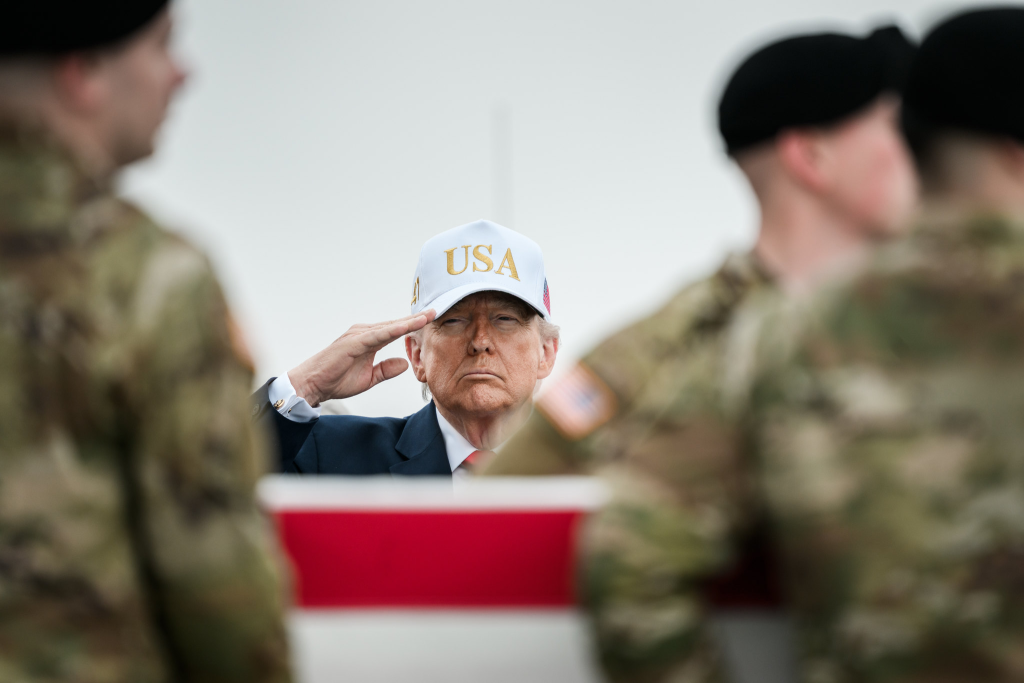
– On February 28, the United States and Israel launched joint preemptive strikes against Iran in an operation the Pentagon named “Operation Epic Fury.” Iran retaliated by firing missiles toward Israel and nearby countries with U.S. military bases.
– Iranian Supreme Leader Ayatollah Ali Khamene was killed on the first day of the attack.
– Six U.S. soldiers were killed during a drone strike on March 1 on Port Shuaiba in Kuwait.Subsequently, one soldier was also killed at Prince Sultan Air Base in Saudi Arabia.
– Iran attacked major airports in several Gulf cities, including Dubai, Abu Dhabi, and Doha with most strikes intercepted. The escalation forced closure of regional airspace and a full suspension of operations, with some flights resumed on March 2.
– Qatar halted its liquefied natural gas (LNG) production at the Ras Laffan complex and the Mesaieed industrial zone, disrupting roughly 20% of global LNG supply. -Saudi Arabia shut down its largest domestic oil refinery, the Ras Tanura refinery. Oil production in Iraqi Kurdistan and several Israeli offshore gas fields, including the giant Leviathan field, were suspended as precautionary measures.
– On March 2, an Iranian-made drone struck the runway of the British RAF base at Akrotiri, Cyprus, with two more drones later intercepted. This comes after the UK reversed course and granted U.S. access to its air bases.
– The U.S. Embassy in Riyadh, Saudi Arabia was hit by drones on March 3.Saudi defense forces intercepted two cruise missiles and destroyed nine drones near the Prince Sultan U.S. air base outside the capital.
– A senior Iranian Islamic Revolutionary Guard Corps (IRGC) official on March 2 declared the Strait of Hormuz closed and threatened to fire on any ship attempting passage. Two days later, the IRGC declared full control of the Strait of Hormuz.
– At least three tankers were attacked off the Gulf coast and a seafarer was killed on March 1, while electronic warfare disrupted GPS and AIS navigation for over 1,000 ships across the region.
– President Trump announced on March 3 the U.S. will offer selective insurance guarantees through the International Development Finance Corporation (DFC) and naval escorts to ensure safe passage for oil tankers through the Strait of Hormuz to “ensure the FREE FLOW of ENERGY to the WORLD.”
– The conflict has resulted in an 80% drop in vessel traffic, effectively choking off about 20% of global seaborne crude oil, sending chartering rates for crude tankers surging to a record $424,000 a day and prompting major shipping companies including CMA CGM to suspend port bookings across much of the Persian Gulf.
– The Strait of Hormuz remains effectively closed. However, several ships managed to pass the Strait: the Shenlong passed on March 4 while switching its signals off, and the Iron Maiden passed through overnight on March 5 after changing its destination signal to “China-owner,” prompting other vessels to do the same.
– Iran on March 7 accused the U.S. of attacking a desalination plant on Qeshm Island, affecting water supplies to 30 villages.
– Iran state media on March 8 announced that Mojtaba Khamenei, the second son of the deceased Ayatollah Ali Khamenei, has been named Iran’s new supreme leader, defying the US.
– On the same day, Bahrain said an Iranian drone damaged one of its desalination plants, marking a significant escalation as both sides targeted civilian water infrastructure.
– Iran’s Foreign Minister Abbas Araghchi confirmed Russian cooperation but declined to specify whether Moscow is sharing intelligence on U.S. military positions.
– As major oil producers in the Middle East cut supplies, oil prices surged to as high as $119.50 a barrel on March 9, with Brent posting its biggest-ever absolute single-day price jump and gaining as much as 66% since the U.S.-Israeli strikes on Iran began, approaching the all-time high of $147 set in 2008.
– European LNG prices surged 46% and oil prices jumped as much as 13%, above $82 a barrel, due to stranded production and shipping. of fuels.
– The U.S. and Israel launched the most intense airstrikes of the war on March 10, while IRGC continued the threat to block all Gulf oil shipments unless attacks cease.
– Global markets partially recovered after Trump’s March 10 remarks suggested he may seek to end the conflict before his initially stated four-week timeframe.
Associated News References:
“Heaviest day of strikes yet on Iran despite market bets that war will end soon,” Reuters, March 9
“Greek Oil Tanker Exits Strait of Hormuz With Its Signal Off,” Bloomberg, March 9
“Pentagon Announces Seventh U.S. Death in War With Iran,” The New York Times, March 8
“Iran war: How ships are avoiding being targeted in Strait of Hormuz,” Business Standard, March 8
“Oil prices hit highest since 2022 at more than $119 a barrel on Iran war,” Reuters, March 8
“Vital Desalination Plants in Iran and Bahrain Are Attacked,” The New York Times, March 8
“Mojtaba Khamenei, son of ayatollah killed in U.S.-Israeli strikes, named Iran’s new supreme leader, state media reports,” NBC News, March 8
“Last 2 names of 6 US soldiers who died in Kuwait attack identified by the Pentagon,” Associated Press, March 4
“IRGC says Iran in ‘complete control’ of Strait of Hormuz amid Trump threats,” Al Jazeera, March 4
“Trump Says US Will Escort, Insure Oil Tankers Amid the Iran War,” Bloomberg, March 3
“British Base Hit in Cyprus, U.K. Terror Threat Under Review as Iran War Spreads,” Time, March 2
“US Embassy in Riyadh Attacked as Iran Steps Up Saudi Strikes,” Bloomberg, March 2
“Iran vows to attack any ship trying to pass through Strait of Hormuz,” Reuters, March 2
“European gas prices jump by as much as 45% as Qatar stops LNG production,” Euronews, March 2
“Qatar LNG, Saudi refinery, Israeli oil, gas fields down due to Mideast strikes,” Reuters, March 2
“Hormuz erupts: Attacks, GPS jamming, Houthi threats rock Strait amid US-Israeli strikes,” Fox News, March 1
“Iranian supreme leader killed in airstrike, leaving power vacuum atop regime,” Politico, February 28
“US joins Israel in preemptive strike on Iran as Trump confirms ‘major combat operations’,” Fox News, February 28

– Amid the Iran conflict, five UN Security Council members—Bahrain, France, Russia, China, and Colombia—called for an emergency meeting of the Council on February 28.
– U.N. Secretary-General António Guterres condemned both the U.S.-Israeli strikes on Iran and Iran’s retaliatory attacks at the emergency session, calling for an immediate return to negotiations.
– China’s Ambassador to the U.N. Fu Cong said China was very concerned by “the sudden escalation of regional tensions.”
– Britain, France, and Germany issued a joint statement condemning only Iranian strikes, urging Tehran to seek a negotiated solution.
– British Prime Minister Keir Starmer initially refused U.S. access to British bases for strikes on Iran, but reversed course on March 1 after Iran’s retaliatory attacks hit targets where British personnel were stationed.
– On March 1, China’s Foreign Minister Wang Yi, in a call with his Russian counterpart Sergei Lavrov, condemned the U.S.-Israeli attacks on Iran and the killing of Supreme Leader Khamenei as “unacceptable,” urging for an immediate ceasefire and return to dialogue, imploring Chinese citizens in Iran and Israel to evacuate as the conflict disrupted flights and injured Chinese nationals in the region.
– Minister Araghchi told Minister Wang on March 2 that Tehran had “no choice but to defend itself,” promised to ensure the safety of Chinese citizens in Iran, and urged Beijing to help prevent further escalation. Minister Wang reaffirmed China’s support for Iran’s sovereignty and called on the U.S. and Israel to immediately cease military actions.
– Minister Wang Yi told Israeli counterpart Gideon Saar during a phone call on March 3 that the attacks on Iran interrupted negotiations that had “made significant progress” and demanded an immediate cessation of military operations, while Saar agreeing to ensure the safety of Chinese personnel in Iran.
– On the same day, Russian Foreign Minister Lavrov warned that the war could trigger the very nuclear proliferation the U.S. and Israel claimed to want to prevent, saying forces in Iran and Arab countries could now pursue nuclear weapons because “the US doesn’t attack those who have nuclear bombs.”
– China called on all parties to cease military operations and protect navigation in the Strait of Hormuz.
– Between February 28 – March 1, Spain blocked the U.S. from using jointly-operated military bases at Morón de la Frontera and Rota to launch strikes against Iran. Later on March 4, Spanish Prime Minister Pedro Sánchez doubled down on his criticism of the U.S strikes against Iran.
– Qatar’s Foreign Ministry on March 3 declared that Iran’s attacks have crossed “every red line” by targeting not only military facilities but also civilian areas such as airports and LNG facilities, and said retaliation is firmly on the table.
– President Putin warned on March 4 that Russia may halt gas supplies to Europe immediately amid the Iran crisis-driven energy price spike.
– A Chinese parliamentary spokesperson on March 4 reiterated calls for an immediate ceasefire in Iran, saying “no country has the right to control international affairs” or “dictate the fate of other nations.”
– Minister Wang on March 4 confirmed with his Saudi Arabian and UAE counterparts that China will send special envoy Zhai Jun to the Middle East for mediation purposes.
– During a press conference on March 8, Minister Wang urged an immediate halt to military operations, calling it a war that “should not have happened,” but did not go beyond Beijing’s previous statements.
– French President Emmanuel Macron on March 9 announced plans for a “purely defensive” multinational escort mission to reopen the Strait of Hormuz once the “most intense phase” of the war ends, while also pledging to deploy the nuclear-powered aircraft carrier Charles de Gaulle and other forces to the Eastern Mediterranean and wider Middle East.
– France, the UK, and Greece have sent military assets to Cyprus after a drone strike on a British base, with Greece dispatching four F-16s and two frigates to intercept missiles and drones.
Associated News References:
“France preparing to escort ships in Strait of Hormuz when war calms: Macron,” Al Jazeera, March 9
“China Hails ‘Landmark’ Year in US Ties Despite Widening Iran War,” Bloomberg, March 8
“China to Send Special Envoy to Middle East,” The Wall Street Journal, March 5
“Russia, China raise diplomatic voices against US-Israeli attacks on Iran,” Al Jazeera, March 4
“Russia may halt gas supplies to Europe amid Iran energy spike, Putin says,” Reuters, March 4
“Iran to do ‘utmost’ to protect China’s citizens amid US-Israel attacks: FM,” Al Jazeera, March 3
“Trump threatens to cut off trade with Spain over air bases,” Politico, March 3
“China calls for vessels in strait of Hormuz to be protected amid soaring shipping costs,” The Guardian, March 3
“’Iran’s attack will not go unanswered,’ Qatar’s foreign ministry says,” Euronews, March 3
“China condemns attacks on Iran, urges ceasefire and talks,” Reuters, March 1
“UN chief condemns U.S.-Israeli attacks on Iran during emergency Security Council meeting,” PBS, February 28

– German Chancellor Friedrich Merz went on his inaugural visit to China from February 24-26 to manage trade tensions and economic dependence between Germany and China.
– Germany’s economy is increasingly strained by competition with China. German industry leaders warned that Chinese subsidies, exports, and supply-chain leverage are harming Germany’s manufacturing sector.
– Prior to his visit on February 18, Merz at a CDU party event warned the United States against escalating tariff policies that could trigger a trade conflict with Europe, while signaling openness to expanding strategic cooperation with China despite ongoing geopolitical tensions.
– On February 25, Merz called for a reset in Germany’s trade relationship with China, citing a growing €90 billion trade deficit and concerns about Chinese industrial overcapacity and unfair competition, while still seeking continued economic cooperation and new business deals.
– Merz on February 26 visited the Chinese tech hub of Hangzhou with a delegation of business leaders to strengthen economic ties with China.
– Also on February 26, Merz concluded his first official visit to China, highlighting continued economic cooperation but warning that Chinese industrial overcapacity and trade imbalances remain major challenges for Germany and Europe.
– After his visit, Merz said the trip helped strengthen economic ties with China and expand opportunities for cooperation, including potential Airbus aircraft purchases, while Germany continued pressing Beijing on trade imbalances and industrial overcapacity.
– Shortly after his trip to China, Chancellor Merz visited Washington from March 2-3.
– During a White House meeting with Chancellor Merz on March 3, U.S. President Trump defended the U.S. attack on Iran, criticized European allies for limiting support for the military campaign, and highlighted what he described as a “good relationship with China” amid broader tensions with traditional partners.
Associated News References:
“Trump slams European allies, praises China and continues to justify Iran attack,” South China Morning Post, March 4
“Trump and Merz discuss Iran, tariffs and Ukraine,” Deutsche Welle, March 3
“Germany’s Merz leaves China with stronger ties as Trump trade battle looms,” South China Morning Post, February 26
“Germany’s Merz eyes business opportunities at Chinese tech hub in Hangzhou,” Al Jazeera, February 26
“Germany’s Merz says challenges remain as he concludes inaugural China trip,” Reuters, February 26
“Merz calls for rebalancing of Germany’s ‘unhealthy’ trade ties with China,” Politico, February 25
“Merz heads to Beijing as Germany Inc. reels from ‘China shock’,” Politico, February 23
“Merz warns US on tariffs, hails ‘future cooperation’ with China, Politico, February 19
– U.S. Trade Representative Jamieson Greer on February 20 said Washington plans to launch new Section 301 investigations targeting most major trading partners, including China, potentially leading to tariffs over issues such as industrial overcapacity, forced labor, digital taxes, and pharmaceutical pricing.
– Following the February 20 Supreme Court ruling invalidating Trump’s tariffs, thousands of lawsuits are emerging as businesses seek refunds while courts determine how repayment should proceed.
– The U.S. International Trade Commission on February 26 launched an investigation into the economic impact of revoking China’s permanent normal trade relations (PNTR) status, a move that could significantly raise tariffs on Chinese imports and reshape bilateral trade.
– U.S. and Chinese trade officials, Scott Bessent and He Lifeng, are expected to meet in mid-March ahead of a planned Trump-Xi summit, with discussions covering Chinese purchases of Boeing aircraft, U.S. soybean imports, and the future of fentanyl-related tariffs.
– U.S. officials are considering pressing China to reduce purchases of Russian and Iranian oil and instead buy more American energy ahead of the planned Trump-Xi summit.
– U.S. Customs and Border Protection on March 6 said it cannot comply with a court order to stop processing import duties that include the struck-down IEEPA tariffs, citing system limitations in handling $166 billion in duties across 53 million entries; but said it is developing an automated refund system that could be ready in 45 days.
– China reported exports surged nearly 22% in January-February compared with a year earlier, driven by strong shipments of semiconductors, automobiles, and electronics, even as exports to the U.S. fell 11%, highlighting China’s growing reliance on other global markets amid ongoing U.S.-China trade tensions.
Associated News References:
“China’s exports surge in Jan-Feb despite waning trade with the US,” ABC News, March 9
“US Tells Tariff Refund Judge It Can’t Comply With Order,” Bloomberg, March 6
“U.S. Has a Big Ask for China: Buy Less Oil from Russia, More From America,” The Wall Street Journal, March 5
“US, China Trade Chiefs to Meet Mid-March Before Trump-Xi Summit,” Bloomberg, March 3
“White House faces thousands of lawsuits as it tries to slow-walk tariff refunds,” Politico, March 3
“China emerges as big winner from Supreme Court’s tariff ruling,” NBC News, March 1
“US trade panel to probe impact of revoking China’s permanent normal trade status,” Reuters, February 26
“USTR expects new Section 301 probes to cover most major trading partners,” Reuters, February 20

– China’s National People’s Congress (NPC) and the Chinese People’s Political Consultative Conference (CPPCC) are holding their annual Two Sessions meetings from March 5-11. The Chinese government is set to release its annual economic growth goal for 2026, and release the 15th five-year plan that outlines policy goals for 2026-2030.
– Premier Li Qiang released a target of annual growth for the year 2026 to be 4.5% to 5%.
– The 2026 target is the most modest since 1991 and the first formal downgrade since 2023, signaling tolerance of slower expansion amid structural economic strains.
– Premier Li acknowledged that China faces “formidable” challenges in transitioning to new growth drivers, with acute imbalances between strong supply and weak demand, and said the lower growth targets were set to “lay a solid foundation for delivering better performance in the coming years.”
– On March 9, China announced plans to develop a new overarching financial law and a dedicated financial stability law in 2026, along with amendments to existing banking and central bank laws, as part of Beijing’s ambition to become a global financial superpower.
– Foreign Minister Wang Yi on March 8 held a press conference as part of the Two Sessions. During the press conference. He said that the U.S.-China dialogue is essential to preventing “misunderstandings and misjudgements,” which could escalate into confrontation, adding that the agenda for high-level exchanges is “on the table” ahead of an anticipated Xi-Trump summit later this month.
– When asked about the “G2” concept promoted by President Trump, Minister Wang rejected the idea, saying “the world cannot be run by major countries” alone and that China “will never take the beaten path of seeking hegemony.”
– Earlier on March 4 ahead of the opening of the Two Sessions, China’s parliamentary spokesperson said Beijing is willing to promote communication with the U.S. at all levels ahead of the expected Trump-Xi summit while upholding its “red lines” and principles.”
– On March 9, it was determined that President Trump’s upcoming state visit to China will be limited to Beijing due to scheduling and security concerns. Both sides indicated the U.S.-Israeli strikes on Iran have had “very limited” impact on summit planning.
Associated News References:
“China’s financial superpower ambitions get legal backing at ‘two sessions’,” South China Morning Post, March 10
“Exclusive | Trump’s China visit limited to Beijing due to tight schedule and security needs: sources,” South China Morning Post, March 9
“The U.S. and China running the world together? China says no thanks,” NBC News, March 7
“China says US talks vital as Trump targets Beijing’s key partners,” Reuters, March 7
“China Sets Lowest Growth Target Since 1991 as Old Model Falters,” Bloomberg, March 4

“US to counter China’s critical minerals dominance with ‘game-changing’ innovations,” South China Morning Post, March 10
“Why China’s critical mineral dominance is still disrupting US supply chains,” South China Morning Post, March 9
“US and China clash over fentanyl and tariffs at global drugs meeting,” Reuters, March 9
“Exclusive: Trump’s Gaza plan on hold as Iran war pauses disarmament talks, sources say,” Reuters, March 9
“In a bid to counter China, Trump hosts a summit for Latin America leaders,” Al Jazeera, March 6
“China ramps up ‘high stakes’ tech race with US as economic imbalances deepen,” Reuters, March 5
“US Won’t Allow India to Become Rival Like China, Official Says,” Bloomberg, March 5
“China’s Luckin Coffee acquires Blue Bottle,” Semafor, March 4
“Honduras weighs shift in China-Taiwan ties as Trump pushes for US dominance in Latin America,” ABC News, March 4
“China says it seeks communication with US but vows to hold its ‘red lines’,” Reuters, March 4
“New nuclear control agreement should include US, Russia and China: Rubio,” South China Morning Post, February 27
Trump’s Maritime Insurance Gambit Signals a New Phase in U.S-China Competition
By Yilun Zhang
March 10, 2026
The Trump administration’s recent decision to mobilize the U.S. International Development Finance Corporation (DFC) to provide political risk insurance for vessels transiting the Persian Gulf should be understood as more than a temporary wartime response. It also points to a broader shift in how the United States is competing with China in the maritime domain. As China has consolidated its dominance across the physical layers of the global maritime supply chain—from shipbuilding and port infrastructure to commercial shipping and logistics—the United States is increasingly relying on a different set of instruments to retain influence: finance, regulation, insurance, and security…
Iran’s “Closure” of the Strait of Hormuz as a Reprisal to US-Israeli Joint Attack: A Legality Analysis
By Yinan Bao
March 9, 2026
On the night of February 28, 2026, Reuters, citing European and Iranian sources, reported that Iran’s Revolutionary Guards declared that “no ship is allowed to pass the Strait of Hormuz”, following the US-Israeli joint attack on Iran earlier that day. This “threat” was confirmed on March 2 as an Iranian Revolutionary Guards senior official announced that “the Strait of Hormuz is closed and Iran will fire on any ship trying to pass”. BBC and Reuters also reported on March 2 that global oil prices have jumped after several fuel tankers were attacked near the Strait of Hormuz…
Cancelling ‘Liberation Day’: The U.S. Supreme Court and its Takedown of Trump’s IEEPA-based Tariffs
By Sourabh Gupta
March 4, 2026
The day of reckoning for President Donald Trump’s ‘Liberation Day’ reciprocal tariffs has arrived.
On February 20, 2026, the Supreme Court ruled on the legality of the reciprocal as well as trafficking tariffs in one of the most consequential trade policy cases heard by the court. At issue in Learning Resources, Inc. v. Trump was the president’s authority under the International Emergency Economic Powers Act (IEEPA) to levy tariffs – of unbounded scope if need be – after declaring a national emergency to address a threat to the nation’s security during peacetime. No president has imposed a tariff invoking this authority since the statute’s enactment in 1977…
L.E.A.D. Legislative Brief: A Congress Approaching Midterms that Reacts to Turbulent U.S.-China Relations
By Yilun Zhang
March 2, 2026
Since the end of the August recess, the legislative tempo of the 119th Congress has slowed markedly in aggregate output. Yet its attention to China has not receded.
As of December 31, 2025, a total of 17,978 bills and resolutions had been introduced, compared to 12,624 as of July 31. Only 5,354 additional legislative items were introduced between August and December—a clear contraction relative to the first seven months of the year. In quantitative terms, legislative productivity decelerated…
What global firms should take note of after U.S. Supreme Court’s ruling on Trump’s tariffs
By Yilun Zhang
February 26, 2026
The U.S. Supreme Court’s recent 6–3 ruling that President Donald Trump’s tariffs imposed under the International Emergency Economic Powers Act (IEEPA) were unlawful has triggered widespread discussion about whether U.S.–China trade tensions may now ease. The Court determined that IEEPA, a 1977 statute allowing the president to regulate commerce during foreign-triggered national emergencies, does not authorize the imposition of tariffs. Because the ruling declared the IEEPA-based “fentanyl” and “reciprocal” tariffs unlawful from the outset, many observers interpreted the decision as a structural weakening of the Trump administration’s trade leverage…
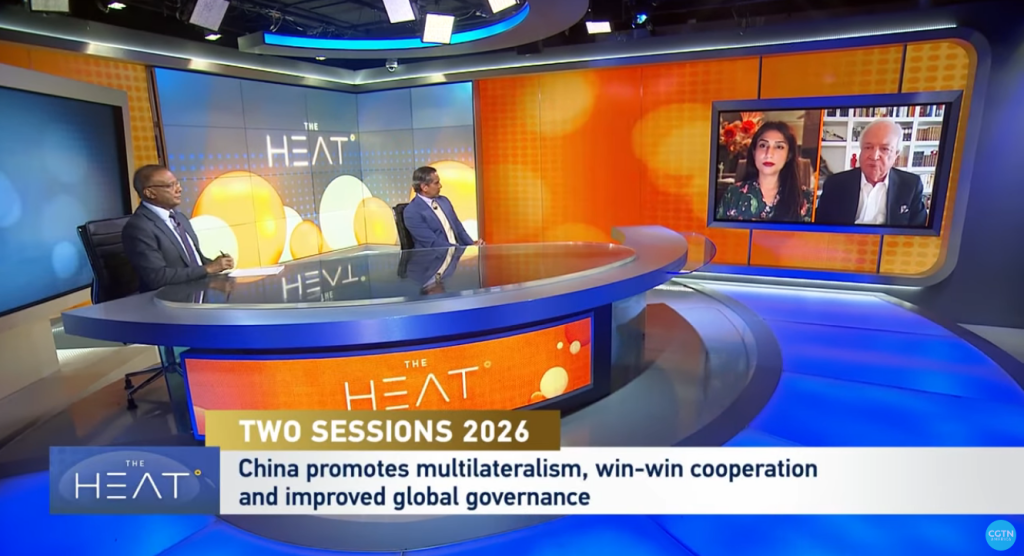
On Monday, March 9, 2026, Senior Fellow Sourabh Gupta was interviewed by CGTN’s America’s The Heat on China’s Two Sessions and foreign policy in 2026.
On Monday, March 2, 2026, Senior Fellow Sourabh Gupta was quoted by the South China Morning Post on Iran strikes, implications for Trump-Xi summit.