
ICAS Trade ‘n Tech Dispatch (online ISSN 2837-3863, print ISSN 2837-3855) is published about every two weeks throughout the year at 1919 M St NW, Suite 310, Washington, DC 20036.
The online version of ICAS Trade ‘n Tech Dispatch can be found at chinaus-icas.org/icas-trade-technology-program/tnt-dispatch/.
In One Sentence
Mark the Essentials
Keeping an Eye On…
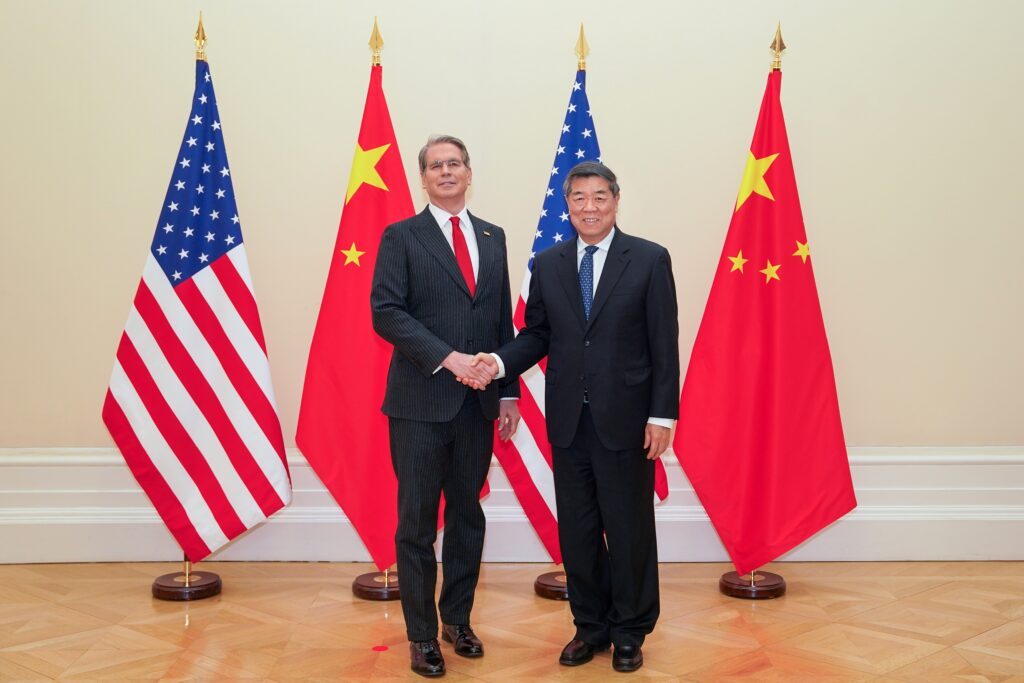
The intense focus on ‘deliverables’ in Paris is understandable and important. The two sides’ reciprocal commitments that were locked down during the Trump-Xi Busan meeting in November 2025 need to be preserved, extended and widened. That being said, it is more useful perhaps to focus at this time on dispelling certain new worries that have crept in since the Supreme Court’s voiding of Trump’s IEEPA-based tariffs on February 20th. Does the ruling change Washington’s leverage or goals in the Paris talks and beyond on tariff arrangements with China? Do the new USTR-led investigations that have been initiated under fresh authorities (Section 301, Section 232) and towards which China raised strong objections in Paris, amount to a major shift in strategy? And will the Court’s ruling have a material impact on the kind of practical arrangements that are doable on the supply chains or critical minerals front?
The short answer to all three questions is a big NO.
First, on the issue of leverage, there has been little to no material change at all. The IEEPA-based trafficking tariffs had already been halved to 10%. The threat of IEEPA-based Russia and Iran secondary tariffs notwithstanding, they were never imposed on China. Regarding the IEEPA-based reciprocal tariffs, both sides had suspended their tit-for-tat levy except for a 10% component, and which the U.S. has now temporarily re-imposed via the Section 122 workaround. More to the point, the purpose of the tariffs was to lay the ground for a leverage-based conversation, and that conversation has now produced an accommodation over six rounds of talks. With a loose consensus already on the table, the leverage – or lack of – stemming from the Supreme Court’s decision is somewhat immaterial to the U.S.-China trade and tech. conversation.
Second, regarding the new USTR-led investigations, again, they do not amount to a major U.S. policy shift, although it may be a big one for Trump personally since he hoped – wrongly as it turned out – that he could deploy IEEPA tariffs flexibly on a whim. U.S. administrations have long imposed Section 301 and 232 tariffs, including the previous Trump and Biden administrations. It was all along understood that if/once the Supreme Court overruled the IEEPA-based tariffs, the administration would use authorities under Section 122, 232, 301 and even perhaps 338 to carry the same workload and reimpose tariffs at roughly similar levels. So long as the reimposed tariffs under these new authorities do not bust through the current reciprocal tariff ceilings as well as remain in part suspended, as most of the IEEPA-based tariffs were, the investigations do not fundamentally alter the bottom line. The Section 122 tariffs have already been imposed and the new Section 301 tariffs, based on ‘excess capacity’ and ‘forced labor’ pretenses, could be announced in less than three months. Governments will no doubt protest pro forma. But so long as the final tariff playbook looks similar to the pre-February 20th level, both sides will figure out a way to move forward on this basis.
Finally, the Court’s ruling will have no material impact on the type of arrangements, or underlying leverage, on the critical minerals front. China’s threat of blockage of critical minerals flows in late-September had been occasioned by the ‘50% Affiliates (export control) Rule’ that the Commerce Department had rolled out under the framework of IEEPA. The U.S. Commerce Department could hence always reimpose that rule if it wishes to (and China will, no doubt, take the necessary countermeasures). The Court had stricken down just the executive tariff powers under IEEPA; the export control, asset freezes and property blocking powers remain entirely intact. As such, the question of leverage, or lack of, does not arise. Again, the larger point to note is that the truce that the two sides had worked out in Busan in November 2025 (a stay on major export controls as well as on additional tariffs in exchange for business-as-usual flows of critical minerals) needs to be extended out beyond the one-year November 2026 timeline.
U.S.-China trade and tech ties are, unusually, at a somewhat stable juncture. The stability could yet be fleeting. When Mr. Trump gets to Beijing later this spring or summer, the two sides must resolve to lock down the prevailing state of play on tech. and tariffs through the rest of the president’s term.
Expanded Reading
In One Sentence
Mark the Essentials
Keeping an Eye On…
First, call it a case of questionable timing. Just earlier this January, the U.S.’ Inflation Reduction Act was raked over the coals at the WTO dispute settlement body (DSB) with the constituted panel ruling that the IRA tax credits amounted to an illegal subsidy – contingent as their disbursals were on the use of domestic over imported goods, among other legal infirmities. The IAA’s disbursal criteria, including local content requirements and European preference for certain procurement schemes, are just as legally questionable – shielded as they claim to be behind the veil of the WTO’s Government Procurement Agreement as well as GATT Article XXIV which allows member states to depart from the ‘most favored nation’ principle in case of preferential trade agreements. The Commission’s proposal to selectively expand the IAA’s preferences to a free trade partner or one that opens its procurement market to the EU – and thereby circumvent the WTO Subsidies and Countervailing Measures Agreement (SCM) Agreement’s local content proscriptions – is not likely to cut ice with a WTO panel. And given that the EU is a party to the Multi-Party Interim Appeal Arbitration (MPIA) Arrangement, the stand-in body for the WTO DSB’s Appellate Body, the EU will not be able to simply kick this matter into the long grass. It may well have to walk back its potentially non-compliant measures.
Second, call it a case of the shoe being on the other foot. The EU had persistently for some time badgered Beijing about the latter’s coerced technology transfer requirements as a condition for approving European inward investments. Technology transfer requirements and similar such performance criteria are, to be clear, disallowed under WTO rules (although the Europeans never quite came around to bringing a case against Beijing at the WTO for reasons best known to themselves). The OECD, too, was pressed into service to spit out high-minded treatises on the inadmissibility of technology transfers. How curious then that the IAA now compels foreign (read Chinese) investors to license IP rights and share know-how to benefit its targeted EU partner, as one among a number of conditions for investment, and that the EU entity must exclusively own such IP rights and know-how it develops. The Commission also arrogates a “European preference” to EU businesses engaged in decarbonization-linked cement or steel production, using procurement or subsidy conditions, to create a “lead market” for such low-carbon content products. That’s perfectly noble and fine. The problem though is the Commission never displayed such indulgence or sympathetic understanding when China had sought to create a “lead market” for its own electric vehicles by way of production and consumer subsidies – though, admittedly, subsidies on a gargantuan scale.
Be that as it may, the Commission’s proposed Industrial Accelerator Act (IAA) is still in the early stages of consideration within the European bureaucratic sausage-making process. The European Council as well as the Parliament will get to weigh-in, potentially foreshadowing complex deliberations ahead. Perhaps, if the European Council, Member States and the Parliament had taken a more forthcoming approach towards the now-stillborn Comprehensive Agreement on Investment (CAI) with China back in the early 2020s, the EU may never have had to get into the sort of preferences and subsidy rat-race that it finds itself mired in now with Beijing.
Expanded Reading
Legislative Developments
Hearings and Statements
Expanded Reading