
ICAS Trade ‘n Tech Dispatch (online ISSN 2837-3863, print ISSN 2837-3855) is published about every two weeks throughout the year at 1919 M St NW, Suite 310, Washington, DC 20036.
The online version of ICAS Trade ‘n Tech Dispatch can be found at chinaus-icas.org/icas-trade-technology-program/tnt-dispatch/.
Issues of the dispatch will occasionally include a closer perspective on a specific issue in the Trade and Technology domain. Spotlights will provide necessary background information, seminal current events, and close analysis with key takeaways via a single author.
In One Sentence
Mark the Essentials
Expanded Reading
Joe Biden Forging Ahead With Efforts To Counter China As Donald Trump, Election Loom Large, South China Morning Post, June 24, 2024
US to keep tariffs on USMCA countries, issues with Canada ‘significant’, Greer says, Reuters, May 26, 2026
Streaming tax clouds USMCA review, Politico, May 26, 2025
Major EU countries push for tougher China policy ahead of Brussels debate, SCMP, May 25, 2026
5 EU countries call for tougher trade weapons to tackle China, Politico, May 25, 2026
First USMCA negotiations to focus on content rules, economic security, Greer says, Reuters, May 22, 2026
Trump is trying to get permanent trade war powers, The Hill, May 21, 2026
Businesses starting to receive their IEEPA tariff refunds, CBS News, May 14, 2026
Legislative Developments
Hearings and Statements
Expanded Reading
Brown Introduces Legislation To Reinstate Trade Adjustment Assistance, Office Of Sen. Sherrod Brown (D-Oh), June 18, 2024
Baldwin Leads Colleagues Urging Trump Admin to Keep American Workers at Center of U.S.-Mexico-Canada Trade Negotiations, May 20, 2026
Ricketts Introduces MARKET Act to Protect Agriculture Exports from Communist China, Office of Pete Ricketts (R-NE), May 19, 2026
Congressman Bean Launches Foreign Trade Zone Caucus, Office of Aaron Bean (R-FL), May 19, 2026
Ways and Means Democrats Lay Out Priorities in Upcoming USMCA Review, Ways and Means Committee, May 18, 2026
Wyden and Markey Press Trump Administration on Failure to Aid Small Businesses Hammered by Illegal Tariffs; Without Help from SBA, Importers Relied on Predatory Loans to Stay Afloat, Senate Committee on Finance, May 15, 2026
Congressman Carter, Higgins Request Section 301 Investigation into Unfair Seafood Trade Practices Harming American Fishermen, Office of Troy Carter (D-LA) , May 13, 2026
Moolenaar and Dingell Introduce Legislation That Would Ban Chinese Vehicles from U.S. Roads, China Select Committee, May 11, 2026
Congressman Brad Sherman Introduces Bill to Halt U.S. Oil Exports, Shield Americans from Price Spikes Amid Iran War, Office of Brad Sherman (D-CA) , May 7, 2026
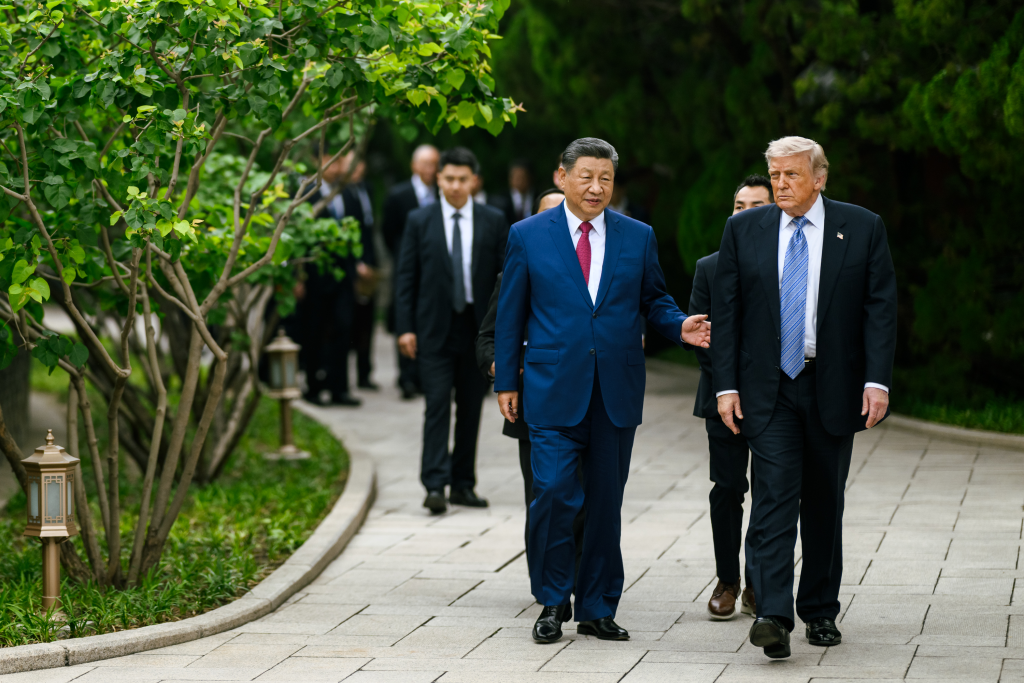
On May 13–15, eight and a half years after his first “state-plus” visit to Beijing, President Donald Trump paid a lower-key state visit to China. The two presidents reached consensus on several issues, the most notable of which was the reframing of their bilateral relationship as one of “constructive strategic stability” based on “fairness and reciprocity.” For Xi, the framing signals a more conducive environment for China’s modernization goals. For Trump, it signals a more balanced economic and trade relationship that advances U.S. business interests. The two leaders also announced a range of outcomes on trade and investment, including several deal commitments, and addressed a number of pressing geopolitical matters.
The two sides will charter a Board and Trade and a Board of Investment. The Board of Trade will provide a framework to manage bilateral trade in “non-sensitive” items, particularly by identifying products for mutual and equal tariff reduction and exemptions. Approximately $30 billion of each side’s identified exports will initially be subject to the MFN rate rather than current elevated rates, with further reductions and exemptions expected once agreed upon. The U.S. Trade Representative is expected to issue a Federal Register notice on this soon.
The Board of Investment will provide a framework for discussing investment issues, particularly Chinese investment plans in the U.S. Since the aim is to invite selective industrial investment into the U.S., discussions would need to be limited to areas outside the heightened CFIUS investment screening criteria. It bears noting that under Trump’s America First Investment Policy of February 2025, PRC-affiliated persons are restricted from investing in advanced technology, critical infrastructure, agriculture, energy, raw materials, and other strategic sectors.
The two sides are to promote a modest expansion of agricultural trade. China will purchase at least $17 billion worth of a broad range of U.S. agricultural exports annually in 2026, 2027, and 2028, while also honoring its November 2025 commitment to purchase at least 25 million metric tons of soybeans annually through those same years. These figures reflect predictability rather than a significant increase in purchases. U.S. agricultural exports to China have typically averaged between $25–30 billion annually during 2012–24, with soybeans accounting for nearly half of overall agricultural exports and averaging $13 billion in sales per year. With the $17 billion annual purchase commitment, overall U.S. agricultural exports to China should now reliably reach the $30–35 billion range. The U.S., meanwhile, is expected to prioritize imports of Chinese dairy products, seafood, fruits, and other specialty goods.
The two sides are to resolve several non-tariff barriers related to agricultural trade. On China’s side, this includes resuming poultry imports from U.S. states certified by the USDA as free from highly pathogenic avian influenza, and restoring market access for a number of U.S.-owned beef facilities. Five-year registrations for 425 beef facilities that had lapsed last year have been renewed, and 77 new facilities have been added to the approved list. The lapse had driven down beef exports from $1.98 billion in 2024 to $977 million in 2025. On the U.S. side, longstanding concerns — some dating back more than a decade — related to Chinese dairy and seafood products are to be addressed, and Shandong province is to be recognized as free from highly pathogenic avian influenza.
The two sides are to reciprocally deepen their procurement of aircrafts and engines. China has approved an initial purchase of 200 Boeing aircraft, the first purchase commitment since 2017, with the possibility of purchase of up to 750 jets. U.S. has committed to continued sale of GE and Safran’s LEAP-1C engine for COMAC’s narrowbody C919 passenger aircraft. China, interestingly, has tied the scaling up of the Boeing aircraft purchases to supply guarantees for the engines and parts.
In addition, China agreed to address U.S. supply chain shortages of specialty rare earths used in the defense, aerospace, and semiconductor sectors, as well as concerns about its restrictions on rare earth production and processing equipment and technologies. Given the defense applications of some of these rare earths, the Chinese readout is more guarded, noting that the two sides “will jointly study and resolve each other’s reasonable and legitimate concerns.”
The broader topic of export controls was not taken up in Beijing. Earlier this year, the U.S. Commerce Department issued a final rule establishing a more favorable license review policy for exports of certain advanced chips to China, including NVIDIA’s H200 and AMD’s MI325X. A subset of Chinese companies have been approved by Chinese authorities to purchase these chips.
On the energy front, four U.S. LNG cargoes are reportedly en route to China for June delivery — the first direct shipments during Trump’s second term. China’s implementation of its energy purchase commitments under the Phase One Trade Agreement of January 2020 had been a sore point during the first Trump administration. There was skepticism about China’s ability to meet those targets, as well as about its longer-term intentions in this sector. China, for its part, had raised concerns about the inadequacy of crude oil transportation infrastructure at U.S. Gulf of Mexico ports — specifically, the inability to accommodate very large crude carriers (VLCCs) — which added to transport costs.
The two sides will continue honoring the terms of their Joint Arrangement on Economics and Trade (Busan Consensus) with the aim of extending the arrangement beyond its November 10, 2026 deadline. That arrangement suspended: (a) the U.S.’ 24% reciprocal tariff and China’s equivalent countermeasure; (b) the U.S. 50% Affiliates Export Control Rule and China’s sweeping rare earths export control measures of October 9, 2025; and (c) their reciprocal investigations into the maritime, logistics, and shipbuilding industries. U.S. tariff levels are also to be kept at or below the Busan Consensus levels, as the IEEPA-based tariffs are replaced with new Section 301 tariffs.
The U.S. and China will establish a formal dialogue on artificial intelligence (AI), with the aim of developing a protocol on best security practices to prevent misuse of AI models by non-state actors. The dialogue is expected to focus on national security considerations rather than the ethics, transparency, and safety issues that shaped the two countries’ first intergovernmental AI meeting in Geneva in May 2024. A first session is expected within the next six weeks.
On Iran, both sides agreed that Iran must not be allowed to possess a nuclear weapon, that navigational freedoms must be restored in the Strait of Hormuz, and that tolls cannot be levied. China also committed not to sell weapons systems during the ongoing Middle East emergency. China’s support for the U.S. position, however, is tied to an end to hostilities and a permanent, comprehensive ceasefire — a condition closer to the Iranian position.
China also pushed to have the Treasury Department’s April 24 sanctions on five Chinese refiners, which handle Iranian crude, lifted. On May 2, MOFCOM invoked its 2021 Blocking Rules for the first time, directing Chinese entities including state banks to disregard the Treasury Department’s sanctions. Privately, however, MOFCOM advised banks to refrain from extending new loans to these refiners in the near term, to limit their exposure to U.S. secondary sanctions. While the administration’s response remains unclear — Trump himself noted he was considering the matter — it is worth noting that the U.S. has agreed in principle, in its most recent communications with Iran, to waive Treasury’s Iran oil sanctions for the duration of negotiations.
On the Korean Peninsula, in an important gesture toward the U.S., President Xi confirmed their “shared goal to denuclearize North Korea.” To be clear, a denuclearized Korean Peninsula has long been China’s stated position. But over the past two years or so — ever since Kim Jong-un secured new military technology and security assurances from Moscow following North Korean losses in Kursk — China has quietly downplayed sanctions and denuclearization in its official statements, increasingly treating Pyongyang’s nuclear status as a fait accompli. To secure Kim’s attendance at the WWII 80th anniversary commemorations last September, the nuclear issue was kept off the Xi-Kim agenda as well. This gesture toward the U.S. is unlikely, however, to translate into meaningful additional pressure on North Korea to denuclearize.
On a related note, President Xi is expected to travel to Pyongyang in the coming weeks, potentially laying the groundwork for a subsequent Trump-Kim Jong-un meeting. In January 2019, Kim visited Xi in Beijing after Trump asked Xi on the sidelines of the December 2018 G20 summit in Buenos Aires to help facilitate a meeting with the North Korean leader. That Xi-Kim Beijing meeting laid the groundwork for the subsequent Trump-Kim meeting in Hanoi in February 2019.
The U.S. and China also exchanged views and reiterated their positions on Taiwan, and held detailed discussions on the administration’s controversial arms sales package. The future status of the arms sales package remains an open question. While the package — a massive one featuring advanced command and control systems, surface-to-air missiles, radars, and counter-drone capabilities — is currently being held “in abeyance,” it is unlikely to serve as a “very good negotiating chip” vis-à-vis Beijing. For one, doing so would violate the U.S.’ own One China Policy, which prohibits linking Taiwan arms sales to negotiations with Beijing. Second, it would establish an unprecedented linkage between arms sales and commercial or political matters in the context of cross-strait relations. On the other hand, a presidential endorsement of a high-profile arms package to Taiwan could severely disrupt plans for Xi’s high-stakes White House visit on September 24. Trump is clearly in a difficult position, and his response — whichever way it goes — will reveal much about his China priorities.