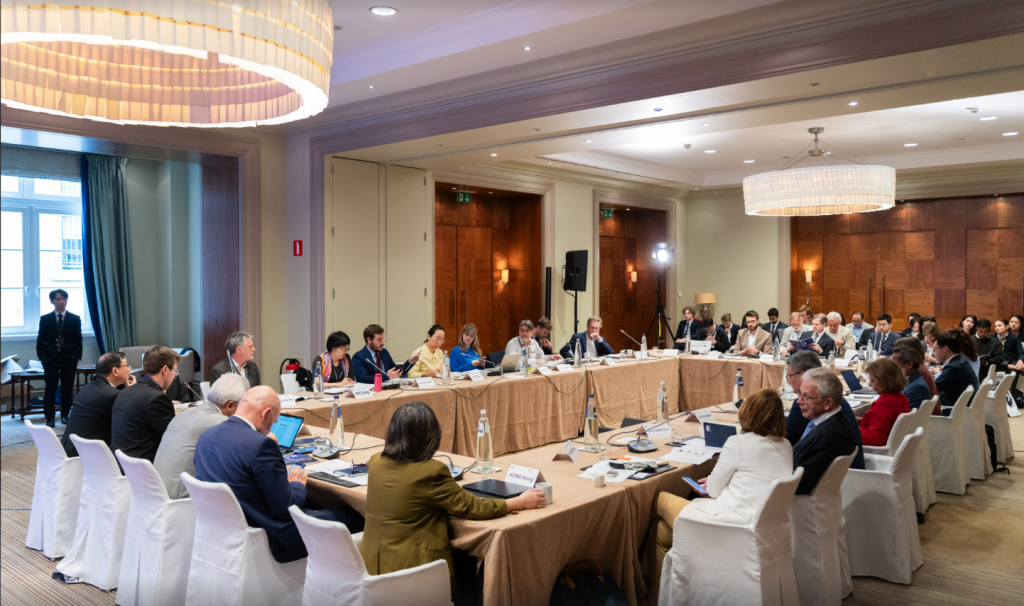
On June 10–11, 2026, the Institute for China-America Studies (ICAS) co-hosted the “EU-China Relations in an Era of Great Power Competition and Global Order Reconfiguration” conference in Brussels, Belgium with the Institute for China-Europe Studies (ICES), the National Institute for South China Sea Studies (NISCSS), and the Institute for Security & Development Policy (ISDP). The event brought together policymakers, diplomats, and scholars from Europe, China, and the United States to discuss the future of EU-China relations in a rapidly changing international environment.
The conference opened with remarks from Yang Li, Executive Director of ICES; Dr. Wu Shicun, Chairman of ICAS’ Advisory Board and the chairman of Huayang Institute for Research on Maritime Cooperation and Ocean Governance; and Joanna Szychowska, Director for Asia, Services and Investment, Digital Trade, Intellectual Property and Public Procurement at the European Commission’s DG Trade.
The first panel, “Beyond De-risking: Toward a Resilient Framework for EU-China Economic Relations,” examined the growing prominence of economic security in both Europe and China. Participants discussed the challenges posed by regulatory measures, investment screening mechanisms, industrial policy initiatives, and broader debates over de-risking, competitiveness, and market access. Speakers also explored how both sides could maintain stable economic engagement while managing concerns. Some speakers argued that growing economic interdependence should be viewed as a source of resilience and shared prosperity rather than as a vulnerability to be weaponized, while others emphasized the value of technological cooperation and co-development in addressing common challenges.
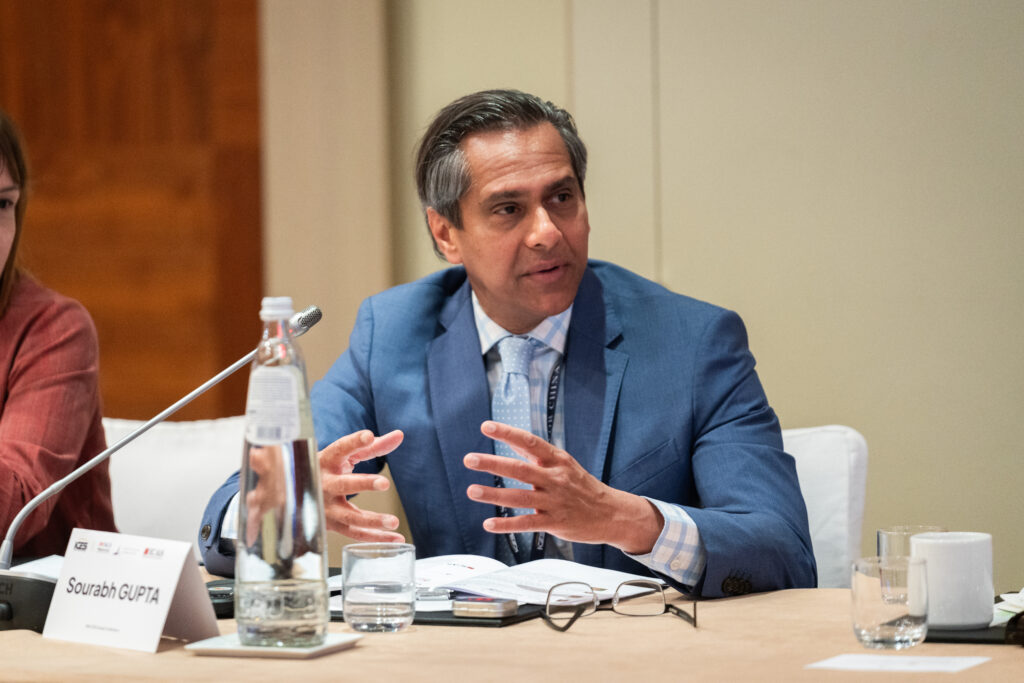
ICAS Senior Fellow Sourabh Gupta moderated the second panel, “The Third Variable: Dynamics and Trade-offs of EU-China-US Relations.” The discussion explored how relations among China, the European Union, and the United States increasingly shape one another amid intensifying great power competition. Participants considered the implications of evolving U.S. policies, debates surrounding strategic autonomy and multipolarity, and the challenges of balancing economic, political, and security interests in a shifting international order. Several speakers emphasized the importance of maintaining channels for dialogue and avoiding the securitization of issues that may be better addressed through pragmatic cooperation.
The luncheon discussion featured H.E. Fei Shengchao, Ambassador of the People’s Republic of China to the Kingdom of Belgium, and Dr. Fabian Zuleeg, Chief Executive and Chief Economist of the European Policy Centre (EPC). Their remarks focused on the broader trajectory of EU-China relations on security, trade, and economy, and the role of dialogue in managing differences amid growing geopolitical uncertainty.
ICAS Executive Director Dr. Nong Hong participated as a speaker in the third panel “Shared Horizons: Managing EU-China Ties through Ocean Stewardship.” Her remarks focused on Chinese and European interests and policies in the Arctic, as well as potential areas for future cooperation. The panel also examined maritime governance issues ranging from the Arctic to the South China Sea and the Strait of Hormuz. Participants discussed opportunities for cooperation in areas such as ocean governance, environmental protection, and maritime transportation, while also addressing differing perspectives on regional security issues and freedom of navigation. Several speakers highlighted the potential for practical cooperation despite broader strategic disagreements. Discussions also touched on the prospects for collaboration in areas including maritime sustainability and shipping decarbonization.
The final panel, “Framing the Future: How Narratives Define the EU-China Dialogue,” examined how concepts such as economic security, strategic autonomy, openness, and cooperation are interpreted differently in Europe and China. Participants discussed how public narratives influence policymaking and explored ways to improve mutual understanding and communication between the two sides.