

The Northwest Passage is a series of Arctic sea routes that connect the Atlantic and Pacific Oceans through the Canadian Arctic Archipelago. As climate change reduces sea ice and lengthens the summer navigation season, the route has attracted renewed attention as a potentially shorter alternative for certain trans-Arctic voyages. The Northwest Passage is also closely connected with Canada’s northern infrastructure and critical mineral development. If ports, roads, and related corridors are built, the route may help link Canada’s Arctic coastline with inland resource regions, including areas with significant critical mineral potential. With future traffic expected to increase, the Northwest Passage could become part of a regional Arctic logistics system supporting mineral exports and broader strategic access for Canada and its allies.
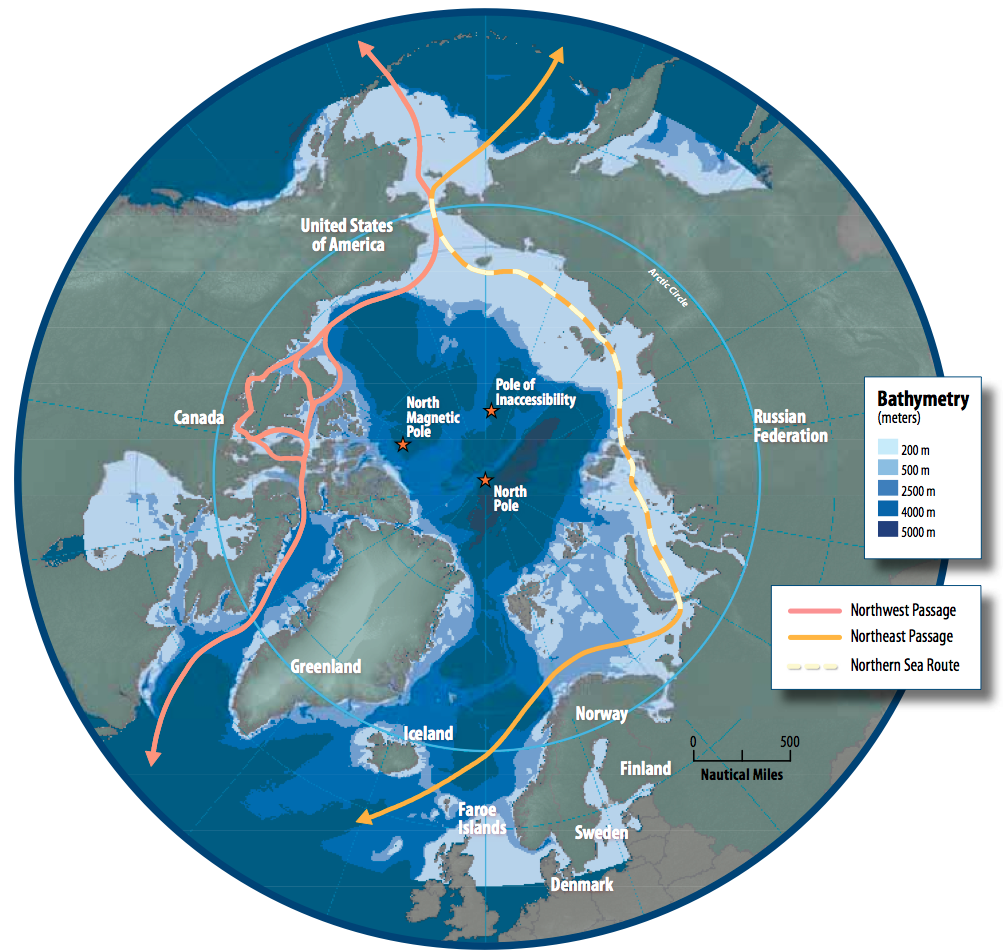
A recent Canadian infrastructure push has brought the Northwest Passage back into the spotlight. Recently, Canada announced a funding of C$50 million for planning and preconstruction work on the Grays Bay Road and Port project in Nunavut. The project includes a proposed deepwater Arctic port at Grays Bay and an approximately 230-kilometer all-season road connecting the port southward toward the Nunavut–Northwest Territories border. It is designed to support northern communities, improve transport reliability from inland to the Arctic, and unlock critical mineral development in the Kitikmeot region.
The maritime significance of the project lies in its attempt to connect land-based mineral development with Arctic sea access. Grays Bay is located in the central Canadian Arctic, near the Northwest Passage, and has often been discussed as a potential gateway between the Canadian North, Arctic shipping routes, and broader North American transport systems. If linked with related corridor proposals, including the Slave Geological Province Corridor and the broader Arctic Economic and Security Corridor concept, the project could eventually help connect the Northwest Passage to the North American highway network.
That makes the project important from two perspectives. From a shipping perspective, an Arctic deepwater is essential if northern routes are to become more than seasonal lines on a map. From a critical minerals perspective, Canada’s northern regions contain critical mineral resources that could support clean energy technologies, large-scale energy storage, and defense supply chains. Without infrastructure, however, those resources remain difficult and expensive to bring to market. Grays Bay therefore links two critical topics that are often treated separately: the future of Arctic shipping and the search for secure critical mineral supply chains. It suggests that the Northwest Passage’s near-term relevance may come less from container shipping and more from regional resource logistics.
The larger significance of this development is that critical minerals may give the Northwest Passage a more concrete economic and strategic purpose. For years, debates about the Northwest Passage have often focused on whether melting ice could turn it into a major global shortcut. Realistically, however, the route is unlikely to become a new Suez Canal anytime soon. Its more plausible future is as a part of a regional Arctic shipping system that plays an especially important role in specific sectors, and critical minerals may become one of the most important of those sectors. This future development potential enhances both the economic and strategic value of Canada’s infrastructure development project.
Meanwhile, there is also a climate governance paradox that is worth noticing. The clean energy transition requires large quantities of critical minerals, and developing new sources could support decarbonization and supply-chain resilience. At the same time, expanding Arctic ports, roads, mining projects, and shipping activity would inevitably bring new environmental pressures to one of the world’s most fragile regions. More vessels could mean higher black carbon emissions, underwater noise, greater accident risks, and possible pollution in areas where search-and-rescue and emergency response capacity remain limited. Infrastructure development also raises questions about Indigenous rights, local consent, and whether northern communities will meaningfully share in the benefits of projects built across their lands and waters. Managing these concerns will be a governance challenge for the Canadian government as the project moves forward.
Geostrategic consideration brings another layer of complexity to this issue. Following the war in Ukraine, the West is hoping for the Northwest Passage to become a more reliable corridor as opposed to the Russian Northern Sea Route. However, unlike the Northern Sea Route—which runs primarily along Russia’s northern coast and has been actively promoted by Moscow for greater international cooperation—Canada considers parts of the Northwest Passage its internal water, while the United States has traditionally viewed it as an international strait. The unresolved legal and political debates are likely to further develop as the United States and its allies seek more secure critical mineral supply chains and may increasingly see Canadian Arctic infrastructure as part of the West’s broader effort to reduce reliance on China-linked processing and supply networks.
That said, the governance and international participation of the Northwest Passage may take years to become a major headline or headache as it is still far from becoming a reliable transportation corridor for now. It continues to face major constraints, including sea ice, limited port infrastructure, and environmental risks. Its future will depend not only on Canada’s infrastructure development, but also on how Canada balances climate protection, pollution control, Indigenous rights, and maritime safety. Because of its strategic value, the route may also become a growing focus of international competition.
This Spotlight was originally released with Volume 5, Issue 6 of the ICAS MAP Handbill, published on June 30, 2026.
This issue’s Spotlight was written by Zhangchen Wang, ICAS Research Associate.

Maritime Affairs Program Spotlights are a short-form written background and analysis of a specific issue related to maritime affairs, which changes with each issue. The goal of the Spotlight is to help our readers quickly and accurately understand the basic background of a vital topic in maritime affairs and how that topic relates to ongoing developments today.
There is a new Spotlight released with each issue of the ICAS Maritime Affairs Program (MAP) Handbill – a regular newsletter released the last Tuesday of every month that highlights the major news stories, research products, analyses, and events occurring in or with regard to the global maritime domain during the past month.
ICAS Maritime Affairs Handbill (online ISSN 2837-3901, print ISSN 2837-3871) is published the last Tuesday of the month throughout the year at 1919 M St NW, Suite 310, Washington, DC 20036.
The online version of ICAS Maritime Affairs Handbill can be found at chinaus-icas.org/icas-maritime-affairs-program/map-handbill/.