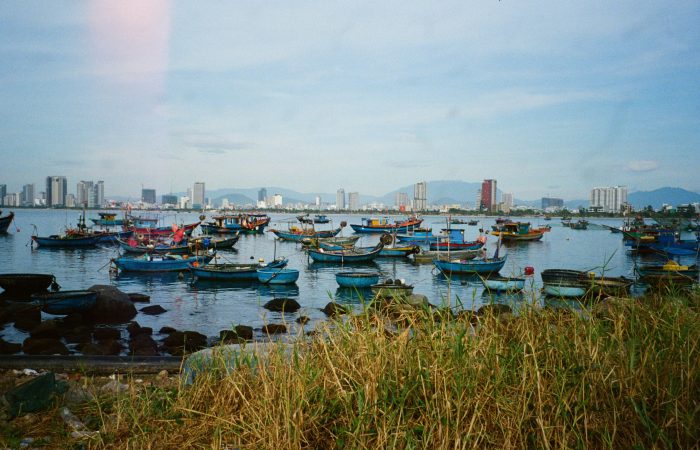
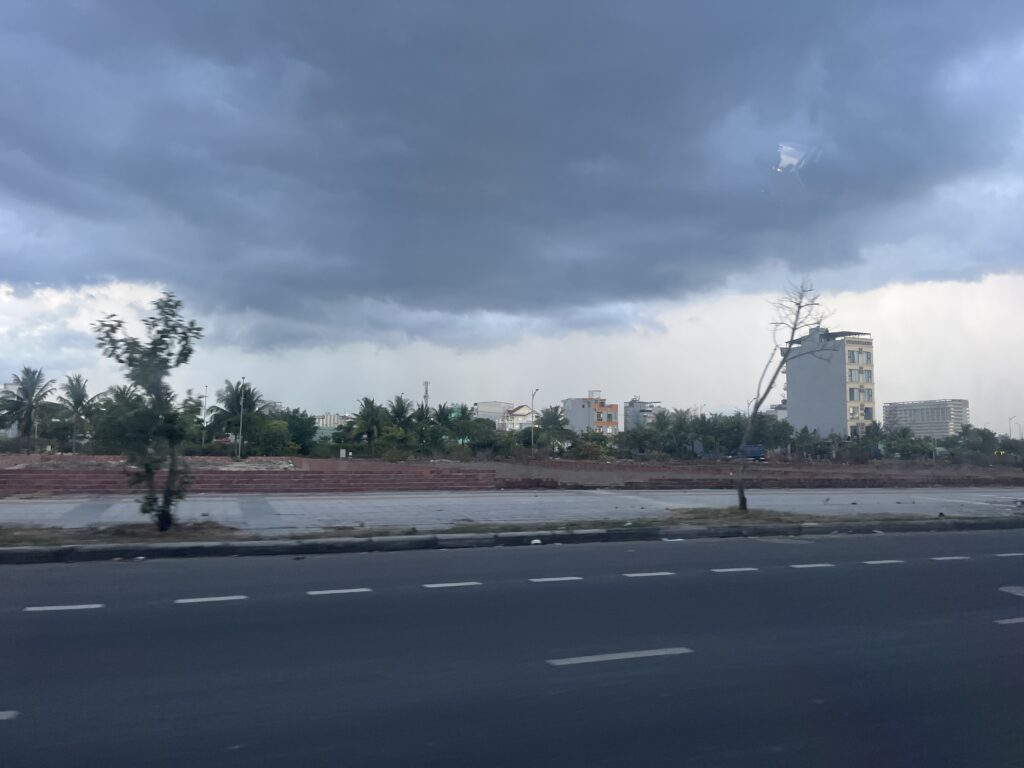
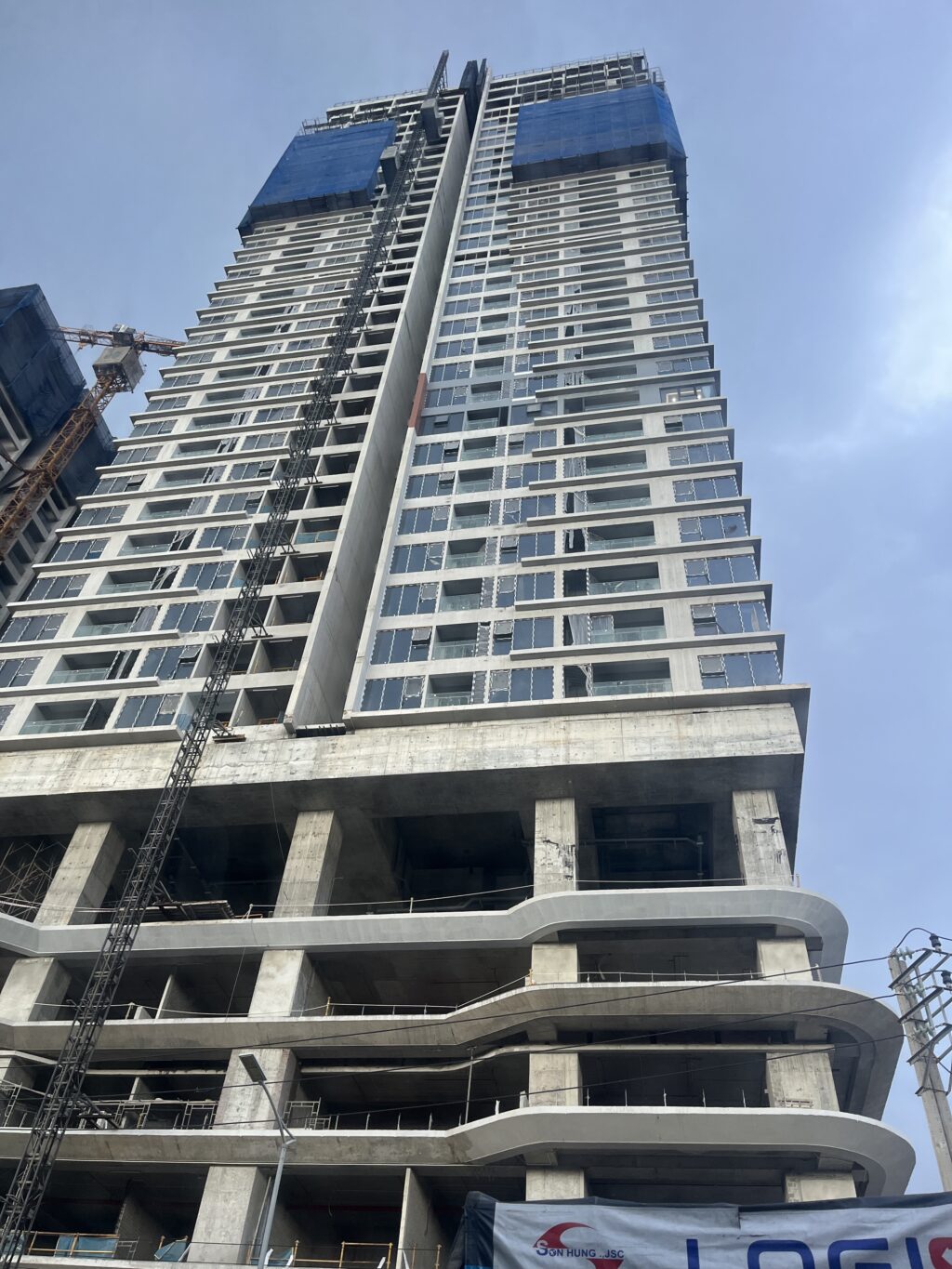
From the sleepy corners of the cove where boats lie in waiting, to the strip lauded as ‘Vietnam’s Miami’, there is a notable absence in Da Nang. Large swaths of land remain undeveloped, buildings unfinished, construction stalled, with cranes rusting on the sidelines. The attractions that stand completed are vying for a specific type of customer: Chinese gamblers.
Restricted from gambling at home, many Chinese travel to Da Nang to scratch their itch. Due to this influx, many businesses opened specifically targeting Chinese tourists such as Chinese grocery stores, restaurants, and Chinese-speaking hotels. However, the lay of the land changed, and now many plots sit empty, littering the southern shores with parcels of dust and leftover concrete. The businesses that remain open are changing their appearance; instead of simplified Chinese, they now are converting signage to Korean hangul.
Some attribute the decay in the skyline to issues that have plagued Vietnam for the last few years, such as overbuilding and aggressive real estate expansion sputtering out before construction is through. Similar to China, Vietnam finances much residential real estate through pre-sales, some of which are never completed. Multiple property developer CEOs were indicted for market manipulation or defrauding investors, ultimately resulting in a stock market plunge in 2021. Others claim it was simply a byproduct of tourism ceasing during pandemic years, domestically exacerbated by the Evergrande crisis which caused sharp reductions in Chinese international travel. Yet, a tour guide specified it’s a microcosm of a lingering visa policy and compounding maritime debacles from over a decade ago.
New Passports Bring New Problems
Beginning in 2012, China began issuing passports containing a map that showed the nine-dash line in the South China Sea, including the Paracel Islands and other areas also claimed by neighboring countries. Vietnam stopped stamping visas directly into the passports and instead issued visas on separate sheets of paper to avoid any implication of recognizing the map. However, the impact of this policy and subsequent rows in the South China Sea are not restricted to tourism. Chinese investors seeking to establish an enterprise in Vietnam must register and obtain documents notarized by Vietnamese notaries, who for a brief period of time, refused to authorize the documents of anyone using the new Chinese passport.
Anti-China sentiment has periodically surfaced in Vietnam, particularly during periods of heightened tension in the South China Sea. In 2015, an investigation found 71 Vietnamese had facilitated the illegal purchase of 137 lots of land along the coast to Chinese buyers. The 2014 oil rig crisis threatened business in Vietnam as well. When China deployed the Haiyang Shiyou 981 drilling platform in waters near the disputed Paracel Islands, an area subject to overlapping Chinese and Vietnamese claims, protests erupted in Vietnam. Riots tore through industrial parks and factories believed to be Chinese-owned were burned, ultimately leaving hundreds injured and 21 dead. Beijing evacuated thousands of Chinese nationals, and Vietnamese authorities moved quickly to compensate affected businesses. Investment flows resumed within the year, a pattern that has more or less repeated after every subsequent flare-up in the South China Sea.
China ranked as the second-largest source of newly licensed foreign projects in Vietnam through the first three quarters of 2025. Manufacturing absorbed the overwhelming share of that money, not casinos or coastal resorts, but factories, electronics, and supporting industries. More recent figures suggest China’s relative position may already be softening. By early 2026, South Korea had overtaken China as Vietnam’s leading source of new investment. Modern Vietnam-South Korean relations were initially similarly strained, with Vietnam still holding out for formal recognition over civilian massacres and sexual violence perpetrated by South Korean troops during the Vietnam War. Nonetheless, South Korea has integrated itself into Vietnam’s manufacturing ecosystem, and in more varied areas such as real estate, retail, and consumer goods, with emphasis on cross-border training and education. It is a small window into a larger shift: the capital chasing Vietnam’s growth is diversifying, and the country that once anchored so much of Da Nang’s coastal development strategy is no longer assumed to be the default patron.
Gambling Blues
Taken together, perhaps the most obvious reason for the failure of industry to erupt from the casinos is the casinos themselves. If the FDI numbers show Chinese money flowing steadily into Vietnamese factories, the casino sector tells the opposite story. There are sustained losses despite years of construction. In Phu Quoc, the Corona Resort & Casino, the only venue in Vietnam authorized to admit local gamblers, has never turned a profit. Government figures cited by the Ministry of Finance show that between 2019 and 2024, Vietnamese nationals made up roughly 52 percent of all gamblers at the property but generated close to 88 percent of total casino revenue, meaning domestic players were spending far more per visit than the international clientele the resort had been designed to court.
Put the two trends side by side and Da Nang’s half-finished skyline starts to make more sense. The Chinese capital that has actually materialized in Vietnam between periods of unrest over the past decade went overwhelmingly into factories and supply chains, not into the casino resorts that were supposed to anchor the coast. Even worse, the casinos that did get built have spent years bleeding money regardless of who walks through the door. The Chinese gambling boom that Da Nang’s developers bet on was, in retrospect, a shakier proposition than the plethora of half-built towers implied. South Korea is now Da Nang’s single largest source of international arrivals. Unlike the Chinese casino traffic, the Korean wave is driven by price and convenience. At roughly a five hour flight and a fraction of the cost of other resort hotspots, Vietnam pulled in more Korean visitors last year than any other country in Southeast Asia.
It is little wonder, then, that the signage across Da Nang’s southern strip is being repainted in Korean hangul rather than restored in simplified Chinese. Anti-Chinese sentiment over the South China Sea induces cyclical turmoil among the residents of Vietnam, turning the coast into an increasingly important battleground. The businesses on the ground that survive tend to follow the money that’s consistent and reliable, and for now, that money is arriving from Seoul, Busan, and Incheon rather than from across the northern border.