
ICAS Trade ‘n Tech Dispatch (online ISSN 2837-3863, print ISSN 2837-3855) is published about every two weeks throughout the year at 1919 M St NW, Suite 310, Washington, DC 20036.
The online version of ICAS Trade ‘n Tech Dispatch can be found at chinaus-icas.org/icas-trade-technology-program/tnt-dispatch/.
In quick succession, the second Trump administration has launched a volley of tariffs against pharmaceutical imports. On April 2, President Trump announced a baseline tariff of 100% on a subset of patented pharmaceuticals and pharma ingredients (along with a host of exceptions), following a Section 232 investigation of the sector. That announcement was followed up by a post on X on July 21, threatening to impose a 100% tariff on generics imports, starting August 1, 2028. The tariffs double on August 1, 2029. Alongside, there have been important initial steps taken to decouple pharmaceuticals and biotech supply chains from China…
In One Sentence
Mark the Essentials
Expanded Reading
Legislative Developments
Hearings and Statements
Expanded Reading
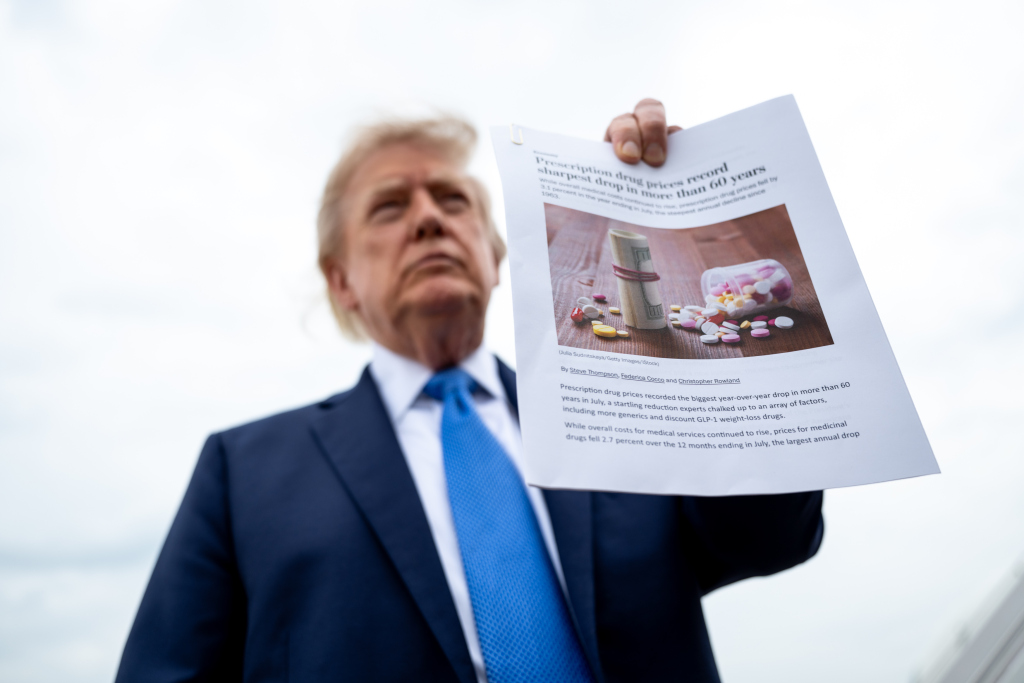
In quick succession, the second Trump administration has launched a volley of tariffs against pharmaceutical imports. On April 2, President Trump announced a baseline tariff of 100% on a subset of patented pharmaceuticals and pharma ingredients (along with a host of exceptions), following a Section 232 investigation of the sector. That announcement was followed up by a post on X on July 21, threatening to impose a 100% tariff on generics imports, starting August 1, 2028. The tariffs double on August 1, 2029. Alongside, there have been important initial steps taken to decouple pharmaceuticals and biotech supply chains from China, especially as the latter races up the rungs of the global drug supply chain from generics, to supply of active pharma ingredients (APIs), to outsourced biotech manufacturing, to drug discovery and development.
Generics account for roughly 90% of all prescriptions filled in the U.S. but only a fraction (12%) of total spending on prescription drugs. Profit margins are thin.
China’s large footprint in the U.S.’ generics supply chains is primarily upstream – producing approx. 40% of key starting materials (KSM) used in U.S.-approved APIs for small molecule drugs, as well as many key accompanying chemical inputs.
A tad lower down the supply chain, Chinese active pharmaceutical ingredients (APIs) account for approx. 25 to 30% of small molecule drug volumes sold in the U.S., after factoring in the U.S.’ indirect exposure via India. That said, China is moving into higher-value APIs, including as evidenced by its overtaking of India for the first time in two decades in API drug master file submissions to the Food and Drug Administration (FDA) in 2024.
China’s downstream footprint in terms of the U.S.’ exposure to final drug form (FDF) generics is small (3% for oral doses and 12% for injectables), and more-or-less non-existent for branded drugs. Europe, and Ireland in particular, is a big player in this branded segment.
Given the compressed margins, onshoring of the generics supply chain is, in principle, not a cost-effective proposition. In any case, if boosting local production is the goal, investment tax credit-based incentives using, say, the Defense Production Act (DPA) Loan Program as well as emergency stockpiling of the most critical medications, rather than resorting to deterrents such as tariffs, is the more appropriate means.
Given China’s significant upstream footprint, policies to onshore API production without complementary policies to onshore the auxiliary chemicals used for synthesis of APIs and intermediates will fail to derisk the supply chain.
Given the U.S.’ exposure to China is partly indirect (via India), sector-wide pharma tariffs on final drug form generics is a blunt – and perhaps even a counterproductive – tool that could lead, both, to drug availability shortages in the U.S. as well as New Delhi to double-down on price competitive Chinese APIs.
China-only tariffs could draw API production away from China but would need to be complemented with a diversified, friendshoring plan and friend-shored capabilities. Pharma tariffs today, in any case, are applied at the API production country rate (i.e., China being the “country of origin”) rather than the point of final manufacturing (India) in cases where there is no ‘substantial transformation’ downstream of the exported product.
June 2021: The Biden administration conducts an exhaustive 100-Day review of the pharma and API sector, stemming from its Supply Chain Executive Order of Feb. 2021. Other critical sectors reviewed are semiconductors, large capacity batteries, and critical minerals and materials.
September 2022: Jake Sullivan, Biden’s national security advisor, lists biotechnologies and biomanufacturing as one among three “force multiplier” families of technologies that would define the geopolitical landscape of the 21st century (the other two are computing related technologies and clean energy technologies).
March 2023: The Biden administration adds five subsidiaries of BGI, China’s market leader in genomics sequencing, to the Entity List.
January 2025: The Biden administration, in its waning days, adds BGI Genomics and MGI Tech to the Pentagon’s Section 1260H List of Chinese Military Companies.
April 2025: Trump initiates a Section 232 national security investigation on pharmaceuticals, pharma ingredients and related products, including on the concentration of imports from a small number of suppliers.
December 2025: Congress passes the U.S. Biosecure Act, which is folded into the FY2026 NDAA (Natl. Def. Authorization Act). Per the Biosecure Act, U.S. executive branch agencies are barred from procuring biotechnology equipment and services from a “biotechnology company of concern,” and pharma companies that engage with a “biotechnology company of concern” are barred too from U.S. federal government contracts. The Office of Management and Budget (OMB) is tasked with drawing up a list of “biotechnology compan[ies] of concern” by Dec. 2026 by including those that are either (a) placed on the Dept. of War’s Section 1260H Chinese Military Companies List and have a biotechnology nexus, or (b) are subject to the control or operate on behalf of a foreign adversary government (China, Russia, Iran, North Korea).
April 2026: Trump issues Proclamation 11020 announcing the results of the Section 232 investigation. The Proclamation imposes a baseline tariff of 100% on a subset of patented pharmaceuticals and ingredients only, along with a number of exemptions. These are:
June 2026: The Dept. of War adds WuXi AppTec. to its Section 1260H Chinese Military Companies List, thus warranting its designation as a “biotechnology company of concern,” per the U.S. Biosecure Act. At this time, WuXi AppTec. has challenged the referral and has been granted a preliminary injunction.
Adding Biotechnology to List of Sectors that would be Subject to Federal Outbound Investment Screening. In the FY2026 NDAA, Congress codified and expanded the Biden administration’s Outbound Investment Rule by adopting the Comprehensive Outbound Investment National Security (COINS) Act. The COINS Act prohibits or requires notification of certain direct outbound investments as well as financial transactions undertaken by U.S. persons with Chinese (and other “countries of concern”) entities in the semiconductor, quantum, AI, high-performance computing, and hypersonic sectors. The purpose of the COINS Act was to screen and restrict American capital as well as greenfield and brownfield investments from fueling Chinese capabilities in the five listed sectors. At this time, a draft bill has been introduced – the Biotech Investment National Security (BINSA) Act – that would add biotechnology to the list of “covered sectors” within the meaning of the COINS Act. With China’s share of global biotech venture funding rising at the expense of U.S. biotech companies, the aim of BINSA is to cut the American capital cord that funds China’s drug innovation engine.
Stronger Scrutiny of U.S. Pharma Companies’ Purchases of IP Rights of Chinese Drugmakers’ Early-Stage/Experimental Drugs. U.S. biotech start-ups typically generate revenue by selling the IP rights to promising early-stage/experimental drugs to major pharmaceutical companies. But with major drug companies increasingly turning also to Chinese biotech companies – 20 deals in excess of $50 million were signed with Chinese biotechs in 2025 compared with 19 with American biotechs – concerns about the hollowing out of the U.S. biotech ecosystem have come to the fore. To address these concerns, proposals are being floated that would require such IP rights acquisitions to undergo a mandatory Treasury Dept. review.
Stronger Scrutiny of Chinese Patients’ Clinical Trial Data, including subjecting the results to more rigorous FDA review, as well as charging higher regulatory fees in order to discourage major pharma companies from relying on early-stage safety studies conducted in China.
Separately but relatedly, since 2025, bulk transfers of sensitive personal data – including anonymized human genomic data of as few as U.S. 100 persons – to China is already prohibited, as per the Justice Department’s Bulk Data Rule.
The additional measures pose a question that is strikingly similar to the one faced by Washington in the AI models and software sector: Does it embrace competition or will it choose further decoupling and containment?