

September 18, 2026

Volume 6

Issue 19

ICAS Trade ‘n Tech Dispatch (online ISSN 2837-3863, print ISSN 2837-3855) is published about every two weeks throughout the year at 1919 M St NW, Suite 310, Washington, DC 20036.
The online version of ICAS Trade ‘n Tech Dispatch can be found at chinaus-icas.org/icas-trade-technology-program/tnt-dispatch/.
What's Been Happening

-1-

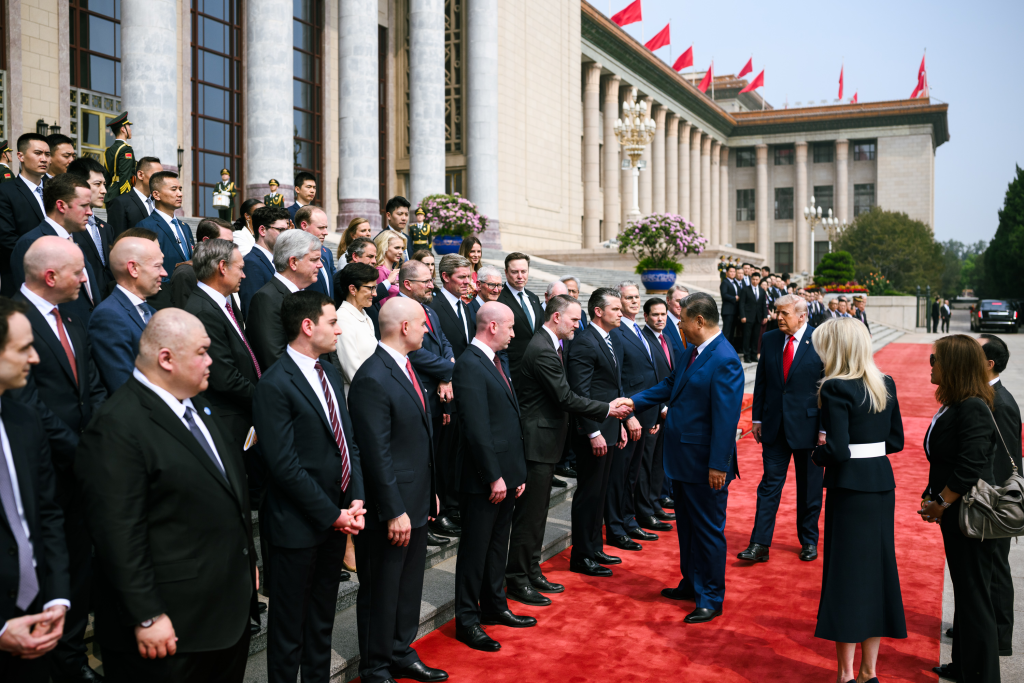
Trade Tensions Persist Ahead of Xi’s Planned Visit

Source: President Donald J. Trump participates in a welcome ceremony with President Xi Jinping of the People’s Republic of China, Thursday, May 14, 2026, at the Great Hall of the People in Beijing, China. (Official White House Photo by Daniel Torok)

-1-

In One Sentence

  • A Chinese Commerce Ministry spokesperson said on September 10 that Beijing and Washington are consulting on a framework for reciprocal tariff reductions on $30 billion worth of goods through the Board of Trade, echoing USTR Jamieson Greer’s stated hope to release results during Xi’s visit, while recent statements from both governments have made no mention of the parallel Board of Investment announced alongside it at the May 2026 Beijing summit.
  • Treasury Secretary Scott Bessent told the House Financial Services Committee on September 15 that he will meet Chinese Vice Premier He Lifeng this weekend for final preparatory talks before the summit, as the two sides discuss cutting tariffs on certain goods including U.S. energy and agricultural shipments under the earlier plan for reciprocal reductions on roughly $30 billion in trade, a potential sign that the leaders’ meeting will extend the one-year truce reached in October 2025.
  • On September 8, Transportation Secretary Sean Duffy released a letter to Ford CEO Jim Farley expressing “profound concern” over the automaker’s ties to Chinese firms, singling out its battery technology licensing agreement with CATL at the BlueOval Battery Park in Marshall, Michigan, its assembly partnership with Geely in Spain, and its component talks with BYD.
  • President Trump said in a September 11 Fox News interview that he would allow Chinese automakers to build cars in the U.S. provided they hire American workers, while maintaining the effective ban on Chinese vehicle imports and drawing a firm line against Chinese cars assembled in Mexico for the U.S. market.

Mark the Essentials

  • Commerce Secretary Howard Lutnick signaled on September 2 that easing U.S. semiconductor export controls is unlikely at the Xi summit, noting that China had not taken up the administration’s January “olive branch” allowing H200 chip sales on the condition that the U.S. collect 25 percent of the resulting revenue, and describing the broader enforcement challenge as a game of “whack-a-mole.”
  • Republican lawmakers largely sided with Sec. Duffy, with Sen. Rick Scott praising the secretary for “sounding the alarm” over Ford’s ties to Chinese Communist Party-linked companies and the House Select Committee on China amplifying the criticism, underscoring the political pressure on American firms even as the administration itself sends mixed signals on Chinese investment.
  • Beijing is weighing whether to send a delegation of tech, finance, electric vehicle, and aerospace executives to accompany Xi to Washington, mirroring the American CEO delegation that joined Trump in Beijing in May, though reporting suggested that the composition of the delegation, and the delegation itself, remains undecided on the Chinese side and may prove more symbolic than substantive.
  • Ford chief executive Jim Farley pushed back forcefully against Duffy’s letter, telling the Wall Street Journal that it reflected “basic misunderstandings, mistruths” that could have been resolved with a five-minute call, and flatly denying that Ford had proposed any framework to facilitate Chinese joint ventures on U.S. soil, a rebuttal notably echoed by the White House’s own Rapid Response account, which praised Ford as a “GREAT American company.”

Keeping an Eye On…

Is something brewing on the U.S.-China Board of Investment front?

To be clear, the chances of anything significant materializing on this front are low. The American body politic is firmly opposed to Chinese investment in the United States, and the administration appears equally opposed, judging by its America First Investment Policy order, released a month after the president’s inauguration. As the AFIP notes, China “systematically direct[s] and facilitate[s] investment in United States companies and assets to obtain cutting-edge technologies, intellectual property, and leverage in strategic industries … the United States should not allow the PRC to take over United States critical infrastructure, [especially investors targeting] the crown jewels of technology, food supplies, farmland, minerals, natural resources, ports, and shipping terminals.” A few paragraphs later, the order states that the administration will “use all necessary legal instruments, including CFIUS, to restrict PRC-affiliated persons from investing in United States technology, critical infrastructure, healthcare, agriculture, energy, raw materials, or other strategic sectors.” On the outbound side, the AFIP calls for “new or expanded restrictions on United States outbound investment in the PRC in sectors such as semiconductors, artificial intelligence, quantum, biotechnology, hypersonics, aerospace, advanced manufacturing, directed energy, and other areas implicated by the PRC’s national Military-Civil Fusion strategy.”

Clearly, there is little room for a Board of Investment on either the inbound or outbound side, at least from the U.S. perspective.

That said, no senior administration official has definitively rejected the idea of a Board of Investment. The Chinese president is due to arrive with a delegation of CEOs, an unmistakable signal that he has authorized investment-side deals with U.S. counterparts. The delegation promises to be something of a soft-power coup for President Xi. President Trump, too, has spoken of welcoming Chinese investment—including recently—provided that Chinese capital is put to work producing goods for American consumers using American labor. As long as the cat, black or white, can catch mice, its provenance appears to matter less to Trump.

So we return to the question: is something brewing with regard to the U.S.-China Board of Investment?

A definitive answer should emerge within a week. The window for approving such investments on U.S. soil is narrowing rapidly, and now largely depends on one man’s political willingness to break with his own party and the broader political establishment—two months before what could be a difficult midterm election for Republicans. On reflection, this is not a particularly healthy state of affairs, given that foreign investment often involves substantial sunk costs and long gestation periods.

Expanded Reading

-2-

A U.S.-Canada Trade War…For How Long?

-2-

In One Sentence

  • Canadian retaliatory tariffs on roughly $20 billion worth of U.S. goods took effect on September 8, imposing levies of 15 to 50 percent on products ranging from steel and appliances to dairy and electronics, in response to the Section 338 tariffs the United States imposed on a comparable volume of Canadian goods on August 22.
  • Hours later, President Trump escalated further, issuing Section 338 proclamations banning imports of Canadian dairy, beer, other alcoholic beverages, and motorcycles effective September 29, while separately ordering the USTR and the General Services Administration to remove Canadian-origin products from federal procurement schedules covering more than $50 billion in annual purchases.
  • Prime Minister Mark Carney said on September 14 that a “mutually advantageous agreement” with the United States remains possible but must respect Canadian sovereignty, cultural institutions, and Ottawa’s ability to pursue other trade deals, responding to Trump’s claim that Canada was “dying to make a deal.”

Mark the Essentials

  • Business groups on both sides of the border warned of mounting economic damage, with the U.S. Chamber of Commerce’s Neil Bradley calling the escalation “damaging to both economies” and cautioning that the shifting mix of tariffs, import bans, and procurement restrictions is creating significant uncertainty for businesses and consumers. 
  • Lawmakers from both parties pushed back against the escalation, with Democrats including Sens. Ruben Gallego (D-AZ) and Amy Klobuchar (D-MN) warning of higher costs for households, while Kansas Republicans Jerry Moran and Roger Marshall objected to Trump’s threat to bar Canadian jet maker Bombardier from the U.S. market, citing more than 1,200 jobs in their state, even as House Ways and Means Chair Jason Smith (R-MO) backed the pressure campaign. 
  • The dispute has grown increasingly personal, with Carney dismissing Commerce Secretary Lutnick’s claim that Ottawa abandoned talks for domestic political gain, saying “unelected Cabinet members in the United States” are not “experts on Canadian politics,” while Trump warned on Truth Social that Canadian politicians casting him as “the enemy” would face severe political consequences once their economy “collapses.”
  • Against this backdrop, Carney has accelerated Canada’s pivot toward Europe, a shift that gained a striking endorsement on September 16 when European Commission President Ursula von der Leyen used her State of the Union address, with Carney in attendance, to propose that Canada become the EU’s first “associate member” and build what she called an “Alliance for the Future” beyond the existing free trade agreement. 
  • In the same address, von der Leyen sharpened the EU’s own posture toward China, describing the bloc’s roughly $1 billion-per-day goods trade deficit with China as having reached “a tipping point” and pledging to use “all the tools at our disposal” to rebalance the relationship, while announcing a new European corporation to procure and stockpile critical minerals and rare earths to reduce dependence on Beijing.

Keeping an Eye On…

One would have thought that an integrated North American market would be the perfect springboard for the United States to project economic influence globally. Apparently, this is not the case for President Trump. 

Despite Ottawa being the largest trading partner for 34 U.S. states, no country has been subject to a wider range of tariffs during the second Trump administration than Canada. These range from IEEPA-based fentanyl tariffs, to IEEPA-based reciprocal tariffs, to temporary Section 122 tariffs, to subsequent Section 301 and Section 232 tariffs on a variety of imports. Just when it seemed Mr. Trump could not raise the stakes any further in deploying tariff authorities, his latest tariff imposition on Canada arrived: Section 338(d) of the Tariff Act of 1930. It is worth dwelling on this authority for a moment.

First, by way of background, the Tariff Act of 1930 is the same act that produced the notorious “Smoot-Hawley” provisions. Trump and Peter Navarro may admire the provision, but they likely constitute a minority of two. Second, until recently, this authority was not even mentioned in the “Overview and Compilation of U.S. Trade Statutes” published annually by the U.S. Congress—a testament to its obscurity. Third, there is no public record of Section 338 being used or threatened since 1949. Yes, 1949. The administration has evidently done its archival homework. Fourth, no president had invoked Section 338 to impose tariffs in the 96 years since its enactment—until Trump did so against Canada in late August. Finally, the statute has since been superseded by two more comprehensive statutes—Section 232 of the Trade Expansion Act of 1962 and Section 301 of the Trade Act of 1974—both of which cover the same ground as Section 338 but in far greater detail, including with respect to remedial actions.

So what are the chances that Section 338 will survive a legal challenge? Very slim. Does that matter? Not particularly. As with the Section 122 episode in February—left to sunset after 150 days and replaced by Section 301 tariffs—the Section 338 tariffs will likely be withdrawn before any legal challenge reaches finality. And how are the Canadians feeling about being subjected to an anachronistic statute that includes no exemption for USMCA-compliant goods, on top of the administration’s decision not to renew the USMCA in its current form? One need look no further than Prime Minister Carney’s presence at the European Parliament in Strasbourg this week for an answer. The fantasy of a 51st state will have to wait a while longer.

Expanded Reading

On the Hill

Legislative Developments

  • House Ways and Means Committee ranking member Richard Neal (D-MA) and House Foreign Affairs Committee ranking member Gregory Meeks (D-NY) circulated a “dear colleague” letter urging Democrats to oppose the Senate-passed Lindsey O. Graham Sanctioning Russia and Iran Act of 2026, arguing it would cede congressional oversight of trade by granting President Trump broad authority to impose tariffs of up to 100 percent on countries of his choosing.
  • On September 1, the House passed the Protecting American Industry and Labor from International Trade Crimes Act, led by House Select Committee on the Chinese Communist Party Chair John Moolenaar (R-MI), which would establish a Justice Department task force to investigate and prosecute trade-related crimes often linked to China-backed companies, including duty evasion and transshipment.
  • On September 1, the House Energy and Commerce subcommittee on commerce, manufacturing and trade advanced three China-focused bills: the Open-Source AI Leadership Act from Rep. Gabe Evans (R-CO), directing Commerce to address foreign barriers to American open AI models; the Chip EQUIP Act, barring CHIPS Act recipients from buying semiconductor equipment from foreign entities of concern; and the Automotive National and Economic Security Act from Reps. Diana Harshbarger (R-TN) and Debbie Dingell (D-MI), mandating a study of U.S. automakers’ ties to foreign adversaries.
  • On September 1, Senate Minority Leader Chuck Schumer (D-NY) introduced the End Trump’s Tariff Tax Act, co-sponsored by 12 Senate Democrats and Sen. Angus King (I-ME), which would void the July Section 301 forced labor tariffs and the Section 338 tariffs on Canada, refund duties already collected, and repeal both Section 122 and Section 338 tariff authorities.
  • On August 27, House Ways and Means member Brad Schneider (D-IL), Senate Finance member Peter Welch (D-VT) and Sen. Kirsten Gillibrand (D-NY) introduced the Banning Antiquated Duties and Delivering Equitable American Levies Act, or BAD DEAL Act, which would repeal Section 338 of the Tariff Act of 1930 and direct the president to refund duties collected on Canadian goods under the statute.
  • On August 27, House Financial Services Committee member Mike Lawler (R-NY) introduced the EXIM Bank Continuity in Competitiveness Act, which would halve the waiting period from 120 to 60 days before Cabinet officials can temporarily join the Export-Import Bank’s board to restore a quorum.

Hearings and Statements

  • In a September 9 letter to CBP Commissioner Rodney Scott, 10 House Democrats led by Rep. Haley Stevens (D-MI) urged the agency to expedite approval of IEEPA tariff refund claims, warning that administrative backlogs are preventing small businesses from meeting the 90-day filing deadline for liquidated shipments.
  • In a September 3 letter to DHS Secretary Markwayne Mullin, House Select Committee on the Chinese Communist Party Chair John Moolenaar (R-MI) and ranking member Ro Khanna (D-CA), along with six colleagues, questioned lax enforcement of the Uyghur Forced Labor Prevention Act, citing declining detention activity and requesting a briefing on efforts to expand the UFLPA Entity List, which the administration has updated only once.
  • In an August 31 letter to President Trump, 88 House Democrats led by Rep. Debbie Dingell (D-MI) urged the administration to ease its escalating tariff war with Canada, warning that continued escalation would harm integrated cross-border supply chains and weaken cooperation on defense, energy and the environment.
  • In an August 28 letter to USTR Greer and Commerce Secretary Lutnick, Sen. Susan Collins (R-ME) urged the administration to resume negotiations with Canada before its retaliatory tariffs take effect, noting that roughly 62 percent of the $170 million in Maine goods subject to the duties come from the state’s forest products sector.

Expanded Reading