

ICAS Trade ‘n Tech Dispatch (online ISSN 2837-3863, print ISSN 2837-3855) is published about every two weeks throughout the year at 1919 M St NW, Suite 310, Washington, DC 20036.
The online version of ICAS Trade ‘n Tech Dispatch can be found at chinaus-icas.org/icas-trade-technology-program/tnt-dispatch/.
In One Sentence
Mark the Essentials
Keeping an Eye On…
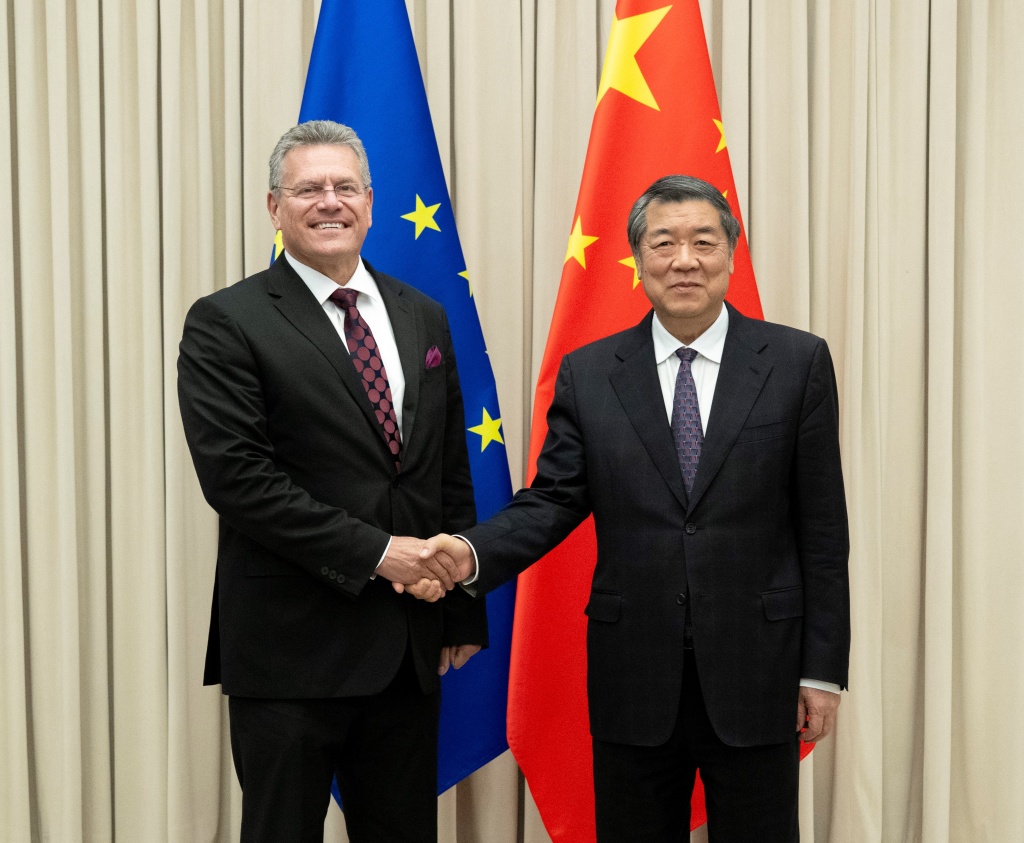
China and the European Union have dialed down their trade, investment, and industrial policy tensions for the time being. This dialing down is not a final resolution; that isn’t even close. Both sides, and the EU in particular, are still in the process of building out their industrial policy and economic security instruments. Just as arms control follows – not precedes – the build out of deterrence capability, both sides will find better trade, investment, and economic security bargains and a fuller resolution achieved of their tensions once they have built out policy toolkits to their satisfaction. That said, their October 9 joint statement and the resolution of the festering tensions over skyrocketing Chinese hybrid vehicle exports to the bloc is a valuable respite.
So, what did we learn from this round of China-EU skirmishes?
First, both sides are adept at upping-the-ante and then finding ways to reconcile. Just when it seemed that the two sides would overshoot the landing zone in the case of anti-subsidy duties on Chinese battery electric vehicle (BEV) imports, the two sides managed to resolve the matter this January, with the EU thereafter releasing a guidance document on submission of price undertaking offers. Similarly, the two sides have now achieved a medium-term resolution of their plug-in hybrid electric vehicles (PHEV) tensions, which runs through 2030.
Second, the Chinese side might like to leave the impression of being hard-boiled negotiators, but the inescapable fact is that Beijing is attentive to the socio-economic pain in Europe’s industrial heartland and especially the employment losses in pillar industries, such as autos. China’s export juggernaut in autos is a product not just of an intensely innovative and competitive domestic marketplace, but also the product of a European industry that has been asleep at the wheel, in the hock of trade unions and car lobbies, and reluctant to shift from internal combustion engines. China has nevertheless relented. Expect China to extend a certain indulgence towards Europe’s chemical industry woes too – laboring as the industry is under war-induced input cost spikes. But don’t expect similar indulgence to extend to other sectors such as robotics or drones where the backward socioeconomic linkages to Europe’s manufacturing base are limited.
Third, European ‘derisking’ could not be more different than the U.S.’ ‘decoupling’ when it comes to China. As the Franco-German leaders themselves have noted vis-à-vis China, the goal of ‘derisking’ is to “gradual[ly] …minimize vulnerabilities while fostering trade relationships” and, equally, “remain conducive to foreign direct investments while addressing issues related to economic security, technology transfers and local employment.” No U.S. president will express such a sentiment, now or anytime in the foreseeable future, it can safely be said. Chinese FDI is not welcome in the U.S. and trade ties are sought to be attenuated to the maximum extent possible.
Fourth, the most important sentence in the October 9 China-EU joint statement may not be Point 2 regarding hybrid vehicles. Rather, it may be the twelve words that constitute Point 8: “the two sides agreed to engage in a technical dialogue on FSR.” Foreign Subsidies Regulation has been a persistent thorn in the flesh of Chinese investment in the EU during its short lifespan, and for good reason. Chinese industrial policy interventions require far greater transparency, especially when they entail external spillover effects. It is unreasonable for Beijing to expect European firm investments in its own internal market to be held to higher state aid disciplines than investments by Chinese firms in Europe. A China-EU modus vivendi on fair, acceptable and enforceable industrial policy disciplines would be a gamechanger for ties. It is an objective worth striving for, but much work remains in regards to this at the Chinese end.
Finally, deterrence pays, and pays handsomely, when backed by a large consumption market as well as the willingness to engage constructively. It has worked for China in the past and is working for the EU now: expect an updating as well as further buildout of Europe industrial policy tools, such as the Industrial Accelerator Act (IIA) and Procurement Regulation; expect new defense and economic security instruments, such as its revised FDI Regulation due to come into force in January 2028; a revised Cybersecurity Act, a diversification instrument, and a possible last resort, bazooka-quality, quick retaliation instrument.
Battle lines are being drawn. Constructive engagement and productive results are also being achieved. Sounds like a different sort of ‘win-win’.
Expanded Reading
In One Sentence
Mark the Essentials
Keeping an Eye On…
The three heavyweights of the global economic system – the U.S., the EU, and China – have a lot to say on structural excess capacity, industrial policy, and exchange rates. Within the space of a week or so, each has placed on the record its view on a tense policy matter, with the latter two submissions (a Franco-German one and a Chinese one) being fairly unusual interventions. Pity, though. While each made good points, they could have spoken of their own shortcomings with greater candor.
First, the U.S.-led statement at the G20 trade ministerial on addressing (Chinese) structural excess capacity. It is true that China has a serious structural overcapacity problem on its hands. Disorderly capacity expansion (as well as ‘involution’ type behaviors) is a problem that the Chinese government has itself acknowledged, including in the recent October 9 Party and government-issued “Opinions on Developing New Quality Productive Forces” that lambasts the tendency of local governments to engage in “malicious investment promotion blindly” and “recklessly burning money.” That said, the ‘blind’ investment promotion has mostly been channeled via market mechanisms to emerging and advanced industrial sectors (like EVs, batteries, foundational semiconductors) that are mostly dominated by private players, unlike a decade ago when excess capacity was mostly in SOE-led primary industries (such as steel, aluminum, cement).
In which case we ask: Is this so different from the excess capacity bubble brewing in the U.S.’ AI data center buildout? More pointedly, if it is the U.S.’ case that non-market policies and practices are at play in this oversupply, then perhaps Washington too should reflect on the fact that by imposing endless tariffs, export controls, and the like in the name of national security and thereby place a thumb on the market’s scale, it has prevented the functioning of the market mechanism itself in the first place. How’s that for a non-market practice?
Next, to the rare Franco-German ‘non-paper’ on (China’s) industrial policy practices, issued two days prior to the China-EU trade ministerial in Beijing. It is true that Chinese private players continue to benefit from a bevy of subsidies and subsidy programs – not all of which are notified to the WTO. Subsidization to encourage entry and competition and winnowing it down thereafter to compel exit of uncompetitive players is a feature, not a bug, of China’s emerging and advanced industries incubation system. That said, subsidy support is oftentimes extended beyond its requisite shelf life and the withdrawal process is slow to kick-in. On the other hand, subsidization has ceased to be the decisive factor in the hyper-competitiveness and innovation efflorescence under way in corporate China. That owes instead to the width and depth of China’s industrial ecosystem – materials, supply chains, engineering expertise, etc. – as well as the public-private synergy at the local level to build, deploy and scale capabilities, processes, and know-how into world-leading products. As European and global economies reel from the shock of China 2.0 and its “three new” exports (EVs, batteries, solar panels), only to be soon confronted by China 3.0 and its “new new three” exports (biopharma, industrial robots, AI software), Europe would do well to confront the homegrown reasons for its corporate torpor rather than metastasizing the case of China’s industrial subsidy practices, and distracting its focus in the process.
Finally, to the equally rare intervention by the People’s Bank of China on the RMB exchange rate, issued on the day of the China-EU trade ministerial in Beijing, and presumably to push back at the EU’s charge that the gaping trade deficit with Beijing is a function of the latter’s currency manipulation practices. It is true that China has ceased to purpose its exchange rate to obtain a competitive advantage, especially as its export basket has moved up the value chain and become less sensitive to exchange rate movements. For most of the past few years, PBoC has in fact guided expectations in favor of RMB appreciation, not depreciation. And truth be told, as China pursues RMB internationalization, the upside of a strong yuan far exceeds the downside of weak one. That said, the PBoC paper elliptically glides over the single most important reason for the currency’s weakness in international markets today – which is, the dismal state of China’s domestic economy and the unreformed state of its financial intermediation apparatus. The key driver in its macroeconomy, domestic final demand, is in a mess because the powers-that-be are too craven to force a reckoning in the imploding property sector. By some accounts, China’s housing sector loss adjustment has been even slower than Japan’s slow-motion correction in the 1990s, as developer firm exits are delayed and the Party – habituated to thinking of itself as the state – prioritizes the solvency of its affiliated investment vehicles tied to local government finances over the needs of the country and its people. Of course, the People’s Bank cannot bring itself to say this to its masters. And so, the macroeconomy muddles through and the exchange rate scrapes by.
With great power, must also come greater candor.
Expanded Reading
Legislative Developments
Hearings and Statements
Expanded Reading