The international strategic waterway transit regime is facing a new structural pressure: while the relevant transit rights remain legally valid, their realization is continuously constrained by factors such as the war environment, security risks, coastal state regulations, commercial risk aversion, environmental protection, and infrastructure capacity. This paper summarizes this phenomenon as “conditional transit,” describing a system where transit rules remain formally stable, but the actual accessibility, predictability, and affordability of transit are declining. The paper analyzes international strategic waterways, including typical or special strategic straits such as the Strait of Hormuz, the Strait of Malacca-Singapore, the Turkish Straits-Black Sea, and the Bering Strait, as well as the Arctic shipping route, which comprises several sea areas, straits, and shipping segments. Based on a review of the legal framework of international transit regimes, the paper constructs an analytical framework from four dimensions: institutional conditionalization, security conditionalization, market conditionalization, and environmental conditionalization, comparing the manifestations of conditionalization mechanisms and their practical differences in different strategic waterways. The study argues that the main risk facing the current international transit regime is not the explicit abolition of the openness principle, but rather the gradual weakening of its function in actual operation. For China, the focus of strategic waterway governance is not only on maintaining the legal openness of the right of passage, but also on enhancing the actual availability, predictability and institutional resilience of maritime passages through cooperative governance, capacity building and the provision of public goods, based on respect for the sovereignty of coastal states and the framework of international law.
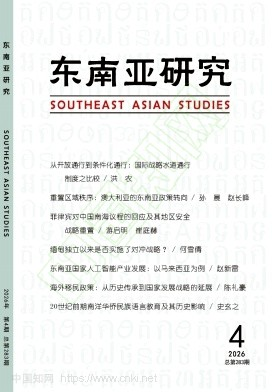
Book Details: ISBN1008-6099, 10.19561/j.cnki.sas.2026.04.001
Publication Date: 22 July 2026
About the Author:
Nong Hong
Executive Director & Senior Fellow
Dr. Nong Hong holds a PhD of interdisciplinary study of international law and international relations from the University of Alberta, Canada and held a Postdoctoral Fellowship in the University’s China Institute. She was ITLOS-Nippon Fellow for International Dispute Settlement (2008-2009), and Visiting Fellow at Australian National Centre for Ocean Resources and Security (2019), the Center of Oceans Law and Policy, University of Virginia (2009) and at the Max Planck Institute for Comparative Public Law and International Law (2007). She is concurrently a research fellow with China Institute, University of Alberta, Canada, and the National Institute for South China Sea Studies, China. Her research takes an interdisciplinary approach to examining international relations and international law, with focus on International Relations and Comparative Politics in general; ocean governance in East Asia and the Arctic; law of the sea; international security, particularly non-traditional security; and international dispute settlement and conflict resolution.





Finland and Norway’s call to Putin tests European unity over Russia