
ICAS Trade ‘n Tech Dispatch (online ISSN 2837-3863, print ISSN 2837-3855) is published about every two weeks throughout the year at 1919 M St NW, Suite 310, Washington, DC 20036.
The online version of ICAS Trade ‘n Tech Dispatch can be found at chinaus-icas.org/icas-trade-technology-program/tnt-dispatch/.
In One Sentence
Mark the Essentials
Keeping an Eye On…
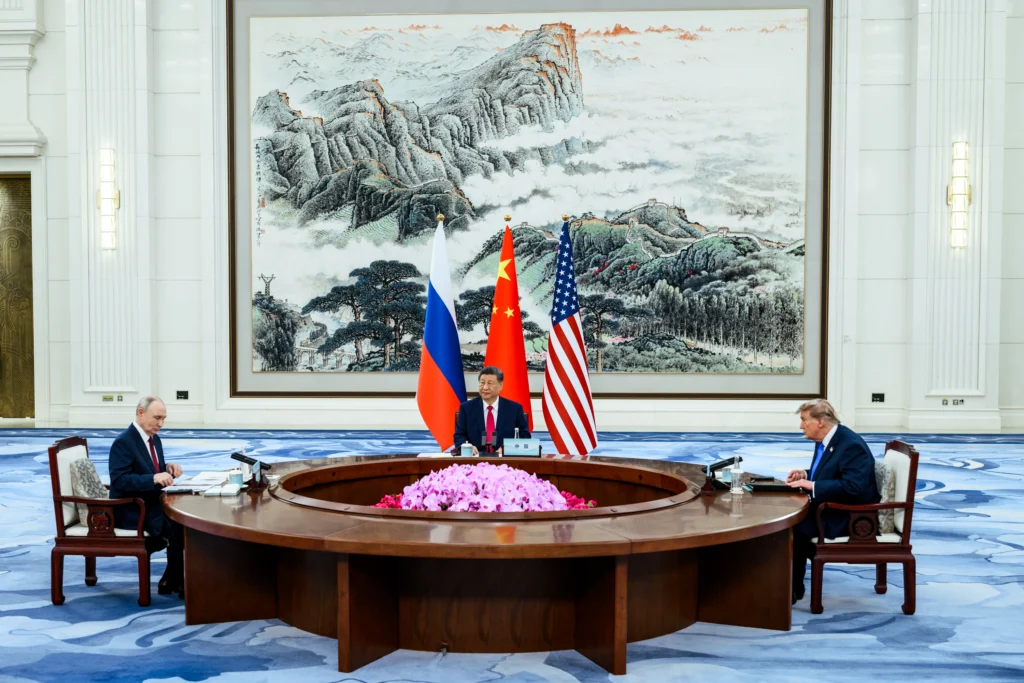
In his famous treatise on European peacemaking in the wake of the Napoleonic Wars, a young Henry Kissinger had observed that the essence of visionary statesmanship was the transformation of force into reciprocal obligation by identifying a legitimizing principle of order based on a loose consensus on the nature of justice in the international system. A wise statesman was one who sat alongside protagonist and peer at the high table and sought to restrain the raw exercise of power by transforming power and influence into applicable rules that were founded on fairness and reasonableness, and which were broadly accepted and adhered to by friend and foe alike within the prevailing order. For just a fleeting moment, let’s assign this visionary worldview to the triumvirate of Putin, Xi and Trump, their ‘Declaration toward Peace’, and to the purposes of their meeting in Shenzhen last week.
Ok, now let’s get back to reality.
The trilateral meeting, by all accounts, seems to have gone off well. The Trump-Xi bilateral was cordial, although perhaps not productive. The APEC summit seems to have proceeded without a hitch. Given the scant information released by all the major players involved however, perhaps it might be better to frame a series of pressing questions related to U.S.-China relations than furnish a set of observations.
The U.S. and China have established a Board of Trade as well as a ‘30-for-30’ tariff reduction framework that is up and running. Senior officials even held their inaugural meeting under the Board of Trade’s working procedures in the week prior to the Shenzhen meeting. No doubt the 30-for-30 framework has a certain value, but the state of implementation of tariff reduction commitments is the obvious question. A more important question is this: is ‘30-for-30’ the outer limit of bilateral trade policy ambition, given that the standout feature of ’30-for-30’ is its obvious lack of ambition? It bears noting that for the first time since 2000, China will cease to be the U.S.’ largest bilateral trade surplus partner in Asia when 2026 draws to a close, with the trade surplus more than halved since 2018. China had pitched a ‘broader arrangement’ on trade and investment in the run-up to the White House summit meeting in September. What happened to, or remains of, that ‘broader arrangement’?
The U.S.-China Board of Investment, though officially established, seems to have remained on the drawing board. Washington says its purpose is predictability of investment for the Chinese side and market access for the U.S. side. Given that the Board of Investment was conceived as a means to invite Chinese investment in select U.S. industrial sectors, or so the Chinese hoped. Has the moment figuratively come to switch the light off on any major Chinese investments in the U.S. in the future? Or is there still a fighting chance that something could come out on the investment front on the sidelines of the G20 meeting in Miami?
On their Joint Arrangement on Economics and Trade (Busan Truce/Consensus), will the slow going on rare earth flows from China collapse the truce in January? Unlikely, but we nevertheless ask. By the way, with the Trump administration issuing a tough Remote Access export control rule to patch up chip diversion pathways during the week of the Shenzhen meeting and stemming from the Nvidia-Megaspeed revelations, will MOFCOM now respond in kind? Will the Busan Truce be able to sustain such pressure from both ends?
The U.S. and China have touted their recent progress on the AI safety front. Reportedly, the two sides are looking at an incident notification mechanism as well as seeking to formalize safety protocols. But we cannot help but ask: let alone advance discussions on these points, did the two empowered interlocutors on the AI issue, Sec. Bessent and Vice-Premier He, even meet in Manila or Shenzhen?
Mil-mil engagement has been a rare, substantive bright spot of late in the bilateral relationship. The two sides’ crisis management as well as operational safety working groups met during the first and third week of November, respectively. On the other hand, both sides appear to have gone radio silent on their proposed MoU on military crisis communications and management (which, if signed, would be a useful achievement). So, what’s up on this MoU front? Are inter-agency divisions in the U.S. still holding up matters?
Finally, the trilateral summit declaration did hint at small but nevertheless notable forward movement on the strategic stability and nuclear risk reduction front. Beijing had been adamant that it would not join trilateral discussions on nuclear risk reduction; it has yielded somewhat. Given that the U.S. and Russia still possess 85% of the world’s total nuclear warheads, including those in storage and retired ones awaiting dismantlement, what sort of trilateral conversation should be anticipated? Nuclear-related discussions could, after all, range from testing, transparency, risk reduction, force-sizing, and means of delivery to space-based systems, including restraints on the deployment of offensive weaponry in space. Will the conversation be a truly trilateral one, or one that is conducted on separate bilateral tracks?
Lots of questions at this time; very few answers on offer. Maybe the U.S. and China need to step up their public communications capabilities first.
Expanded Reading
In One Sentence
Mark the Essentials
Keeping an Eye On…
Has China shot itself in the foot as a result of its extensive chip diversion operations that have now come to light following the ‘Two Huangs’ affair? Leading Chinese AI companies had, after all, been able to legally access significant volumes of Nvidia’s advanced Blackwell chips remotely to train their AI models, including on (non Chinese-owned) Southeast Asian data center-hosted clouds. Blackwells, to be clear, are barred from export to China or China-headquartered entities elsewhere; restricted amounts of less powerful H200 Hopper chips are permitted for export though to cleared Chinese end-users.
The Biden administration had sought to curtail this remote access pathway in January 2024 with its Infrastructure-as-a-Service draft rule, which would have compelled U.S. cloud companies that provided computing power for foreign AI training to report and in certain instances restrict access to certain (i.e., Chinese) customers. The rule failed to gain traction for two main reasons: by what parameters were U.S. cloud computing vendors to judge if a Chinese client was conducting a training run? And wouldn’t such U.S. vendor tracking of proprietary client information amount to a problematic intrusion of privacy and violation of IP and shred their business model? To compensate for its failure to push the rule through, the Biden administration, less than a week before demitting office, inscribed a lesser Data Center VEU (verified end user) provision in its AI Diffusion Rule that would impose checks to prevent the diversion of advanced chips to China.
Once the second Trump administration took the reins of power, one of its first acts however was to disown Biden’s AI Diffusion Rule. Because certain previous China-related chip regulations had been grandfathered into the Diffusion Rule (and thereafter struck to avoid duplication), this disowning ensured that not only did (a) data center VEU checks cease to be a priority, but that (b) checks on advanced AI chips destined to overseas subsidiaries of China headquartered firms, as well as (c) the Foundry Due Diligence Rule that was intended to prevent the use of front companies by the likes of Huawei to get chips fabricated at overseas foundries went unenforced. On remote access, the Trump administration’s S&T advisor reasoned at the time that large-scale server racks at overseas compute facilities were easily monitor-able for risk of physical diversion. As for large-scale multibillion dollar runs to train sophisticated models, these remote access facilities were either not suited for the purpose or could be monitored through stringent KYC data center vendor reporting requirements.
Now, with the ‘Two Huangs’ affair having revealed the falsity of the monitoring and tracking argument, access to compute capacity via IaaS providers was, after all, a conduit for the diversion of physical chips, each of these pathways that had been in play has been shut via the Commerce Department’s November 16th Remote Access interim final rule. To prevent the physical diversion of chips, a license will be required to export advanced AI chips to Indonesia, Singapore, Malaysia, Thailand, and Brazil. Chip smugglers better move elsewhere. To prevent the hitherto legal remote access to advanced AI chips, new restrictions will apply to such exports when there is knowledge that the items destined for use in data centers is to provide computing power to a China-headquartered company. The administration argues that this was the purpose all along of the Biden administration’s advanced computing/supercomputing rule of October 2022. To prevent the likes of Huawei and other Chinese chip designers from surreptitiously – via third parties – placing orders with front-end chips fabricators (like TSMC) and chip packagers, overseas fabrication of any chip design for a Chinese company at the 14 nanometer or more advanced level will now require a license. As for the loophole stemming from non-enforcement of the AI Diffusion Rule that could have potentially allowed advanced AI chips to flow to overseas subsidiaries of China-headquartered firms, it was shut earlier this May.
Hence, a Remote Access rule that was intended to address the physical diversion of AI chips has in fact gone a lot further in sealing the various avenues for their transfer or usage by China’s rising crop of dynamic AI companies. Pathways both licit and illicit have been shut – although the question of enforcement remains a tricky one and is perhaps the reason for the intra-agency (Treasury and NSC v. Commerce) falling out related to the rule’s release. To be sure, it is not the case that all advanced AI chips will now cease to enter China or cease to flow to overseas entities that are subject to Chinese jurisdiction. High-performance AI chips, even at the 3 nano width and installed in consumer products like Xiaomi or Vivo smartphones will continue to flow on business-as-usual terms – albeit, after a license approval process that will no doubt chew up time and cause delays. A limited number of H200 will also flow to cleared end-users, per administration policy. But as for China’s AI frontier-hugging firms, the earlier pathways that had been a valuable lifeline no longer look as viable as they were and only time will tell how they have coped.
And so, we ask once again: did China shoot itself in the foot and hurt its own budding AI model companies through its furtive diversion operations whose cover has now been well-and-truly blown?
Expanded Reading
Legislative Developments
Hearings and Statements
Expanded Reading