
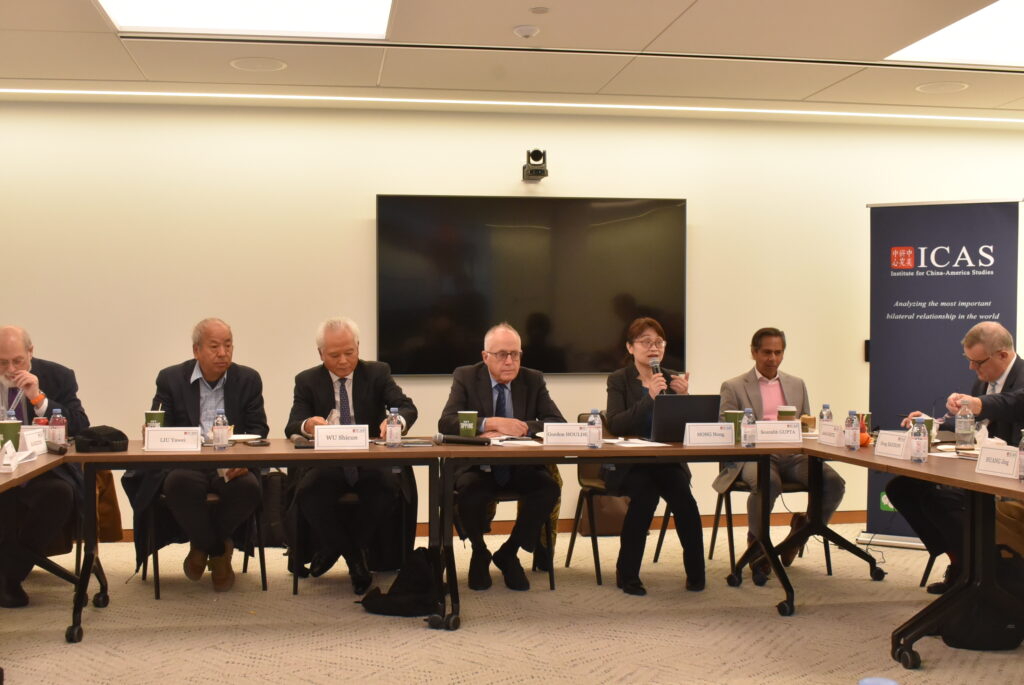
On Friday, October 31, 2025, the 7th “U.S.-China Plus” Roundtable was held at the Institute for China-America Studies’ office in Washington, D.C. Originally launched in 2019 as the “China–U.S.–Canada” Trilateral Roundtable, the “U.S.-China Plus” framework was designed to move beyond bilateral dialogue by incorporating perspectives from third-party countries. The seventh roundtable brought together experts from China, the United States, Canada, Germany, and Brazil to examine evolving U.S.–China economic frictions, geopolitical flashpoints following Donald Trump’s return to the White House, and the implications of U.S.–China competition for Europe, Latin America, and other third-party regions. The Roundtable consisted of two panels: Panel I, Trade Wars Reloaded? Economic Statecraft and Strategic Controls in U.S.-China Competition; and Panel II, Flashpoints and Fault Lines: Geopolitical Tensions under Trump 2.0. More than ten scholars and policy experts participated in the discussion.
During the Roundtable, each panel began with short opening remarks guided by pre-circulated questions, followed by an interactive discussion among panelists and invited participants. Dr. Nong Hong, Executive Director and Senior Fellow of the Institute for China-America Studies, delivered the introductory remarks. Opening remarks were provided by Dr. Wu Shicun, Chairman of the Advisory Board of ICAS, and Professor Gordon Houlden, Director Emeritus of the China Institute at the University of Alberta. The Roundtable concluded with closing remarks by Dr. Liu Yawei, Senior Advisor for China Focus at The Carter Center.
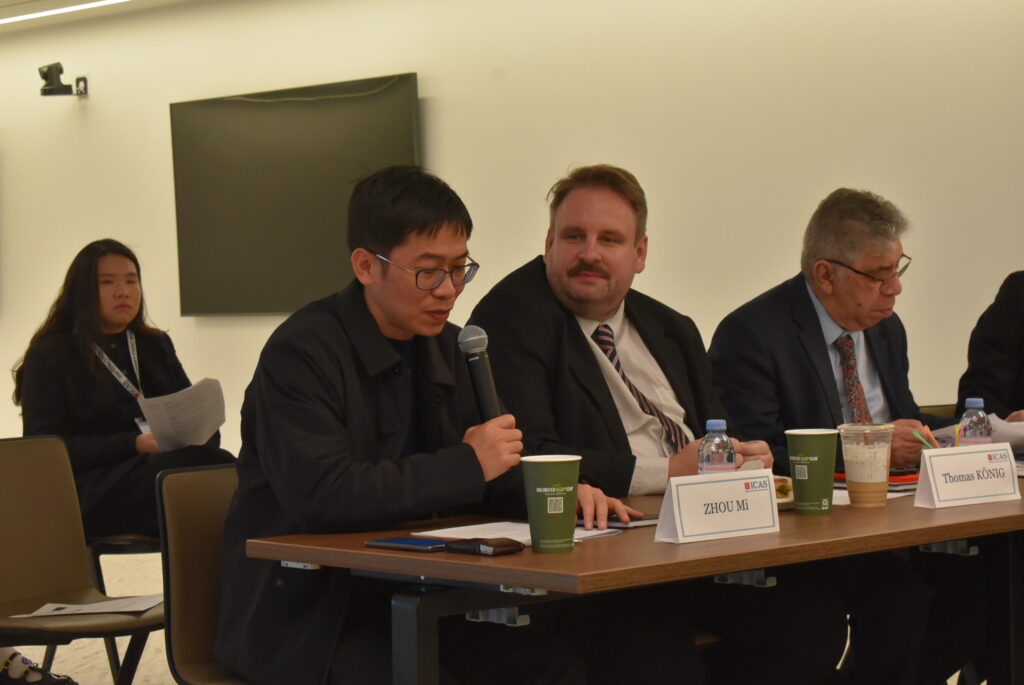
The first panel, “Trade Wars Reloaded? Economic Statecraft and Strategic Controls in U.S.-China Competition”, featured Mr. Kei Koizumi, Fellow at the American Association for the Advancement of Science and former senior official at the White House Office of Science and Technology Policy; Mr. Zhou Mi, Deputy Director of the Institute of American and Oceania Studies at the Chinese Academy of International Trade and Economic Cooperation; Mr. Otaviano Canuto, Nonresident Senior Fellow at the Brookings Institution and Principal of the Center for Macroeconomics and Development; and Mr. Thomas König, China Director of the German Chamber of Commerce and Industry (DIHK). The panel was moderated by Dr. Denis Simon, Distinguished Fellow at the Institute for China-America Studies.
The panel examined how U.S.–China economic competition has entered a more institutionalized phase characterized by tariffs, export controls, and strategic trade policy tools, particularly following President Trump’s return to office. Panelists broadly agreed that while recent bilateral tensions have shown signs of tactical stabilization, technology-related competition and economic statecraft are becoming long-term and structural features of the relationship.
From a Chinese perspective, Zhou Mi emphasized China’s continued commitment to multilateral trade frameworks, particularly in Asia. He highlighted China’s support for regional free trade arrangements, including the China–ASEAN Free Trade Agreement 3.0, which places new emphasis on the digital economy, green development, supply chain resilience, and intellectual property protection. Zhou noted that many economies now face difficult choices between multilateral openness and partial market closure, and warned that tariff escalation and unilateral trade actions risk undermining the broader spirit of free trade. He also underscored challenges faced by small and medium-sized enterprises, which must balance emerging opportunities against rising compliance and geopolitical risks.
Kei Koizumi focused on the U.S. policy toolkit shaping economic competition with China. He argued that presidential authority over tariffs has enabled highly discretionary and ad hoc trade actions, in contrast to slower legislative or trade agreement processes. Export controls, he noted, have become another powerful executive instrument, increasingly driven by information and evidence-based assessments. Koizumi observed that U.S. firms have sought to navigate this environment through intensified engagement with the executive branch, while recognizing that much of the existing tariff regime remains well above pre-trade-war levels and unlikely to fully roll back.
Otaviano Canuto provided a Latin American perspective, characterizing U.S.–China competition as a form of long-term rivalry marked by transactional bargaining and periodic truces rather than stable resolution. He cautioned that trade frictions and strategic controls could compress the policy space for emerging economies, particularly in Latin America, forcing them to adjust to shifting rules set by major powers. Canuto also noted that developments in U.S. financial and treasury policy toward the region warrant close attention, given their broader implications for economic stability.
Thomas König assessed the evolving German and European approach toward China, noting that Germany–China relations are currently at a low point. He explained that Germany’s policy debate has shifted over the past five years toward viewing China increasingly through the lens of “systemic rivalry,” a shift reflected in coalition agreements and government signaling. While political coordination at the European level has intensified, König argued that policy clarity remains limited, particularly regarding port strategy, export controls, and cybersecurity. He emphasized that German businesses continue to rely on China, even as legal, regulatory, and geopolitical risks grow, leading to tensions between corporate pragmatism and political expectations.
Taken together, the panel highlighted how economic statecraft has become a central arena of U.S.–China competition. While approaches differ across regions, panelists agreed that strategic controls, tariffs, and regulatory uncertainty are reshaping global trade patterns, with significant spillover effects for Europe and Latin America.
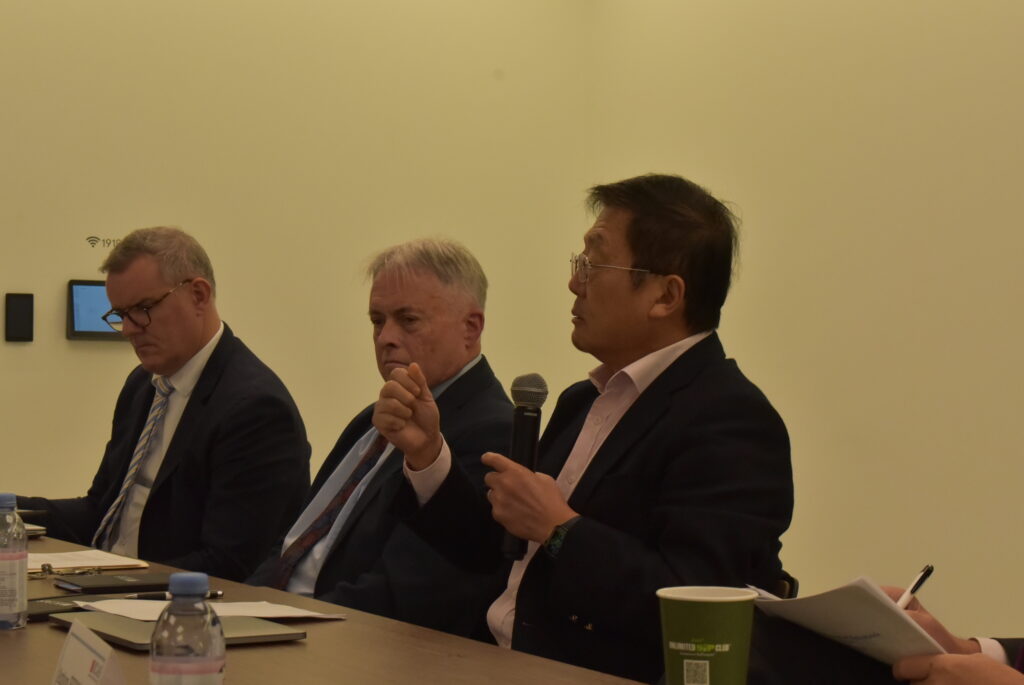
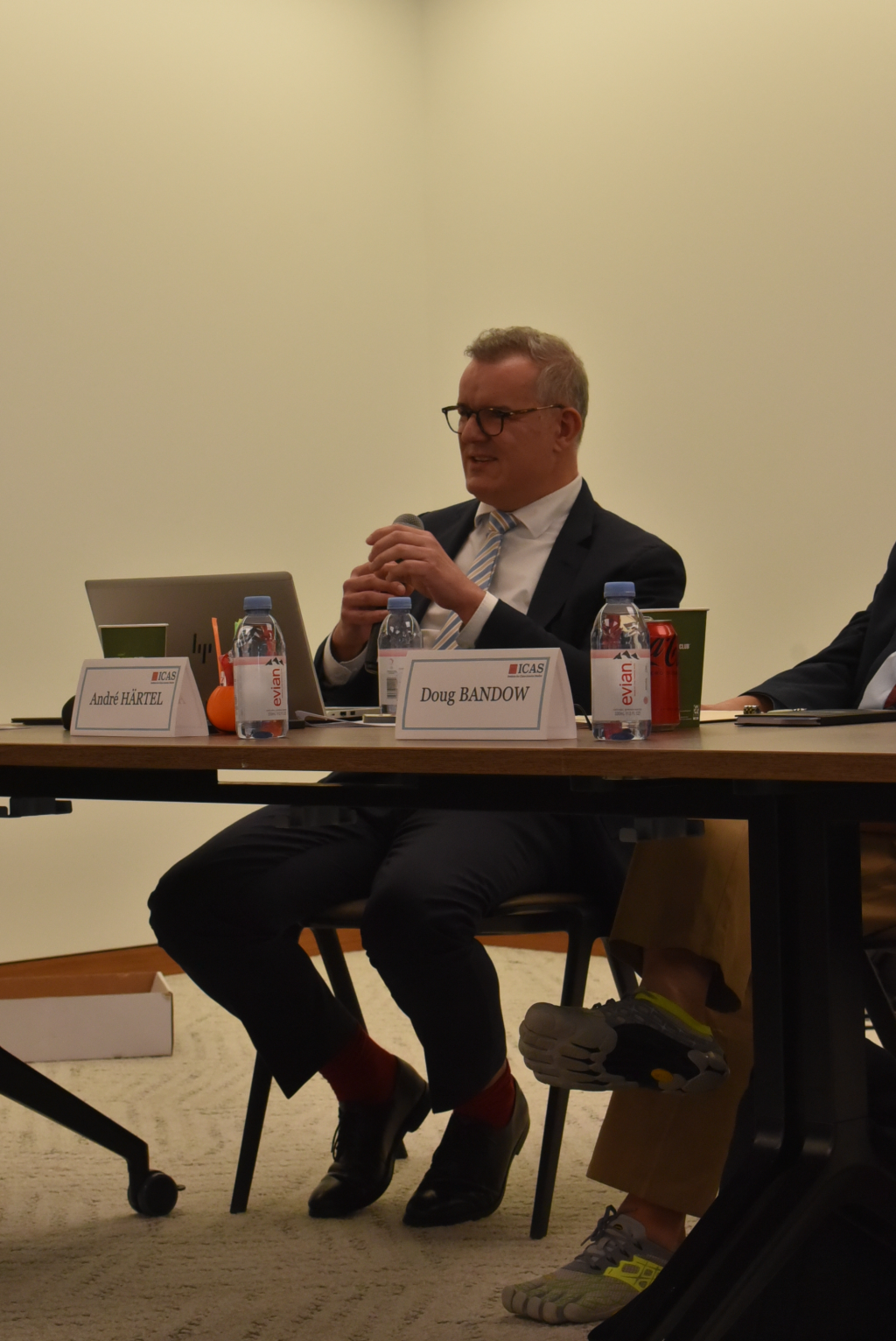
The second panel, “Flashpoints and Fault Lines: Geopolitical Tensions under Trump 2.0″, featured Mr. Doug Bandow, Senior Fellow at the Cato Institute; Professor Huang Jing, Distinguished Professor and Director of the Institute for American and Pacific Studies at Shanghai International Studies University; Professor Anton Fedyashin, Associate Professor at American University; and Dr. André Härtel, Head of the Brussels Office of the German Institute for International and Security Affairs (SWP). The panel was moderated by Mr. Sourabh Gupta, Senior Fellow and Head of the Trade ’n Technology Program at the Institute for China-America Studies.
The panel explored how geopolitical flashpoints are evolving under President Trump’s second term and what these shifts mean for U.S.–China relations. Panelists broadly agreed that while China remains central to U.S. strategic rhetoric, Washington’s policy focus appears increasingly oriented toward domestic priorities and the Western Hemisphere, raising questions about the sustainability of U.S. engagement in other regions.
Doug Bandow argued that despite persistent tensions, recent high-level U.S.–China interactions have given limited attention to security issues, including Taiwan. He maintained that Taiwan remains the most volatile issue in bilateral relations, even as U.S. foreign policy under Trump shows signs of prioritizing transactional diplomacy and burden-shifting toward allies. Bandow also noted Europe’s growing internal political fragmentation and the increasing dominance of defense considerations over trade in European policymaking.
Huang Jing focused on the military balance and strategic realities in East Asia, emphasizing Taiwan and the South China Sea as core sovereignty issues for Beijing. He argued that great power competition increasingly resembles other prolonged conflicts, where neither side can easily impose decisive outcomes. From his perspective, Taiwan has become a settled issue in strategic terms, given the evolving military balance across the Strait.
Anton Fedyashin addressed the Ukraine conflict and Russia’s strategic calculations. He argued that Western sanctions have not achieved their intended outcomes and were not designed to succeed decisively from the outset. Fedyashin emphasized Moscow’s preference for comprehensive negotiations rather than ceasefires, while also noting Russia’s growing economic and strategic alignment with non-Western frameworks such as BRICS.
André Härtel examined Europe’s role in the Ukraine conflict, noting that European states have, in some respects, overtaken the United States in terms of military support. He highlighted the challenges Europe faces in maintaining unity, managing the costs of prolonged conflict, and preparing for potential settlement scenarios that could impose long-term economic and political burdens on the continent.
Across differing regional perspectives, the panel underscored the growing complexity of geopolitical fault lines under Trump 2.0. While views diverged on the likelihood of cooperation or stabilization, panelists agreed that U.S.–China competition, combined with unresolved conflicts in Europe and Asia, is contributing to a more fragile and fragmented international order.
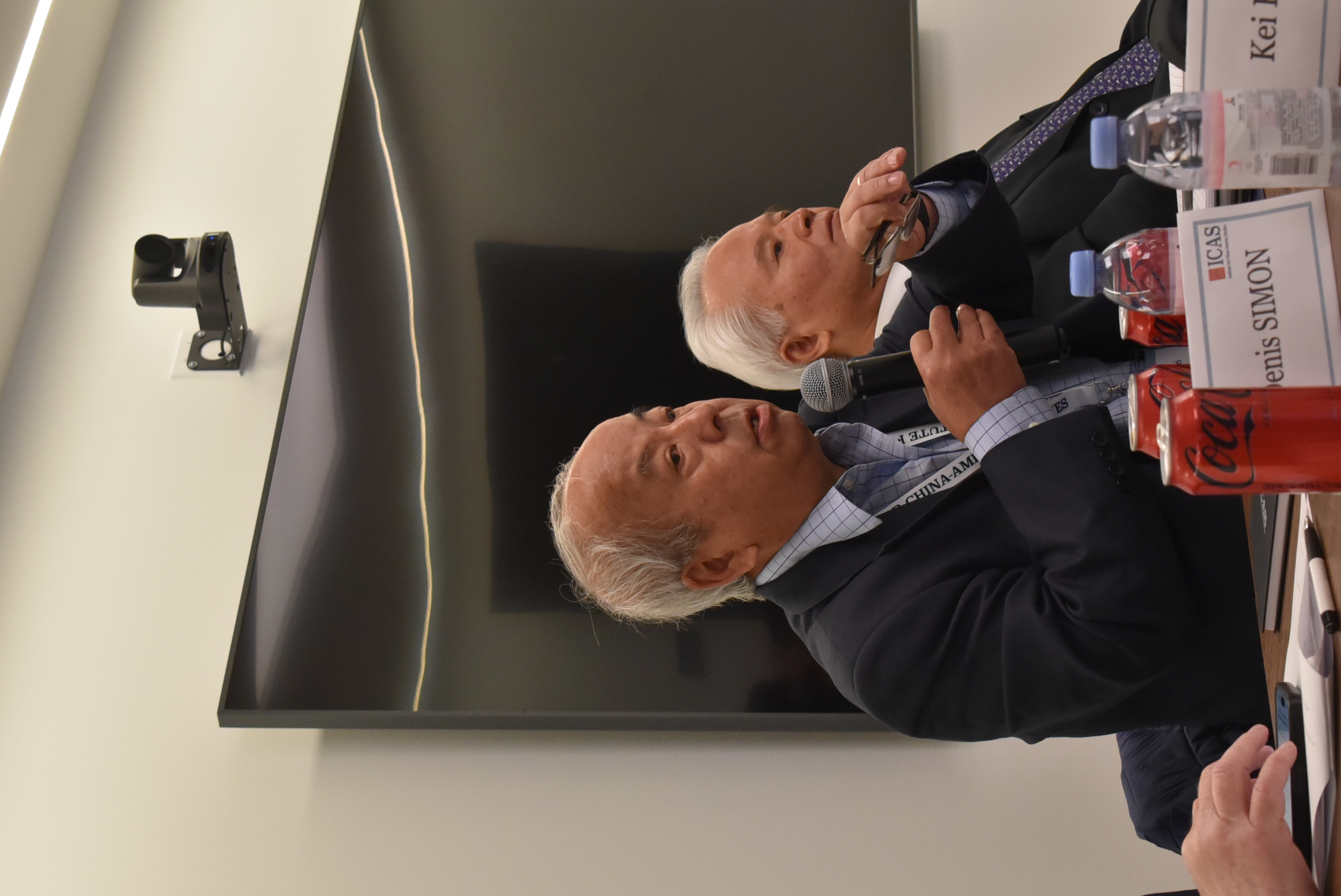
In his closing remarks, Liu Yawei reflected on the panel discussions and emphasized that competition is likely to remain the defining feature of U.S.–China relations. While limited tactical stabilization may occur, deep-seated economic, geopolitical, and structural differences persist. He underscored the importance of maintaining sustained communication across multiple levels and argued that dialogue formats such as the “U.S.-China Plus” Roundtable—bringing together Chinese, American, and third-party perspectives—will play an increasingly important role in managing tensions and preserving channels for engagement amid global uncertainty.