
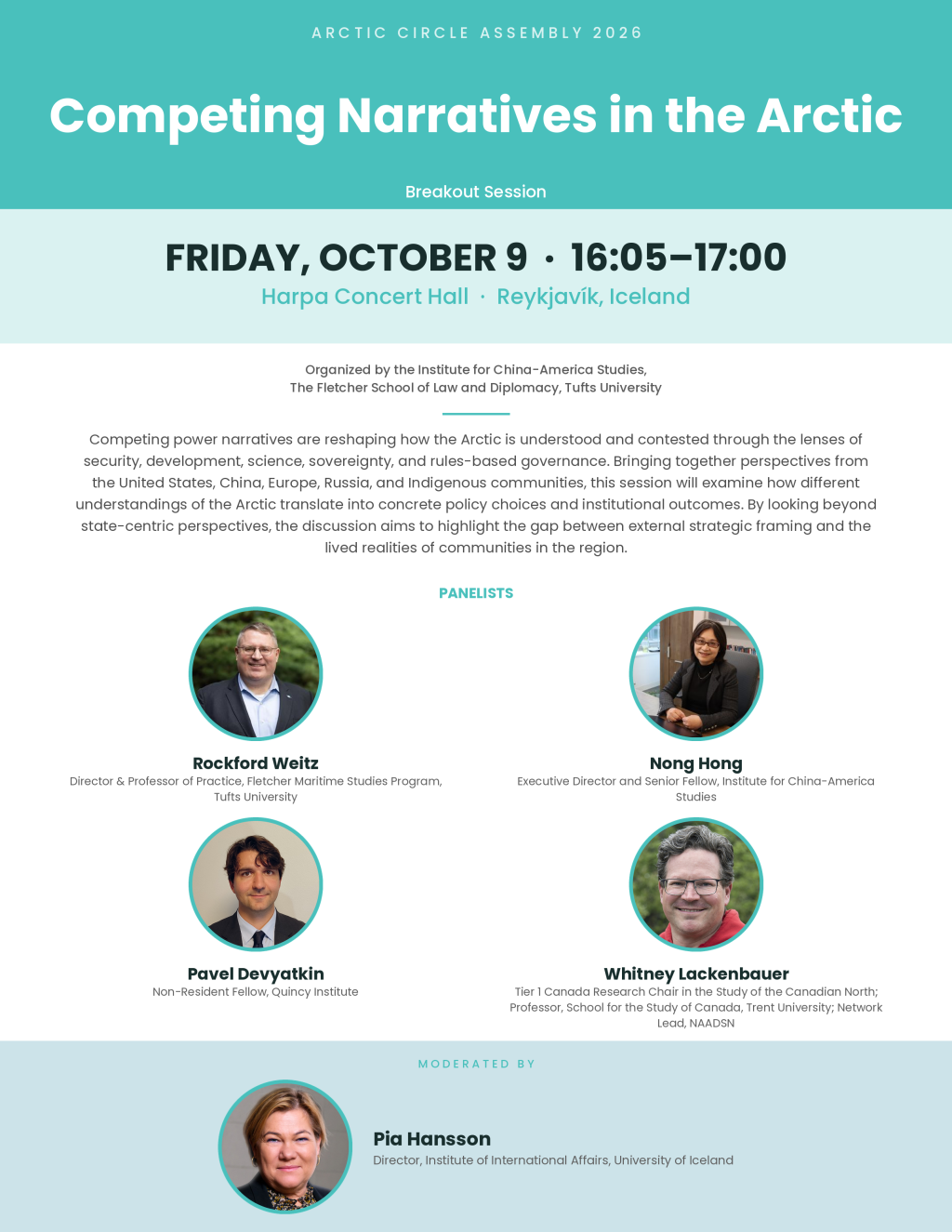
On Friday, October 9, ICAS and The Fletcher School of Law and Diplomacy at Tufts University will cohost the breakout session “Competing Narratives in the Arctic” at the Arctic Circle Assembly in Reykjavik, Iceland. Panelists include Rockford Weitz (Director & Professor of Practice, Fletcher Maritime Studies Program, Tufts University), Nong Hong (Executive Director and Senior Fellow, Institute for China-America Studies), Pavel Devyatkin (Non-Resident Fellow, Quincy Institute), Whitney Lackenbauer (Tier 1 Canada Research Chair in the Study of the Canadian North; Professor, School for the Study of Canada, Trent University; Network Lead, North American & Arctic Defense & Security Network), and the session will be moderated by Pia Hansson (Director, Institute of International Affairs, University of Iceland). Further info on panelists can be found below.
Competing power narratives are reshaping how the Arctic is understood and contested through the lenses of security, development, science, sovereignty, and rules-based governance. As geopolitical competition intensifies, these narratives are increasingly influencing not only how
outside actors engage the region, but also how Arctic governance priorities are defined and debated. Bringing together perspectives from the United States, China, Europe, Russia, and Indigenous communities, this session will examine how different understandings of the Arctic
translate into concrete policy choices and institutional outcomes. It will also explore how external narratives affect Arctic residents, Indigenous rights, local priorities, and the broader legitimacy of Arctic governance. By looking beyond state-centric perspectives, the discussion
aims to highlight the gap between external strategic framing and the lived realities of communities in the region.
Rockford Weitz is professor of the practice in maritime studies at The Fletcher School at Tufts University. He brings a wealth of expertise in maritime geopolitics and commodities trading to his courses on entrepreneurial leadership, maritime security, and global maritime affairs. As director of the Fletcher Maritime and Arctic Studies program, Weitz is a leader in research related to maritime security, arctic studies, blue technology, and energy geopolitics.
As professor of practice, Weitz draws from his previous experience as a former commodities trader. He served as founding CEO at CargoMetrics, where he led the effort to build a VC-backed financial technology business that grew in value to over $110M. An Arctic expert, Weitz advised the Singaporean prime minister’s office on the global implications of opening Arctic sea routes. Additionally, he has been committed to Track II diplomacy and negotiation since working on a social entrepreneurship venture in Bethlehem. With years of experience in both the global maritime industry and academia, Weitz is a trusted advisor to politicians and business leaders, and he is a frequent commentator in the media.
Pavel Devyatkin is a non-resident fellow at the Quincy Institute, senior associate and leadership group member at The Arctic Institute, and visiting lecturer at HSE University. His research on Arctic security and cooperation, nuclear arms control, and U.S.-Russia-China relations has been published by the U.S. Department of Defense, Polar Journal, Strategic Analysis, Responsible Statecraft, and other outlets. He provides consultations to diplomats and private companies and has presented research globally, including at the Arctic Council, Oxford University, George Washington University, Shanghai Institutes for International Studies, and Moscow State Institute of International Relations. He has been featured in Reuters, BBC, Washington Post, South China Morning Post, and other outlets. Pavel previously held fellowships with the United Nations (UNCCD), Stanford-U.S. Russia Forum, and Middlebury Institute of International Studies. An American of Russian ancestry, he is a graduate of the London School of Economics and University College London.
P. Whitney Lackenbauer, Ph.D., is Canada Research Chair in the Study of the Canadian North and Professor in the School for the Study of Canada at Trent University, Canada. He is network lead of the North American and Arctic Defence and Security Network (NAADSN) and recently received Canada’s Polar Medal. He has (co-)written or (co-)edited more than seventy books and more than one hundred academic articles and chapters. His recent books include Non-Arctic State Policies and Strategies: Alignments with Canada (edited 2026), Sensible Justice: Investigating the Murders of Radford and Street, 1913-1918 (2026), TAKUNIQ: The Canadian Rangers and Canada’s High Arctic in an Era of Strategic Competition (2025), The Russian Arctic in the 2010s and 2020s: Selected Articles from the Arctic Yearbook (co-edited 2025), Northwest Passages: Navigating the Canadian Arctic from Gjøa to Harry DeWolf (co-edited 2025), and
Canadian Arctic Defence and Foreign Policy: Recent Developments (edited 2025).
Pia Hansson is the Director of the Institute of International Affairs and its three centres, the Centre for Small States Studies, the Centre for Arctic Studies and Höfði Reykjavík Peace Centre. Pia is in charge of daily operations, policy and supervision of staff, including the coordination of a number of research projects in the field of international relations and foreign policy, the organization of conferences and seminars, and the publication of conference volumes and book series. Pia supervises fund raising and communication with sponsors, is in charge of media relations, writing applications and reports for grants and planning and implementing international intensive courses for graduate students of international relations and political science. In addition, Pia has taught a graduate level course on international cooperation at the University of Iceland for the last three years.
Pia holds a B.A. degree in Communication from the University of Minnesota and an M.A. degree in International Relations from the University of Iceland. She also pursued an M.F.A. programme in Television Production at the City University of New York. For years Pia worked as a Broadcasting Producer and Director, both in Iceland and abroad, until she became the Media Specialist at the Embassy of the United States in Iceland from 2000-2006. In the winter of 2007-8 Pia served as the Head Spokesperson for the Sri Lanka Monitoring Mission (SLMM), a Nordic ceasefire monitoring mission in Sri Lanka, on behalf of the Icelandic Ministry for Foreign Affairs.