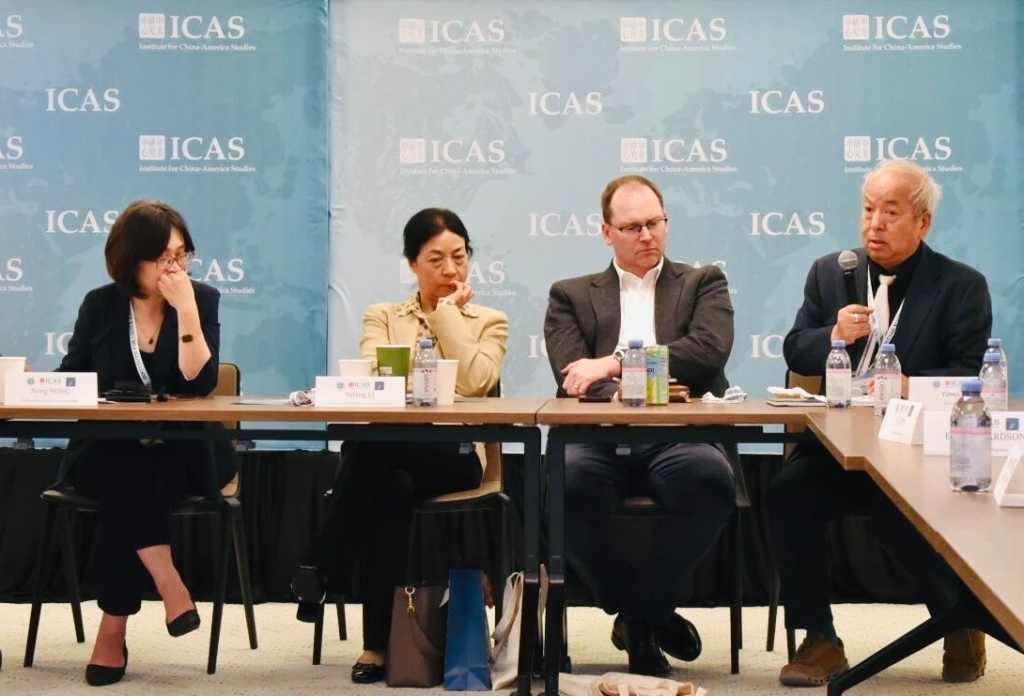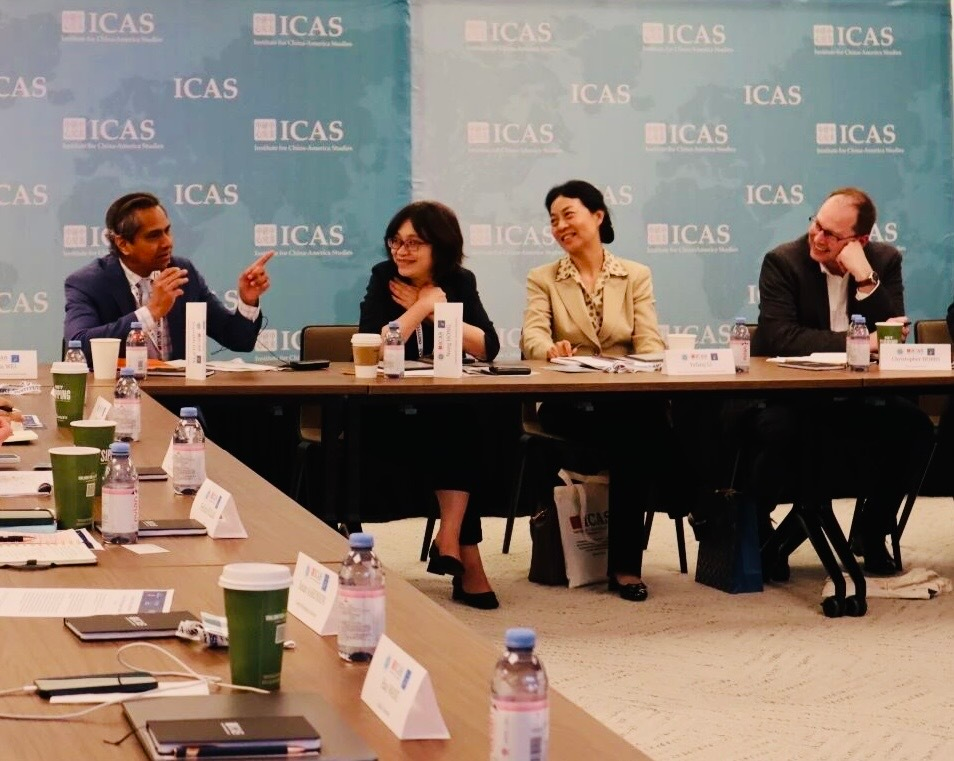
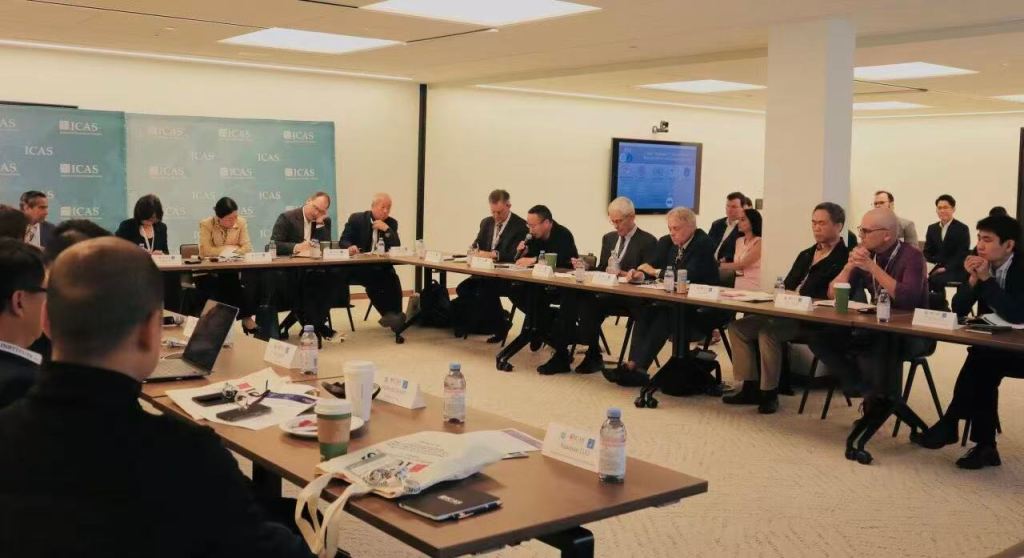
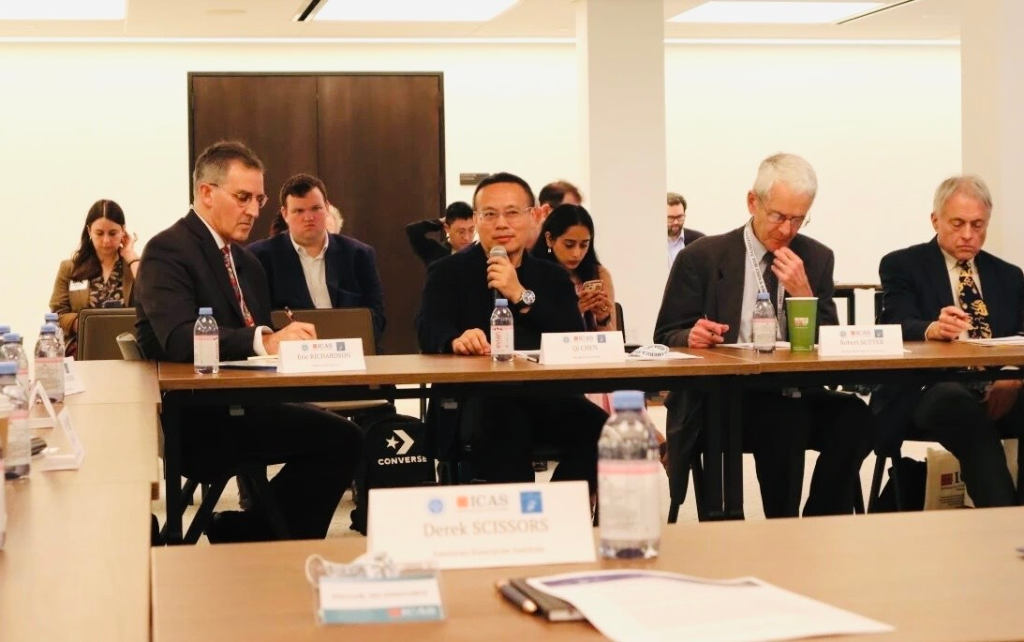
On April 17, 2026, the Institute for China-America Studies (ICAS), in collaboration with the Academy of Contemporary China and World Studies and the Carter Center, organized a symposium titled “High-Quality Development at a Time of Strategic Adjustment: Seeking a New Framework for Managing U.S.-China Relations” in Washington, D.C. The symposium, which was held by invitation only, brought together a diverse group of participants from leading academic institutions, think tanks, policy organizations, and the private sector in both the United States and China. It included scholars from major universities such as Tsinghua University, George Washington University, Fudan University, Beijing International Studies University, and the Chinese University of Hong Kong (Shenzhen), alongside researchers and fellows from prominent U.S.-based think tanks including the Cato Institute, the American Enterprise Institute, and the Asia Society Policy Institute. Additional contributions came from practitioners in government advisory roles as well as the private sector, including representatives from APCO Worldwide, and Canadian Solar, Inc. This institutional diversity ensured that the discussions integrated strategic, economic, technological, and business perspectives to examine the evolving foundations of U.S.–China relations against the backdrop of intensifying strategic competition and shifting domestic priorities in both countries.
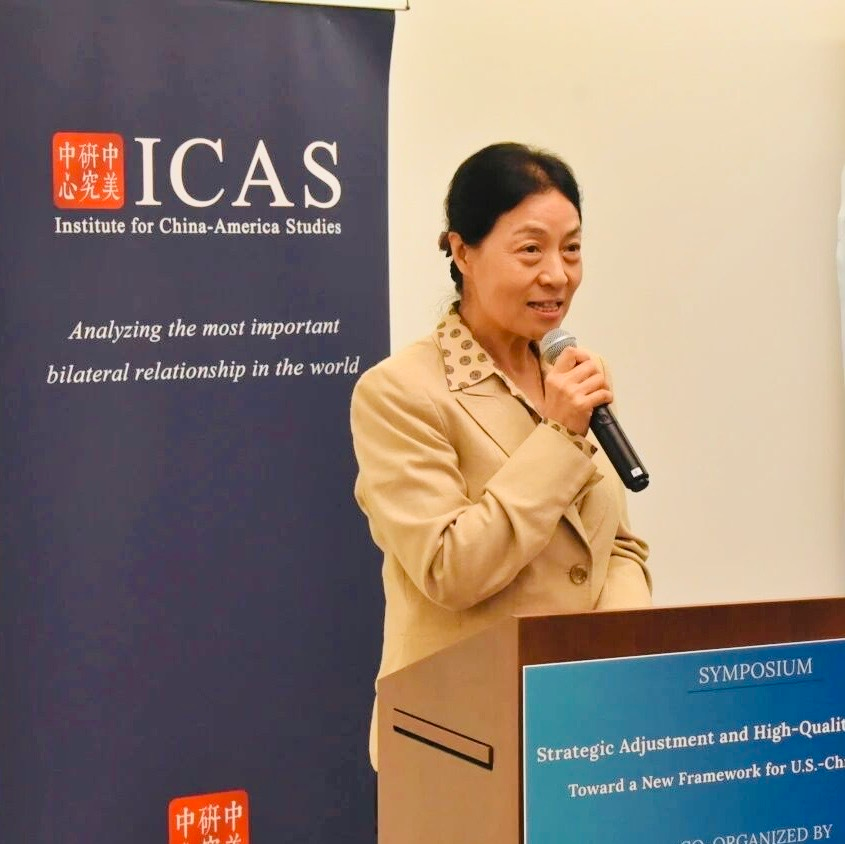
Dr. Nong Hong, Executive Director of ICAS, delivered the welcome remarks, followed by opening remarks from Yafang Li, President of the Academy of Contemporary China and World Studies, and Christopher Hobbs, Deputy Director for Peace Strategy and Operations at the Carter Center.

Panel I Managing U.S.-China Relations: Regional Stability and Strategic Adjustment
The first panel of the symposium focused on managing U.S.–China relations and regional stability with particular emphasis on the security dynamics in the Western Pacific and the centrality of the Taiwan issue. Panelists broadly agreed that while both Washington and Beijing continue to seek to avoid direct military confrontation, the risk environment has grown more complex due to intensified strategic signaling, shifting alliance dynamics, and evolving domestic political considerations on both sides. The Taiwan Strait remains the most consequential flashpoint in the bilateral relationship, and managing tensions in this domain without triggering broader destabilization remains a core challenge.
A recurring theme in the discussion was that U.S.–China relations cannot be understood through any single issue area in isolation. Economic ties, security competition, domestic politics, and technological rivalry are increasingly intertwined, creating a layered and mutually reinforcing dynamic. While channels of dialogue—such as economic consultations and people-to-people exchanges—remain important and largely unobjectionable, their political space in Washington has narrowed. In particular, bipartisan skepticism in the U.S. Congress toward China-related engagement, including technology cooperation and even certain forms of exchange, has hardened, limiting policy flexibility on the American side.
Panelists also pointed to the persistence—and in some cases fluidity—of “red lines” in the bilateral relationship. The Taiwan issue was identified as the clearest and most sensitive boundary, with both sides maintaining strong positions: Beijing emphasizing peaceful reunification while opposing separatism, and Washington continuing to view Taiwan as strategically important within its regional security architecture. At the same time, there was recognition that deterrence alone is insufficient to maintain stability. Without parallel investments in diplomacy and crisis management mechanisms, the risk of miscalculation or escalation cannot be effectively contained.
From the U.S. perspective, it was noted that domestic political divisions and shifting policy priorities—particularly under the Trump administration—have introduced additional uncertainty into both economic and security policy. While President Trump’s approach has tended to prioritize economic leverage, including tariffs and transactional bargaining, this has at times come at the expense of strategic coherence in security policy. Moreover, U.S. policies have, in some cases, alienated traditional allies, complicating coordination in the Indo-Pacific and potentially reshaping the broader competitive landscape with China.
From the Chinese perspective, panelists emphasized that Beijing’s long-term strategic direction remains firm, particularly its approach to development and foreign policy. The forthcoming phase of economic planning, including the next Five-Year Plan, was described as a critical juncture in advancing China’s model of “high-quality development,” with a focus on structural upgrading and technological innovation. At the same time, China continues to seek to avoid direct involvement in major power conflicts, emphasizing stability and the prevention of escalation, especially in the Taiwan Strait.
At a broader systemic level, the discussion highlighted the emergence of a more complex global order, characterized by elements of both bipolarity and multipolarity. The rise of artificial intelligence and the broader “fourth industrial revolution” were identified as key drivers reshaping the competitive landscape, while the global backlash against globalization has introduced new uncertainties into the international system. In this context, the U.S.–China relationship was described by some as increasingly “normalized” within a competitive framework, even as fundamental questions remain unresolved—particularly regarding the strategic rationale for U.S. commitments in the region and the long-term trajectory of cross-strait relations.
The panel concluded with a shared recognition that avoiding conflict must remain the overriding priority for both sides. Neither the United States nor China can afford a direct confrontation, particularly over Taiwan. Achieving this objective will require not only maintaining credible deterrence, but will also require strengthening diplomatic engagement, clarifying strategic intentions, and developing more effective mechanisms for crisis management. Ultimately, the ability of both countries to manage their internal challenges and align domestic priorities with external strategy will play a decisive role in shaping the future trajectory of their relationship.
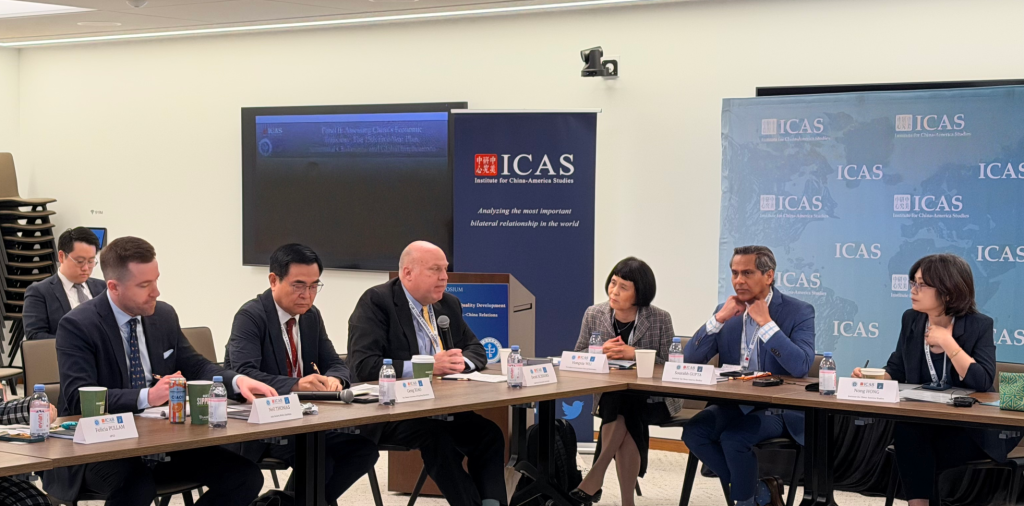
Panel II Assessing China’s Economic Trajectory: The 15th Five-Year Plan, Structural Challenges, and Global Implications
The second panel of the symposium assessed China’s economic trajectory in the context of the forthcoming 15th Five-Year Plan, with a focus on structural challenges, policy direction, and global implications. Panelists broadly agreed that China’s economy is entering a critical transition phase, in which the emphasis is shifting from the pace of growth to its quality, sustainability, and underlying drivers. While China retains significant industrial capacity and policy flexibility, the effectiveness of its next-stage development strategy will depend on its ability to navigate a complex set of structural constraints.
A central theme of the discussion was the evolving balance between resilience and adjustment within China’s economic model. Panelists noted that China is simultaneously seeking to reduce external vulnerabilities while maintaining a central role in global supply chains. This dual objective—greater self-reliance alongside continued integration—has become a defining feature of its economic strategy. In this context, innovation-driven development was identified as a key priority, although questions remain regarding the efficiency and long-term returns of such investments.
At the same time, panelists emphasized that domestic economic challenges are becoming increasingly salient. Issues such as local government debt, imbalances in investment and consumption, and pressures on household wealth were highlighted as areas requiring careful policy calibration. There was a shared view that China’s long-standing reliance on investment-led growth has reached its limits, and that a more balanced macroeconomic structure—anchored by stronger consumption demand—will be essential for achieving high-quality development. However, facilitating this transition will require sustained fiscal support and structural reform, particularly in areas affecting income distribution and domestic demand.
Discussion of the 15th Five-Year Plan suggested a strong degree of policy continuity rather than a sharp departure from previous frameworks. Panelists noted that the plan is likely to reinforce existing priorities, including the expansion of high-technology sectors and emerging industries, while maintaining support for traditional industrial strengths such as critical minerals and manufacturing. This approach reflects a pragmatic strategy of gradual adjustment rather than abrupt transformation. At the same time, it was acknowledged that the success of these policies remains uncertain, with some characterizing the current phase as a “high-stakes” effort to sustain productivity growth under increasingly constrained conditions.
From a comparative perspective, panelists also reflected on structural imbalances in both China and the United States. While China faces the challenge of rebalancing toward consumption, the U.S. economy was described as exhibiting its own form of imbalance, characterized by high levels of consumption relative to production. These contrasting dynamics underscore the interdependent nature of the bilateral economic relationship, even as strategic competition intensifies.
Despite prevailing tensions, there was cautious optimism regarding the potential for continued economic engagement between the two countries. Some panelists pointed to areas where cooperation remains possible, particularly in addressing shared economic challenges and maintaining stability within global supply chains. At the same time, it was emphasized that the trajectory of China’s domestic economic reforms will have significant implications not only for its own development, but also for the broader geoeconomic landscape and the future of U.S.–China economic relations.
The panel concluded with the insight that China’s transition toward high-quality development is both necessary and inherently complex. Its success will depend on the country’s ability to rebalance its growth model, sustain innovation, and manage structural risks, while remaining sufficiently integrated into the global economy. In turn, how this transition unfolds will play a critical role in shaping the prospects for more stable and mutually beneficial economic engagement between China and the United States.
Panel III Rewiring Economic Engagement: Trade, Technology Controls, and Investment in U.S.-China Relations
The final panel of the symposium examined the evolving landscape of economic engagement as well as competition between the United States and China, focusing on the interplay of trade, technology controls, and investment flows. Panelists broadly agreed that economic relations are no longer governed primarily by efficiency or comparative advantage, but increasingly shaped by national security considerations. As a result, trade, technology, and capital are now deeply intertwined within a policy framework that seeks to manage interdependence rather than expand it.
A central theme of the discussion was that the boundary between economics and security has effectively collapsed in Washington’s policymaking process. As noted by several panelists, both the current U.S. National Security Strategy and broader political discourse treat economic security as an extension of national security. This shift has been reinforced by domestic political dynamics, where China policy has become closely tied to electoral signaling. For policymakers and firms alike, this has created a more constrained and unpredictable operating environment, in which economic decisions are increasingly subject to political scrutiny.
At the same time, panelists emphasized that these measures have only resulted in selective decoupling. Tariffs and technology restrictions have imposed real costs and introduced friction into bilateral ties, but trade volumes remain significant and business linkages persist. Instead of a clean break, what has emerged is a system characterized by selective restriction alongside continued engagement. In this context, existing dialogue mechanisms—such as high-level economic channels—provide some capacity to manage tensions, but remain limited in scope and insufficient to address underlying structural divergences.
The discussion also highlighted the growing complexity of technology governance, particularly in the field of artificial intelligence. Panelists pointed out that AI simultaneously functions as a commercial asset and a global public good, yet there is little regulatory conversation – let alone convergence – between the United States and China. Divergent approaches to data governance, openness, and public oversight have created an environment in which technological competition coexists with deep interdependence. Despite ongoing tensions, there was a clear recognition that AI ecosystems remain globally interconnected, with shared talent pools, research linkages, and overlapping development pathways. In this sense, full decoupling in AI was viewed as neither feasible nor desirable.
Concerns were also raised about the broader societal implications of AI development. Panelists noted that governments in both advanced and emerging economies have struggled to adequately incorporate public input into AI governance, even as the technology’s impact on labor markets and social structures accelerates. This disconnect risks undermining public trust and could generate resistance to technological adoption. As such, there were calls for a more inclusive and adaptive approach to AI governance, one that better prepares societies for structural change while ensuring that regulatory frameworks keep pace with innovation.
On the investment front, the panel underscored the continued resilience of cross-border business activity, particularly at the subnational level. While national-level policies have tightened, state and local governments in the United States continue to pursue foreign investment, including from Chinese firms, often with a pragmatic focus on job creation and economic development. Panelists noted that subnational engagement remains an important, if underappreciated, channel for sustaining bilateral economic ties, even in a more restrictive federal policy environment.
From a corporate perspective, it was observed that Chinese firms are adapting to the changing landscape by localizing production, forming joint ventures, and maintaining a lower public profile in the United States. In certain sectors, particularly energy and manufacturing, Chinese companies have continued to expand their presence, supported in part by local-level incentives and the commercial logic of accessing the U.S. market. At the same time, broader U.S. policy objectives—such as controlling inflation and rebuilding domestic manufacturing capacity—are likely to shape the parameters within which such engagement can continue.
The panel concluded with the assessment that while economic engagement between the United States and China is being fundamentally “rewired,” it is far from being dismantled. Competition, restriction, and cooperation now coexist within a more complex and fragmented framework. Moving forward, the key challenge will be to develop more durable and predictable mechanisms for managing this hybrid system—one that acknowledges strategic competition while preserving sufficient space for economic interaction and global coordination.