
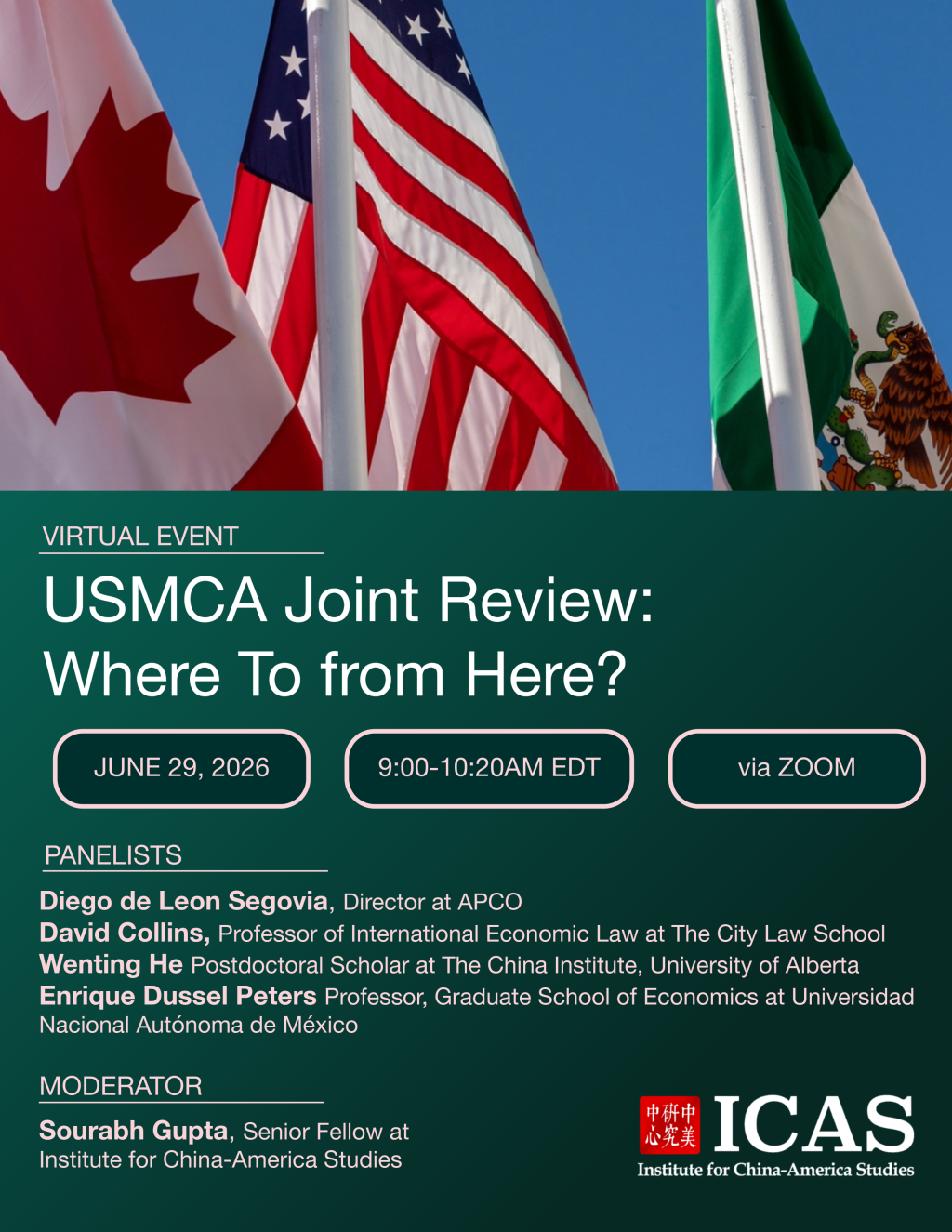
The Institute for China-America Studies (ICAS) held a virtual discussion on Monday, June 29, with Diego de Leon Segovia, Director at APCO; David Collins, Professor of International Economic Law at The City Law School; Wenting He, Postdoctoral Scholar at The China Institute, University of Alberta; and Enrique Dussel Peters, Professor at the Graduate School of Economics at Universidad Nacional Autónoma de México. Sourabh Gupta, Senior Fellow and Head of the Trade n’ Technology Program at ICAS, moderated the discussion.
The discussion took place just before the first six-year joint review of the United States-Mexico-Canada Agreement (USMCA). Although the review is formally intended to determine whether the three parties will extend the agreement for another sixteen years, panelists broadly agreed that the process has become a much wider negotiation over the future of North American production. The central questions are how much manufacturing should take place in the United States, how tightly Mexico and Canada should align with U.S. economic security priorities, and how Chinese participation in North American supply chains should be treated.
De Leon Segovia emphasized that the formal review date should be understood as the start of a process rather than a deadline for a final agreement. If the three governments do not immediately agree to an extension, USMCA will remain in force and move into a possibly 10-year phase of annual reviews. He noted that most businesses in the three countries continue to support the agreement because of the market access and supply-chain integration it provides. At the same time, the White House has made clear that it will not simply renew the agreement without seeking changes, leaving companies uncertain about how long the negotiations will continue and what new conditions may emerge.
The U.S. approach appears to combine two objectives. The first is to reduce Chinese and other non-market content in North American supply chains. The second is to bring a greater share of manufacturing and manufacturing employment into the United States. These goals do not necessarily mean that Washington wants to eliminate Mexico’s role as North America’s major manufacturing base. U.S. companies remain deeply invested in Mexico, and many regional supply chains cannot be relocated quickly. Rather, the emerging policy direction is toward a more conditional form of regional integration in which production in Mexico or Canada receives less favorable treatment when it depends heavily on Chinese capital, technology, components, or control.
Dussel Peters argued that this shift must be understood in the context of a new triangular relationship among the United States, China, and other countries such as Mexico and Canada. China is now an essential manufacturing supplier across Latin America. Chinese value added has also become more visible in Mexican exports to the United States, and much of Mexico’s importing from China is conducted by multinational firms, including U.S. companies. This makes the effort to remove Chinese content difficult because Chinese inputs are often embedded in production networks that support the competitiveness of North American firms themselves.
Automobiles are likely to be the most important test case. Panelists discussed possible U.S. efforts to raise regional value-content requirements and to require a larger portion of each vehicle to be produced specifically in the United States. Mexico and Canada may still have room to attract additional investment and help manufacturers meet tighter North American content rules. A separate U.S.-content requirement within USMCA’s rules-of-origin, however, would be much more disruptive because it would reserve more production for the United States rather than allowing companies to satisfy the rules through investment anywhere in North America. Short transition periods would be especially difficult for an industry whose sourcing and investment decisions are made years in advance.
Additionally, for Chinese automotive companies, formal compliance with USMCA rules of origin may not be enough to secure access to the U.S. market. De Leon Segovia noted that Mexico sees a strong economic case for Chinese investment but must manage the political risk of appearing to provide a route for Chinese products into the United States. Dussel Peters added that the Mexican government has become cautious about approving major Chinese auto plants when the USMCA negotiations remain unresolved. Collins was similarly skeptical that Canada could serve as a reliable platform for Chinese automakers seeking access to the United States, given the depth of Canada’s economic dependence on its southern neighbor.
The discussion suggested that U.S. policy may increasingly focus on the owners of the company, technology, and production process as well. References to capital and factory ownership, combined with existing U.S. restrictions on Chinese connected vehicles and investment, point toward a broader ownership-based approach in this sector. Under such a framework, assembling a product in Mexico or Canada would not necessarily remove concerns about Chinese control, and even direct investment in the United States might remain subject to restrictions.
The same policy logic could eventually reach beyond automobiles. De Leon Segovia highlighted renewable energy and pharmaceuticals as sectors in which U.S.-China competition is already visible, while He noted that clean energy is increasingly treated as an economic security issue rather than only a matter of cost and emissions. Solar, battery, and industrial manufacturing projects in North America often rely on Chinese-made machinery and technical expertise even when their final products are locally manufactured. Manufacturing equipment was not presented as a central subject of the current review, but future policy attention could move upstream from finished products and raw materials to the equipment, software, and services used in production.
From the Canadian perspective, Collins and He described a difficult balancing act. Canada has sought to improve economic relations with China and diversify beyond the U.S. market, but it cannot easily jeopardize access to the United States. He argued that Chinese firms considering Canada should therefore build flexibility into their supply chains, strengthen traceability and compliance systems, and preserve the ability to change sourcing or production if regulations shift. She also suggested that Canada-China cooperation may remain more feasible in lower-sensitivity areas such as hydrogen, carbon capture, grid technologies, and also other climate-related innovation than in electric vehicles or critical mineral supply chains.
Collins also focused more broadly on Canada’s position in the review. He noted that Canada has appeared less involved in the formal negotiations than Mexico, and some discussions may be taking place privately. Ottawa’s priorities include restoring predictable access to the U.S. market, addressing U.S. tariffs on Canadian steel, aluminum, and automotive goods, and resisting rules that would reserve a fixed share of vehicle content specifically for the United States. He also emphasized the difficult domestic political environment in which Prime Minister Mark Carney cannot afford to appear overly accommodating to Washington after a period of unusually sharp bilateral tensions. Meaningful progress on U.S.-Canada relations could depend heavily on a political understanding between Carney and Trump, followed by technical work on narrower sectoral concessions rather than a comprehensive settlement.
Looking ahead, the panelists generally expected USMCA to survive but not necessarily to receive a quick and clean extension. De Leon Segovia and Collins anticipated that the agreement may enter annual review, possibly accompanied by smaller sectoral deals or tariff concessions. Dussel Peters raised the possibility that the trilateral framework could increasingly give way to separate U.S.-Mexico and U.S.-Canada arrangements. Across these scenarios, the most immediate consequence for companies is prolonged uncertainty. Mexico and Canada will remain important facets of North American production but they can no longer be treated as automatic gateways to the U.S. market. Future access is likely to depend on a combination of product origin, ownership and control, supply-chain transparency, and alignment with U.S. economic security priorities.
Diego de León Segovia is a Director based in New York where he is a member of the Office of the Executive Chair (OXC). Diego supports senior level officers to coordinate and advance APCO’s OXC projects in Latin America and other strategic regions, especially those regarding climate change. Before joining APCO, Diego served as director for urban, energy and infrastructure affairs and director for climate change at the Mexican Ministry of Foreign Affairs, where he oversaw the supervision of bilateral and multilateral negotiations related to these topics.
Professor David Collins specializes in the law of the World Trade Organization and international investment law. He also heads City Law School’s Digital Trade Research Group. David was nominated to the roster of panellists for NAFTA (now USMCA)’s trade remedies disputes by the government of Canada and to the panel of arbitrators for EU and UK free trade agreements by the European Commission and the British government respectively. He has been an oral witness for the UK parliament’s International Trade Committee (HoC) and International Agreements Committee (HoL) as well as for the Canadian parliament’s International Trade Committee (HoC). In 2025 the WTO Secretariat appointed him to the roster of experts under Art 27.2 of the Dispute Settlement Understanding.
Wenting He is a postdoctoral scholar at The China Institute, University of Alberta. She holds a PhD in International Relations from the Australian National University. Her research focuses on economic ideas, economic crises, development finance, and geoeconomics, with a particular expertise on China. Her work has been published in peer-reviewed journals such as The China Quarterly and Asia Policy. Beyond academic research, Wenting is actively engaged in both teaching and policy communities. She has taught in 15 university courses in International Relations and has delivered 4 executive education programs on China’s foreign and economic policies for the Australian Government.
Enrique Dussel Peters has a Ph.D. in Economics at the University of Notre Dame (1996). Professor at the Graduate School of Economics, Universidad Nacional Autónoma de México (UNAM) since 1993. Coordinator of the Center for Chinese-Mexican Studies (Cechimex) of the School of Economics at UNAM and of the Academic Network of Latin America and the Caribbean on China (Red ALC-China). Member of Sistema Nacional de Investigadores (level 3). Research topics that interest him include economic development, political economy, industrial organization, and trade theory; NAFTA and CAFTA; evolution of industrial, trade, and regional patterns in Latin America and Mexico. As an ongoing project, he is coordinating a group of studies and respective publications of China’s overseas foreign direct investment (OFDI) in Latin America and Mexico and of Mexican firms in China.
Sourabh Gupta is a senior Asia-Pacific international relations policy specialist with two decades of Washington, D.C.-based experience in a think tank and political risk research and advisory capacity. His key area of expertise pertains to the intersection of international law, both international trade and investment law and international maritime law (Law of the Sea), with the international relations of the Asia-Pacific region. His areas of specialization include: U.S.-China trade and technology competition; analysis of developments in World Trade Organization and Asia-Pacific economic regionalism; analysis of major power relationships (China-U.S., China-Japan, China-India, U.S.-Japan, U.S.-India, Japan-India; Russia-Japan relations) and key flashpoint issues in the Asia-Pacific region; and analysis of outstanding territorial disputes and maritime law-related developments. He is a member of the United States Council for Security Cooperation in the Asia-Pacific (USCSCAP).