
ICAS Bulletin (online ISSN 2836-3418, print ISSN 2836-340X) is published every other week throughout the year at 1919 M St NW, Suite 310, Washington, DC 20036.
The online version of ICAS Bulletin can be found at chinaus-icas.org/bulletins/.
– On October 16, China’s Ministry of Commerce proposed a curb on 23 AI-related technologies in an effort to limit overseas ownership and replication of Chinese models, including methods for coordinating more than 10,000 AI chips.
– Also on October 16, China’s Ministry of Commerce announced export restrictions on 12 solar-related technologies to maintain a technological edge in renewable energy and boost domestic innovation.
– The U.S. Department of Homeland Security (DHS) made the public order on October 19 mandating the removal of Chinese AI model DeepSeek technology and the procurement of DeepSeek products from federal civilian agency AI systems, including services developed using the company’s technology, following the initial National Defense Authorization Act (NDAA) ban in January 2026.
– On October 22, the U.S. Department of the Treasury issued a Notice of Proposed Rulemaking (NPRM) to increase outbound investment screening under the Comprehensive Outbound Investment National Security (COINS) Act, expanding prohibitions for Super Intelligence systems, semiconductors, quantum software, and biotechnology.
– On October 28, the DHS placed three Chinese genomics companies on the Uyghur Forced Labor Prevention Act Entity List, after alleged use or facilitated use of forced labour of Uyghurs and other minorities, or source material from the Xinjiang Uyghur Autonomous Region. China’s embassy in Washington rejected the allegations.
– Chinese export restrictions on tunnel boring machines and components are set to go into effect on November 18, mandating export operators to apply for a license in accordance with export control law and regulation of dual-use items.
Associated News References:
“China Moves to Restrict Exports of Some Solar Technologies,” Bloomberg, October 16
“China commerce ministry announces export controls for tunnel boring machines,” Reuters, October 19
“U.S. bans DeepSeek from government agency systems amid AI rift with China,” CNBC, October 20
“Treasury Issues Proposed Rule to Implement Comprehensive Outbound Investment National Security Act,” U.S. Department of the Treasury, October 22
“US bans imports from BGI Genomics, MGI Tech, citing ties to forced labor in Xinjiang,” Reuters, October 28
“China’s new export curbs draw a line around its AI crown jewels,” Reuters, October 28
“FCC votes to ban all Chinese labs from testing US electronics,” Reuters, October 29
“China’s 5,000-Ton Digging Machines Are a Trade War Risk to India,” Bloomberg, November 1
– After the passing of former Japanese Prime Minister Yasuo Fukuda on October 22, Chinese President Xi Jinping extended condolences to the family and called on current Japanese leadership to “safeguard the political foundation” of ties between the two nations, serving as a rare direct reference to the relationship since it began deteriorating in November 2025.
-During a parliamentary hearing on October 23, Japanese Defense Minister Shinjiro Koizumi opened discussion regarding propulsion systems for next-generation submarines, citing Indo-Pacific regional security as a benefit to Japanese possession of nuclear submarines.
-It was reported on October 22 that Chinese export stalling of yttrium, a mineral critical in manufacturing aviation engines and semiconductor production equipment, has left Tokyo months away from running out of the rare earth, with imports to Japan decreasing from 51,000 kilograms in September 2025 to 4,000 kilograms in September 2026.
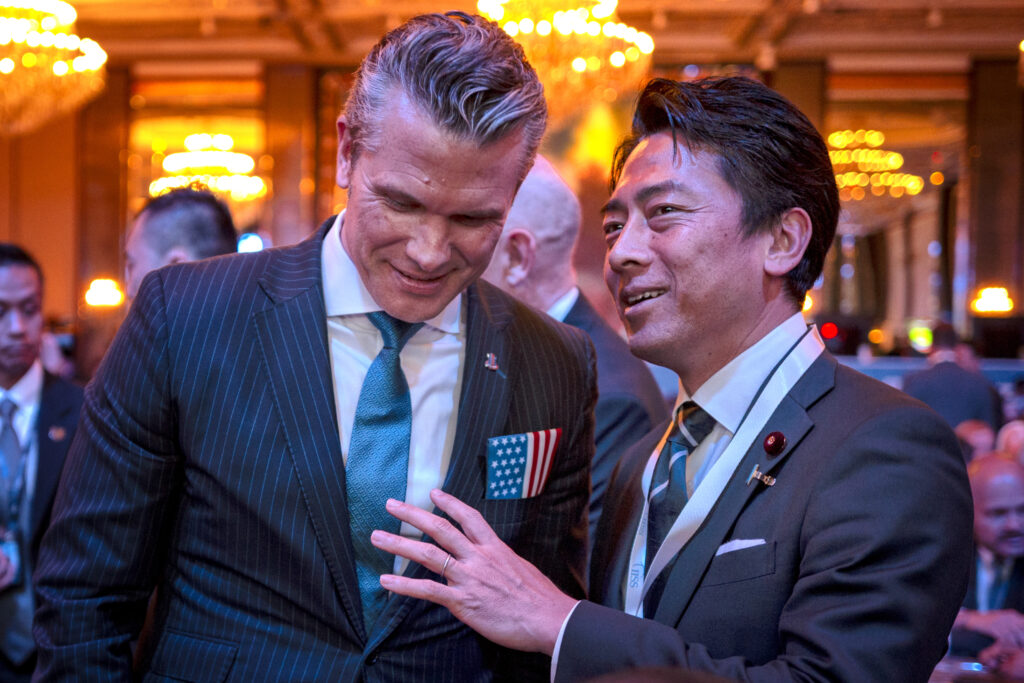
– On October 29, Japanese Defense Minister Shinjiro Koizumi and U.S. Secretary of War Pete Hegseth announced Operation Supercharge, a joint defense production agreement to assemble and inspect Advanced Medium-Range Air-to-Air Missiles (AMRAAM) and Standard Missile-3 (SM-3) Block IIA interceptors in Japan.
– Operation Supercharge aims to supply critical munitions for F-35 fighter jets, share technical information between U.S. and Japanese manufacturers to accelerate arms production, and reinforce deterrence capabilities amidst regional security concerns.
– From October 19-29, 11,000 U.S. service members joined 45,000 Japan Self-Defense Forces personnel in Exercise Keen Sword 27 (KS27), a multilateral military exercise held in Japan, with additional participants from 7 other countries.
-On October 29 a spokesman for China’s Foreign Ministry, Guo Jiakun, criticized popular Japanese TV series “Vivant” for its spreading of anti-China sentiment in Japan and promotioning of negative views of China, ultimately leading to Sanrio, the Japanese entertainment company behind Hello Kitty to cancel its merchandising partnership with the show.
Associated News References:
“Supplies of rare earth yttrium have ‘stalled,’ industry ministry official says,” The Japan Times, October 22
“China’s Xi calls on Japan to protect political foundation of ties,” Reuters, October 27
“Japan to Sell More Weapons Abroad, Breaking With Postwar Pacifism,” NPR, October 29
Hello Kitty company cuts ties with Japanese spy show after China outcry,” The Guardian, October 29
“How a Japanese Spy Drama Became the Target of China’s Anger,” The New York Times, October 31
“US experts warm to Japanese nuclear subs as check on China in Asian waters,” Nikkei Asia, November 3

– On November 3, the U.S. midterm elections ended in a Democratic victory, winning an estimated 258 House seats and securing at least 54 Senate seats, with races such as Alaska and Mississippi still too close to call as of November 5.
– China is an explicit campaign issue in three Senate races: both parties in Iowa’s October 7 debate brought up trade policy with China and its effect on domestic market, the October 11 debate in South Carolina directly discussed China in relation to data canters, and both parties in Texas discussed foreign ownership of land in Texas in the October 6 and 13 debates.
– The American Meat Producers Association is running a $30 million campaign against the Save Our Bacon Act on the argument that it ‘saves China’s pork industry,’ because Chinese-owned Smithfield would gain from preempting California’s Proposition 12.
– During the North Carolina senate campaign, Republican Michael Whatley argued that Democrat Governor Roy Cooper granted a $32 million tax break to a solar company with deep ties to the Chinese government.
– Texas Republican Ken Paxton launched a $15 million ad campaign accusing his Democratic opponent James Talarico of support for and being “soft on China”, white Talarico responded claiming Paxton was “cozied up with the CCP” after a 2019 trip to Beijing.
Associated News References:
“Paxton allies launch $15 million ad campaign,” Politico, August 31
“Iowa Senate debate, October 7, 2026,” Semblen, October 7
“U.S. Senate candidates talk tariffs, immigration, Social Security at first debate,” The Gazette, October 8
“Data center anxiety plays out in Senate campaign debates,” Roll Call, October 19
“From Soybeans to Data Centers, China Debate Hits US Midterm Campaigns,” VAO Mandarin, October 20
“Data Center Industry Pushes for Darline Graham in South Carolina Senate Race,” The New York Times, October 26
“Trump-Backed ‘America First’ Senate Candidate Busted
“2026 Senate Results: Democrats retake control” NBC News, November 4
“2026 House Results: Democrats Win Control” NBC News, November 4
“Pentagon designates China-backed campus cultural centers a threat to US national security,” The Guardian, October 23
“US to halt visa waivers for Chinese traveling to Pacific territory,” Nikkei Asia, October 28
“Huawei opens defence in US criminal trial, touting its record of innovation,” South China Morning Post, October 29
“Trump voices uncertainty about Nvidia CEO, a close tech advisor,” The Washington Post, November 1
“Surging costs and China trade war test US farmers’ loyalty to Trump,” Nikkei Asia, November 2
“US Congress welcomes record number of lawmakers of Chinese descent,” South China Morning Post, November 5
Three themes stood out in Washington’s China policy discussion over the past two weeks. First, how the U.S.-China technology competition across AI, quantum software, and pharmaceuticals is unfolding. In the last two weeks, biotechnology has become a more explicit national security issue, as China’s supply chain for pharmaceuticals continues to advance. While some argue that the U.S. Treasury Department’s expansion of the COINS Act strengthens American competitiveness, others raise questions about technology decoupling hindering domestic innovation. Second, Trump’s latest diplomatic activity with Iran and Russia has generally been received by analysts and the American public negatively. Amidst high domestic friction and shifting geopolitical tensions, the legitimacy and sustainability of President Trump’s “shock-and-awe” foreign policy has come into question. Foreign-policy leaders across political groups broadly agree that tariffs are worsening cost-of-living standards, therefore playing a role in the decreasing popularity of Republican candidates in the U.S. November midterm election. The third theme addresses how China discussion in the midterm election may impact U.S. domestic economy and Trump’s foreign policy. With growing concern about foreign ownership of American agriculture, policymakers in Washington are being pushed to weigh whether further economic decoupling from China is worth the impact it may have on American farmers, businesses, and consumers.
October 21 hosted by Hudson Institute
October 21 by Center for Security and Emerging Technology, Georgetown University
October 22 hosted by CISI
October 28-29 hosted by CSIS
October 23 hosted by Georgetown University’s Initiative for U.S.-China Dialogue on Global Issues
November 3 hosted by Brookings
November 5 hosted by Stimson Center
November 9 hosted by CSIS
November 9-10 hosted by Victims of Communism Memorial Foundation
November 10 hosted by American Enterprise Institute
November 20 hosted by Global Taiwan Institute
November 12 hosted by Washington Post Intelligence
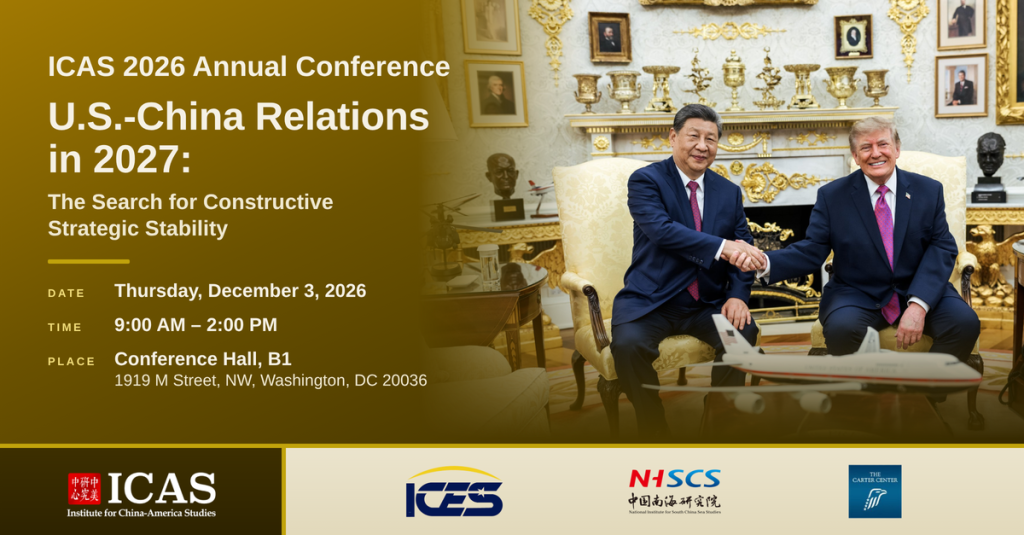
U.S.-China Relations in 2027: The Search for Constructive Strategic Stability
December 3, 2026
9:00AM-2:00PM
On December 3, ICAS will host our annual conference in conjunction with the National Institute for South China Sea Studies, The Carter Center, and Institute for China-Europe Studies. The ICAS Annual Conference brings together scholars, former officials, diplomats, policy practitioners, and other specialists to assess major developments in U.S.-China relations and their wider regional and global implications. The 2026 conference will convene in Washington, D.C., at a time of renewed leader-level engagement, continuing strategic competition, shifting domestic political dynamics in the United States, and broader changes in the international strategic environment.
7th Symposium on Ocean Governance and Maritime Cooperation
November 6-7, 2026
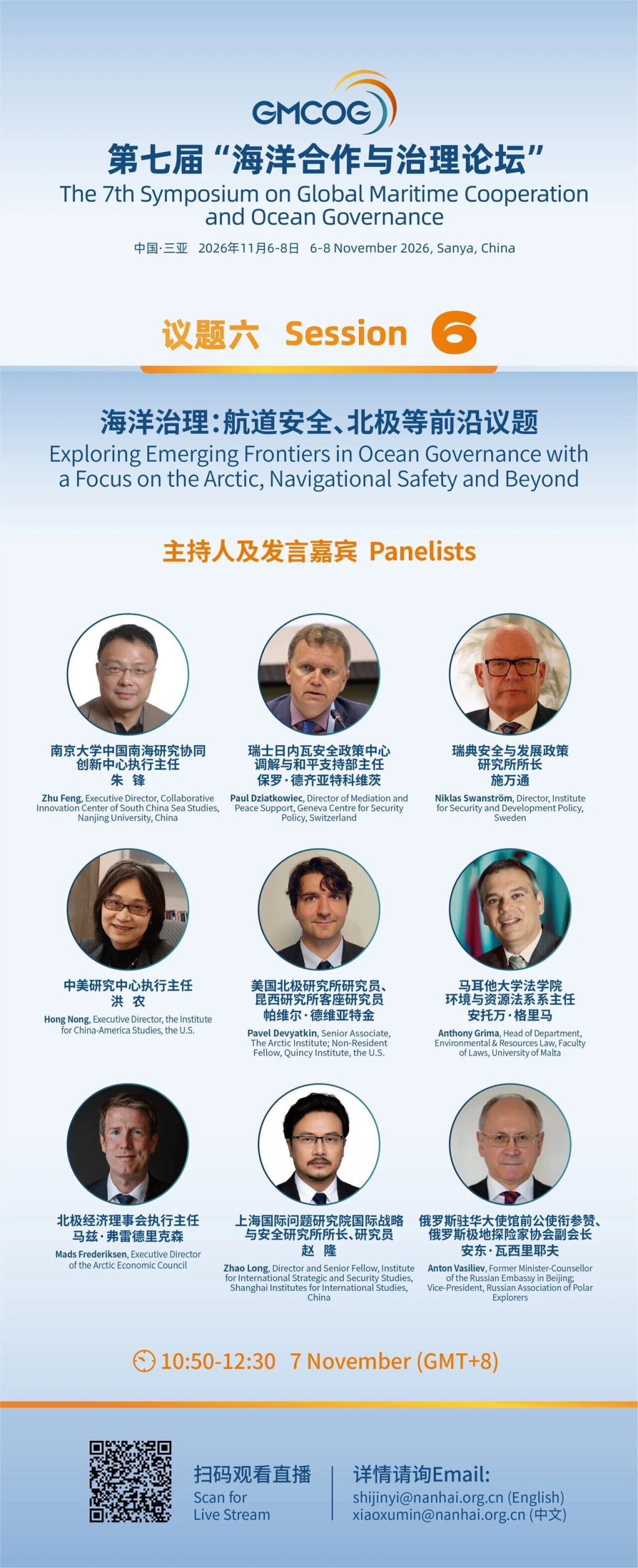
Executive Director Dr. Nong Hong and Research Associate Zhangchen Wang will attend the 7th Symposium on Global Maritime Cooperation and Ocean Governance held in Sanya, China. Dr. Nong Hong will be on the panel “Exploring Emerging Frontiers in Ocean Governance with a Focus on the Arctic, Navigational Safety and Beyond” while Zhangchen Wang will speak as part of the Young Scholars Forum on “Ocean Conservation and Governance in the Age of AI”.
Europe’s Arctic Recalibration: Ambitions, Constraints, and Strategic Choices
By Nong Hong
October 21, 2026
The European Union (EU) released its new Arctic Strategy on October 20, 2026, reflecting a changing assessment of the region’s geopolitical and economic importance. Since the EU adopted its previous Arctic policy in 2021, the Russia-Ukraine war, Finland’s and Sweden’s accession to NATO, growing interest in Arctic resources and shipping routes, and tensions surrounding Greenland have altered the regional strategic environment. Climate change continues to transform the Arctic, but security concerns and economic interests now occupy a more prominent place in European policy discussions.

The Midterms May Change Congress but Not Its China Consensus
By Yilun Zhang
October 27, 2026
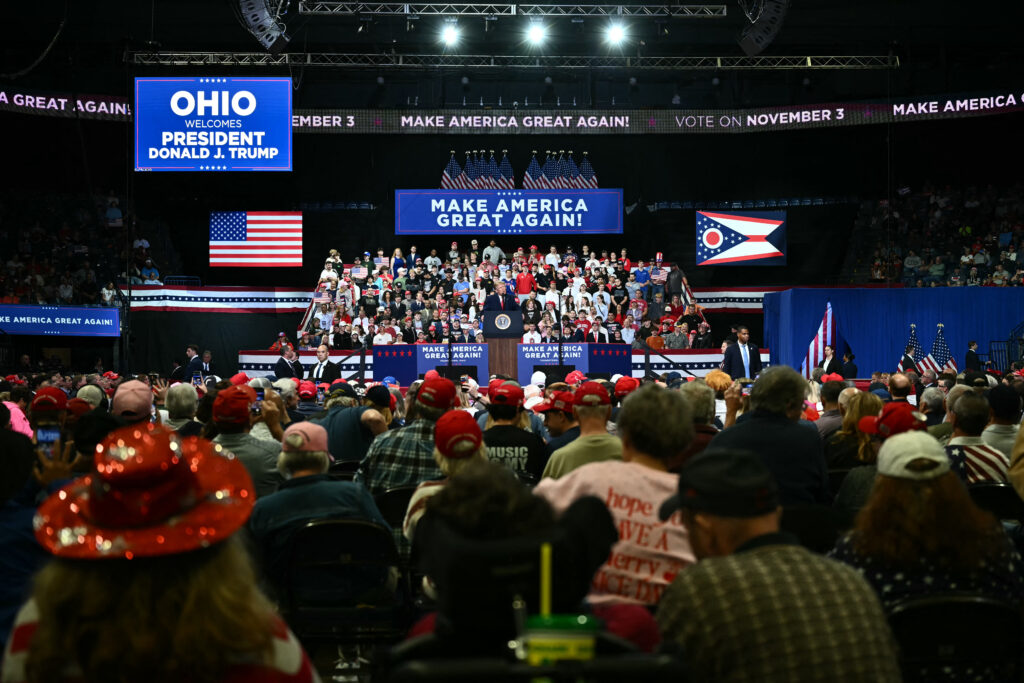
At an October rally in Ohio supporting Senator Jon Husted, President Donald Trump defended data centers with a familiar warning: “They’ll go to China.” Sherrod Brown’s criticism concerned subsidies for technology companies and costs passed to households. The immediate argument was about electricity bills, local authority, and corporate benefits. China supplied the strategic justification for one side’s answer.
Russia-Norway Fisheries Cooperation: Resilience and Its Limits
By Nong Hong
October 27, 2026
Norway and Russia reached a fisheries agreement on October 23, setting catch quotas for 2027 and extending their cooperation on scientific research and resource management in the Barents Sea. The negotiations, held in Istanbul, marked the first face-to-face meeting between the two sides since 2019. The agreement came despite continuing tensions over the Russia-Ukraine war, sanctions on Russian fishing companies, and disputes over access to Norwegian ports. It reflects the durability of fisheries cooperation, even as political disputes have begun to interfere with some of the arrangements that support it.

EV Investment Could Open a New Pathway for U.S.-China Relations
By Zhangchen Wang
October 29, 2026
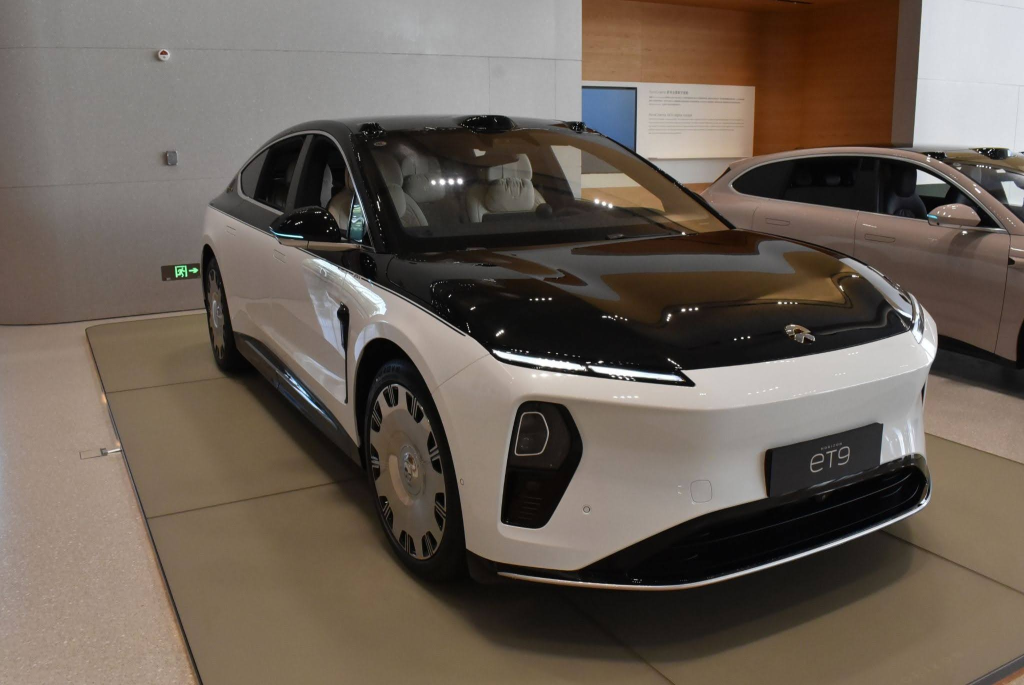
A recent news report suggests that U.S. and Chinese negotiators are discussing a list of projects in non-sensitive sectors that could form the first round of Chinese investment in the U.S. under the new bilateral Board of Investment. Options reportedly under consideration include electric vehicles (EV), battery storage, and power equipment and infrastructure, among other as-yet-unspecified areas. EV investment could become an early test of the Board, and this potential opening deserves serious consideration.
Finland and Norway’s call to Putin tests European unity over Russia
By Nong Hong
November 3, 2026
When Finnish President Alexander Stubb and Norwegian Prime Minister Jonas Gahr Støre called Russian President Vladimir Putin on October 27, they took an unusual diplomatic step at a time when direct high-level contact between European governments and Moscow has been limited. The call, initiated by the two Nordic leaders ahead of renewed peace negotiations, also drew criticism from Denmark over the lack of broader European coordination.
On November 5, 2026, Senior Fellow Sourabh Gupta was quoted in the South China Morning Post on AI competition with China affecting the midterms.
On November 4, 2026, Sourabh Gupta was quoted in the South China Morning Post on Midterms impact on China policy.
On November 4, 2026, Sourabh Gupta was quoted in the South China Morning Post on U.S. Midterm elections.
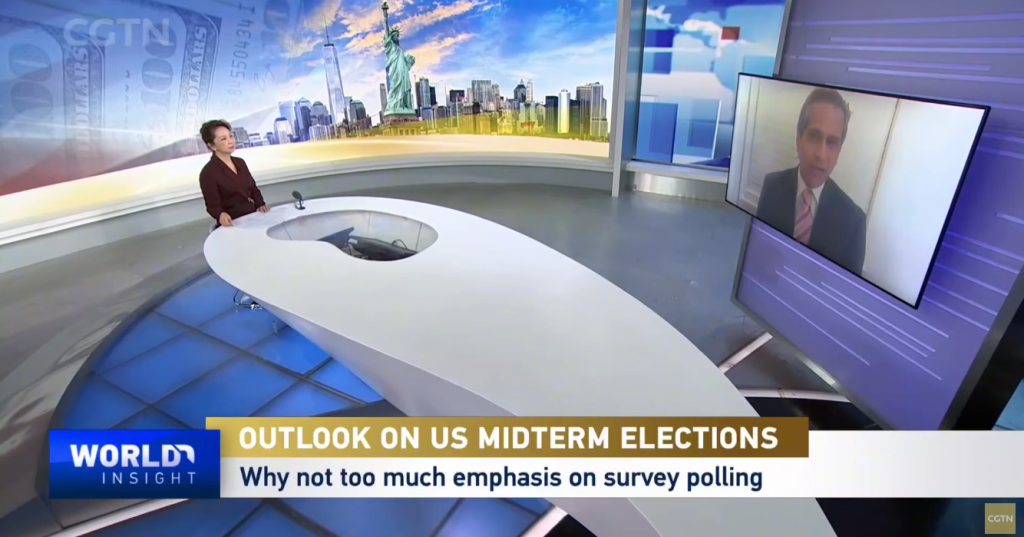
On November 3, 2026, Sourabh Gupta appeared on CGTN World Insight ahead of U.S. Midterm elections.