
ICAS Bulletin (online ISSN 2836-3418, print ISSN 2836-340X) is published every other week throughout the year at 1919 M St NW, Suite 310, Washington, DC 20036.
The online version of ICAS Bulletin can be found at chinaus-icas.org/bulletins/.
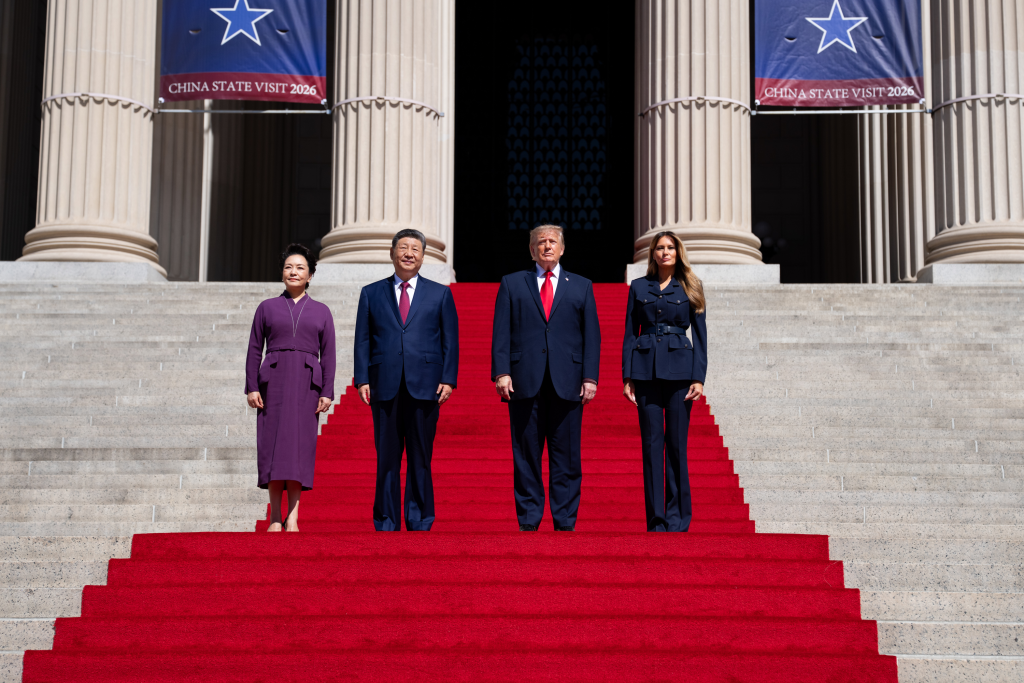
– On September 25, U.S. President Donald Trump said he expected to meet Chinese President Xi Jinping again in China during the APEC Economic Leaders’ Meeting in Shenzhen in November and at the U.S.-hosted G20 summit in Florida in December, pointing to continued leader-level engagement following President Xi’s Washington visit.
– On October 1, Chinese Ambassador to the U.S. Xie Feng described closer presidential ties, a stable bilateral relationship, and cooperation on trade, counternarcotics, military communication and people-to-people exchanges as key outcomes of the visit.
– Xie also reiterated Beijing’s “four red lines” on Taiwan, democracy and human rights, China’s political system, and its development rights, while calling for continued use of diplomatic and economic channels to manage differences.
– Meanwhile, implementation of the new U.S.-China Board of Trade remains a work in progress. The two sides released lists covering up to $30 billion each in products eligible for tariff reductions, but U.S. Trade Representative Jamieson Greer said on October 2 that there was no specific timeline for implementation and that U.S. tariff changes would first have to undergo domestic legal procedures.
– Trade frictions also remain unresolved despite the extended truce. China extended two investigations into U.S. trade practices until December 27, while Washington continued to press Beijing over industrial overcapacity, forced labor and critical mineral policies.
– On October 3, Senator Steve Daines, a close Trump ally and longtime interlocutor with Beijing, urged both sides to “stay engaged” rather than retreat over disagreements including rare-earth supply chains. Critical minerals are expected to remain an important issue as the two governments prepare for further talks later this year.
Associated News References:
“Trump says he will meet Xi in China in November,” Reuters, September 25
“US, China agree to cut tariffs on $60B worth of products,” The Hill, September 28
“US pushes against overproduction with eye on China at G20 meeting,” AFP, September 30
“China extends two trade barrier probes into US till December 27,” Reuters, September 30
“Exclusive: China Ambassador Reveals Deals and ‘Red Lines’ of Trump-Xi Talks,” Newsweek, October 1
“Greer says no specific timeline set for enforcing US-China Board of Trade,” South China Morning Post, October 2
“Exclusive | ‘No retreat’: key Trump ally urges continued US-China engagement on rare earths,” South China Morning Post, October 3

– On October 4, Bloomberg Intelligence reported that the performance gap between leading U.S. and Chinese AI models had narrowed to a record low of about 3%, compared with around 9% in May and 15% earlier this year. The improvement followed the September release of DeepSeek’s V4.1 Flash model and added to concerns over how quickly Chinese developers are narrowing the U.S. technological lead.
– Chinese firms are also working to reduce dependence on the U.S. AI technology stack. On September 30, DeepSeek announced a partnership with Huawei to develop and open-source programming tools for Huawei’s Ascend AI chips, including software designed as an alternative to Nvidia’s CUDA ecosystem.
– On October 1, Rep. Ro Khanna asked OpenAI, Anthropic, Google, Meta and SpaceXAI for information on attempted or successful unauthorized Chinese access to their model weights and on measures being taken to protect sensitive AI technology.
– At the same time, the two governments are beginning to establish a limited channel for managing AI risks. Following President Xi’s visit, the U.S. and China agreed to create an AI dialogue and a bilateral communication mechanism for serious AI-related incidents, with another round of discussions expected by November.
– On October 3, Treasury Secretary Scott Bessent said Washington plans to propose an emergency notification process for major AI incidents and expressed confidence that Beijing would participate.
– On September 29, it was also reported that U.S. chipmakers Nvidia and AMB are lobbying the Trump administration to stop lawmakers from curbing their exports to China, as the Capitol is seeking to enact China-related chip export restrictions in the annual defense policy bill.
Associated News References:
“US Lead in AI Over China Narrows After DeepSeek Gains, BI Says,” Bloomberg, October 4
“U.S. to propose emergency AI notification system with China,” AXIOS, October 3
“Deepseek and Huawei partner to develop AI software,” Semafor, October 1
“Leading Democrat asks AI firms for data on any Chinese access to sensitive code,” Reuters, October 1
“Lawmakers plan to cut off China from AI chips. Nvidia, AMD want Trump to intervene.,” POLITICO, September 29
“U.S. and China agree to “super intelligence” dialogue amid AI tensions,” AXIOS, September 26

“Giant pandas Ping Ping and Fu Shuang arrive in Atlanta from China,” ABC News, September 28
“China has quietly got Trump by the soybeans,” Fortune, September 29
“US officials deny there are plans to sell weapons to China,” ABC News, September 29
“Demand Boost for US Crops Still Unclear After China Tariff Cuts,” Bloomberg, September 30
“US slows aircraft-part exports to China as Trump seeks leverage in trade negotiations, sources say,” Reuters, October 1
“Brazil votes in high-stakes election as U.S.-China rivalry and debt loom large,” CNBC, October 2
“US congressman demands Starbucks close its first stores in China’s Xinjiang” Reuters, October 2
“US Solar Panel Makers Try to Catch China With a Big Leap in Technology,” The New York TImes, October 5
Two themes stood out in Washington commentary over the past week. The first was a broad sense of letdown after President Xi Jinping’s state visit. Analysts generally agreed that the summit helped preserve stability and leader-level engagement, but many argued that the ceremony and high-profile diplomacy produced few concrete improvements on the major disputes dividing the two countries. Several commentaries consequently questioned whether President Trump’s highly personalized approach to China is creating durable leverage or simply postponing difficult decisions on trade, technology, Taiwan, and regional security. The second theme was an increasingly sharp domestic debate over how the United States should regulate AI. Trump’s rejection at the United Nations of stronger international AI governance, followed by his preference for voluntary industry safeguards, drew both strong support and criticism. As is often the case in Washington, competition with China quickly became a convenient argument for both sides: advocates of lighter regulation warned against slowing U.S. innovation, while supporters of stronger safeguards argued that responsible governance would ultimately strengthen U.S. leadership. Yet invoking China has done little to resolve the underlying disagreement over how much AI risk Washington should tolerate in pursuit of technological leadership.
September 25 hosted by CSIS
September 28 hosted by CSIS
September 28 hosted by CSIS
September 28 hosted by Stimson Center
September 28 hosted by Atlantic Council
September 29 hosted by Atlantic Council
September 30 hosted by Hudson Institute
October 2 hosted by Brookings Institution
October 5 hosted by Stimson Center
October 6 hosted by Brookings Institution
October 14 hosted by PIIE
October 14 hosted by Atlantic Council
October 14 hosted by CSIS
October 21 hosted by Hudson Institute
October 21 by Center for Security and Emerging Technology, Georgetown University
October 28-29 hosted by CSIS
Competing Narratives in the Arctic
Hosted by ICAS, the Fletcher School of Law and Diplomacy, Tufts University
Esja, Harpa Fifth Level, Harpa Concert Hall and Conference Center, Reykjavik, Iceland
October 9, 2026
Competing power narratives are reshaping how the Arctic is understood and contested through the lenses of security, development, science, sovereignty, and rules-based governance. As geopolitical competition intensifies, these narratives are increasingly influencing not only how outside actors engage the region, but also how Arctic governance priorities are defined and debated. Bringing together perspectives from the United States, China, Europe, Russia, and Indigenous communities, this session will examine how different understandings of the Arctic translate into concrete policy choices and institutional outcomes. It will also explore how external narratives affect Arctic residents, Indigenous rights, local priorities, and the broader legitimacy of Arctic governance. By looking beyond state-centric perspectives, the discussion aims to highlight the gap between external strategic framing and the lived realities of communities in the region.
Greenland Deal Goes Beyond Defense
By Nong Hong
September 29, 2026
The Sept. 22 agreement between the United States, Denmark and Greenland brings military access and economic activity into a broader Arctic security framework. It amends the 1951 Agreement on the Defense of Greenland and subsequent arrangements, including the 2004 Igaliku Agreement. It will take effect after the required diplomatic notification of completed parliamentary procedures. Its significance lies in how defense commitments will increasingly shape investment access and Greenland’s development choices.
The 1951 agreement reflected Greenland’s Cold War role in the defense of the island and the region of the North Atlantic Treaty Organization, given its position between North America and the Soviet Union. The new agreement retains the geographic logic but extends U.S. military access.
Europe Must Define When Industrial Resilience Overrides Carbon Performance
By Zhangchen Wang
September 30, 2026
The European Union is advancing legislation to extend the Carbon Border Adjustment Mechanism’s (CBAM) coverage of steel- and aluminum-intensive products farther down the value chain. At the same time, the European Commission’s proposed Industrial Accelerator Act (IAA) would add low-carbon and Union-origin requirements to selected public procurement and support schemes while using permitting and investment rules to expand European industrial capacity and resilience.
The IAA’s measures are not inherently in conflict with CBAM. Its low-carbon purchasing rules can strengthen the carbon signal created by CBAM, while production brought into Europe would become subject to EU climate rules directly. The central issue is which standard will determine treatment when the objectives diverge.
On Monday, September 30, 2026, Senior Fellow Sourabh Gupta was interviewed by Time-Weekly on the establishment of a strategic communication mechanism following the Washington summit.
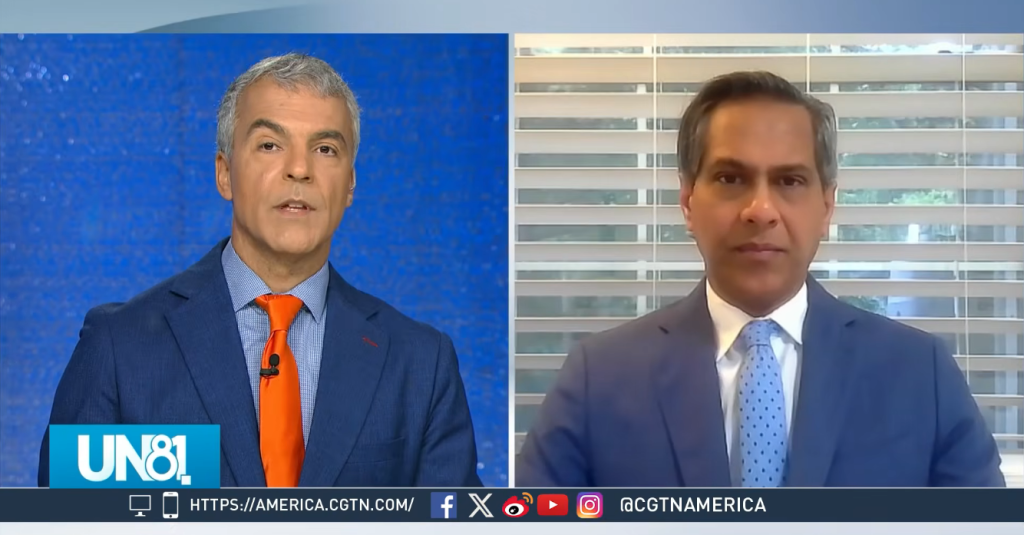
On Monday, September 28, 2026, Sourabh Gupta was interviewed by CGTN America on China’s speech at the October UN debate and the implications of “true multilateralism”.
On Monday, September 25, 2026, Sourabh Gupta was interviewed by Global Times on the importance of bilateral diplomacy after the Washington summit.
On Monday, September 25, 2026, Sourabh Gupta was interviewed by CGTN America on expectations for the September summit, highlighting key discussion of trade, AI, and bilateral cooperation.
On Monday, September 25, 2026, Sourabh Gupta was interviewed by CGTN on how the September summit might impact the U.S. and China managing major differences while pursuing closer coordination.