
By The ICAS Team
China’s Economic Growth Drops to Lowest Level since 1992
Laura He
CNN, October 18
“China’s growth dropped last quarter to its lowest level in nearly three decades, as the world’s second largest economy continues to feel the pain from the trade war with the United States. China’s gross domestic product grew by 6% in the three months to September 30, the weakest quarterly growth rate since 1992 and down from 6.2% in the April-June period, according to government statistics released on Friday. It also missed the average forecast of 6.1% projected by analysts polled by Refinitiv.”
“‘Trade tension with the US is the key factor weighing on business sentiment and investment activities, although domestic stimulus policies are providing some buffer from the down side,’ said Chaoping Zhu, global market strategist for JP Morgan Asset Management.”
Top Economic Advisers Warned Trump on Tariffs Before China Truce
William Mauldin and Nick Timiraos
The Wall Street Journal, October 18
“President Trump’s top economic adviser last week arranged an Oval Office briefing with outside experts who warned the president that continued escalation of U.S.-China trade tensions could imperil the economy and hurt Mr. Trump’s chances for re-election, according to people familiar with the meeting.”
China Says US must Cancel New Tariffs for Ultimate Trade Deal
Evelyn Cheng
CNBC, October 17
“China emphasized Thursday that the U.S. must remove tariffs in order for the two countries to reach a final agreement on trade, Ministry of Commerce spokesman Gao Feng said. ‘China’s position, principle and goal for the China-U.S. trade negotiations has never changed,’ Gao said in Mandarin at a weekly press conference, according to a CNBC translation. ‘Both sides’ ultimate goal for the negotiation is to end the trade war, cancel all additional tariffs,’ he said. ‘This is good for China, good for the U.S. and good for the world.’”
‘The Losses Have Already Been Substantial.’ Adam Silver Addresses Fallout from the NBA-China Controversy
Sean Gregory
TIME, October 17
“During the first TIME 100 Health Summit on Thursday, NBA commissioner Adam Silver said that he’s willing to deal with the business consequences of Daryl Morey’s Oct. 4 tweet supporting protesters in Hong Kong.”
China Confirms Two U.S. Citizens Detained as Tensions Rise
Dandan Li and Iain Marlow
Bloomberg, October 17
“The Chinese foreign ministry said it has detained two American citizens who run an English-teaching business in China, a development that comes amid rising diplomatic tensions and a broader trade war between the two countries.”
Under New Rule, Chinese Diplomats Must Notify State Dept. of Meetings in U.S.
Edward Wong
The New York Times, October 16
“State Department officials said the new measures were ordered in reciprocity for China’s strict limits on the actions of American diplomats there.”
China Emerges with Wins from U.S. Trade Truce
Chao Deng and Lingling Wei
The Wall Street Journal, October 12
“U.S. shelves new tariffs against Beijing while leaving many demands to be worked out later.”
China Announces Timetable for Opening Finance Industries
Associated Press
MarketWatch, October 11
“China announced a timetable Friday for carrying out a promise to allow full foreign ownership of some finance businesses, starting with futures traders on Jan.1, as Beijing tries to make its slowing economy more competitive and efficient. Ownership limits will be ended for mutual fund companies on April 1 and for securities firm on Dec.1, the China Securities Regulatory Commission said on its website. Until now, foreign investors have been limited to owning 51% of such businesses.”
China Plans to Restrict Visas for U.S. Visitors with ‘Anti-China’ Links
Keith Zhai
Reuters, October 9
“China is planning tighter visa restrictions for U.S. nationals with ties to anti-China groups, people with knowledge of the proposed curbs said, following similar U.S. restrictions on Chinese nationals, as relations between the countries sour.”
U.S. Blacklists 28 Chinese Entities Over Abuses in Xinjiang
Ana Swanson and Paul Mozur
The New York Times, October 7
“ The Trump administration said Monday that it had added 28 Chinese organizations to a United States blacklist over concerns about their role in human rights violations, effectively blocking those entities from buying American products.”
China Pulls Out of Giant Iranian Gas Project
Benoit Faucon
The Wall Street Journal, October 6
“China National Petroleum Corp. has pulled out of a $5 billion natural-gas project in Iran as escalating tensions threaten to sever Beijing’s trade with Tehran, a key lifeline for the Islamic Republic.”
Trump Publicly Urges China to Investigate the Bidens
Peter Baker and Eileen Sullivan
The New York Times, October 3
“President Trump made a similar, but private, request of the president of Ukraine, an episode that has prompted an impeachment inquiry.”
China’s Maritime Strategic Challenge
Douglas J. Feith and Admiral Gary Roughead
National Review, October 18
“America and its allies must cooperate to counter the military-commercial threat.”
Trump is Beijing’s Best Asset
Paul Haenle and Sam Bresnick
Foreign Policy, October 15
“Chinese officials want the U.S. president reelected—because he’s so weak.”
The NBA-China Disaster is a Stress Test for Capitalism
Derek Thompson
The Atlantic, October 12
“On August 19, the definition of a company in America changed. The Business Roundtable, a U.S. lobbying group that represents nearly 200 companies, issued a statement proclaiming that the “purpose” of a business in 2019 was no longer to look out merely for shareholders. It was to protect the interests of all “stakeholders”—employees, partners, suppliers, communities, the environment, the very world itself. The group’s lofty statement seemed to reorient the role of a public company from the maximization of profit to the maximization of goodness.”
9th Annual China Defense and Security Conference
Event hosted by The Jamestown Foundation,October 15, 2019
The U.S.-China Technology Relationship in Flux
Event hosted by Brookings,October 4, 2019
The U.S.-China Trade and Strategic Relationship/Rivalry
Event hosted by The Washington International Trade Association,October 2, 2019
Global China: Assessing China’s Growing Role in the World and Implications for U.S.-China
Event hosted by Brookings, October 1, 2019
Strategies and Resources for Protecting IP in China with the USPTO
Event hosted by The US-China Business Council, October 1, 2019
China’s New Era in Techno-Governance
Event hosted by CSIS,November 6, 2019
Stealth War: How China Took Over While America’s Elite Slept
Event hosted by The Institute of World Politics, November 5, 2019
Managing the Risk of Tech Transfer to China
Event hosted by CSIS,October 29, 2019
Moving Target: China Policy Coordination for the United States and Japan
Event hosted by Carnegie Endowment for International Peace, October 23, 2019
U.S.-China Conference: Global Views on China and U.S.-China Strategic Competition
Event hosted by Georgetown University, October 22, 2019
September 24 – 25, Halifax, Canada
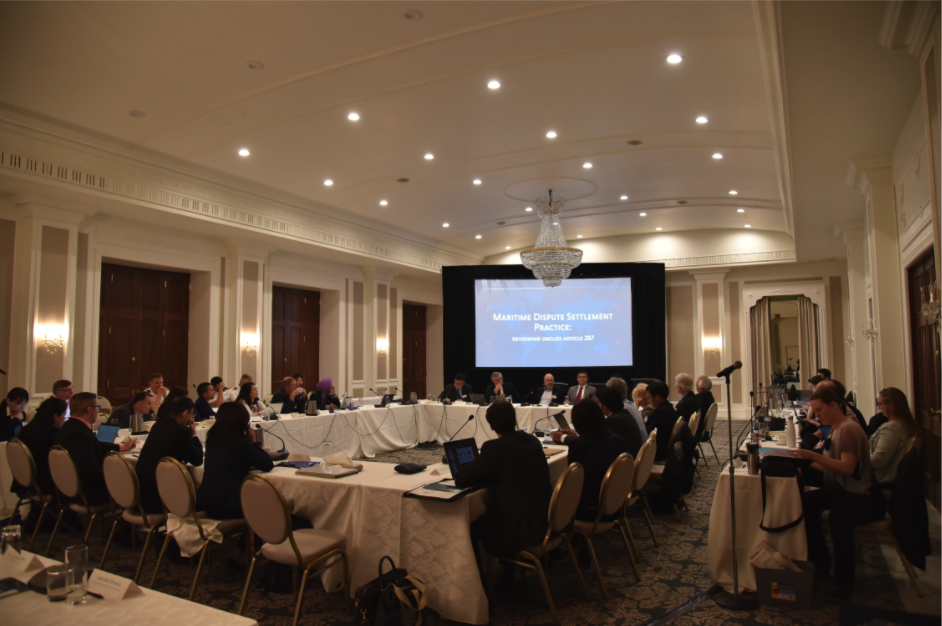
On September 24-25, 2019, the 7th Asia-Pacific/Arctic Maritime Security Forum was held in Halifax, Canada, co-sponsored by the China Institute at the University of Alberta, the National Institute for South China Sea Studies, the Institute for China-America Studies, and Dalhousie University’s Marine & Environmental Law Institute. This year’s forum focused on ocean governance in the Asia-Pacific and the Arctic.
Professor Gordon Houlden, Director of the China Institute opened with welcoming remarks. He emphasized the importance of the conference hosting representatives from nine countries, including: Canada, the United States, China, Japan, Australia, India, South Korea, Sweden, and Singapore. He stated that whether or not an accord is reached on any or all of the issues discussed, bringing together experts from so many different backgrounds serves to provide deeper and stronger understandings of the perspectives of each group represented.
Dr. Shicun Wu, President of the National Institute for South China Sea Studies thereafter delivered his remarks, recalling the importance of the Track II dialogue and the progress that has been achieved over the past six Maritime Security Forums. He also shared his observations on recent developments of issues in the South China Sea, highlighting the major challenges to security cooperation in the region. Professor Phillip Saunders, Director of the Marine & Environmental Law Institute of Dalhousie University, concluded the welcoming remarks by underscoring the importance of inclusion in maritime security dialogues, noting the presence of senior naval (Canadian) and coast guard (US) representatives in attendance.
Dr. Shicun Wu, President of the National Institute for South China Sea Studies, moderated the first panel, which provided a scene-setter of recent developments related to maritime security in the South China Sea, Northeast Asian waters, the Indian Ocean, and the Arctic Ocean.
The South China Sea
Disputes in the South China Sea are vastly intertwined and complicated. It was the view of the panel that the goal for the short term should be to manage these issues and not attempt to solve them. It was the conclusion of this panel that in order to help manage disputes in the short term, it is imperative for each stakeholder to show restraint (on the seas and at the negotiating table), continue to develop bilateral and multilateral relations, show respect for one another, always be ready and willing to have consultation, and to emphasize cooperation.
Northeast Asian Waters
The panel acknowledged that major stakeholders in the region, such as China, Japan, and South Korea, are obligated to cooperate under Article 123 of UNCLOS. This implies that the management, exploration, and exploitation of resources must be co-managed by these states. However, the panelists emphasized that as maritime security matters are not included in this Article, setbacks to the co-management of trade and resource exploitation will arise, such as the 2008 Joint Development Agreement between China and Japan remaining unimplemented. Moving forward, maritime security should be viewed as inclusive, with decision making processes including State and non-State actors, as well as international courts.
The Indian Ocean
Despite being a relatively small ocean compared to the Atlantic and the Pacific Oceans, it was noted that the Indian Ocean may be the most critical ocean. A quarter of the global population resides in the area, with about two-thirds of the world’s oil, half of all containers, and a third of all bulk cargo makes its way through the Indian Ocean each year. The region is not without its own security concerns. For example, in the Gulf of Aden alone, losses from piracy in a five-year period reached $18 billion. However, foreign countries with a stake in the region have many pathways to help improve security in the region, including: enhancing the creation and maintenance of naval and coast guard forces, encouraging the use of space-based AIS technologies and increase training workshops, and utilizing multilateral mechanisms, such as information sharing.
The Arctic Ocean
The Arctic typically is viewed through a dual narrative, both as a place of peril and opportunity. Competing visions of the Arctic by the U.S., Russia, and China raise questions about how smaller Arctic States will be impacted, as well as the future of the region as a whole. As the changing strategic international environment impacts the Arctic, another question being raised is about whether new ordering principles or arrangements are needed to ensure these impacts are minimized or properly co-managed. Moving forward, it was recommended that the debate for the potential need of an Arctic Treaty or augmented functional agreements should be revisited, as well as how such a decision-making process should be conducted.
Michael Butler, director of the International Ocean Institute of Canada, moderated the second panel, which sought to initiate a discussion on what lessons can be learned from the different models of ocean governance in the South China Sea, Northeast Asian waters, Southeast Asian waters, and the Arctic.
The panel began with a discussion of UNCLOS Article 197 and ocean governance and their relationship with the United Nations Sustainable Development Goals. Ocean governance encompasses a wide swath of national and international institutions, which involve a combination of lateral, top-down, and bottom-up management systems. However, it was noted that transboundary impacts to countries outside of these agreements are often unaccounted for, which can lead to increased tensions. The panel posited that pursuing governance mechanisms that enhance regional security, such as promoting agreements, treaties, or codes of conduct, can also fall in line with U.N. Sustainable Development Goal 14, which aims to sustainably manage and protect marine and coastal ecosystems from environmental degradation.
In regard to the future of ocean governance in the Arctic, a narrative of inclusivity at the local, regional, and global levels must be taken into account. The emergence of bodies that are created to better understand the needs and priorities of residents of indigenous communities is seen as a prime example of the Arctic states approach to the usage of Article 76 of UNCLOS. The Arctic Fisheries Moratorium Agreement was cited as including the perspectives of all stakeholders, and yet still being successful by even including those with competing interests. However, challenges remain, such as ensuring that inclusivity becomes a norm in the broader goals and objectives that help decide national policy.
The panel moved next towards a discussion on lessons that can be learned from Australia’s history of ocean governance, utilizing marine spatial planning and marine protected areas (MPA). Early failures in adequate ocean governance policies largely stemmed from the fact that there was no cross-jurisdictional coordination. In other words, the Federal government would push ad hoc coordinated actions without participation from states, territories, or indigenous peoples. Australia’s current MPA system has seen greater levels of success by better incorporating these needs, allowing it to become more comprehensive, adequate and representative of the needs of stakeholders.
The panel concluded by looking at the development of ocean governance in the South China Sea and debated the role of UNCLOS in the region. Most of the time, when academics discuss the South China Sea, they overwhelmingly look at just the disputes. Discussions on the role of ocean governance is typically not given the weight it needs. Each coastal nation in the South China Sea tries very hard to manage the region under what it considers to be its national boundaries and limits and each of these states also have different interpretations on how international policy should be implemented. Examples of ocean governance initiatives include ecosystem-based management, marine protected areas, the Coral Triangle Initiative, and community-based management. In situations where these initiatives or other situations lead to the potential of igniting potential disputes, UNCLOS has a dual role: it should simultaneously be utilized as an international regime that allows for internal coherence and external relations. However, as a framework for ocean governance and dispute settlement in the South China Sea, its effectiveness will largely be based on state practice.
Professor Aldo Chircop, the Canada Research Chair in Maritime Law and Policy (Tier 1), at Dalhousie University’s Schulich School of Law, served as the third panel’s moderator. This panel explored UNCLOS Article 287, which allows States that have ratified the Convention the option to choose various forms of settlement disputes. The panel explored some of the options provided, such as the International Court of Justice (ICJ) and the International Tribunal for the Law of the Sea (ITLOS).
The panel began with a discussion on Part XV of UNCLOS and the question of whether compulsory adjudication should be a necessary feature of law for the peaceful settlement of disputes. Within the history of UNCLOS, it was noted that dispute settlement by adjudication has been rare, with compulsory adjudication being even rarer. As a result, there is potential for both procedural and substantive fragmentation, overreach, and room for ‘salami-slicing’ tactics that could undermine maritime stability.
The panel continued with a discussion of the realities in East Asia, especially in the South China Sea and the East China Sea and their challenge to effective dispute settlement. It was noted that all the coastal states in this area have strengthened their construction of coast guard and maritime law enforcement capabilities. However, given the large disparities in capacity and management system, it would be a challenging task for countries to balance the safeguarding of maritime rights and crisis control measures. In this regard, the panel assessed the ICJ as a procedure of choice for maritime dispute settlement.
The panel also discussed the dearth of cases referred to ITLOS and its implications for the maritime order of Northeast Asia. The panel assessed the implication of this situation for the current role and function of the Tribunal along with its jurisprudence to the current maritime order in Northeast Asia. The panel also put forth a discussion on how to fill in the gap between ITLOS as an international judicial body and maritime disputes in Northeast Asia to facilitate a better option for the stakeholders to choose a suitable dispute settlement mechanism.
The panel combined the previous discussions and compared the ICJ and ITLOS with the Annex VII arbitration, which serves as a compulsory means provided for in Part XV of UNCLOS. Annex VII arbitration has more theoretical opportunities to be applied than does ITLOS and ICJ given that member states that do not make a declaration, or chose different bodies, shall be deemed to have accepted arbitration. Situations may arise in which increasing amounts of maritime disputes have to be submitted for Annex VII arbitration in the long run. In this sense, Annex VII arbitration may not be an auxiliary position in the dispute settlement mechanism in practice. The panel suggested that, from the perspective of the proceedings rather than the result of the ruling, Annex VII arbitration is compulsory because it can be initiated without a special agreement between the parties to the dispute in advance or afterwards.
Gordon Houlden, director of the China Institute of the University of Alberta, moderated the fourth panel that staged the discussion regarding the practices and the existing challenges for maritime law enforcement in the respective maritime regions.
The panel began by addressing the U.S. experience related to maritime law enforcement. Although the United States is not a signatory of the UNCLOS, the U.S. Coast Guard respects and acknowledges most of the essence of the UNCLOS due to the fact that the U.S. regards the regime of the oceans as a rule-based system. This system creates a balance between coastal states sovereign rights, flag state sovereignty, and the freedom of navigation on the high seas. UNCLOS, together with other international treaties, helps define the rules that applies to the enforcement performance of the U.S. Coast Guard.
The panel continued with a discussion of some of the key variables that the Canadian maritime legal forces tries to deal with, especially in the Arctic context. Canada is putting a lot of effort into its law enforcement capabilities in the Arctic region. The panel pointed out that Canada’s real focus is less on security but more on the norms. Canada concentrates on how to deal with the complex political environment, when more and more countries are getting involved in the Arctic region, and how to build up the norms in the Arctic for Canada to guarantee high functionality of its legal enforcement that protects Canada’s interests.
The panel also discussed the regional maritime enforcement agencies in Southeast Asian waters that are tasked with duties related to maritime defense, safety and security as distinct from navies as a non-traditional force. The discussion highlighted that lack of resources, access and integration of maritime law enforcement agencies among Southeast Asian countries make their capability insufficient for properly policing Southeast Asian waters. The panel suggested that the countries of Southeast Asia ought to fill the vacuum in their domestic context and collaborate more with their regional partners.
Before the end of the session, the panel evaluated the development of coast guards in East Asia, where coast guards have become active since 2010. Nevertheless, the scope is unclear, which tends to confuse the boundary between military and law enforcement. Coast guards are widely used to defend and to consolidate claimants’ positions, sometimes even being involved in collisions. The panel recommended that the duty of coast guards in East Asia should be clearly defined, efficient communication and coordination mechanisms to prevent collision of legal enforcement forces should be established, and a push made for regional cooperation between coastguards.
Dr. Wendy Watson-Wright, CEO of the Ocean Frontier Institute of Canada, served as the moderator for the fifth panel. This panel addressed a diverse group of topics that could bring opportunities for cooperation, including shipping, marine environmental protection, and marine scientific research.
The panel began with an introduction on the role of nonprofits in protecting the marine environment through marine spatial planning. Clear Seas, a Canadian nonprofit was created out of concern that the Canadian marine industry, such as the transport of oil and LNGs, was subject to misinformation. In order to bring awareness to the public and lawmakers of the impacts these industries have on the marine environment, Clear Seas looks at hazards related to the transportation of all commodities in Canadian waters and informs the public on relevant maritime laws that regulate these industries. The panelists posited that promoting the continual improvement of the shipping industry and improving public understanding and confidence is a critical first step towards ensuring adequate regulations and enforcement measures are in place.
The panel continued by raising the question of whether emission standards in the Arctic and the South China Sea should be scaled up. The shipping industry emits harmful pollutants such as nitrogen oxide, sulphur oxide, volatile organic compounds, particulate matter, and of course, carbon dioxide. Air pollution has a clear impact on human health, the environment and the climate, with coastal communities being particularly vulnerable to these effects. Although ship emissions in both regions are subject to international standards under Annex VI of MARPOL, protections remain inadequate. The panel suggested that one mechanism that should be explored as a potential pathway is to institute emission control areas in each region, which would have the dual effect of promoting cooperation from participating states.
The panel continued with a discussion on potential regulatory strategies related to heavy fuel oil (HFO) for Arctic shipping. In 2011, the International Maritime Organization (IMO) adopted a ban on the use and transportation of HFOs in Antarctic waters, which has come into effect. Since then, there has been debate amongst the IMO, Arctic Council, industry associations, and environmental NGOs about whether to adopt a similar policy for Arctic waters. However, indigenous people have not directly been part of the conversation. Challenges continue to exist that have stalled the creation of a HFO regulatory strategy, and which must be dealt with through holistic approaches.
The panel concluded with an examination of oil spill preparedness and response cooperation in Northeast Asia, looking at the case of the Sanchi Incident. Although there were sufficient amounts of information sharing amongst countries involved in the response and cleanup, such as China, Japan and South Korea, the collective response was still considered inadequate. There was insufficient knowledge or training on how to properly deal with the type of oil that spilled – cargo condensate, which led to a failure in properly understanding the scope of the spill.
Dr. Gordon Houlden, director of the University of Alberta’s China Institute, moderated the final panel. Like the previous panels, this panel began with presentations from select research institutions from various regions. However, as one of the overarching themes of the Forum was to find innovative ways in which conflict can be mitigated through cooperation and information sharing, this section allows for an open discussion amongst all participants of the conference to explore opportunities of institutional cooperation in the area of ocean governance.
The panel began with the introduction of the China-ASEAN Academy on Ocean Law and Governance, and the first four annual programs that have been completed since January 2016, collaboratively organized by the NISCSS, China-Southeast Asia Research Center on the South China Sea Studies (CSARC), and International Ocean Institute-Canada (IOI-Canada). The Academy will launch the first special program on maritime law enforcement in late October 2019, with support from the Australian National Centre for Ocean Resources and Security (ANCORS) of the University of Wollongong. CSARC was introduced as a consortium of renowned research institutes and think tanks of China and ASEAN countries, dedicated to research and projects to promote cooperation among littoral countries of the South China Sea.
IOI-Canada’s flagship training program, Ocean Governance: Policy, Law and Management, was introduced next. It is held annually in Halifax, now has more than 735 alumni from more than 100 countries worldwide. Participants after completing the program have shared and disseminated their acquired knowledge and skills on returning home through various means so that training program could have a multiplier impact on ocean governance.
Next, Australian experiences in capacity building for ocean governance of the Pacific region and its relevant experiences with some African, Caribbean and ASEAN countries were outlined. Regarding ASEAN countries, capacity building has been conducted mainly through bilateral assistance and FDA between Australia and individual member countries, such as Indonesia and Malaysia. Regarding Pacific countries, capacity building has largely been through training and scholarship opportunities between government agencies, as well as assistance in monitoring, control and surveillance in fisheries and maritime security, and assistance in law and policy development.
The final presentation of the conference introduced geographic information systems technology (GIS) as a platform for collaborative maritime studies. Much of the analyses conducted by academic and research institutions are in the form of commentary and opinion pieces that largely focus on limited aspects of this domain. Consequently, scholars and the general public lack an objective and comprehensive educational tool to gain both a big picture understanding combined with deeper, specialized insights into various economic, security, and legal sectors in the maritime domain that can be presented through direct and interactive data visualizations.
By using GIS and its related technologies to create interactive maritime trackers, academic circles and government entities have a new way of cooperating and sharing data with one another outside of the conference room. Representatives of research institutions, navies, and coast guards were invited to collaborate and streamline issues related to maritime policy research through a visual and interactive platform. As a result, future collaboration is expected following the conference between these entities that will allow for greater clarity in maritime policy research by providing accurate, live data tracking on developments in the various sectors of the maritime domain.
Some participants pointed out that sometimes it is difficult to find information about what is going on in a particular region with regard to capacity building. Therefore, the discussion on this panel was helpful from an information sharing perspective.
There were discussions on creating a maritime tracker of the Arctic region, though it was pointed out that although the current capabilities may not be sufficient to track the numbers of vessels transiting different routes of the Arctic region, tapping into historical AIS data, which can differentiate different types of vessels, could be used for varied purposes.
Some participants reviewed the efforts of Canadian scholars and universities to assist capacity building in island states with limited expertise and resources. It was pointed out that scholars and legal experts need to help smaller states develop their capacity to fulfill their marine management responsibilities and enjoy the benefits of development opportunities enshrined in relevant international conventions and legal instruments.
Some participants pointed out that funding and international cooperation related to capacity building very much depend on the immediate political climate. Speakers answered questions about fundraising in different political contexts. For instance, most of the research and training programs that ANCORS runs are based on contracts, and other parties to the contract are responsible for relevant funding for ANCORS. About half of IOI-Canada’s funding is from the headquarters in Malta. IOI-Canada needs to spend a significant amount of time for fundraising in order to provide scholarships for people from under-developed countries and communities to participate in its training programs. However, impact from the political climate on IOI-Canada was viewed as negligible. The China-ASEAN Academy on Ocean Law and Governance mainly relies on funding from the China-ASEAN Cooperation Fund. It is very difficult for the Academy to obtain donations from foreign parties and international NGOs, because the latter risk being interpreted as being supportive of China’s position in the sensitive South China Sea dispute.
The panel and Forum concluded with a final discussion on ways in which to promote strategies of developing capacity building programs. Information sharing and cooperation are considered effective ways by which to alleviate stresses to project or program funding, especially if the changing political climate were to become an issue. Dr. Gordon Houlden, Dr. Shicun Wu, and Professor Phillip Saunders thanked everyone for their participation and all three looked forward to the 8th Asia-Pacific/Arctic Maritime Security Forum to be held in China in 2020.
Click for details on the 7th Asia-Pacific/Arctic Maritime Security Forum