

ICAS Maritime Affairs Handbill (online ISSN 2837-3901, print ISSN 2837-3871) is published the last Tuesday of the month throughout the year at 1919 M St NW, Suite 310, Washington, DC 20036.
The online version of ICAS Maritime Affairs Handbill can be found at chinaus-icas.org/icas-maritime-affairs-program/map-handbill/.
Fire Burns For 12 Hours On US Navy Warship Off Okinawa
August 20 – CNN
[U.S.]
A fire broke out aboard the USS New Orleans, a U.S. Navy amphibious transport dock ship, while anchored off Okinawa. An investigation is underway, and a set of new inspection and training procedures to prevent future fires were introduced. The damage by the fire may sideline the vessel for 60 to 120 days, and it might set back the ship’s combat readiness for years.
US Seeks Shipbuilding Expertise From South Korea And Japan To Counter China
August 17 – AP News
[U.S., South Korea, Japan]
Two U.S. senators, Tammy Duckworth and Andy Kim, are visiting South Korea and Japan to explore joint shipbuilding ventures aimed at boosting the U.S. ‘s declining naval shipbuilding capacity, which trails far behind China’s. They plan to meet top shipbuilders to discuss construction and repair of noncombatant vessels for the U.S. Navy in the Indo-Pacific. The trip follows President Trump’s push to revive American shipbuilding, and comes as China formed the world’s largest shipbuilder, commanding over 21% of the global market.
US Deploys 2 Warships Into South China Sea After Chinese Collision
August 14 – Taipei News
[U.S., China, the Philippians]
Following the Chinese collision in the South China Sea on August 11, the United States deployed two warships to waters near the incident area. No incidents were reported during the U.S. patrol as the two ships were monitored by a Chinese navy vessel.
Footage Shows Two Chinese Ships Collide During Clash With Philippine Vessel Near The Huangya Island
August 11 – The Washington Post
[China, the Philippians]
As shown from video footage on August 11, a China Coast Guard vessel collided with a Chinese navy destroyer on Monday while both ships were pursuing a Philippine Coast Guard ship near Huangyan Island in the Scarborough Shoal. Philippine authorities confirmed the collision left the smaller Chinese vessel severely damaged. The China Coast Guard stated it had taken necessary measures to expel Philippine coastguard and government vessels from waters near the Huangyan Island on that day.
China Creates World’s No. 1 Shipbuilder, Driven By Rivalry With US
August 11 – The Wall Street Journal
[China, U.S.]
China has finalized a $16 billion merger between two state-owned shipbuilders—China State Shipbuilding Corporation (CSSC) and China Shipbuilding Industry Corporation—forming the world’s largest shipbuilder. The combined entity will hold over 530 vessels and 54 million deadweight tons in its order book, with annual revenues of around $18 billion. The move is expected to bolster China’s military-civil fusion by integrating commercial and naval shipbuilding capabilities. Meanwhile, U.S. shipbuilding lags behind, with China now accounting for 55% of global tonnage, compared to less than 0.05% for the U.S.
China Fired Warning Shots At Japanese Warship In Chinese Waters
August 11 – Newsweek
[China, Japan]
A previously undisclosed incident from July 2024 recently came to light. A Japanese destroyer reportedly entered Chinese territorial waters during PLA military drills, prompting China to fire two warning shots. The incursion, traced to a navigational error by the Japanese crew, caused no damage but led to diplomatic tensions. China criticized the incident and reaffirmed its requirement for prior approval for foreign military vessels entering its waters, while Japan replaced the ship’s captain shortly after.
Australia Selects Japan’s Mitsubishi Heavy Industries For $6.5b Warship Deal
August 5 – AP News
[Australia, Japan]
Australia has awarded a major defense contract to Mitsubishi Heavy Industries to build 11 new warships based on Japan’s Mogami-class frigate design, in a deal expected to be worth AU$10 billion over the next decade. According to the contract, three ships will be built in Japan and the remaining eight in Australia, with the first expected to be operational by 2030. This marks one of Japan’s largest defense export deals and the first time it will construct warships abroad, reflecting growing Japan-Australia defense ties.
India And The Philippines Announce Partnership To Strengthen Trade, Defense And Maritime Ties
August 5 – AP News
[India, the Philippines]
India and the Philippines have elevated their relationship to a strategic partnership following a high-level meeting between Indian Prime Minister Narendra Modi and Philippine President Ferdinand Marcos Jr. in New Delhi. The upgraded partnership underscores a deepening alignment between the two countries, especially in light of growing maritime frictions with China.
Asia-US Sea Freight Rates Set To Extend Declines Amid Tariff Chaos
August 5 – Reuters
[U.S.]
Sea freight rates from Asia to the U.S. are expected to decline further in 2025 due to global overcapacity and weakened trade demand, particularly between China and the U.S. Spot rates have already fallen sharply since June—by 58% to the U.S. West Coast and 46% to the East Coast—according to Xeneta. This downturn follows a brief rise during a 90-day tariff pause in U.S.-China trade talks.
Regional Focus: The Indo-Pacific
Recent developments have highlighted the strategic competitions over the Indo-Pacific. The incident in the South China Sea, which involved not only China and the Philippines but also the U.S., has indicated the U.S.’ intention of continued intervention in the region. The U.S. approach to its allies in the region, such as the potential shipbuilding collaborations with Japan and South Korea, indicates that the broader competition to counter China’s rising industrial capabilities and geopolitical influences is still ongoing. As a result, the Indo-Pacific remains one of the most critical theaters. It is not merely a site of naval incidents or bilateral disputes, but the center of a much larger, multidimensional rivalry between the U.S. and China. This contest spans security, industrial policy, technological standards, and trade architecture. Tracking developments in this region offers a direct lens into how both powers operationalize their strategic visions—and how other regional actors navigate between them.
Brazil Seeks China’s Support To Salvage Maritime Emissions Pact Opposed By Trump
August 21 – South China Morning Post
[Brazil, China, U.S.]
Brazil is actively supporting the International Maritime Organization’s (IMO) proposed Net-Zero Framework to curb emissions from international shipping and is seeking further clarity from China on its implementation stance. The U.S. opposes the plan, citing economic concerns and threatening retaliation, while China recently shifted to support the deal despite earlier reservations. Brazil views China’s cooperation as key to finalizing the agreement in October, and highlights Chinese firms’ adherence to sustainability standards at Brazilian ports.
4,500 US Marines Launch Anti-Drug Operation In Latin America Waters
August 17 – The Tico Times
[U.S.]
The U.S. Southern Command has deployed over 4,500 personnel to the Caribbean and Latin American waters to counter organized crime and strengthen regional cooperation. The operation involves amphibious ships and joint training with partner nations, including limited exercises in Panama. At the same time, Panamanian authorities confirmed that all activities comply with bilateral agreements and sovereignty standards.
Chevron-Chartered Tanker Docks At Venezuela To Load Oil After New US License
August 12 – Reuters
[U.S., Venezuela]
A tanker from the Chevron company docked at Venezuela’s PDVSA terminal on Aug. 12, preparing to export crude to the U.S. under a renewed restricted license issued in July. This marks Chevron’s first such shipment since its previous license expired in May. Additional Chevron-chartered tankers are en route to Venezuela or nearby transfer zones, signaling resumed crude activity. The U.S. license established in early August permits oil swaps but prohibits payments to Venezuela’s government.
China Accuses US Of Using ‘Lies As Pretext For Seeking Control’ Of Panama Canal
August 12 – South China Morning Post
[China, U.S., the UN]
At a UN session chaired, the U.S. and China exchanged differing views regarding strategic influence over the Panama Canal. The U.S. raised concerns about foreign involvement in critical infrastructure and maritime activity, while China emphasized its support for Panama’s sovereignty and neutrality of the canal. The discussion comes amid a paused $22.8 billion global port sale involving Chinese firms and recent naval incidents in contested waters. Both sides framed their positions in terms of regional stability and trade security.
COSCO Targets Major Stake In $23 Billion Panama Canal Port Deal
August 8 – AINvest
[Panama, China]
China’s COSCO is seeking a 20–30% stake in a $23 billion port deal that includes key assets near the Panama Canal, following the lapse of BlackRock and MSC’s exclusivity. This move could enhance COSCO’s global shipping footprint and reshape competitive dynamics in maritime logistics. The ports in question are strategically located, with potential long-term trade and infrastructure implications.
US Envoy Says To Ban Chinese-Linked Operators From Key Panama Canal Ports
August 8 – South China Morning Post
[U.S., Panama]
The U.S. ambassador to Panama criticized the Chinese-linked Panama Ports Company and voiced support for replacing it, citing operational concerns. Legal and political challenges to the company’s contract have emerged in Panama, including lawsuits and a presidential proposal to restructure the port model. These developments add uncertainty to a $23 billion global port sale involving the operator.
Regional Focus: Latin America
Latin America has emerged as a strategic arena in U.S.-China competition — not due to geographic proximity or ideological alignment, but because it embodies the material and institutional risks of global power rivalry. The U.S. easing sanctions on Venezuelan oil is not a sign of strategic redirection, but rather a response to structural pressures. Instability in regions such as the Middle East and domestic inflation have compelled Washington to make pragmatic energy trade-offs. Meanwhile, China’s calculated shift to support the IMO emissions pact signals a growing willingness to shape — rather than reject — global regulatory norms, particularly in sectors like green shipping where it holds commercial advantages. At the same time, contests over port operations at the Panama Canal and shifts in Brazil’s diplomatic posture suggest that this competition is no longer simply about trade. It is about control over rule-setting, surveillance capabilities, and standards implementation. These cases illustrate that Latin America is no longer a peripheral zone, but a microcosm of the great-power rivalry where climate governance and infrastructure standards have become key platforms for projecting strategic influence. By examining developments in Latin America, we gain insight into how the U.S. and China act beyond their home regions, revealing their true priorities, limitations, and adaptive strategies in an era of structural global competition.
Iran’s Navy Launches Country’s First Military Drill Since 12-Day War With Israel
August 21 – Yahoo News
[Iran]
As reported by the state media, Iran launched its first military exercise since the end of its 12-day war with Israel. A video shared by the Iranian military showed navy vessels launching missiles at targets in the sea in the Gulf of Oman and the Indian Ocean.
Turkey Bars Ships With Ties To Israel And Suspends All Trade
August 21 – The Maritime Executive
[Turkey, Israel]
Turkey is reportedly imposing new restrictions on trade and shipping with Israel, suspending exports of construction-related materials until a Gaza ceasefire is declared. While trade had officially been halted in May 2024, recent reports suggest Turkish exports continued. Now, port authorities are allegedly delivering verbal instructions barring Turkish ships from Israeli ports and vice versa. Restrictions may also extend to international vessels linked to Israel or carrying military cargo.
Canada Courts Arctic Allies To Counter Russia
August 20 – POLITICO
[Canada]
Canada is deepening its Arctic defense cooperation with Nordic NATO allies amid rising tensions with Russia and trade frictions with the U.S. Prime Minister Mark Carney dispatched key ministers to Sweden and Finland to explore new military and industrial partnerships. Meanwhile, Foreign Minister Anita Anand emphasized that NATO must expand its strategic focus to include Arctic security, signaling a broader shift in Canada’s defense posture toward multilateralism and reduced dependence on the U.S.
German Navy Ship Calls In Greenland For The First Time
August 19 – Naval News
[Germany, Greenland]
Germany’s naval replenishment ship Berlin has arrived in Nuuk, Greenland, after conducting replenishment-at-sea operations with NATO vessels near Iceland. This marks the first visit of a German naval ship to Greenland and aligns with Germany’s Arctic policy objectives. The mission aims to enhance maritime security in the strategically vital GIUK (Greenland-Iceland-UK) gap, a key route for NATO transatlantic logistics and a potential chokepoint for Russian submarines.
Maersk Contains Fire Onboard Marie Maersk Vessel Off Liberia
August 18 – Reuters
[Liberia]
Danish shipping giant Maersk reported that a fire onboard the container vessel Marie Maersk, which broke out off the coast of Liberia on August 14, has been contained from spreading further. In a statement, the company noted that external firefighting teams are expected to board the vessel soon to reinforce ongoing operations and provide support to the crew. While Maersk confirmed all crew members are safe, it has yet to assess or comment on potential damage to the cargo.
China Launches 18-Day Arctic Express Containership Route To Europe With Stops In UK, Germany, Poland
August 18 – High North News
[China]
Chinese shipping operator Haijie Shipping will launch the first liner-style container service from China to Western Europe via the Arctic’s Northern Sea Route, starting September 20, 2025. The route, which will connect Chinese ports to European ports including Felixstowe, Rotterdam, Hamburg, and Gdansk, will take just 18 days—significantly shorter than traditional routes via the Suez Canal. Unlike prior point-to-point Arctic shipments, this marks the first regular multi-stop container service between Asia and Europe through the Arctic.
Bahrain Sees First U.S. Carrier Visit In 5 Years
August 11 – USNI News
[Bahrain, U.S.]
The USS Nimitz Carrier Strike Group arrived in Bahrain, marking the first carrier visit to the country since 2020. The visit coincides with Iran’s recent seizure of an oil tanker, allegedly carrying smuggled fuel.
Iran Detains Another Tanker As Crackdown On Smuggling Continues
August 11 – The Maritime Executive
[Iran]
Iran has reported the detention of a tanker allegedly involved in diesel fuel smuggling close to the Strait of Hormuz. Seventeen foreign crewmembers were arrested. Iran’s Border Police and Navy are intensifying anti-smuggling efforts using aerial surveillance and intelligence tools, while courts continue issuing prison sentences for convicted smugglers. Iraq has also increased inspections of tankers in recent weeks.
Bahri Denies Carrying Israel-Bound Shipments
August 11 – Seatrade Maritime
[Saudi Arabia]
Saudi shipping company Bahri issued a statement denying allegations that its vessels were transporting shipments to Israel. Bahri reaffirmed that it operates in accordance with Saudi Arabia’s policies supporting the Palestinian cause and stated it had never transported goods to Israel, reserving the right to take legal action against those spreading false claims.

On July 23, 2025, the International Court of Justice (ICJ) issued a landmark advisory opinion, adopted unanimously, on the international legal obligations of states concerning climate change. This long-anticipated decision, requested by the United Nations General Assembly (UNGA) in 2023, and led by a coalition of Pacific island nations spearheaded by Vanuatu, marks a pivotal moment in the legal framing of climate responsibility. For the first time, the ICJ has clarified how existing international law, spanning environmental treaties, customary norms, and human rights obligations, applies to the climate crisis. The opinion brings legal precision to what has long been seen as a domain of political negotiation and moral appeal.
Key Findings
The Court affirmed that states have legal obligations to prevent, reduce, and redress the adverse effects of climate change. These obligations arise not only under specific climate treaties such as the United Nations Framework Convention on Climate Change (UNFCCC) and the Paris Agreement, but also under customary international law and international human rights law.
Importantly, the ICJ emphasized the principle of “due diligence,” requiring states to take all reasonable measures to prevent significant transboundary environmental harm, particularly in light of the best available scientific knowledge—such as the findings of the Intergovernmental Panel on Climate Change (IPCC). The Court also reaffirmed the principle of “common but differentiated responsibilities and respective capabilities (CBDR-RC),” acknowledging historical emissions and varying capacities among countries.
Furthermore, the Court linked climate obligations with the protection of fundamental human rights, especially the rights to life, health, food, and a healthy environment, thus reinforcing the emerging intersection between climate and human rights law.
Legal Debates
While the ICJ’s advisory opinion brings important clarity to the legal foundations of climate responsibility, it also raises a series of deeper legal debates that merit closer examination.
First, the Court did not definitively establish when states’ international legal obligations related to climate change began to take effect, nor when breaches may have occurred. Clarifying the temporal scope of responsibility, whether grounded in treaties, customary law, or general principles, remains a complex and contested issue, especially for claims involving historical emissions.
Second, the opinion affirms the applicability of the “no-harm principle” in customary international law to climate change but stops short of precisely defining the extent of state duties under this principle or its relationship to treaty obligations under the UNFCCC and Paris Agreement. Whether treaty norms codify, supplement, or override customary rules remains unresolved.
Third, while the Court recognized general obligations under the UN climate regime—such as mitigation and international cooperation—it offered limited analysis of key treaty obligations like climate finance, adaptation, and technology transfer. This cautious approach leaves room for future legal interpretation but also prompts debate over the sufficiency of the Court’s articulation of state duties.
Fourth, the methodology the Court employed to identify and interpret customary international law, particularly in relation to the law of the sea and human rights law, is of great legal interest. While the opinion cross-references the UN Convention on the Law of the Sea (UNCLOS) and various human rights treaties, it provides limited analysis of how specific climate-related norms have crystallized through general and consistent state practice accompanied by opinio juris.
Fifth, in addressing state responsibility and legal consequences, the Court acknowledged the potential for breaches to incur responsibility but refrained from elaborating on remedial measures such as reparation, compensation, or guarantees of non-repetition. This reserved treatment reflects judicial prudence but also signals that further doctrinal development is necessary.
These ongoing legal debates underscore the evolving nature of international climate law and the complex interpretive challenges it presents. While the ICJ’s opinion lays important groundwork, it simultaneously highlights the pressing need for continued legal scholarship, strategic litigation, and international negotiation to further clarify the contours of state responsibility in the face of a warming planet.
Political Significance
While the Court’s reasoning prompts important legal debates, its implications extend beyond jurisprudence to the political and normative dimensions of global climate governance. Although advisory opinions are not legally binding, they hold considerable legal authority and moral weight—especially when issued by the principal judicial organ of the United Nations. This particular opinion may serve as a persuasive interpretive tool in shaping the trajectory of future climate litigation, informing treaty negotiations, and guiding national climate policy.
For developing countries and climate-vulnerable small island states, the opinion marks a diplomatic and legal milestone. It bolsters their calls for climate justice by reaffirming that states contributing to climate change are accountable under international law—not just broadly, but through specific obligations such as prevention, mitigation, and reparation.
For developed countries, particularly major emitters, the opinion intensifies pressure to translate climate pledges into enforceable legal commitments. It also signals to domestic courts and civil society actors that failure to act—or inadequate action—on climate change may now amount to a breach of international legal obligations. This could further encourage strategic climate litigation aimed at holding governments and corporations accountable for their contributions to global warming.
Moreover, the opinion reinforces the integration of climate obligations within the broader framework of international law—including human rights law, environmental law, and the law of state responsibility. In doing so, it contributes to greater legal coherence in an otherwise fragmented system of climate governance.
Practical Obstacles to Implementation
While the advisory opinion has great potential, it also faces significant practical and political challenges.
First, as a non-binding instrument, its legal weight depends on how states, courts, and international bodies choose to interpret and apply it. Deep divergences persist in how countries understand concepts such as “equity,” “fairness,” and “historical responsibility,” making it difficult to translate the opinion’s principles into consistent global action.
Second, the Court exercised judicial restraint by avoiding prescriptive emission targets or a clear hierarchy of obligations among states. This cautious approach leaves unresolved ongoing disputes over the level of ambition required and the fairness of burden-sharing. It also sidesteps the complex task of aligning climate obligations with other international legal regimes, such as trade, investment, and energy frameworks, where conflicts may arise.
Finally, the opinion offers no enforcement mechanism. Even where obligations are clearly articulated, the current international legal system lacks effective tools to ensure compliance. This gap underscores the crucial role national courts, regional bodies, and political coalitions must play in turning legal interpretation into tangible climate action.
Toward a Climate Rule of Law
The ICJ’s advisory opinion on climate change represents a decisive step toward the legal codification of climate responsibility. It marks a shift from voluntary climate commitments to normative legal expectations grounded in international law. By framing climate change as not only a scientific and political challenge but also a legal one, the Court has paved the way for a more structured and just approach to global climate governance.
For countries in the Global South, the opinion provides a robust tool to pursue climate justice and demand accountability. For all states, it serves as a reminder that climate inaction is not only a policy failure, it may also constitute a legal violation. As the world faces escalating climate risks, this opinion lays a foundation for building a climate rule of law where responsibility is shared, obligations are clear, and justice is no longer optional.
The ICJ’s opinion also arrives amid a growing global wave of climate litigation, where courts are increasingly called upon to adjudicate climate-related harms, clarify legal duties, and compel action. From youth-led lawsuits to claims rooted in constitutional and human rights law, litigation has become a strategic tool for shaping policy and enforcing accountability. With the Court now affirming that states have legal obligations tied to climate change, the groundwork is laid for even more assertive legal strategies to address climate injustice and to ensure that governments do not merely promise action—but deliver it.
This issue’s Flagship Analysis was written by Nong Hong, Executive Director at ICAS on August 5, 2025.
The Fujian (Type 003) is China’s third aircraft carrier and the most advanced warship ever constructed for the People’s Liberation Army Navy. Officially launched on June 17, 2022, it is the first Chinese carrier to be equipped with a catapult-assisted take-off but arrested recovery (CATOBAR) system, employing the electromagnetic catapults (EMALS). With a full-load displacement exceeding 80,000 tons and a flat, expansive flight deck, the Fujian represents a generational leap in China’s naval aviation and forward deployment capabilities. The Fujian’s catapult system enables the launch of multiple types of heavier fixed-wing aircraft such as fighter jets, airborne early warning, control (AEW&C) planes, and support aircrafts, greatly expanding operational reach. Such systems have marked a significant difference in comparison with China’s earlier carriers that employed ski-jump ramps, which would limit the aircraft’s adaptation, take-off weight, and operational range. Further, the Fujian’s larger-sized flight deck and hanger bay, in comparison with China’s previous aircraft carriers, would also allow more aircrafts to be stored onboard while at sea, significantly boosting the durability and flexibility of flight operations.
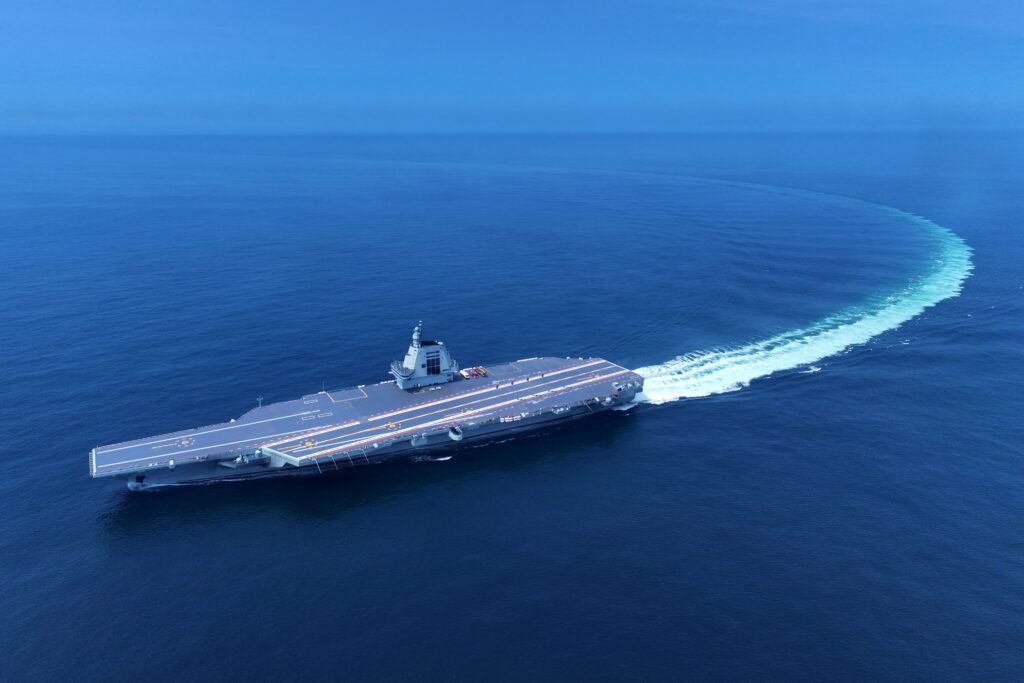
Since the ship’s launch, the Fujian has experienced a continuous set of mooring and sea trials. Over the past two months, the process has advanced significantly toward entering service, with the 8th sea trial and operational preparations being conducted. On August 4, the Xinhua News Agency stated that the commissioning process of the aircraft carrier is in the final stage. It has also mentioned that China has “completely mastered the technologies of the new CATOBAR system”. All such messages would indicate that the Fujian is going to be commissioned soon.
Simultaneously, the development of the naval air wing for the Fujian has also witnessed significant progress. In the Zhuhai airshow in November 2024, the Chinese Navy unraveled its new J-15 T Fighter that mounted with the adaptational modifications specifically for the catapult-launching system. On the other hand, the new 5th generation fighter J-35 has also shown signs of readiness of carrier-based operations, as well as the new KJ-600 early warning aircraft. With these programs progressing as the aircraft carrier enters service, the operational capabilities would be built rapidly.
The Fujian’s commissioning will significantly elevate China’s combat capabilities at sea. With its advanced CATOBAR system, the ship can support more diverse mission profiles and higher sortie-generation rates than its predecessors. This allows the Chinese Navy to operate with greater range and endurance, thereby enhancing its ability to sustain combat operations in far-seas environments. Such improvements translate into a more credible and persistent Chinese naval presence across the region.
These enhanced capabilities have direct implications for the regional security landscape. In the South China Sea and the Western Pacific, the Fujian would provide China with the means to maintain a continuous and more capable carrier presence. This not only reinforces China’s maritime claims but also creates a stronger deterrent against challenges from other actors, including the power projection of the United States. Strategically, the Fujian narrows one of the most visible technological gaps between China and the United States, introducing a new variable into Washington’s force planning. While it will not overturn U.S. naval dominance in the near term, it does compel the U.S. to reconsider whether its current deployment pattern—typically maintaining a single carrier strike group in the Indo-Pacific—might not be sufficient enough to uphold its current level of deterrence and regional influence. In the South China Sea, it strengthens China’s ability to deter challenges from other claimants and from external powers such as the United States, whose freedom of navigation operations (FANOPs) and deepening security cooperation with other regional states have at times heightened tensions. However, by making escalation more costly, the Fujian could discourage unilateral moves that risk destabilizing the region. In this sense, its presence functions as both a deterrent and a stabilizer. It can make the potential competitors rethink before deploying more forces with intentions of escalation. From this perspective, this aircraft carrier is not solely a tool of competition, but part of a broader dynamic in which China’s growing capabilities shape the choices of regional states and the strategic environment in the Indo-Pacific.
Noticeably, the overinterpretation on the Fujian’s role as being directed at potential conflicts across the Taiwan strait would be misleading. The Fujian’s design and purpose extend well beyond a Taiwan contingency. Its main emphasis on sustained far-seas aviation operations indicate that it is built for long-term power projection rather than short, localized campaigns. From a strategic perspective, the Fujian should be better understood as part of China’s broader naval transformation toward a blue-water force. By expanding operational reach across multiple theaters, the Fujian helps ensure that China is not confined to coastal defense but is instead capable of sustaining influence and protecting interests on a much larger scale.
This issue’s Spotlight was written by Letong Qian, Part Time Research Assistant Intern at ICAS.
Government Releases & Other Press Statements
Analyses & Opinions
Other Research

On August 6, 2025, Dr. Nong Hong conducted an in-depth discussion with Captain Anurag Bisen, veteran submariner of the Indian Navy. This EVI explores India’s strategic, scientific, and economic interests in the Arctic, including its work on climate research, emerging shipping routes, and energy cooperation. The discussion examines India’s deepening collaboration with Russia on Arctic projects, its engagement with the United States and other Arctic states, and its positioning relative to other Asian Observer states such as China.
Shadow Fleets in the Arctic: Uncharted Waters for Governance and Sanctions
by Nong Hong
August 7, 2025
The Arctic is no longer a remote frontier shielded from the geopolitics of oil and sanctions. As Arctic Today recently reported, more than 30 oil tankers linked to Russia’s so-called “shadow fleet” have transited Norwegian waters in 2024 alone, carrying sanctioned crude from Murmansk and other Arctic ports. This activity—designed to circumvent Western sanctions—reveals the fragility of sanctions regimes and the limitations of international ocean governance in addressing coordinated evasion tactics.


The Institute for China-America Studies is an independent nonprofit, nonpartisan research organization dedicated to strengthening the understanding of U.S.-China relations through expert analysis and practical policy solutions.
1919 M St. NW Suite 310,
Washington, DC 20036
icas@chinaus-icas.org
(202) 968-0595
© 2026 INSTITUTE FOR CHINA-AMERICA STUDIES. ALL RIGHTS RESERVED.