
ICAS Maritime Affairs Handbill (online ISSN 2837-3901, print ISSN 2837-3871) is published the last Tuesday of the month throughout the year at 1919 M St NW, Suite 310, Washington, DC 20036.
The online version of ICAS Maritime Affairs Handbill can be found at chinaus-icas.org/icas-maritime-affairs-program/map-handbill/.
10 Cuban nationals on U.S. speedboat intended to carry out an ‘armed infiltration,’ Havana says
February 26 – NBC News
[Cuba, United States]
Seven of the ten aboard the Floridian speedboat that entered Cuban territorial waters early Wednesday morning were identified, with the Cuban Ministry of Interior reporting they were all U.S. residing Cuban nationals intent on infiltrating Cuban borders for terrorist purposes. Assault rifles, handguns, bulletproof vests, improvised explosive devices, telescopic sights, and camouflage uniforms were confiscated from the boat. Secretary of State Marco Rubio denied any U.S. involvement as other politicians called the incident a “massacre” and the Cuban government’s version of events untrustworthy.
Cuban forces open fire on Florida boat as 4 killed in territorial waters confrontation
February 25 – Newsbreak
[Cuba, United States]
Cuba’s Ministry of Interior announced that a speedboat with Florida registration had been detected in Cuban territorial waters and opened fire against Cuban personnel. In response, the Cuban military opened fire, resulting in four fatalities and six injured. This incident took place at a time of heightened tension between the United States and Cuba as the U.S. blockade continues to damage the Cuban economy amidst other countries’ attempts to deliver aid.
Panama’s accession to IHO marks major step in international maritime cooperation
February 17 – Hydro International
[Panama]
In late January, Panama joined the International Hydrographic Organization (IHO). As an IHO member, Panama may now play a more active role in the shaping and implementation of international hydrographic standards that support safe maritime navigation.
U.S. Forces Strike 3 Suspected Narco Boats in Eastern Pacific, Caribbean
February 17 – USNI News
[United States, Caribbean]
On February 16, U.S. forces struck three boats that were allegedly carrying illegal narcotics and killed 11 people onboard. According to SOUTHCOM, the strikes were on vessels that were operated by “unnamed designated terrorist organizations”. Since the beginning of Operation Southern Spear, a total of 135 people have been killed in 40 announced strikes on alleged narcotics vessels.
2 Mexican Navy ships laden with humanitarian aid dock in Cuba as US blockade sparks energy crisis
February 12 – AP News
[Mexico, Cuba, United States]
Two Mexican Navy ships loaded with humanitarian aid arrived in Cuba two weeks after United States President Donald Trump threatened tariffs on any country selling or providing oil to Cuba. One ship reportedly carried around 536 tons of food and personal hygiene items, while the second ship carried over 277 tons of powdered milk. Mexican President Claudia Sheinbaum said that Mexico plans to send more humanitarian aid and seeks to promote peaceful dialogue.
China to Pause Panama Deals After Ports Contract Cancelled
February 5 – Bloomberg
[China, Panama]
Panama’s top court ruled that a Hong Kong-linked concession to operate ports at either end of the Panama Canal is unconstitutional, a decision widely seen as bolstering the Trump administration’s efforts to curb Chinese influence in the Western Hemisphere. In response, China is asking state firms to halt talks over new projects within the country and shipping companies to reroute cargo as part of a broader retaliation. Beijing criticized this decision as bowing to American pressure, warning Panama that it would pay a “heavy price”.
Venezuelan Oil Exports Increase to 800,000 bpd in January Under US Control
February 2 – Marine Link
[Venezuela, United States]
Venezuelan exports rose to around 800,000 barrels per day (bpd) from 498,000 bpd after the U.S. capture of Nicolas Maduro and ending of the oil blockade. Since the United States Treasury Department issued the first licenses to U.S. companies and Petróleos de Venezuela (PDVSA), oil production and shipments have accelerated. Around 18 million and 38 million barrels have yet to be exported under the $2 billion supply deal between Venezuela and the U.S., with sale proceeds going to a U.S.-supervised fund.
Recent developments across the Caribbean highlight the region’s growing strategic significance at the intersection of maritime governance, security operations, energy flows, and great-power competition. Panama’s accession to the International Hydrographic Organization marks a step toward deeper integration into international maritime regulatory frameworks, reinforcing its role in navigation safety and ocean governance at a time when scrutiny over its strategic infrastructure is intensifying.
The Panama Canal remains central to regional geopolitical dynamics. Following a ruling by Panama’s top court voiding a Hong Kong-linked port concession, tensions between the United States and China have sharpened, with Beijing signaling retaliatory economic measures and Washington framing the issue in terms of sovereignty and strategic influence. These disputes underscore the canal’s continued importance as a global chokepoint and symbol of broader U.S.-China competition in Latin America.
Maritime security operations have also intensified. U.S. forces continue to conduct additional strikes against suspected narcotics vessels in the Eastern Pacific and Caribbean, reflecting an expanded counter-narcotics posture linked to broader regional security priorities. Meanwhile, humanitarian and energy-related maritime flows remain politically charged, as Mexican naval vessels delivered aid to Cuba and Venezuela’s oil exports increased under U.S.-supervised arrangements following political upheaval.
Cuba is also at the forefront of new controversy after a Floridian boat with U.S. residing Cuban nationals entered Cuban territorial waters and opened fire on Cuban Border Guard Troops, resulting in the deaths of four individuals and injuring six others. Preliminary reporting from Cuba’s interior ministry indicates the men entered with intent to incite terrorism. This event comes almost thirty years to the day of when Cuba shot down two unarmed civilian planes in 1996, resulting in further embargoes on the island. Secretary of State Marco Rubio stated that no U.S. personnel were attached to the incident and that the State Department is working closely with Cuban officials to investigate.
Taken together, these developments reflect more than routine maritime activity. They highlight how the Caribbean basin sits at the intersection of law enforcement imperatives, energy security concerns, and strategic competition. Counter-narcotics operations remain central to regional stability and maritime governance, while shifting energy flows in Venezuela and Cuba underscore the economic and political stakes of maritime access and supply chains. At the same time, U.S. engagement across the region aligns with a broader effort to reinforce influence in the Western Hemisphere and limit China’s expanding role in critical infrastructure, particularly in strategic nodes such as the Panama Canal. The convergence of these dynamics suggests that maritime activity in the Caribbean is increasingly shaped by both practical governance needs and deliberate geopolitical positioning.
US expands sanctions on Iran over oil sales, weapons programs
February 25 – Reuters
[Iran, United States]
The United States Treasury Department imposed sanctions on Iranian individuals and “shadow fleet” vessels it said is enabling Iran’s illicit oil sales and weapons production. These sanctions are a part of the U.S. President Donald Trump’s campaign to clamp down on Iran’s economy as both countries attempt to reach a deal resolving Iran’s nuclear program.
U.S. military buildup worries Iranians as last-chance round of talks nears
February 24 – PBS News
[United States, Iran]
The United States is building up the largest force of American warships and aircraft in the Middle East in decades as the U.S. and Iran go into another round of talks over Iran’s nuclear program. U.S. President Donald Trump warned Iran of possible military action against the country if these talks fall apart.
Gulf countries back Kuwait’s sovereignty after Iraq draws new boundaries
February 23 – Al Jazeera
[Kuwait, Iran]
Qatar, Bahrain, Oman, Saudi Arabia, and the United Arab Emirates have pledged support for Kuwait’s sovereignty after Iraq submitted new maritime coordinates to the United Nations. Iraq said it made the updates based on the lowest low-water line used to measure its territorial water. Kuwait’s Ministry of Foreign Affairs rejected the claim and emphasized that the fixed maritime areas remain under their complete sovereign authority.
Red Sea naval force extends stay as Houthi attacks cease
February 23 – Tradewind News
[EU, Yemen]
The European Union has extended the recent naval mission set up to counter Houthi attacks on commercial shipping in the Red Sea. Shipping vessels have started a cautious return to transiting through the Suez Canal as a ceasefire with the Houthis was enacted.
February 18 – Marine Insight
[Iran]
Iran announced the temporary closure of the Strait of Hormuz for live-fire drills as more talks with the United States surrounding Iran’s nuclear programme proliferate. Around 20% of the world’s oil passes through the Strait of Hormuz. While Iran regularly conducts military exercises, this closure marks the second live-fire drill in recent weeks.
First Maersk – Gemini Cooperation Flagship Transits Suez Canal
February 11 – The Maritime Executive
[Denmark, Germany, Egypt, Oman]
Maersk’s dual-fuel methanol containership Astrid Maersk completed its first eastbound transit of the Suez Canal as part of the restored Gemini Cooperation route with Hapag-Lloyd, marking a gradual return of liner traffic to the Red Sea corridor amid improved security conditions and naval escorts. The Suez Canal Authority highlighted ongoing incentives and toll reductions aimed at rebuilding traffic, though volumes remain at roughly half of previous peak levels.
US issues fresh guidance to vessels transiting Strait of Hormuz as Iran tensions simmer
February 10 – Reuters
[United States, Iran]
The United States Department of Transportation’s Maritime Administration advised U.S.-flagged commercial vessels traveling through the Strait of Hormuz to stay away from Iran’s territorial waters and decline Iranian forces permission to board. The Strait of Hormuz is a key shipping lane for oil supplies and the only sea passage from the Persian Gulf to the open ocean.
Iran Intercepts American Tanker in Strait of Hormuz
February 3 – The Maritime Executive
[Iran, United States]
The United Kingdom Maritime Trade Operations (UKMTO) reported that a U.S.-flagged vessel, Stena Imperative, was approached by Iranian gunboats and asked to prepare for boarding. The ship ignored the request and proceeded on course with a U.S. Navy warship as an escort. Tensions between Tehran and Washington have escalated as the U.S. increased its naval presence in the Middle East and threatened to strike Iran over its bloody crackdown on protestors.
US navy shoot down Iranian drone in Arabian Sea
February 3 – Euro News
[United States, Iran]
On February 3, the U.S. military announced that it had targeted and downed an Iranian-owned drone in the waters of the Arabian Sea. This incident comes as U.S. forces increase their presence within the region and tensions rise between the United States and Iran as a new round of nuclear talks are to take place.
Recent developments across the Red Sea and the Strait of Hormuz highlight a fragile security environment for global shipping, shaped by ongoing regional conflicts and renewed diplomatic tensions between major powers.
Tensions in the Strait of Hormuz and Arabian Sea are rooted in a long-standing dispute between the United States and Iran, particularly over Iran’s nuclear program. Over the recent weeks, the United States has increased its military presence within the region as part of a broader effort to pressure Iran over the nuclear talks and its violent crackdown on protests. This buildup has prompted Iran to carry out demonstrations of military capability within the Strait of Hormuz. The Strait of Hormuz is a crucial area as one-fifth of the world’s oil supply passes through daily. This month, Iran temporarily closed the Strait of Hormuz for live-fire military drills for the second time in recent weeks. This move highlights the strategic leverage Iran holds over one of the world’s most critical maritime chokepoints. The United States has responded with heightened maritime security measures within the region. The United States Department of Transportation’s Maritime Administration issued advisories to U.S.-flagged vessels to avoid Iranian territorial waters and deny boarding requests from Iranian forces.
In the Red Sea, the European Union has extended its naval mission established to counter attacks carried out by Houthi forces on commercial vessels within the region. The mission’s continuation comes as a ceasefire with the Houthis has led to a cautious resumption of commercial traffic through the Suez Canal, a critical route for global trade and shipping. While shipping volumes remain low compared to previous years, some shipping companies are gradually returning to the canal with naval escorts. For instance, this month, the containership, Asterisk Maersk, operated by Maersk restored their Gemini Cooperation route. The Suez Canal authority has also announced toll reductions in order to rebuild traffic. However, major shipping lines are still cautious about returning to the Canal.
Overall, maritime security across the Middle East remains fragile as strategic chokepoints are vulnerable to military escalation and political tension. With increased U.S. military presence in the region, President Donald Trump warned Iran of possible military action against the country if nuclear talks fall apart. While this threat may serve primarily as a deterrence, it also signals that the U.S. is prepared to conduct strikes against Iran if necessary. Continued maritime political diplomacy will play a critical role in determining whether this stability can be sustained for the future.
Arctic Ship traffic hits record 40% increase in 2025
February 18 – Shipping Telegraph
[Arctic]
In 2025, the number of ships operating in the Arctic reached a record high of 1812 vessels, marking a 40% increase from 2013 according to the Arctic Council Working Group on the Protection of the Arctic Marine Environment (PAME). Climate change along with an increase in natural resource extraction have contributed to the increase in Arctic shipping, which continue to have implications on longer navigation seasons and new access within the Arctic.
U.S. Plans to Deploy More Missile Systems in the Philippines, Challenging China
February 17 – The Wall Street Journal
[China, Philippines, United States]
The United States announced plans to deploy additional advanced missile systems and unmanned weapons platforms to the Philippines as part of efforts to strengthen deterrence in the South China Sea. The move reinforces the long-standing U.S.-Philippines mutual defense treaty and comes amid ongoing tensions with China over maritime claims and regional security, including concerns related to Taiwan.
Trump Administration Warns Peru That a Chinese Port Is Costing Its Sovereignty
February 11 – Bloomberg
[United States, Peru, China]
The Trump administration warned that Peru may be compromising its sovereignty by allowing a Chinese-owned company to operate the Chancay Port with limited regulatory oversight. Peru rejected the claim.
Captain Pleads Not Guilty as China Prosecutes for Baltic Cable Damage
February 11 – The Maritime Executive
[China, Finland, Estonia, Russia]
The captain of the Hong Kong–registered container ship NewNew Polar Bear pleaded not guilty in a Hong Kong court to charges related to damaging Baltic subsea telecom cables and the Baltic connector gas pipeline in October 2023. Finnish and Estonian investigations linked the damage to anchor-dragging by the vessel, though questions over intent and jurisdiction remain central, as similar incidents have heightened regional security concerns and prompted increased NATO monitoring.
EU proposes to replace Russian oil price cap with full maritime services ban
February 9 – Shipping Telegraph
[European Union, Russia]
The European Union proposed new sanctions that would replace a price cap on Russian oil with a full ban on maritime services. This means that European firms could no longer provide insurance, shipping, or transport services for Russian oil cargoes. If approved by all EU member states, the new measure would ban all maritime services to tankers regardless of the price of the crude that they carry.
Indian Coast Guard Busts Three Iran-Linked Shadow Fleet Tankers
February 8 – The Maritime Executive
[India, Iran]
The Indian Coast Guard (ICG) busted three sanctioned tankers allegedly involved in a “smuggling racket” within the Arabian Sea. Through surveillance and data analysis, the ICG launched a coordinated raid about 100 nautical miles off of Mumbai. These ships are believed to be engaged in ship-to-ship transfers to move Iranian oil from the Mideast to foreign buyers.
Mexico teams up with Ukraine for its first Antarctic research campaign
February 5 – Mexico News Daily
[Mexico, Ukraine, Arctic]
The Research and Assistance Center in Technology and Design of the State of Jalisco (CIATEJ) and the Mexican Agency for Antarctic Studies (AMEA) in collaboration with Ukraine’s National Antarctic Scientific Center are leading Mexico’s first scientific campaign in Antarctica. The team will conduct research aboard Ukrainian icebreaker, Noodfera, and include projects focused on biodiversity, microbiology, climate change, and biotechnology.
Maldives rejects UK-Mauritius Chagos deal, moves to reclaim lost maritime zone
February 5 – TRT World
[Maldives, United Kingdom, Mauritius]
The Maldives government objected to a UK-Mauritius deal on the Chagos Islands to transfer sovereignty to Mauritius from the UK. A statement from Maldives’ President Mohamed Muizzu reported that legal proceedings have commenced to recover the maritime area lost following the ruling by the International Tribunal for the Law of the Sea. He also announced that the government will rescind a letter from the former Maldives President which recognized Mauritian sovereignty over the Chagos islands.
India Signs Agreement To Establish Bharat Container Shipping Line
February 4 – Marine Insight
[India]
India signed an agreement to set up the Bharat Container Shipping Line (BCSL), a government-backed container carrier aimed at reducing dependence on foreign shipping lines and improving the country’s trade logistics. Over five years, this agreement aims to build a competitive container manufacturing ecosystem in India.
EU aims to boost local shipbuilding with new ‘Made in EU’ plan
February 3 – Reuters
[European Union]
The European Commission is set to propose measures that are designed to ensure that goods and services within the shipping sector are made within the European bloc. These proposals, “Made in EU” will be presented as the EU announces a broader push to prioritize locally manufactured products.
On February 3, two reported encounters—one in the air domain near a U.S. carrier and another involving a merchant vessel in the Strait of Hormuz—were widely framed as fresh indicators of rising friction between the United States and Iran. Read together, they offer a useful reminder of a recurring dynamic in Gulf security: close-range interactions at sea and in the air are seldom “just” tactical. They are also signals about resolve, operational boundaries, red lines, and negotiating posture. Precisely because signaling is often the point, however, misinterpretation can become the trigger. When drones and fast boats operate at close range, ambiguity can grow faster than commanders can confirm intent. Even when neither side seeks escalation, compressed timelines and incomplete information narrow decision space, making outcomes depend heavily on judgment under pressure rather than deliberate strategy.
Uncrewed systems are well suited to maritime signaling because they are inexpensive, easy to deploy repeatedly, and often leave room for ambiguity about intent. That makes them a convenient way to test how an adversary will react without immediately putting higher-value assets at risk. Yet these same attributes can complicate crisis management. A drone closing on a high-value warship can be read in multiple ways: as routine surveillance, a political signal, a test of defensive responses, or the opening move in a harassment episode. If warnings are issued and the drone continues to close, defenders may treat the uncertainty itself as a risk—especially when the asset in question is a carrier and the costs of a mistaken judgment could be high. This is consistent with U.S. official accounts describing the shootdown as a defensive measure to protect the ship and its personnel.
The practical implication is that thresholds matter. In many Gulf incidents, the central question is not whether either party wants conflict, but where each side sets its threshold for decisive action and how clearly that threshold is communicated. When thresholds are unclear, one side may believe it is engaging in calibrated signaling while the other perceives a dangerous approach requiring immediate neutralization. This is a classic pathway from signaling to spiraling dynamics, where each action is interpreted through worst-case assumptions and subsequent moves are shaped less by intention than by fear of vulnerability.
The reported harassment of a U.S.-flagged tanker near the Strait highlights another persistent feature of regional security: commercial shipping can become an arena for strategic messaging. Advisories from the United Kingdom Maritime Trade Operations (UKMTO) and reporting by maritime consultancies typically describe these encounters in operational terms—where they occurred, whether small craft were involved, and whether boarding was attempted. Their wider significance, however, lies in the setting: incidents in or near key chokepoints inevitably carry implications for control, access, and deterrence. In narrow, high-traffic waters, even brief encounters can send outsized signals because they touch the core of regional energy flows and global commercial confidence.
For coastal states, interactions with vessels near sensitive waters can be framed domestically as sovereignty enforcement or deterrence. For extra-regional navies, escorts and defensive air support can be presented as measures to protect international commerce and freedom of navigation. In legal terms, the Strait of Hormuz is widely discussed as an international strait, and the United Nations Convention for the Law of the Sea (UNCLOS) transit passage framework remains a central reference point in policy debates—though key actors differ on its scope and legal basis, including Iran’s more contested view of transit passage. Politically, competing accounts can harden quickly into paired oppositions: “lawful transit” versus “unauthorized entry,” “harassment” versus “warning,” “defensive protection” versus “provocation.” Once these narratives lock in, each side’s room to de-escalate can shrink, because any restraint risks being portrayed as weakness.
A neutral reading is that the shipping lane’s strategic value makes it especially prone to “performative security,” where even small actions are designed to be seen and interpreted. Even limited encounters can move markets by increasing perceived risk premiums, reflected in higher insurance costs, rerouting decisions, and delays. Those market signals can then shape political responses, reinforcing a feedback loop in which economic sensitivity amplifies security anxieties, and security incidents intensify political pressures. This dynamic is particularly strong in the Gulf, where chokepoint geography compresses space and time and the consequences of disruption are quickly priced in by global markets.
Several reports placed the incidents against a broader diplomatic backdrop, alongside public statements and indications of contacts involving senior envoys. Diplomacy can reduce risk, but it can also create incentives for signaling. When talks are anticipated, parties may try to shape the bargaining environment by projecting firmness, reassuring domestic audiences, or highlighting operational reach. This can produce a familiar paradox: messages that underscore openness to negotiation coexist with military postures and tactical encounters that signal readiness to act. The combination is not inherently inconsistent—deterrence often relies on that duality—but it raises the premium on careful crisis communication, because misread signals can collide with fragile political timelines and domestic expectations.
Clearer guardrails would help reduce escalation risk in the Gulf without requiring either side to concede its core positions. At a minimum, risk reduction improves when operational communication is standardized and predictable—consistent with the logic of safe navigation reflected in the COLREGs and, in the Strait context, the broader expectation that passage should not be unnecessarily impeded under the UNCLOS Part III framework. In practice, this means reliable radio protocols, clear warning procedures, and predictable maneuver practices that minimize ambiguity in close approaches. Stability also benefits from shared expectations for encounters near commercial traffic, because when merchant vessels are involved the costs of miscalculation are externalized beyond the immediate parties. Finally, post-incident transparency—prompt factual clarification about time, location, and the sequence of warnings and responses—can reduce the space for rumor-driven escalation even when political narratives remain contested. None of these steps requires strategic alignment. They are compatible with both deterrence and diplomacy because they aim to prevent accidental escalation rather than settle underlying disputes.
The February 3 episodes underscore that maritime and aerial signaling in the Gulf is likely to persist, particularly while broader political disagreements remain unresolved. The central challenge is to ensure that signaling does not become self-fulfilling escalation. That requires encounters that are legible, with clear thresholds, clear warnings, and credible off-ramps. In an environment where seconds can matter, rules and procedures are not abstractions. They are the practical infrastructure of restraint.
If the aim of both deterrence and diplomacy is ultimately a form of stability that the parties can tolerate, lowering the temperature of tactical interactions—especially around high-value naval assets and commercial chokepoints—remains a shared interest, even amid enduring disagreement.
This issue’s Flagship Analysis was written by Nong Hong, Executive Director at ICAS.
Japan’s maritime defense industry has entered a new phase of expansion amid rising regional security tensions and a shift in Tokyo’s national strategy. Over the past several years, Japan has steadily increased its defense spending, committing to raise military expenditures to 2% of GDP—bringing it in line with NATO standards. Under Prime Minister Sanae Takaichi, who took office in October 2025, this trajectory has accelerated both politically and industrially.
Japan’s maritime capabilities are at the center of this transformation. The Japan Maritime Self-Defense Force (JMSDF) has long been one of the most capable naval forces in Asia, but its force structure and legal mandate were historically constrained by Article Nine of Japan’s post-war Constitution. That provision renounces war as a sovereign right and restricts the maintenance of traditional armed forces, allowing only Self-Defense Forces under a narrow interpretation of “exclusive self-defense.”
The ruling Liberal Democratic Party (LDP) has for decades advocated revising Article Nine to formally incorporate the Self-Defense Forces into the Constitution and expand Japan’s role in collective self-defense. With the LDP and its coalition partner securing 316 of 465 lower house seats in the February 2026 election—an unprecedented post-war majority—constitutional revision has again become politically viable.
Parallel to these political developments, Japan’s defense industrial base has undergone structural upgrading. Companies such as Mitsubishi Heavy Industries have expanded shipbuilding, aerospace, and missile production capacities. Japan has also gradually loosened arms export restrictions, allowing the transfer of Patriot PAC-3 systems to the United States and agreeing to export Mogami-class frigates to Australia. Tokyo has further joined Italy and the United Kingdom in co-developing a next-generation fighter jet, signaling its intention to become not merely a security consumer but a defense technology provider.
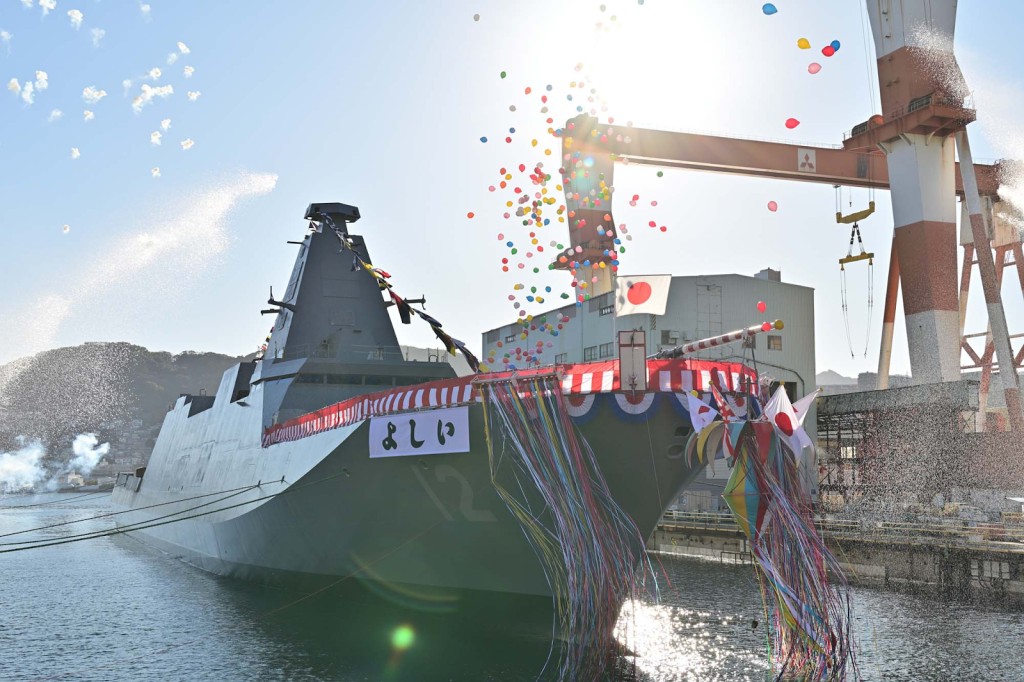
By the end of 2025, Japan completed the final vessel in its largest post-war fleet expansion program. The last of 12 Mogami-class frigates—JS Yoshii—was officially named and launched at a Mitsubishi Heavy Industries shipyard in Nagasaki. The ship is scheduled to join the fleet in 2026, having been constructed in just 17 months from keel-laying to launch. The relatively rapid construction timeline highlights improvements in Japan’s modular shipbuilding techniques and production efficiency.
The Mogami-class program represents a shift toward multi-role, networked, and cost-effective surface combatants designed for both traditional naval operations and gray-zone contingencies in surrounding waters. For Tokyo, this class enhances maritime domain awareness and distributed deterrence capabilities across the broader Western Pacific.
Simultaneously, Washington has begun signaling interest in deeper industrial cooperation. U.S. Navy Secretary John Phelan in 2025 suggested that the United States would discuss with Japan the option of dual-use shipbuilding—constructing commercial vessels with potential military applications—as part of efforts to expand joint capacity and strengthen deterrence against China. The proposal reflects U.S. concern about its own limited shipbuilding capacity and the need to leverage allied industrial bases.
Beyond the U.S.–Japan alliance, Tokyo has also intensified outreach to Europe. Japanese delegations from the Ministry of Economy, Trade and Industry and the Defense Ministry’s Acquisition, Technology & Logistics Agency visited Finland and Sweden to explore dual-use industrial cooperation. In Germany, Japanese infrastructure authorities have promoted technologies relevant to defense logistics, including bridge construction capable of supporting armored vehicles.
These outward moves have not gone unnoticed in Beijing. On February 24, China’s Ministry of Commerce added 20 Japanese entities—including shipbuilding and aerospace affiliates of Mitsubishi Heavy Industries—to its export control list. This marked the first time Japanese firms were included since the list’s creation in January 2025, signaling heightened scrutiny of Japan’s expanding defense industrial role.
First, constitutional revision—whether formal or incremental—will remain a central variable shaping regional perceptions. Even if Prime Minister Takaichi fails to secure the two-thirds upper house threshold required for amendment, gradual reinterpretation of Article Nine could continue. From Beijing’s perspective, the combination of rising defense spending, deregulated arms exports, and constitutional debate reinforces long-standing concerns about Japan’s trajectory. As these concerns deepen, political space for improvement in China–Japan relations may narrow further.
Second, China’s decision to blacklist 20 Japanese defense-related entities reflects more than a legalistic response to export control issues. It also signals Beijing’s unease about Japan’s growing strategic value within the U.S. alliance system. While Japan’s current military capabilities remain limited compared to China’s overall force structure, Tokyo’s strength lies in its ability to integrate technologically and operationally with other U.S. allies. In a broader Indo-Pacific context—spanning Australia, the United States, and increasingly Europe—Japan functions as a key industrial and logistical node within a networked deterrence architecture.
Third, U.S. policy calculations add another layer of complexity. The 2025 U.S. National Security Strategy emphasizes avoiding direct war with China in the Indo-Pacific while maintaining credible deterrence. However, Japan’s status as a treaty ally legally obligates Washington to respond to certain contingencies. President Donald Trump has reportedly cautioned Prime Minister Takaichi against provoking Beijing over Taiwan, underscoring his preference for managing tensions. As Trump prepares for a potential late March–early April visit to China, discussions are expected to focus primarily on trade and Taiwan. Yet Japan’s expanding military role and China-Japanese friction may also enter the agenda.
Japan’s growing maritime defense industry thus sits at a strategic crossroads. For Tokyo, it represents normalization and greater burden-sharing within the alliance system. For Beijing, it raises historical sensitivities and contemporary security concerns. For Washington, it offers industrial reinforcement but also increases the complexity of managing escalation risks in East Asia.
How these three perspectives interact will shape not only Japan’s defense trajectory, but also the broader balance of deterrence and diplomacy in the Indo-Pacific.
This issue’s Spotlight was written by Yilun Zhang, Research Associate at ICAS.
Government Releases & Other Press Statements
Analyses & Opinions
Other Research
Observer States in Arctic Governance
March 3, 2026
8:30 AM – 9:25 AM CET
On Tuesday, March 3, ICAS will host an event at the Arctic Circle Rome Forum in Roma, Italy with Osservatorio Artico titled “Observer States in Arctic Governance”.
The panel will feature ICAS’ Executive Director, Dr. Nong Hong, as well as Sakiko Hataya and Dr. Xiang Gao from the Ocean Policy Research Institute of the Sasakawa Peace Foundation, Marco Volpe from the University of Lapland, and Jihoon Jeong of the Korea Arctic Research Consortium. The panel will be moderated by Agostino Pinna, Special Envoy for the Arctic in the Ministry of Foreign Affairs and International Cooperation. Full bios for all participants can be found below.


The Institute for China-America Studies is an independent nonprofit, nonpartisan research organization dedicated to strengthening the understanding of U.S.-China relations through expert analysis and practical policy solutions.
1919 M St. NW Suite 310,
Washington, DC 20036
icas@chinaus-icas.org
(202) 968-0595
© 2026 INSTITUTE FOR CHINA-AMERICA STUDIES. ALL RIGHTS RESERVED.