
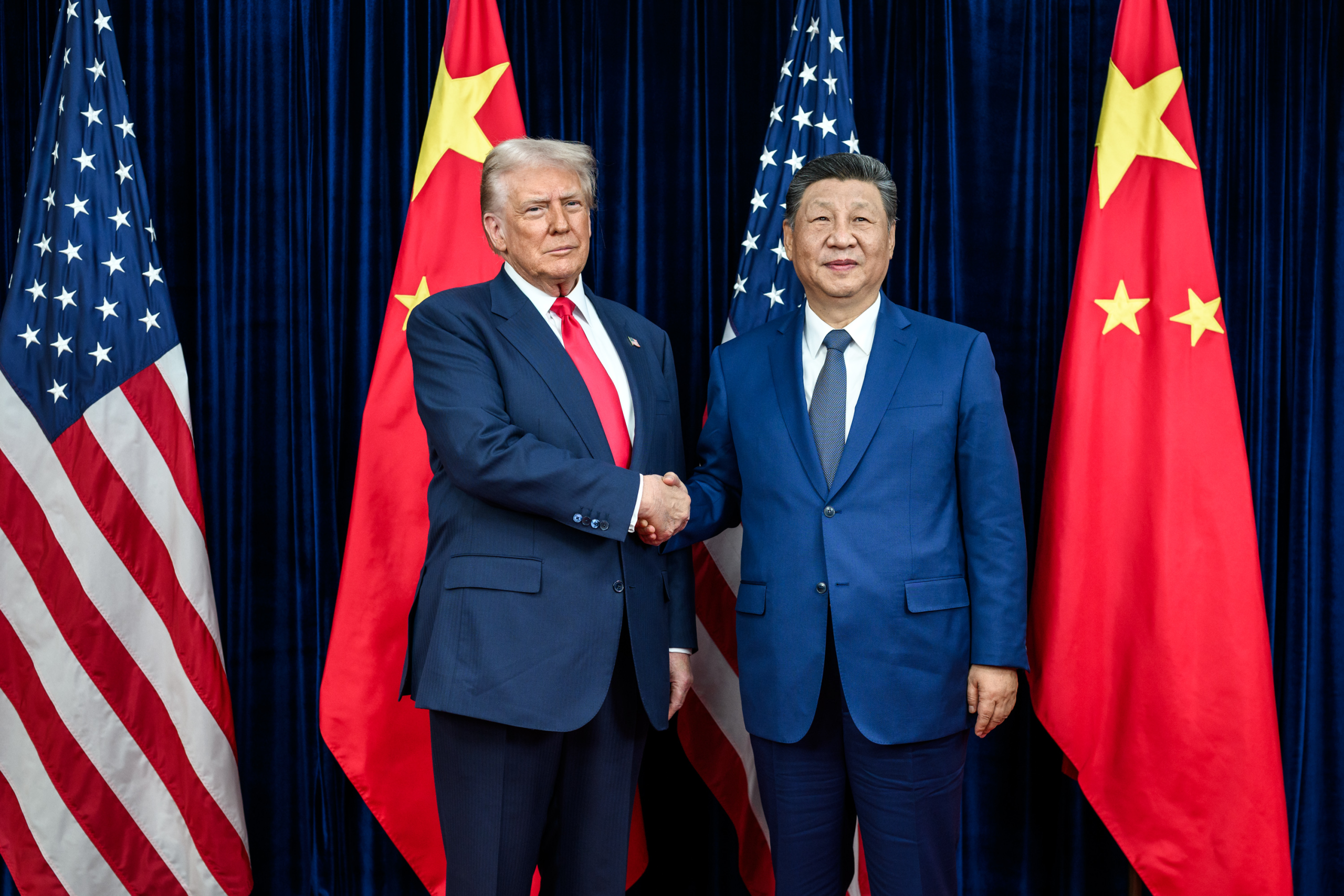
Cover Image Source: President Donald J. Trump participates in a welcome ceremony with President Xi Jinping of the People’s Republic of China, Thursday, May 14, 2026, at the Great Hall of the People in Beijing, China. (Official White House Photo by Daniel Torok)
On May 13–15 2026, over eight years after his first ‘state visit-plus’ to Beijing, US President Donald Trump paid a lower key, yet higher stakes state visit to China. Trump’s meeting with Chinese President Xi Jinping resulted in a host of commitments, including a scheduled reciprocal visit to Washington in September 2026, signalling that hope for strategic restraint could yet return to the bilateral relationship.
The bottom had begun to fall out of the US–China relationship a month after Trump’s November 2017 visit to Beijing, with the publication of the 2017 National Security Strategy. The 2017 National Security Strategy characterised China as a ‘revisionist’ power that was engaged in long-term ‘geopolitical competition’ with the United States. Following a Section 301 probe into China’s technology transfer policies and practices, the US–China trade war was initiated in March 2018. In May 2019, the technology war was kicked into higher gear when Huawei was placed on the US Department of Commerce’s Entity List.
China and the United States — or at least its president — appear to have come full circle this May.
In Beijing, the two presidents utilised the steering wheel of leaders-led diplomacy to nudge their bilateral relationship towards one of ‘constructive strategic stability’ based on ‘fairness and reciprocity’. For Xi, it anticipates a more facilitative environment to attend to China’s modernisation goals. For Trump, it connotes a less imbalanced trade relationship that advances the interests of US businesses. Their divergent purposes aside, the framing is as welcome as it is necessary. Ever since the breakdown of the strategic consensus that Richard Nixon, Mao Zedong and Henry Kissinger bequeathed, the bilateral relationship has groped unsuccessfully in search of a new guiding strategic framework.
In Beijing, the two presidents chartered a US–China Board of Trade and a US–China Board of Investment. While the former will provide a scaffolding to manage their trade in ‘non-sensitive’ goods by identifying products for mutual tariff reductions and exemptions, the latter’s terms of reference are unclear. Trump himself may not be averse to Chinese firms selling US-produced goods made with US labour to US consumers. But his administration’s America First Investment Policy envisages restricting China-affiliated persons from investing in US advanced technology, critical infrastructure, agriculture, energy, raw materials and other strategic sectors.
The two presidents also blessed a host of deal commitments related to the purchase of US agricultural goods, aircraft and energy as well as sorted through irritants related to the flow of Chinese rare earths. The announcement that China will order 200 Boeing jets is tied artfully to the supply of engines and parts for China’s own narrowbody C919 aircraft. Common cause was on display too regarding Iran’s nuclear ambitions, the passage of shipping through the Strait of Hormuz, as well as ’their shared goal to denuclearize North Korea’, though conversations on US arms exports to Taiwan were less salutary.
Most importantly, the two leaders set a date in late September 2026 for Xi’s return visit to Washington. There has not been a visit to the White House by a Chinese president nor the issuance of a presidential joint statement in more than a decade.
On 24 September 2026 at the White House, the two presidents must renew their Busan Consensus on trade and technological competition for another year as their first order of business. The ‘Busan Consensus’ is vital as a stay on major export controls as well as on additional tariffs in exchange for business-as-usual flows of critical minerals.
Next, Trump and Xi should populate their Board of Trade and Board of Investment with tariff cuts and sectoral carve-outs. Rather than view the two boards through the lens of decoupling, their purpose must be to compartmentalise and regulate competition so that proven areas of mutual gain, such as agriculture, selective industrial investment and public health, can be leveraged as stabilising ballast. Blacklisting Chinese knowhow will not make US industrial realities vanish.
The two sides should advance their dialogue on artificial intelligence to prevent the spread of this powerful technology to ill-intentioned third-party actors, including non-state actors. The two sides should also establish a tripolar framework with Moscow for exchanges on strategic stability and arms control. Nuclear testing, transparency, risk reduction, force-sizing as well as the means of delivery must all be placed on the discussion table.
Foremost of all, Xi must press Trump to gradually reverse the unsatisfactory direction of travel of the United States’ ‘One China’ policy, which has been whittled down to admonishing unilateral change of the cross-strait status quo.
Rather than lean yet again on a US president to ‘oppose’ Taiwan’s independence, Xi should invite Trump to support the 1992 Consensus in howsoever indirect a language of the United States’ choosing. Backing a dialogue platform that stands to lower the temperature across the strait should be a logical fit, given that it is official US policy that it does not use the Taiwan card to compete or contain China and takes no issue with efforts to peacefully resolve their dispute.
Trump may appear to be an unlikely personage to co-author a new era of predictable and restrained US–China ties. Such a framing though would be short-sighted. Trump views himself as a proponent of great power diplomacy, even harbouring pretensions as a world-historical statesman. Unlike any previous US administration in recent memory, the China Desk officer in the Trump administration sits behind the Resolute Desk in the Oval Office. Along with US Secretary of the Treasury Scott Bessent, the lead on the trade and technology negotiations, the two are outliers in an administration stacked with anti-China voices.
Beijing must highlight the potential role that the country can play in advancing the interests of US workers, farmers and families, as well as the role that Chinese firms could play in building out the United States’ industrial expansion. The framework of a win-win relationship over the next three years, with adequate leverage and safeguards at each side’s disposal, can be crafted on this foundation.
A spring of hope, rather than a winter of despair, can be returned to the US–China bilateral relationship.
This article was originally published on East Asia Forum on May 28, 2026.


Renewing Sino-American bonds of contact, commerce and civility