
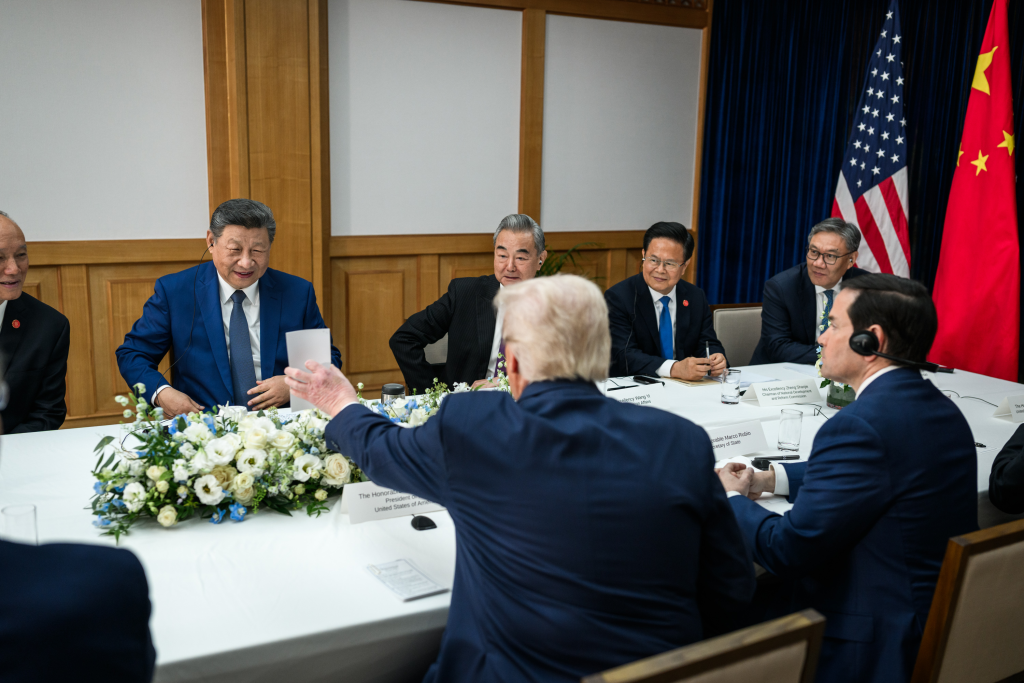
Photo by Xie Huanchi/Xinhua via Getty Images
Canadian Prime Minister Mark Carney’s recent visit to China marked the most substantive thaw in China–Canada relations since the fallout of the Meng Wanzhou affair. While the trip produced a range of symbolic gestures, one outcome stood out for its material clarity: Ottawa’s decision to allow up to 49,000 Chinese electric vehicles (EVs) into the Canadian market annually and to slash tariffs on Chinese EVs from 100 percent to 6.1 percent. In a North American context defined by Washington’s relentless effort to keep Chinese EVs out, this move has inevitably attracted outsized attention—not only from EV manufacturers, but also from policymakers watching the evolving balance within the continent’s trade architecture.
At face value, the policy shift looks like a breakthrough. Chinese EV makers, locked out of the U.S. market and facing growing uncertainty in Europe, suddenly appear to have found a new entry point into North America. Canada, long treated as a junior partner in U.S. trade politics, seems to be asserting an independent economic posture at a moment when its relationship with Washington is under visible strain. Markets and media were quick to frame the decision as a “win” for Chinese EVs and a strategic opening north of the U.S. border.
Yet as with many recent developments in North American trade, the headline tells only part of the story.
From Ottawa’s perspective, the EV decision is best understood not as an embrace of China, but as a hedge against growing U.S. unpredictability. Carney’s remark that China is “more predictable” than the United States—made against the backdrop of tariffs and tariff threats and Washington’s increasingly casual rhetoric about Canada’s sovereignty—was not a declaration of strategic realignment. It was a pointed response to an American political environment in which trade policy has become transactional, personalized, and increasingly detached from institutional guardrails. Opening a limited channel for Chinese EVs gives Canada leverage, signaling that it retains options beyond automatic alignment with U.S. preferences like it was under Carney’s predecessor.
For China, the appeal of the Canadian opening is equally obvious. Domestic competition in the EV sector has intensified in recent years into a brutal price war, while access to European markets remains constrained by tariffs, investigations, and political resistance. In this context, Canada represents not just a new sales destination, but a symbolic breach in North America’s defensive perimeter. Even a modest presence in Canada could amplify competitive pressure on U.S. automakers and underscore the limits of American protectionism in an integrated global economy.
Still, optimism should remain cautioned. The first and most immediate constraint lies in the triangular dynamics among China, the United States, and Canada. The timing of Ottawa’s decision cannot be separated from the looming 2026 review of the United States–Mexico–Canada Agreement (USMCA). The Trump administration has already signaled its intent to use the review to extract tougher concessions from both Canada and Mexico, particularly on issues related to China. Restrictions on Chinese investment, tighter rules of origin, and renewed efforts to prevent “backdoor” access to the U.S. market are almost certain to feature prominently.
In that context, Chinese EVs function less as a long-term Canadian commitment than as a bargaining chip. Ottawa’s willingness to open its market—partially and conditionally—strengthens its hand ahead of negotiations with Washington. But as past experience with the Trump administration suggests, leverage is meant to be traded. If the White House offers sufficiently attractive terms, Chinese EV access could quickly become part of a broader transactional deal. The opening, in other words, is real—but it is not guaranteed.
Canada’s membership in the CPTPP adds another layer to this opening: even if U.S. pressure ultimately constrains Chinese EV access under the USMCA framework, China could still treat Canada as a production and operational foothold oriented toward other major CPTPP markets, rather than as a mere gateway to the United States.
Even if political headwinds do not immediately close the door, market realities pose additional challenges. Canada’s infrastructure is far less conducive to rapid EV adoption than China’s. Harsh winters, long travel distances, and an uneven distribution of public charging facilities slow consumer uptake. Provincial governments vary widely in their commitment to EV expansion, and just a few appear ready to undertake the kind of large-scale infrastructure planning that accelerated adoption in China. Without sustained policy coordination and investment, EV penetration is likely to remain gradual rather than transformative.
This places Chinese manufacturers in an unfamiliar position. Success in Canada may depend not only on competitive pricing and product quality, but also on their willingness to operate within Canada’s regulatory and legal framework to support charging infrastructure and related services. The assumption that market access alone will generate demand risks underestimating the institutional role governments play in shaping EV ecosystems.
After-sales service presents an even more demanding test. Chinese EV brands have worked hard to overturn outdated perceptions of low quality, establishing reputations for reliability, advanced features, and value. Yet servicing vehicles across a vast geography under strict consumer-protection and liability regimes requires a different set of capabilities. Building localized service networks, training personnel, and ensuring timely support across time zones are resource-intensive tasks. Product engineering and after-sales operations are not interchangeable, and weaknesses in the latter can quickly erode trust in the former.
Scale further limits impact. An annual quota of 49,000 vehicles is not insignificant, but it is far from transformative in a country as large as Canada. If dispersed thinly across provinces, Chinese EVs risk becoming a novelty rather than a visible market force. Concentrated deployment in select urban regions could generate stronger demonstration effects, but that would require careful coordination and strategic restraint. Without it, the opening may prove fleeting—noticed briefly, then absorbed without lasting consequence.
Taken together, the outcomes of Carney’s China visit point to a narrow but genuine opportunity rather than a turning point. For Canada, the EV decision offers short-term leverage and a signal of autonomy at a time of strained ties with Washington. For China, it provides a testing ground for North American market acceptance and a chance to refine localization strategies under real-world conditions. For the United States, it serves as a reminder that protectionist pressure can generate unintended openings elsewhere on the continent, regardless of what Mr. Trump says or believes.
Yet durability remains the central question. As the 2026 USMCA review approaches and political incentives in Washington harden, the temptation to fold Chinese EV access into broader negotiations will grow. Whether this opening evolves into a sustained presence will depend less on tariff rates than on political trade-offs, infrastructure investment, and the capacity of Chinese firms to adapt to North American market norms. Absent those conditions, Canada’s EV opening risks becoming another episode of transactional adjustment—significant in the moment, but fragile by design.


The Institute for China-America Studies is an independent nonprofit, nonpartisan research organization dedicated to strengthening the understanding of U.S.-China relations through expert analysis and practical policy solutions.
1919 M St. NW Suite 310,
Washington, DC 20036
icas@chinaus-icas.org
(202) 968-0595
© 2026 INSTITUTE FOR CHINA-AMERICA STUDIES. ALL RIGHTS RESERVED.

Wave of Visits to Beijing Signals Hedging but not Pivoting