

For decades, China’s rise as a global trading power was built upon an international maritime system largely secured by others. As the world’s largest trading nation, one of the largest shipbuilders, and a leading provider of shipping and logistics services, China benefited enormously from stable sea lanes stretching from the Persian Gulf to the South China Sea. Yet as Beijing’s commercial footprint at sea has expanded, so too have the risks associated with protecting it.
Today, China’s maritime interests are no longer limited to coastal waters or nearby regional routes. Chinese commercial shipping, energy imports, overseas port investments, and maritime logistics networks now span nearly every major chokepoint in the global economy, including the Strait of Hormuz, the Bab el-Mandeb, the Strait of Malacca, and the Suez Canal. Approximately 20 percent of the world’s oil trade passes through the Strait of Hormuz alone, including a substantial share of China’s imported energy supplies. In this sense, maritime security has gradually transformed from a peripheral strategic concern into a core component of China’s economic security.
The turning point for many Chinese policymakers and shipping firms came during the anti-piracy operations off Somalia in the late 2000s. Following repeated pirate attacks in the Gulf of Aden, China launched its first long-term overseas naval escort missions in 2008 under the framework of anti-piracy operations. These missions marked one of the first moments in which Beijing was forced to directly confront the security dimension of globalization. For years, China had operated as one of the largest beneficiaries of global trade routes without needing to actively secure them. The piracy crisis exposed the reality that global commerce could not always rely on abstract notions of international stability or assume that maritime security would indefinitely remain a free public good.
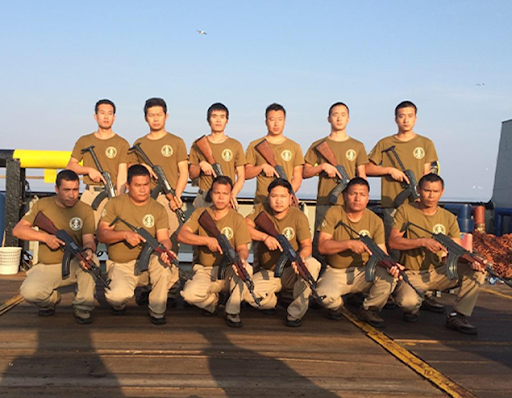
At the same time, the anti-piracy era also accelerated the emergence of Chinese private maritime security companies (PMSCs). Unlike state naval deployments, which are expensive and politically sensitive, private maritime security firms offered Chinese shipping companies a more flexible and commercially oriented means of risk mitigation. These firms gradually began providing services ranging from onboard security teams and route assessments to voyage risk analysis, escort coordination, and maritime crisis management.
However, the development of China’s maritime security industry has differed substantially from Western models.
Western private maritime security firms, particularly those emerging from the United States and the United Kingdom following the wars in Iraq and Afghanistan, evolved into heavily armed and highly professionalized organizations deeply connected to broader national security ecosystems. Many Western PMSCs employed former special forces personnel, operated floating armories, and maintained robust rules of engagement designed for hostile environments. In practice, some evolved into quasi-military extensions of broader Western security architectures abroad.
China’s maritime security sector developed under very different political and legal constraints. Chinese law traditionally imposes strict restrictions on private weapons ownership and limits the scope of private military activity. Equally important, Beijing has long remained cautious about the political symbolism associated with overseas private military contractors, particularly given Western narratives frequently portraying China’s overseas activities as precursors to military expansion.
As a result, Chinese maritime security firms have generally adopted a lower-profile and less militarized operational model. Rather than emphasizing force projection or heavily armed deterrence, many focus on compliance, risk management, voyage coordination, and defensive support services. This distinction has become increasingly important as Chinese shipping interests expand into politically unstable and conflict-prone regions.
In many ways, China today faces a dilemma common to rising maritime powers throughout history: commercial globalization is increasingly generating security obligations that can no longer be entirely outsourced. Yet Beijing remains reluctant to fully adopt the alliance-centered and militarized maritime security structures historically associated with Western naval powers.
This tension became particularly visible in May 2026, when Iranian authorities seized a support vessel linked to Hong Kong-registered Sinoguards Marine Security near the Strait of Hormuz. The incident marked the first known seizure of a private-security-related vessel since the beginning of the latest U.S.-Iran conflict and drew significant attention because the vessel was connected to a Chinese maritime security company operating in one of the world’s most strategically sensitive waterways.
The seizure was notable not only because it involved a Chinese-linked company, but because it revealed the limits of commercial alignment in maritime security affairs. Despite China’s relatively close economic relationship with Iran and Beijing’s importance as a buyer of Iranian oil, Tehran nevertheless appeared unwilling to tolerate the presence of foreign-linked maritime security operations in the vicinity of the Strait of Hormuz.
The incident also highlighted a key distinction between Chinese maritime security firms and many Western counterparts. Reports surrounding the seizure suggested that the vessel and its operators offered little visible resistance during the encounter. While some observers interpreted this as evidence of weakness, the reality may reflect the fundamentally different operational logic underpinning Chinese maritime security firms.
Unlike heavily armed Western private maritime security contractors, firms such as Sinoguards have generally evolved around a model emphasizing de-escalation, legal compliance, and low political visibility. Sinoguards itself, established in 2013 during the height of anti-piracy security demand, presents itself as a neutral maritime security and risk management company rather than a military contractor. Its operations reportedly involve multinational personnel and internationally oriented commercial structures rather than direct integration into a state military apparatus.
This relatively restrained operational profile contrasts sharply with the image often associated with Western maritime security firms operating in conflict zones. In many Western security models, heavily armed contractors and floating armories became normalized features of maritime protection operations during the post-9/11 era. By comparison, Chinese maritime security firms have generally avoided overt militarization and instead adopted a lower-profile approach focused on risk mitigation rather than coercive presence.
The implications of the seizure quickly extended beyond a single vessel. Within days, reports emerged indicating that commercial traffic through the Strait of Hormuz had slowed significantly. Some tankers delayed transits, while a Chinese fuel tanker reportedly paused mid-voyage before continuing its route. The incident underscored a broader reality: China is no longer a distant observer of instability in critical maritime chokepoints. Its shipping networks, energy imports, and commercial interests are now directly exposed to disruptions in the global maritime order.
The broader regional context further amplified these concerns. Amid escalating tensions surrounding Iran and the Strait of Hormuz, President Donald Trump publicly called on countries including China, Japan, South Korea, France, and the United Kingdom to participate in maritime security operations protecting the strait. Trump argued that countries dependent on Hormuz shipping routes should assume greater responsibility for securing them and warned that Washington would “remember” countries unwilling to participate.
Yet China showed little indication of joining a U.S.-led maritime security coalition.
This hesitation was significant. On the surface, China possesses clear economic incentives to maintain open sea lanes in the Persian Gulf. However, participation in a U.S.-led naval security framework would also carry substantial strategic and political implications. Joint patrols, coordinated rules of engagement, and alliance-style maritime policing operations would effectively place China within a broader U.S.-defined maritime security architecture — something Beijing has historically sought to avoid.
As China’s global maritime footprint continues to expand, Beijing will likely face growing pressure to assume a larger role in securing critical sea lanes. The challenge, however, is that China’s commercial interests are now expanding faster than its overseas security architecture.
For years, many Western analysts interpreted developments such as China’s overseas logistics facility in Djibouti as evidence that Beijing was rapidly constructing a globally militarized maritime network modeled after the United States. Yet the behavior of Chinese maritime security firms in places such as the Strait of Hormuz suggests a more cautious and restrained trajectory.
If China were seeking to replicate the traditional Western model of maritime dominance, recent events in the Persian Gulf might have looked very different. Chinese maritime security operations would likely involve more visible armed deterrence, broader naval integration, and more assertive responses to interference at sea. Instead, Chinese firms continue to operate with relatively limited visibility, restrained operational profiles, and an apparent preference for avoiding escalation.
This does not necessarily mean China lacks the capability to expand its maritime security presence more aggressively in the future. Rather, Beijing appears to prefer a model centered on securing commercial access while minimizing the political visibility associated with overseas military expansion.
This distinction matters because it reflects a broader difference between competing maritime security philosophies.
The traditional U.S.-led maritime order has historically emphasized alliance structures, naval dominance, freedom of navigation patrols, and the active policing of strategic waterways. In contrast, China’s current approach appears more focused on preserving stable commercial access while avoiding deep entanglement in regional security conflicts and alliance systems.
In other words, China increasingly seeks to secure the route rather than control the sea.
However, this approach may become progressively more difficult to sustain as geopolitical instability spreads across critical chokepoints. The wars and crises affecting the Red Sea, the Strait of Hormuz, and other strategic waterways are demonstrating that shipping lanes can no longer be treated as politically neutral commercial spaces. Instead, they are becoming increasingly intertwined with broader strategic competition, regional conflicts, sanctions enforcement, and security rivalries.
The seizure of the Sinoguards-linked vessel ultimately revealed more than a single maritime incident. It exposed the growing tension between China’s expanding global commercial interests and its still-evolving maritime security model.
As Beijing continues to emerge as one of the world’s largest maritime stakeholders, the central question may no longer be whether China will expand its overseas maritime security role, but rather what kind of maritime security power China ultimately intends to become.
This Spotlight was originally released with Volume 5, Issue 5 of the ICAS MAP Handbill, published on May 28, 2026.
This issue’s Spotlight was written by Yilun Zhang, Research Associate at ICAS.

Maritime Affairs Program Spotlights are a short-form written background and analysis of a specific issue related to maritime affairs, which changes with each issue. The goal of the Spotlight is to help our readers quickly and accurately understand the basic background of a vital topic in maritime affairs and how that topic relates to ongoing developments today.
There is a new Spotlight released with each issue of the ICAS Maritime Affairs Program (MAP) Handbill – a regular newsletter released the last Tuesday of every month that highlights the major news stories, research products, analyses, and events occurring in or with regard to the global maritime domain during the past month.
ICAS Maritime Affairs Handbill (online ISSN 2837-3901, print ISSN 2837-3871) is published the last Tuesday of the month throughout the year at 1919 M St NW, Suite 310, Washington, DC 20036.
The online version of ICAS Maritime Affairs Handbill can be found at chinaus-icas.org/icas-maritime-affairs-program/map-handbill/.