

Executive Director, Senior Fellow
Critical minerals are not merely industrial inputs; they are the bedrock of modern technological advancement, indispensable for everything from sustainable energy solutions and cutting-edge defense systems to everyday high-tech manufacturing. The global competition for these finite resources has intensified, revealing significant supply chain vulnerabilities for nations heavily reliant on imports. Recognizing this strategic imperative and the growing geopolitical
implications of resource scarcity, the United States has been prompted to modernize its regulatory framework and strategically assert its resource security goals, particularly in underexplored domestic domains.

On June 25, 2025, the Trump administration announced a comprehensive regulatory overhaul aimed at accelerating offshore critical mineral development. These reforms, carried out by the Bureau of Ocean Energy Management (BOEM) and the Bureau of Safety and Environmental Enforcement (BSEE), seek to streamline every stage of the development process. The main objectives are to reduce bureaucratic delays, enhance coordination across federal agencies, and provide greater certainty to industry stakeholders.
These policy changes directly implement an executive order signed by President Trump in April 2025, which set forth a strategic directive to expand deep-sea mining operations domestically. While the executive order laid the foundational vision, the Department of the Interior’s (DOI) new regulations serve as the operational roadmap. Together, they aim to eliminate administrative inefficiencies without compromising essential environmental and safety oversight.
The United States remains heavily dependent on imported critical minerals such as nickel, copper, cobalt, and rare earth elements. With global demand surging—driven by the rapid growth of electric vehicle production, energy storage technologies, and defense modernization—this reliance presents a significant strategic vulnerability. China currently dominates global rare earth supply chains, controlling over 69% of global production and extending its influence across mineral extraction, refining, and processing capacities. This grants Beijing considerable leverage over international markets.
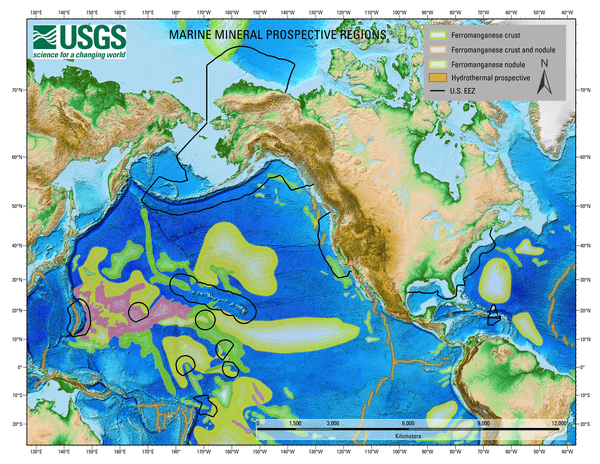
This policy reforms aim to reduce this dependence by unlocking the largely untapped mineral wealth found on the ocean floor. Offshore deposits, especially polymetallic nodules, contain high concentrations of critical minerals essential to the global energy transition and modern industries. These resources represent a crucial alternative to terrestrial sources and a strategic opportunity to strengthen domestic supply chains.
The United States remains heavily dependent on imported critical minerals such as nickel,
copper, cobalt, and rare earth elements. With global demand surging, driven by the rapid growth of electric vehicle production, energy storage technologies, and defense modernization, this reliance presents a significant strategic vulnerability. China currently dominates global rare earth supply chains, controlling over 69% of global production and extending its influence across mineral extraction, refining, and processing capacities. This grants Beijing considerable leverage over international markets.
This policy reforms aim to reduce this dependence by unlocking the largely untapped mineral wealth found on the ocean floor. Offshore deposits, especially polymetallic nodules, contain high concentrations of critical minerals essential to the global energy transition and modern industries. These resources represent a crucial alternative to terrestrial sources and a strategic opportunity to strengthen domestic supply chains.
As Acting Assistant Secretary Adam Suess of the DOI emphasized, “We’re making decisive moves to secure America’s leadership in critical minerals—resources that power our economy, protect our national security, and support modern life.” The reforms respond to longstanding recognition that the U.S. has underdeveloped its own critical mineral resources, exposing vulnerabilities the new policies seek to address.
This perspective is echoed across multiple sectors, where experts emphasize the broader strategic implications of offshore mineral development. As RealClearEnergy argues, “President Trump’s recent Executive Order on offshore critical minerals is more than smart policy. It’s a strategic imperative. Without secure access to [these minerals], America’s economic future and national defense are at risk,” underscoring how such development is now seen as essential in the context of increasingly politicized global supply chains. Similarly, The Washington Post has noted that China’s dominance in rare earth exports enables it to “disrupt defense manufacturing or spy on U.S. systems,” reinforcing the urgency of reducing foreign leverage over clean technology supply chains. The Atlantic Council further stresses that “the United States should treat private capital as a strategic asset. With the right risk-adjusted incentives, U.S. capital markets can outcompete China’s state-directed model,” highlighting the critical importance of scaling up domestic mineral capacity through offshore initiatives.
By prioritizing offshore mineral development, the United States not only taps into vast, previously untapped resource potential but also seeks to diversify its supply chains and shield itself from external market disruptions. This strategic pivot is increasingly recognized as vital to safeguarding both national security and long-term economic competitiveness in a contested global resource landscape.
Several major regulatory changes were introduced:
Major Regulatory Changes
These reforms constitute a comprehensive overhaul of the regulatory framework governing offshore mineral development, targeting multiple stages of the permitting and development process. The overarching goal is to accelerate project timelines while preserving essential oversight and environmental protections.
One of the most notable changes is the extension of early-stage prospecting permits from three to five years, a 66% increase. This extension addresses long-standing industry concerns that the previous three-year term was insufficient for adequately evaluating complex offshore mineral deposits. By providing a longer window for thorough exploration, the new policy reduces the administrative burden on both developers and regulators by lessening the frequency of permit renewals.
Environmental review procedures for initial exploration activities have also been streamlined. The BOEM will now apply expedited environmental assessments to low-impact operations such as mapping and sampling. More comprehensive reviews will continue to be required for intensive activities with higher environmental risks, ensuring that resource development is balanced with ecological safeguards.
Additionally, the policy changes significantly accelerate the leasing process by allowing BOEM to independently identify and prepare potential development areas without first issuing a formal Request for Information (RFI) or convening a multi-agency task force. This marks a fundamental shift from previous procedures, prioritizing efficiency while still enabling stakeholder input at appropriate stages.
Throughout these reforms, scientific oversight remains a cornerstone. The U.S. Geological Survey (USGS) continues to play a critical role by evaluating environmental risks and assessing mineral resource potential, ensuring that development decisions are grounded in robust scientific evidence.
Together, these changes aim to minimize unnecessary paperwork and procedural delays, retain core compliance requirements, and enhance the overall efficiency of offshore mineral development without compromising safety or environmental stewardship.
These policy adjustments are poised to profoundly impact the offshore mining industry, fundamentally altering the economics of marine mineral development in U.S. waters. For mining companies, the reforms offer multiple substantive benefits. Streamlined permitting processes and fewer administrative steps are expected to significantly reduce the time from initial application to operational approvals, leading to demonstrably shorter regulatory timelines and lower compliance costs. The extended five-year permit duration, in particular, allows companies to adopt more methodical exploration strategies without the immediate pressure of an expiring permit, thereby improving project feasibility and enabling more efficient deployment of resources. This enhanced regulatory certainty, stemming from clearer guidelines and accelerated processes, is also anticipated to significantly improve the investment climate, making offshore ventures more attractive to both strategic and financial investors. Ultimately, companies operating in U.S. waters may gain a distinct advantage over those in jurisdictions with more cumbersome regulatory frameworks, providing a crucial competitive edge.
Despite this focus on acceleration, core environmental protections remain robustly intact. The USGS will continue to provide scientific data on mineral resources and monitor potential ecological impacts associated with seafloor development. Mining operations must comply with key environmental laws and retain ongoing environmental monitoring requirements. Recent research on deep-sea mining controversies, cited in the DOI’s announcement, suggests that while mining activities can leave visible traces for decades, affected marine life may gradually recover. This finding provides important context for developing environmentally responsible approaches. The successful long-term viability of these policies hinges on striking a delicate balance between expedited development and rigorous environmental stewardship.
Ultimately, these policy changes aim to position U.S. companies more competitively in the global race for critical mineral resources. By reducing regulatory burdens and accelerating development timelines, the U.S. seeks to close the gap with nations that have already adopted more streamlined approval processes. This global competition is underscored by significant international developments, such as Japan’s recent discovery of an estimated 200 million tons of battery metals within its territorial waters, highlighting the increasing international urgency for marine mineral resources and the strategic necessity of these U.S. reforms.
The U.S. now has a unique opportunity to lead not only in critical mineral extraction, but also in demonstrating how responsible deep-sea governance can be scaled and institutionalized as a global norm. Analysts from institutions such as the Atlantic Council have noted that global leadership in this space will depend not only on resource control but also on shaping the regulatory frameworks that define sustainability and access.
The United States’ policy on critical minerals—including its stance on domestic offshore development and deep seabed mining, as reflected in an April executive order authorizing federal agencies to grant commercial licenses for mining beyond national jurisdiction—has sparked a wide range of international reactions, from cautious cooperation to outright criticism. These responses reflect not only divergent geopolitical interests, but also deeper tensions over environmental governance, multilateral regulation, and the future of deep-sea resource management.
Country / Region | Reaction | Key Points |
|---|---|---|
Critical | Criticized President Trump’s executive order as a violation of international law. Argued that the move undermines the authority of the ISA and the UNCLOS. Emphasized that the U.S. is attempting to bypass international regulations to secure critical minerals, potentially destabilizing global governance frameworks. | |
Critical, advocates multilateral governance | The European Commission expressed deep regret over the U.S. decision, questioning the legality of the move under international law. Highlighted concerns about the environmental implications and the potential erosion of international regulatory frameworks. | |
Cautious, supportive of cooperation | Moving forward with test mining for rare earth materials from the deep seabed near Minamitori Island, marking the world’s first attempt to extract such metals from abyssal mud. The government emphasizes the need for international cooperation and adherence to environmental standards in seabed mining activities. | |
Supportive of balanced development and governance | The government is reviving efforts to establish deep-sea activities support law to facilitate the development of critical mineral resources. Aims to balance resource development with environmental protection through a structured legal framework. | |
Reevaluating opposition | Consider withdrawing its support for an international ban on deep-sea mining, indicating a shift towards a more flexible approach. The government emphasizes the need for strong environmental regulations and scientific research before proceeding with seabed mining activities. | |
Opposition to unilateral actions | Publicly reaffirmed its position supporting a moratorium on deep-sea mining at the ISA meetings. The government opposes the commencement of deep-sea mining without rigorous environmental regulations and scientific assessments. | |
Concerned about environmental and economic impacts | Environmental groups have criticized the U.S. support for deep-sea mining, viewing it as a betrayal of Pacific environmental interests. The government is urged to strengthen international trade ties and seek alternative markets to cushion the impact of U.S. policies. | |
Proceeding with caution | Moving forward with plans to mine seabed minerals along its continental shelf despite public opposition. The government is balancing resource development with environmental considerations and public concerns. | |
Cautiously receptive | Welcomes U.S. investment but upholds strict environmental and sovereignty standards; banned uranium mining in 2021. | |
Skeptical of U.S. unilateralism | Challenged U.S. claims to an expanded continental shelf rich in seabed minerals, emphasizing that without U.S. ratification of UNCLOS, its assertions lack legitimacy. Russian delegates at ISA meetings opposed U.S. jurisdiction extensions, asserting this stance rooted in broader concerns over multilateral governance and Arctic sovereignty | |
Focuses on strategic resource security | Interested in developing offshore minerals to reduce dependence on imports; supports multilateral cooperation but pursues national development goals. | |
Generally supportive of multilateral governance and environmental protection | Support a moratorium on deep-sea mining, emphasizing that no exploitation should proceed until there is sufficient scientific knowledge and strong international environmental safeguards in place. Called for broad international cooperation to delay mining activities and prioritize marine ecosystem protection through the ISA. |
Environmental concerns remain central to the U.S. approach to offshore mineral development. Although the reforms streamline regulatory procedures, they fundamentally do not eliminate substantive environmental safeguards. The BOEM and the BSEE are mandated to ensure responsible development, with a focus on minimizing ecological impact.
The USGS retains its crucial mandate to assess both mineral resource potential and potential environmental impacts associated with seafloor development. The USGS provides critical scientific data to inform decision-making, emphasizing science-based risk mitigation. All development activities must adhere to core environmental regulations, including compliance with statutes like the Outer Continental Shelf Lands Act (OCSLA), which governs federal offshore resource management and includes provisions for environmental protection.
A key aspect of responsible development involves understanding and mitigating the impacts on deep-sea ecosystems. Recent scientific studies, some of which are cited in the DOI announcement, offer important insights. While research indicates that deep-sea mining activities do leave visible traces that can persist for decades and cause immediate impacts such as seabed destruction and sediment plumes, marine life has shown some capacity for gradual recovery in affected areas over extended periods. These findings underscore both the sensitivity of these unique environments and the potential for resilience under certain conditions.
To ensure accountability and minimize disturbance, rigorous environmental monitoring obligations remain integral to any approved project. Companies are required to track and report on ecological impacts throughout the exploration and development process. Furthermore, hazard assessments are conducted to identify and address geological risks associated with seabed operations. These comprehensive measures aim to ensure that mineral development proceeds responsibly, with appropriate oversight, and a continuous commitment to minimizing its environmental footprint on these vital marine habitats.
Legal scholars and international experts underscore that robust, long-term environmental monitoring and scientific oversight are essential for establishing credible and responsible offshore mineral development—particularly if the United States seeks to lead in shaping globally responsible governance models.The United Nations Secretary-General’s Scientific Advisory Board highlights the potentially irreversible impacts of deep-sea mining on marine ecosystems, underscoring the necessity for comprehensive environmental assessments and ongoing monitoring. The ISA enforces strict guidelines for environmental impact assessments, mandating contractors to collect baseline data and conduct continuous ecological monitoring during exploration and mining operations. Additionally, research initiatives like the Eco-Safe Ridge Mining project at the University of Bergen focus on assessing environmental risks and developing mitigation strategies, demonstrating the critical role of science-based oversight in guiding sustainable deep-sea resource management.
The policy changes announced by the US DOI mark a significant and decisive shift in the United States’ approach to offshore mineral resources. These reforms, by streamlining procedures, extending permit durations, and reducing administrative burdens, signal a calculated effort to reposition the U.S. as a major player in the global offshore mineral race, primarily aimed at accelerating the development of secure domestic sources of critical minerals crucial for economic and national security.
The ultimate success and long-term viability of these policies, however, will hinge on their ability to effectively balance the pressing need for expedited development with the ongoing imperative of robust environmental protection. Scientific input from the USGS will play a pivotal role in maintaining this delicate balance, ensuring that development decisions are firmly grounded in a reliable understanding of both resource potential and ecological considerations, complemented by the proactive evolution of sustainable mining practices.
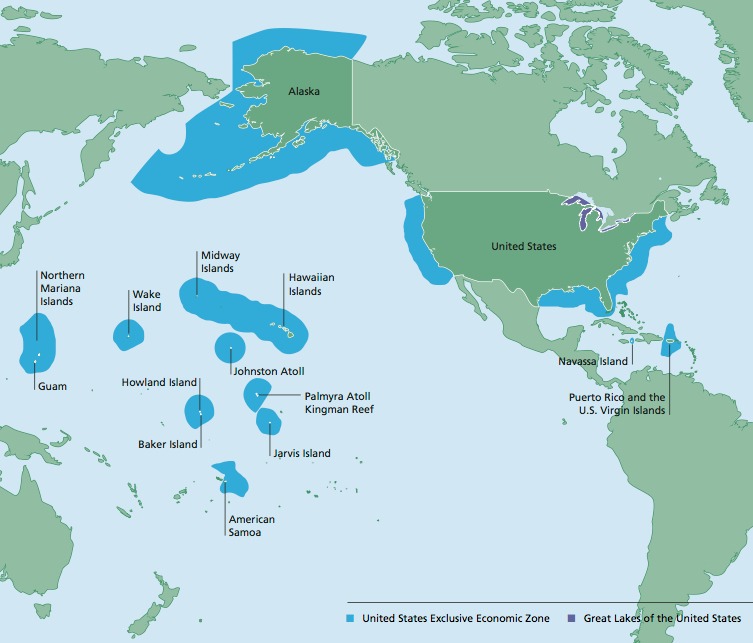
As global demand for critical minerals continues its relentless rise, the strategic importance of developing secure domestic resources will only intensify. While these changes position the United States to compete more effectively in this critical sector, this assertive domestic policy shift is likely to draw significant international scrutiny. The U.S. must carefully navigate potential global concerns, particularly from environmental organizations and nations advocating for more stringent deep-sea mining regulations or moratoriums. Its actions, even within its own exclusive economic zone, may be viewed by some as setting a precedent or potentially undermining nascent international governance efforts, such as those led by the ISA.
Therefore, the future of U.S. offshore mineral development represents a defining test. Credibility as a global leader in responsible seabed governance will necessitate not only robust domestic oversight but also transparent engagement in international dialogues, demonstrating a commitment to responsible resource stewardship that extends beyond its own borders. The world is watching whether the U.S. can truly lead not only in extracting essential minerals, but in setting and adhering to high standards for responsible resource governance in the deep sea for generations to come.

The Institute for China-America Studies is an independent nonprofit, nonpartisan research organization dedicated to strengthening the understanding of U.S.-China relations through expert analysis and practical policy solutions.
1919 M St. NW Suite 310,
Washington, DC 20036
icas@chinaus-icas.org
(202) 968-0595
© 2026 INSTITUTE FOR CHINA-AMERICA STUDIES. ALL RIGHTS RESERVED.


Trump’s Maritime Insurance Gambit Signals a New Phase in U.S-China Competition