
Maritime Affairs Program (MAP) Handbill Spotlight
Interception of the Global Sumud Flotilla in International Waters

Jules Montanez
October 29, 2025
Issue Background
After the military takeover of Hamas in Gaza in 2007, Israel has intensified its blockade on the strip. Exit and entry into Gaza by air and sea is prohibited. There are only three crossings which are controlled by Israel and Egypt. Palestinian movement, imports, and exports are heavily restricted, virtually isolating those within Gaza. After October 7th, Israel announced a “total” blockade, cutting off the entry of food, water, electricity, fuel, and medicine to the 2.3 million people within the strip.
Beginning in 2008, the Free Gaza Movement has launched dozens of ships in order to breach this Israeli blockade of the Gaza strip. The flotillas’ main goal and mission is to carry humanitarian aid with the intention of breaking the Israeli blockade on the Gaza strip. Between 2008 and 2010 several boats successfully reached Gaza, marking the first break in Israel’s naval blockade. However since 2010, all flotillas attempting to break the blockade have been intercepted by Israel in international waters.
Recent Events
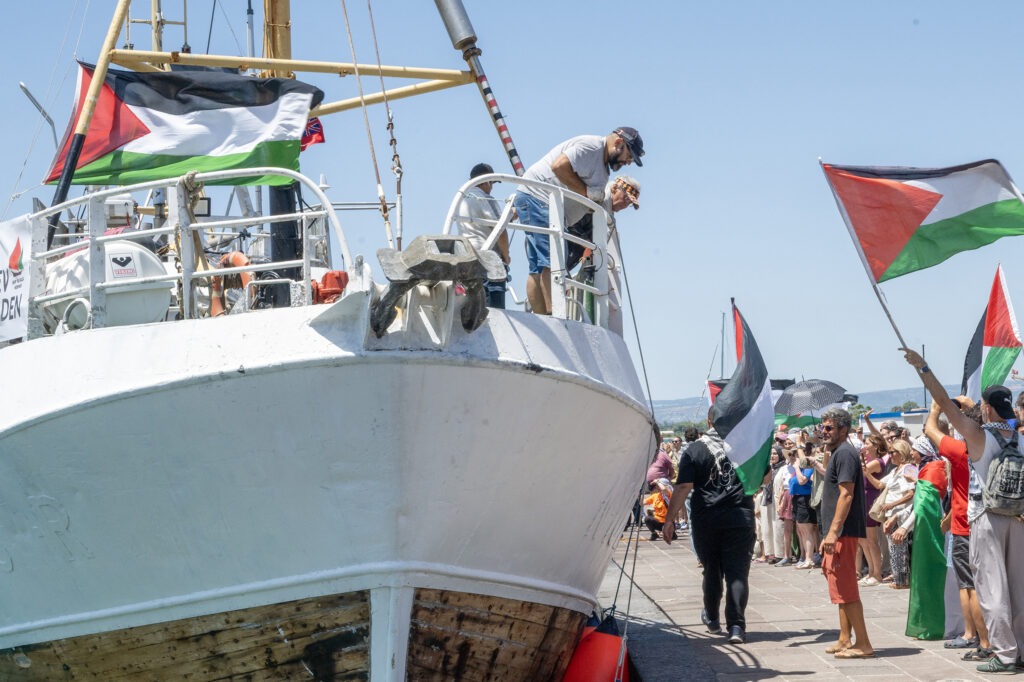
In late August and early September, The Global Sumud Flotilla set sail from Spain with humanitarian aid. The Flotilla, which comprised of over 40 vessels with 500 activists from over 44 countries, is the largest civilian-led convoy of its kind in history. The Israeli foreign ministry released a statement on the Flotilla, stating it was organized by Hamas and that it would not allow the vessels to breach the lawful naval blockade. Israel urged the participants to not break the law and instead utilize the correct channels to deliver aid to the Gaza strip despite little of that aid reaching Palestinians. Food, medicine, and other aid is being weaponized by Israel with over 2000 Palestinians killed within the past 23 months trying to access these aid distribution sites.
On the night of September 24, multiple vessels in the Global Sumud Flotilla were attacked by drones near the South of Greece, prompting Spain and Italy to send Navy patrol vessels for protection and assistance, although not for the whole journey. A couple of days later, on September 28, after the convoys merged in Crete and finished repairs, the vessels continued their journey towards Gaza.
Between October 1 and 2, the Israeli Navy intercepted the ships, with the last vessel being boarded around 42.5 nautical miles (78 kilometers) from Gaza. Hundreds of activists were detained including Greta Thunberg, Nkosi Zwelivelile Mandela, and Rima Hassan. The interceptions reportedly began around 70 nautical miles (130 kilometers) off the shore of Israel and Gaza. A couple of days later on October 8 Israeli forces seized the last nine vessels and detained 145 activists about 120 nautical miles (222 kilometers) off Gaza, causing many to question the legitimacy of Israel’s interception in international waters.
Keep In Mind
The interception of the Global Sumud Flotilla’s voyage drew international attention and the detention of activists triggered widespread protests in cities all over the world. It illustrates the ongoing debate over the legality and morality of Israel’s blockade and the conflict between a nation’s security and international humanitarian norms amidst the ongoing genocide.
Beyond the 1982 UN Convention on the Law of Sea (UNCLOS), which affirms freedom of navigation on the high sea, the interception of the Flotilla raises legal and ethical concerns. Under the San Remo Manual on International Law Applicable to Armed Conflicts at Sea (1994), a naval blockade may be considered lawful if it meets certain conditions, most importantly, that it is not intended to starve civilians or deny them humanitarian assistance While Israel justifies its actions as being necessary to enforce its “legal” blockade rights and national security, numerous UN agencies along with other humanitarian organizations, such as Amnesty International and the Human Rights Watch, have argued that Israel’s blockade is a form of collective punishment on Gaza’s civilian population in violation with the Fourth Geneva Convention (1949). The use of force against unarmed civilian vessels and unlawful detention of activists has also intensified scrutiny of Israel’s adherence to international humanitarian law.
It is crucial to consider the wider geopolitical and economic implications within the Middle East and how regional instability affects the global shipping routes. In particular, Israel’s siege on Gaza has been impacting the Red Sea, a critical maritime route for global trade and energy shipments. The ongoing conflict not only affects global markets but highlights the fragile regional security and relations surrounding the Red Sea. Regional rivalries and conflicts, notably the Houthi attacks, have resulted in blockades, maritime attacks, and growing tensions within the area. Since 2023, with Iranian support the Houthi movement has increasingly targeted maritime traffic within the Red Sea, targeting ships tied to Israel in response to the war. These broader regional security concerns risk potential further escalation with regional powers, especially between Israel and Iran.
While Israel’s blockade and these flotilla missions are nothing new, the latest interception of the Global Sumud Flotilla stresses the need to reassess the root causes of Israel’s blockade and the ongoing humanitarian crisis, otherwise the cycle of violence and suffering will continue to affect Palestinian civilians. Beyond the immediate issue of Gaza, the broader geopolitical implications further illustrate the effects on global shipping routes and Middle Eastern relations within an already unstable region.
This Spotlight was originally released with Volume 4, Issue 10 of the ICAS MAP Handbill, published on October 29, 2025.
This issue’s Spotlight was written by Jules Montanez, Part time Research Assistant Intern.
Maritime Affairs Program Spotlights are a short-form written background and analysis of a specific issue related to maritime affairs, which changes with each issue. The goal of the Spotlight is to help our readers quickly and accurately understand the basic background of a vital topic in maritime affairs and how that topic relates to ongoing developments today.
There is a new Spotlight released with each issue of the ICAS Maritime Affairs Program (MAP) Handbill – a regular newsletter released the last Tuesday of every month that highlights the major news stories, research products, analyses, and events occurring in or with regard to the global maritime domain during the past month.
ICAS Maritime Affairs Handbill (online ISSN 2837-3901, print ISSN 2837-3871) is published the last Tuesday of the month throughout the year at 1919 M St NW, Suite 310, Washington, DC 20036.
The online version of ICAS Maritime Affairs Handbill can be found at chinaus-icas.org/icas-maritime-affairs-program/map-handbill/.