
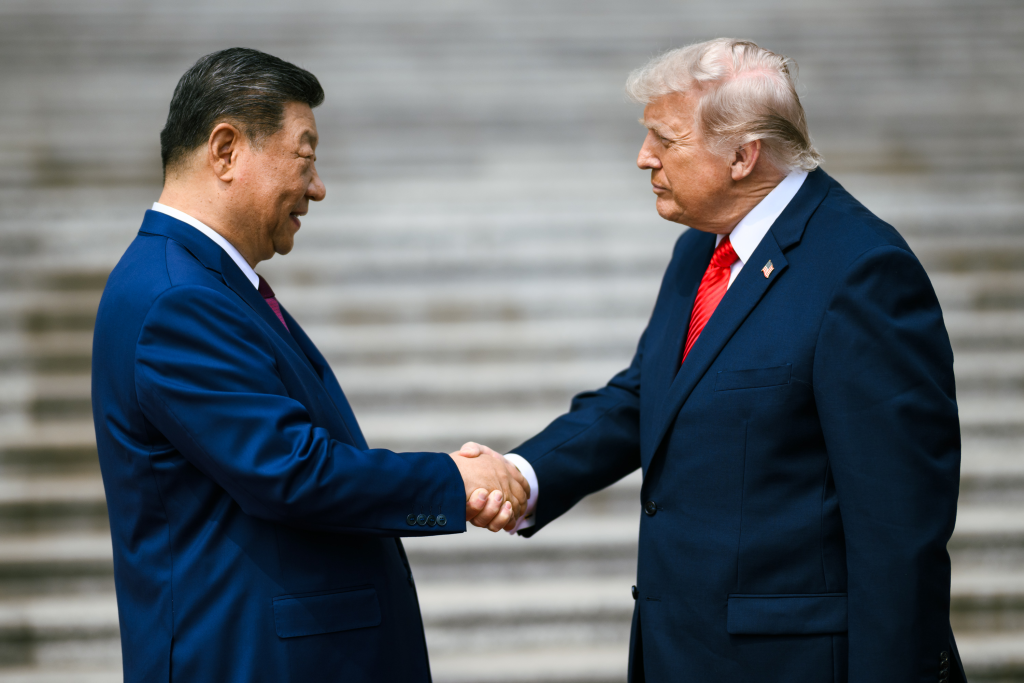
Cover Image Source: Official White House Photo
The stabilizing role of trade in U.S.–China relations is no longer reliable. For decades, bilateral trade served as both a channel of interdependence and a buffer against political escalation. While this function has eroded since the 2010s, it remained visible in moments that could have gone very differently—Belgrade 1999, Hainan 2001, the 2008 global financial crisis, and even tensions in the South China Sea during the mid-2010s. Today, that role is fading. Tariffs, export controls, and an expanding national security framework have weakened trade’s capacity to act as a “shock absorber.” In the void left by this decline, the question is whether cross-border investment can be deliberately structured to serve as a new ballast rather than another source of friction.
Structural constraints across major economies are already pushing the system in this direction. In the United States, a service-oriented economic structure limits both the feasibility and effectiveness of rebuilding large-scale manufacturing capacity. Despite renewed industrial policy efforts, reshoring continues to face persistent obstacles—costs, labor shortages, and incomplete supply chains—making it difficult to expand production at the scale required to replace existing dependencies. Europe, by contrast, remains structurally reliant on manufacturing, making industrial decline a more immediate concern. China faces a different but equally binding pressure: as its manufacturing sector moves up the value chain and approaches the limits of domestic absorption, outward investment is becoming a structural feature of its growth model.
The resurgence of “China Shock 2.0” and “de-risking” narratives reflects a political response to these realities. These frameworks increasingly externalize domestic constraints, recasting deindustrialization pressures in Europe and reshoring limits in the United States as consequences of China’s industrial scale. While analytically convenient, they obscure the extent to which these challenges are rooted in endogenous factors—cost structures, regulatory environments, and long-term economic shifts—while justifying more interventionist policies that have proven both disruptive and counterproductive.
Taken together, these dynamics point toward a system in which capital, rather than goods, becomes the primary vehicle for sustaining global production linkages. For many free-trade proponents, this implies a more limited role for traditional market norms than previously assumed.
Recent European responses offer an early model for this transition. Rather than eliminating interdependence, Brussels seeks to manage it. The proposed Industrial Accelerator Act (IAA) signals a more deliberate framework to shape how foreign capital enters and operates within Europe’s industrial base. The objective is not exclusion, but controlled embedding—aligning external investment with domestic industrial priorities through regulatory incentives, procurement rules, and market access conditions.
At the core of this framework is a differentiated approach to investment structures. Wholly owned foreign direct investment (FDI) remains permissible, but is subject to heightened scrutiny and performance requirements, particularly in strategic sectors. Joint ventures and partnership-based models, by contrast, are structurally favored. Through these arrangements, foreign firms—especially Chinese firms in electric vehicles, batteries, and clean technologies—are encouraged to localize production, share selected capabilities, and integrate into European supply chains. Rather than drawing a binary line between acceptance and exclusion, Europe is constructing a continuum in which market access is conditioned on economic contribution.
If implemented, this approach allows Europe to absorb external capital while managing risk through governance and industrial embedding. FDI operates under tighter oversight and expectations around local integration, while joint ventures function as a mechanism of controlled interdependence. The result is not the elimination of dependence, but its reconfiguration into a form that is more politically manageable and economically productive.
For the United States, this evolving landscape presents a more complex strategic dilemma. While Europe is structuring interdependence to support its internal market, its industrial strategy remains outward-looking, with a significant portion of capacity likely to target external markets—including the United States. Moreover, while U.S. policy tools can constrain the flow of goods from China, they are less effective in limiting imports from allied economies such as Europe, particularly in high-end sectors where substitution is neither immediate nor cost-effective. By contrast, the United States remains focused on limiting exposure.
Yet this approach encounters practical limits. Nearshoring and friend-shoring can redirect trade flows, but are less effective in constraining capital. Chinese firms have expanded production in countries such as Mexico and Vietnam, increasing efforts to meet rules of origin requirements while maintaining upstream linkages to Chinese inputs and technology. Trade policy can reshape geography, but it cannot disentangle investment networks.
As a result, efforts to reduce dependence on China through trade are generating new forms of dependence through investment. Unlike trade, which can be adjusted relatively quickly, investment embeds itself in long-term assets—factories, workforces, and ecosystems—that are not easily reversed. Interdependence thus becomes more durable, even as it becomes less visible.
This raises a fundamental question for U.S. strategy: whether investment can be structured, rather than simply restricted, as part of managing economic interdependence. The United States faces two pathways. One is to continue tightening scrutiny over inbound investment—particularly through mechanisms such as CFIUS—prioritizing risk reduction but limiting industrial collaboration. The other is to explore more selective and structured engagement, including conditional FDI or narrowly defined joint ventures in sectors where domestic capacity is insufficient and risks can be managed.
Such an approach would not replicate the European model directly. Political constraints in the United States remain significant, particularly regarding technology transfer and national security. Yet if investment flows are already reshaping supply chains through Europe, nearshoring economies, and China’s outward expansion, then excluding structured engagement does not eliminate interdependence—it shifts it beyond U.S. control.
In this context, proposals for investment coordination deserve closer attention. Ideas such as a bilateral or multilateral “board of investment,” raised in recent Paris discussions, reflect a growing recognition that capital flows require governance frameworks comparable to those that once governed trade. Recent developments in China reinforce this trend. On April 8, the State-owned Assets Supervision and Administration Commission (SASAC) established a new bureau overseeing overseas state-owned assets, signaling a more coordinated and systematized approach to outward investment. While this may raise concerns about the expanding role of state capital, it also underscores a clear policy commitment to scaling global investment.
The implication is not that investment will automatically stabilize U.S.–China relations, but that it has the potential to do so if deliberately structured. As trade loses its capacity to absorb shocks, investment is becoming the primary channel through which economic ties persist.
At its core, the United States faces a choice between two forms of risk. One is a prolonged “long pain,” in which European industrial consolidation, supported by embedded Chinese capital, increasingly competes in global markets—including the United States—while supply chains evolve beyond U.S. influence. The other is a more immediate “short pain,” in which the United States selectively engages China through structured investment frameworks. While politically difficult, this approach would allow Washington to shape interdependence rather than react to it—stabilizing relations while supporting domestic industrial rebuilding under controlled conditions.
In the end, the question is not whether interdependence can be eliminated, but how it will be structured. Whether investment can replace trade as the ballast of U.S.–China relations will depend on which path the United States is willing to take.


Two Visions of Global Governance in the Age of AI