

Japan’s maritime defense industry has entered a new phase of expansion amid rising regional security tensions and a shift in Tokyo’s national strategy. Over the past several years, Japan has steadily increased its defense spending, committing to raise military expenditures to 2% of GDP—bringing it in line with NATO standards. Under Prime Minister Sanae Takaichi, who took office in October 2025, this trajectory has accelerated both politically and industrially.
Japan’s maritime capabilities are at the center of this transformation. The Japan Maritime Self-Defense Force (JMSDF) has long been one of the most capable naval forces in Asia, but its force structure and legal mandate were historically constrained by Article Nine of Japan’s post-war Constitution. That provision renounces war as a sovereign right and restricts the maintenance of traditional armed forces, allowing only Self-Defense Forces under a narrow interpretation of “exclusive self-defense.”
The ruling Liberal Democratic Party (LDP) has for decades advocated revising Article Nine to formally incorporate the Self-Defense Forces into the Constitution and expand Japan’s role in collective self-defense. With the LDP and its coalition partner securing 316 of 465 lower house seats in the February 2026 election—an unprecedented post-war majority—constitutional revision has again become politically viable.
Parallel to these political developments, Japan’s defense industrial base has undergone structural upgrading. Companies such as Mitsubishi Heavy Industries have expanded shipbuilding, aerospace, and missile production capacities. Japan has also gradually loosened arms export restrictions, allowing the transfer of Patriot PAC-3 systems to the United States and agreeing to export Mogami-class frigates to Australia. Tokyo has further joined Italy and the United Kingdom in co-developing a next-generation fighter jet, signaling its intention to become not merely a security consumer but a defense technology provider.
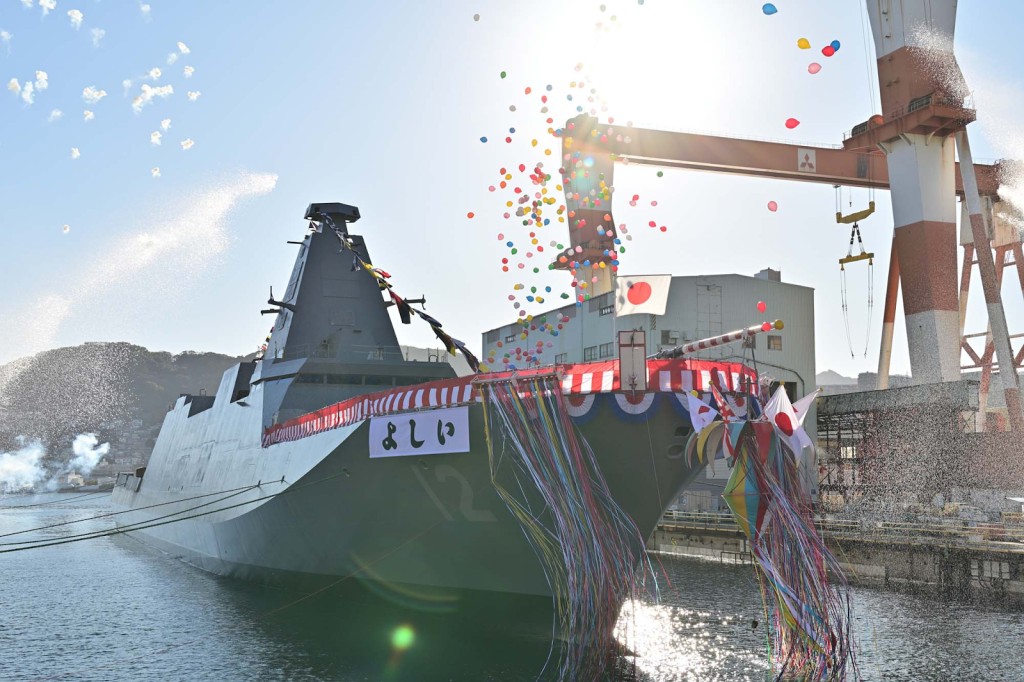
By the end of 2025, Japan completed the final vessel in its largest post-war fleet expansion program. The last of 12 Mogami-class frigates—JS Yoshii—was officially named and launched at a Mitsubishi Heavy Industries shipyard in Nagasaki. The ship is scheduled to join the fleet in 2026, having been constructed in just 17 months from keel-laying to launch. The relatively rapid construction timeline highlights improvements in Japan’s modular shipbuilding techniques and production efficiency.
The Mogami-class program represents a shift toward multi-role, networked, and cost-effective surface combatants designed for both traditional naval operations and gray-zone contingencies in surrounding waters. For Tokyo, this class enhances maritime domain awareness and distributed deterrence capabilities across the broader Western Pacific.
Simultaneously, Washington has begun signaling interest in deeper industrial cooperation. U.S. Navy Secretary John Phelan in 2025 suggested that the United States would discuss with Japan the option of dual-use shipbuilding—constructing commercial vessels with potential military applications—as part of efforts to expand joint capacity and strengthen deterrence against China. The proposal reflects U.S. concern about its own limited shipbuilding capacity and the need to leverage allied industrial bases.
Beyond the U.S.–Japan alliance, Tokyo has also intensified outreach to Europe. Japanese delegations from the Ministry of Economy, Trade and Industry and the Defense Ministry’s Acquisition, Technology & Logistics Agency visited Finland and Sweden to explore dual-use industrial cooperation. In Germany, Japanese infrastructure authorities have promoted technologies relevant to defense logistics, including bridge construction capable of supporting armored vehicles.
These outward moves have not gone unnoticed in Beijing. On February 24, China’s Ministry of Commerce added 20 Japanese entities—including shipbuilding and aerospace affiliates of Mitsubishi Heavy Industries—to its export control list. This marked the first time Japanese firms were included since the list’s creation in January 2025, signaling heightened scrutiny of Japan’s expanding defense industrial role.
First, constitutional revision—whether formal or incremental—will remain a central variable shaping regional perceptions. Even if Prime Minister Takaichi fails to secure the two-thirds upper house threshold required for amendment, gradual reinterpretation of Article Nine could continue. From Beijing’s perspective, the combination of rising defense spending, deregulated arms exports, and constitutional debate reinforces long-standing concerns about Japan’s trajectory. As these concerns deepen, political space for improvement in China–Japan relations may narrow further.
Second, China’s decision to blacklist 20 Japanese defense-related entities reflects more than a legalistic response to export control issues. It also signals Beijing’s unease about Japan’s growing strategic value within the U.S. alliance system. While Japan’s current military capabilities remain limited compared to China’s overall force structure, Tokyo’s strength lies in its ability to integrate technologically and operationally with other U.S. allies. In a broader Indo-Pacific context—spanning Australia, the United States, and increasingly Europe—Japan functions as a key industrial and logistical node within a networked deterrence architecture.
Third, U.S. policy calculations add another layer of complexity. The 2025 U.S. National Security Strategy emphasizes avoiding direct war with China in the Indo-Pacific while maintaining credible deterrence. However, Japan’s status as a treaty ally legally obligates Washington to respond to certain contingencies. President Donald Trump has reportedly cautioned Prime Minister Takaichi against provoking Beijing over Taiwan, underscoring his preference for managing tensions. As Trump prepares for a potential late March–early April visit to China, discussions are expected to focus primarily on trade and Taiwan. Yet Japan’s expanding military role and China-Japanese friction may also enter the agenda.
Japan’s growing maritime defense industry thus sits at a strategic crossroads. For Tokyo, it represents normalization and greater burden-sharing within the alliance system. For Beijing, it raises historical sensitivities and contemporary security concerns. For Washington, it offers industrial reinforcement but also increases the complexity of managing escalation risks in East Asia.
How these three perspectives interact will shape not only Japan’s defense trajectory, but also the broader balance of deterrence and diplomacy in the Indo-Pacific.
This Spotlight was originally released with Volume 5, Issue 2 of the ICAS MAP Handbill, published on February 26, 2026.
This issue’s Spotlight was written by Yilun Zhang, ICAS Research Associate.

Maritime Affairs Program Spotlights are a short-form written background and analysis of a specific issue related to maritime affairs, which changes with each issue. The goal of the Spotlight is to help our readers quickly and accurately understand the basic background of a vital topic in maritime affairs and how that topic relates to ongoing developments today.
There is a new Spotlight released with each issue of the ICAS Maritime Affairs Program (MAP) Handbill – a regular newsletter released the last Tuesday of every month that highlights the major news stories, research products, analyses, and events occurring in or with regard to the global maritime domain during the past month.
ICAS Maritime Affairs Handbill (online ISSN 2837-3901, print ISSN 2837-3871) is published the last Tuesday of the month throughout the year at 1919 M St NW, Suite 310, Washington, DC 20036.
The online version of ICAS Maritime Affairs Handbill can be found at chinaus-icas.org/icas-maritime-affairs-program/map-handbill/.

The Institute for China-America Studies is an independent nonprofit, nonpartisan research organization dedicated to strengthening the understanding of U.S.-China relations through expert analysis and practical policy solutions.
1919 M St. NW Suite 310,
Washington, DC 20036
icas@chinaus-icas.org
(202) 968-0595
© 2026 INSTITUTE FOR CHINA-AMERICA STUDIES. ALL RIGHTS RESERVED.