

Research Associate
Manager, Trade 'n Technology Program
Since the opening of the 119th Congress in January, lawmakers have introduced a total of 12,624 pieces of legislation and resolutions as of August 8. Of these, 564 include China-related references, and 247 contain substantive China-related content with potential policy impact. Unsurprisingly, with Republicans controlling both chambers, Republican members have sponsored the overwhelming majority of these bills—199 compared to just 48 from Democrats.
When grouped thematically, the China-related bills introduced so far in this Congress cluster around several recurring priorities: Taiwan, continued tech decoupling, shipbuilding, and various human rights-related legislations focusing on Xinjiang. In addition to these familiar categories, 2025 has also seen new areas of legislative focus emerge, such as capital decoupling and investment restrictions, rare earth supply chain security and higher education and visa oversight.
These developments not only echo with domestic political imperatives and foreign policy soundbites in 2025— such the White House’s dispute with higher education and concerns over rare earth supply chain resilience during the 3-month long trade war with China—but also add new layers of uncertainty to the future trajectory of U.S.–China relations.
Among the various areas where the 119th Congress voice their concerns and strived to tackle concerns, the issue of Taiwan, emerging capital restriction and decoupling with China, continued tech decoupling efforts with China, and the restrictions on higher education institutions are the most significant that could continue into the second half of the year and the 120th Congress.
From January through the August recess, the legislative calendar has been dominated by the “One Big Beautiful Bill” leaving most China-related proposals stalled at the introduced stage or having cleared only one chamber. None have yet been signed into law. That said, even the “One Big Beautiful Bill” alone contains sections that stipulates to repeal the de minimis exemption rules – a mechanism widely used by Chinese firms to ship goods to U.S. consumers for decades – by no later than July 2027, which eventually resulted into President Trump’s signing of an executive order that finally ends de minimis treatment for all countries on July 30.
Moreover, this lack of final passage of China-related legislation does not diminish their analytical value. On the contrary, because floor time and political capital were so heavily concentrated on a single megabill, the China-related measures that did receive attention during this period reflect lawmakers’ highest priorities. As such, the January–August 2025 docket offers unusually clear signals about where U.S. legislative focus on China is heading, and which issues are likely to anchor congressional action in the months ahead.
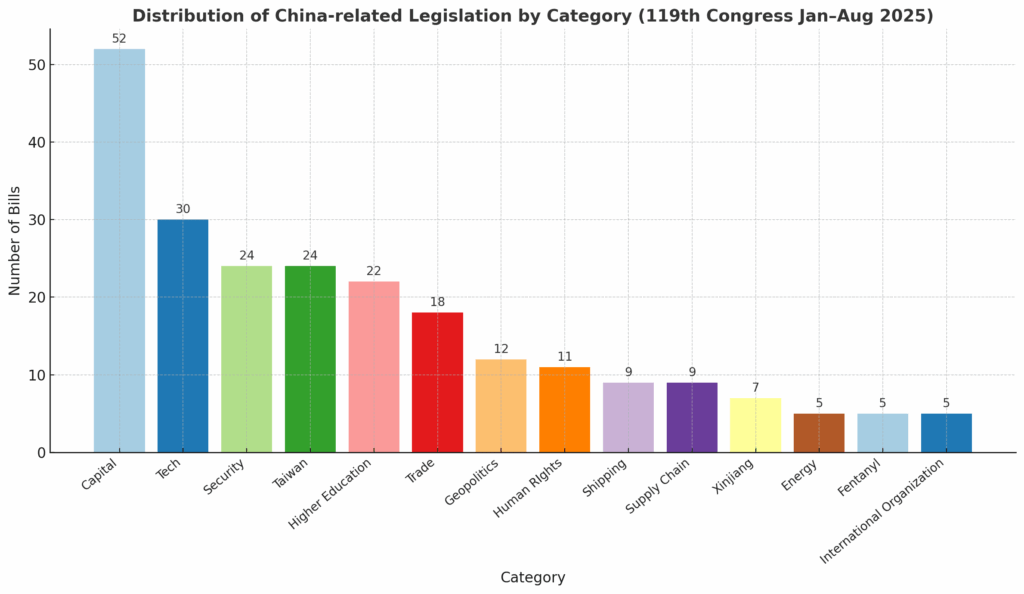
Since the start of the 119th Congress, House passage of several Taiwan-related bills—including those still awaiting Senate action—signals a clear congressional impulse not only to reiterate symbolic support for Taipei, but to concretely reshape the U.S.–Taiwan relationship. With regard to the issue of Taiwan, the 119th Congress, in their limited time, dedicated their efforts to primarily addressing the issue concerning the U.S. commitment to Taiwan both diplomatically and militarily, economic deterrence against Mainland China’s possible armed invasion of Taiwan, as well as Taiwan’s representation and status at international organizations.
Among these, H.R.910 and its companion S.1900 Taiwan Non-Discrimination Act of 2025 would facilitate Taiwan’s participation in the International Monetary Fund (IMF), while the H.R.1512 Taiwan Assurance Implementation Act directs the State Department to conduct a one-time review of U.S.–Taiwan ties, specifically to “identify opportunities and plans to lift self-imposed restrictions on relations with Taiwan.” Equally telling is H.R.1716 Taiwan Conflict Deterrence Act of 2025, which compels the Treasury Department to prepare sanctions planning targeting Mainland China officials and their relatives in the event of an armed invasion of Taiwan. H.R.2416 and S.2224 The Taiwan International Solidarity Act further requires modification of existing legislation to counteract PRC attempts to distort Taiwan’s status within international organizations.
This legislative momentum reflects a broader congressional effort to preemptively fortify U.S. commitments to Taiwan—both as deterrence against potential PLA military actions and as affirmation of Taipei’s international standing. Notably, H.R.1512’s call to lift “self-imposed restrictions” is poised to challenge the longstanding ambiguity of the “One-China” Policy, which is, unfortunately, already missing from the State Department website under the Trump administration, and if enacted, would almost certainly draw a sharp response from Beijing.
Outside of these marquee bills, lawmakers have advanced a suite of proposals aimed at institutionalizing U.S. guarantees to Taiwan. S.974 and its House companion H.R.3180 The Taiwan Representative Office Act instructs the State Department to negotiate the renaming of Taipei’s representative office, while H.R.2113 America Supports Taiwan Act would eliminate the use of “Chinese Taipei” in official U.S. government communications except in narrowly defined historical or international-reporting contexts. S.1588 The Taiwan Relations Reinforcement Act of 2025 goes further by establishing a high-level interagency “Taiwan Policy Task Force,” facilitating Taiwan participation in international summits, military exercises, and economic dialogues, and advocating for renewed Taiwan–U.S. free trade talks and strategic arms-sale dialogues. Meanwhile, H.R.3452 Six Assurances to Taiwan Act seeks to bind U.S. policy more firmly to the Reagan-era assurances under congressional oversight; S.1824 and H.R.3563 Taiwan PLUS Act calls for integrated defense cooperation between Taiwan and U.S. allies; and H.R.4860 U.S.–Taiwan Defense Innovation Partnership Act tasks the Defense Department with establishing a strategic industrial and technological relationship with Taiwan’s military.
Economic deterrence also features prominently. H.R.1531 The PROTECT Taiwan Act empowers regulators to exclude PRC representatives from key financial institutions if there is credible threat of aggression against Taiwan. H.R.3197 The Fortifying U.S. Markets From Chinese Military Aggression Act would establish a Dodd-Frank era-style advisory committee to assess economic fallout of any such aggression. And H.R.4848 and S.2646, which were introduced just before the August recession, would terminate the U.S.–China Income Tax Convention should the People’s Liberation Army (PLA) implement an armed attack.
Lastly, there is increasing legislative attention to securing Taiwan’s global presence. S.774 and companion H.R.600 The WHO is Accountable Act withholds U.S. funding from WHO until it grants observer status to Taiwan—an explicit challenge to China’s longtime standing on Taiwan’s status at the international health governance. Complementing this, S.1216 Taiwan Allies Fund Act aims to finance Taiwan’s efforts to attain meaningful participation in international organizations.
Capital decoupling has emerged as a new focal point of the 119th Congress, with 54 China-related bills directly addressing this issue. Whereas earlier congressional debates on Chinese capital were largely confined to the purchase of U.S. land—particularly agricultural land—this Congress has dramatically widened its scope. Lawmakers are now targeting China’s role in the International Monetary Fund, investigating Beijing’s exchange-rate management, scrutinizing inbound Chinese investments, restricting U.S. capital flows into China, and seeking to contest China’s access to international capital markets. The momentum suggests that congressional focus on capital-related measures will only intensify, raising the likelihood of further steps toward systemic capital decoupling between the two countries.
Among the most notable measures, several have already cleared the House. H.R.386 Chinese Currency Accountability Act of 2025 requires the United States to oppose any increase in the renminbi’s weighting within the IMF’s Special Drawing Rights basket absent strict compliance by China with IMF obligations and global currency standards. Similarly, H.R.692 China Exchange Rate Transparency Act of 2025 mandates that the U.S. Executive Director at the IMF advocate for greater transparency in China’s exchange-rate practices, including indirect interventions via state-owned entities. H.R.1549 and S.1113 China Financial Threat Mitigation Act of 2025 go further, requiring the Treasury to assess U.S. exposure to China’s financial system and recommend measures to mitigate systemic risks. The House also passed H.R.1679 Global Investment in American Jobs Act of 2025, tasking Commerce with reviewing U.S. competitiveness in attracting foreign direct investment, and H.R.1713 Agricultural Risk Review Act of 2025, designed to prevent Chinese acquisition of U.S. farmland. While these bills have moved forward, most remain limited to reporting requirements and signaling intent. Yet, as seen in earlier congresses with technology decoupling, such measures often presage more substantive legislation to follow.
The scope is also expanding, while Congress in the past had long voiced concerns over Chinese acquisition of U.S. lands, the concerns have primarily been focusing on Chinese enterprises’ purchases of farm land in areas near sensitive features with national security concerns such as military bases or airfields. Under the 119th Congress, however, the trend is moving beyond limited national security scopes and extended into Chinese individuals purchasing housing.
Other bills offer a window into the expanding boundaries of capital decoupling. H.R.1730 No Alipay Act of 2025 would prohibit all Alipay transactions in the United States, recalling earlier debates over TikTok, or even earlier, over ZTE and Huawei. S.1223 Prohibiting Foreign Adversary Interference in Cryptocurrency Markets Act explicitly bars adversary-affiliated digital commodity platforms from registering in the U.S., showing how even cryptocurrency—touted as a pillar of future U.S. economic growth—is now being carved out of reach for Chinese participation. Similarly, S.1357 SAFE Act amends U.S. securities law to restrict issuances by Chinese entities, while S.1360 Protecting American Capital Act of 2025 requires annual reporting on U.S. portfolio investments in China. More ambitious measures include S.2046 No China in Index Funds Act, prohibiting U.S. index funds from including Chinese companies, and S.2047 No Capital Gains Allowance for American Adversaries Act, which would reclassify gains from investments in adversary nations as ordinary income. Meanwhile, H.R.4617 and S.2384 American Investment Accountability Act mandates monitoring of U.S. investments in adversary-controlled entities, and S.2563 Global Investment in American Jobs Act of 2025 again calls for interagency review to bolster U.S. competitiveness in attracting trusted capital. Collectively, these proposals reveal a legislative landscape that is increasingly prepared to scrutinize and sever both inbound and outbound capital flows with China.
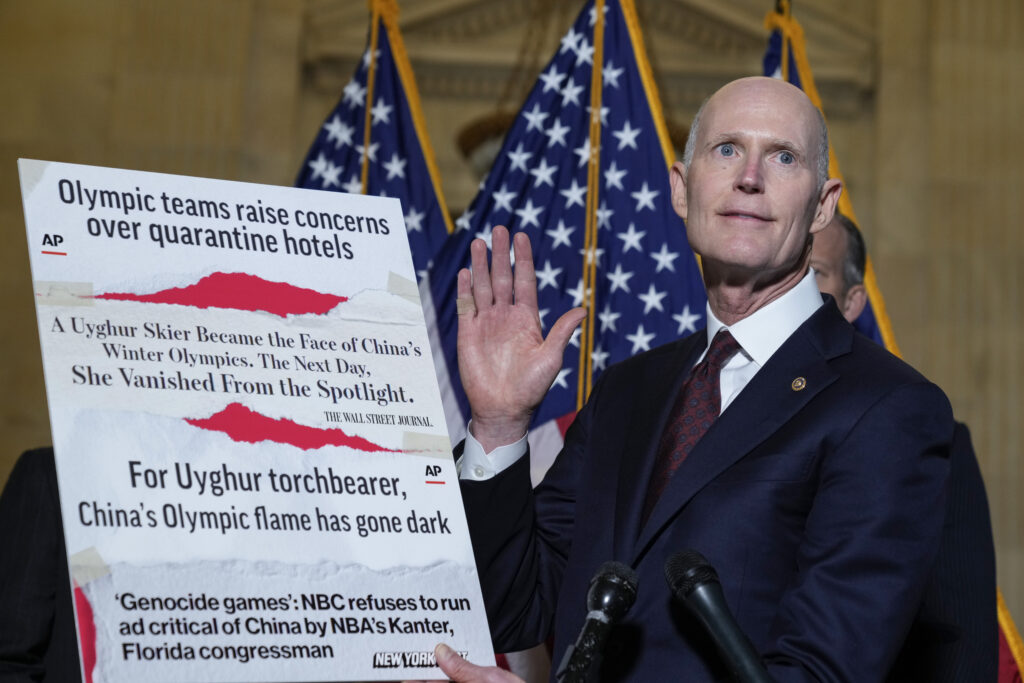
Within this space, one lawmaker stands out: Senator Rick Scott (R-FL). Of the 54 China-related capital decoupling bills introduced, Sen. Scott alone has sponsored seven, and he has sponsored 17 substantive China bills in total across categories. His prolific output underscores how capital decoupling has become a defining political cause for certain members of Congress, particularly among Republican ranks.
The trajectory is unmistakable. As the U.S.–China trade war remains unresolved and technology decoupling advances steadily, capital decoupling threatens to further erode economic ties that once served as ballast in the bilateral relationship. Rather than moderating tensions, congressional actions risk making financial disentanglement another destabilizing feature of U.S.–China relations, adding uncertainty to the global economic order.
Tech decoupling represents a continuation of congressional efforts that began in the 117th and 118th Congresses, and has remained a prominent feature of China-related legislation in the 119th. Among the 30 substantive tech decoupling bills introduced to date, the majority follow the familiar logic of data and digital separation—seeking to reduce U.S. reliance on Chinese products in areas ranging from software to smart vehicles and telecommunications hardware. What stands out in this session, however, is the unusually active role of Democrats: of the 30 bills, 12 were sponsored by Democratic lawmakers, a level of cross-party engagement rarely seen in other categories of China-related legislation.
Perhaps for that very reason, progress has been limited. By the August recess, only three measures had passed a single chamber, all in the House, and each sponsored by Republicans. S.244 and H.R.866 ROUTERS Act requires the National Telecommunications and Information Administration to conduct a national security study of consumer routers and modems developed or supplied by entities under the influence of China. H.R.906 and S.259 Foreign Adversary Communications Transparency Act directs the Federal Communications Commission to publish annual lists of license holders with ties to foreign adversaries, particularly China, including detailed ownership information for cable landing stations and other communications infrastructure. Meanwhile, S.450 and H.R.1166 Decoupling from Foreign Adversarial Battery Dependence Act prohibits the Department of Homeland Security from procuring batteries produced by specified Chinese companies, effective in 2027, while allowing for narrow waivers under strict conditions. That all three bills were advanced under Republican sponsorship underscores the challenging legislative environment for bipartisan consensus in the current Congress.
Beyond these initial measures, Congress has pursued a wide range of additional bills targeting software and artificial intelligence. Following the rise of DeepSeek in China, lawmakers introduced H.R.1121 No DeepSeek on Government Devices Act, prohibiting its use within executive agencies. The H.R.2403 TELL Act requires websites and mobile applications to disclose whether user data is stored in China and accessible to the Chinese Communist Party or state-owned entities. H.R.3209 App Store Freedom Act targets unfair practices in the app marketplace, with Chinese developers in the crosshairs. In the Senate, S.1638 Protection Against Foreign Adversarial Artificial Intelligence Act of 2025 explicitly seeks to prevent AI applications based in adversary countries, especially China, from entering the U.S. digital ecosystem. Together, these measures reveal how Congress is rapidly moving to wall off Chinese software and AI applications from sensitive U.S. domains.
Congress has also acted aggressively in the realm of connected devices, particularly electric vehicles and drones. S.2040 Connected Vehicle National Security Review Act establishes an office within the Department of Commerce to review national security risks associated with foreign-connected vehicle technologies. S.2168 Drones for America Act raises tariffs on Chinese-made drones, while S.1711 and H.R.4361 STOP China Act bars federal funds from being used to procure vehicles or vehicle technologies provided by adversary-based companies. Each of these initiatives reflects a determination to limit China’s footprint in sectors poised to define the future of mobility and smart infrastructure.
Telecommunications remains another major front of decoupling efforts. H.R.1795 NETWORKS Act would impose sanctions on foreign telecommunications companies engaged in espionage against U.S. persons. S.2041 Information and Communications Technology and Services National Security Review Act similarly establishes a Commerce office to oversee ICT services security, overlapping with connected vehicle reviews. Additional measures like H.R.4240 Countering Untrusted Telecommunications Abroad Act and H.R.4506 Securing Global Telecommunications Act demand strategies to reduce reliance on Chinese telecommunications infrastructure worldwide, both at home and abroad.
Finally, Congress has sought to restrict China’s access to U.S. civilian technology while simultaneously strengthening America’s own civil-military innovation fusion. H.R.1122 China Technology Transfer Control Act of 2025 would tighten export controls on critical technology and intellectual property, while S.1754 Preventing PLA Acquisition of United States Technology Act of 2025 directly targets Beijing’s military-civil fusion strategy. At the same time, bills like H.R.2321 and S.1106 United States Leadership in Immersive Technology Act of 2025 and H.R.3160 and S.1553 PREVAIL Act focus on nurturing domestic innovation in immersive and next-generation technologies. These parallel approaches reveal a two-pronged congressional strategy: cutting off Chinese access while boosting U.S. technological leadership.
The cumulative effect is clear. Areas of potential U.S.–China technological cooperation are shrinking rapidly, with congressional oversight extending into increasingly granular domains. As capital decoupling accelerates and educational exchanges decline, the trajectory of U.S.–China tech decoupling is becoming more entrenched and severe, with long-term consequences for bilateral relations and global innovation networks.
Since President Trump’s return to office, one of the most visible domestic fronts has been his “ War on Education,” epitomized by his row with a slew of renowned higher education institutions including Harvard University, Columbia University, and Cornell University.
This heightened political environment has shaped congressional dynamics as well, with higher education emerging as a key target of legislative scrutiny. Within the 119th Congress, at least 22 China-related bills have been introduced focusing on higher education, many of which seek to restrict academic exchanges and tighten oversight on funding and visa issuance tied to China.
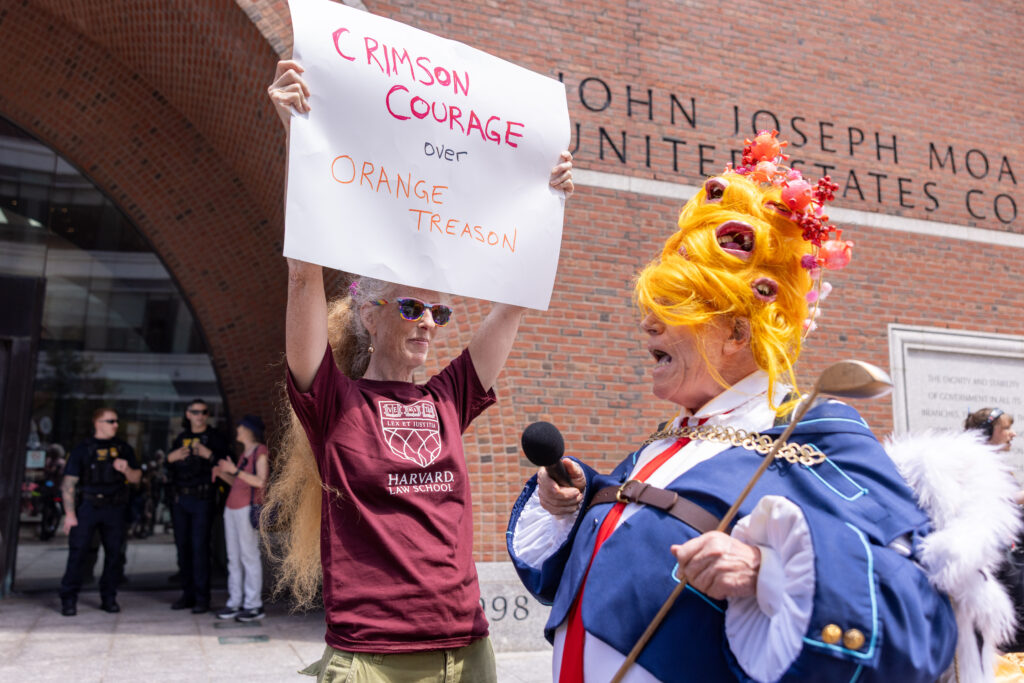
Several measures have already advanced past the House. H.R.881 and S.108 DHS Restrictions on Confucius Institutes and Chinese Entities of Concern Act bars institutions of higher education (IHEs) with ties to Confucius Institutes, the Thousand Talents Program, or other Chinese entities of concern from receiving DHS funding unless such relationships are terminated. H.R.1048 DETERRENT Act strengthens disclosure rules by lowering the threshold for reporting foreign gifts and contracts, prohibiting agreements with adversarial entities without a waiver, and imposing penalties—including loss of student aid eligibility—for noncompliance. Meanwhile, H.R.1318 and S.769 United States Research Protection Act amends the CHIPS-related research laws to more clearly define “malign foreign talent recruitment programs,” explicitly including Chinese government-sponsored talent schemes within its scope. Collectively, these bills reveal a deepening congressional consensus to sever institutional linkages with Chinese-backed programs.
Visa issuance has become another front for congressional oversight. H.R.460 CCP Visa Disclosure Act of 2025 requires applicants for F, J, or M student and exchange visas to disclose whether they have received or will receive funds from the CCP or affiliated entities, with violations grounds for visa revocation. S.108 Protecting Higher Education from the Chinese Communist Party Act of 2025 goes further, rendering CCP members and their family members ineligible for academic visas, subject only to narrow exemptions. H.R.2147 and S.1086 Stop CCP VISAs Act of 2025 adopts perhaps the most restrictive stance, barring all Chinese nationals from receiving student or exchange visas for the purpose of study or research in the United States. Together, these measures underscore the increasing congressional suspicion toward Chinese students and researchers, who have long been a cornerstone of U.S.–China educational exchanges.
Funding restrictions are equally prominent. H.R.542 No Foreign Gifts Act of 2025 prohibits U.S. universities from receiving federal education funds if they accept gifts from China or other adversary nations. H.R.938 No Contracts with Foreign Adversaries Act similarly bans IHEs from contracting with foreign countries or entities of concern without obtaining a waiver from the Department of Education. Transparency measures are also gaining traction, such as H.R.1023 RIFA Act, which requires wealthy private universities to disclose investments tied to foreign entities of concern. Direct prohibitions include H.R.1032 Stop Funding Our Adversaries Act of 2023, which forbids federal agencies from supporting research conducted by or with Chinese government-linked entities, and S.418 Defending Defense Research from Chinese Communist Party Espionage Act of 2025, which blocks contracts between defense-funded universities and Chinese entities while imposing post-employment restrictions on defense researchers. Meanwhile, bills like H.R.1049 Transparency in Reporting of Adversarial Contributions to Education Act and H.R.1069 PROTECT Our Kids Act expand oversight to K–12 schools, requiring disclosure of foreign funding and prohibiting federal support for schools benefiting from Chinese government-linked programs. At the advanced research level, S.929 GATE Act of 2025 restricts Chinese nationals from accessing U.S. national laboratories, while S.1010 CAMPUS Act bars federal funding for universities that maintain ties with Chinese defense-affiliated entities.
Although many of these measures remain largely symbolic, their political salience should not be underestimated. As domestic clashes between higher education institutions and conservative lawmakers intensify, targeting academic ties with China has become a convenient vehicle for advancing partisan agendas. If current trends persist, legislative attempts to restrict Chinese participation in U.S. education—whether through visas, funding, or research collaborations—may well become a new normal, further eroding one of the last remaining bridges between the two societies.
As the 119th Congress moves past its August recess and into a new legislative phase, the trajectory of U.S. China-related policymaking warrants close attention. While most measures introduced thus far have remained at the stage of signaling intent rather than enacting binding law, the thematic concentration of bills—on Taiwan, capital decoupling, technology separation, and higher education oversight—underscores where lawmakers see the greatest urgency. This focus is unlikely to diminish.
Looking ahead, one key uncertainty lies in how domestic legislative dynamics will spill over into the international arena. Whether through capital-market restrictions, technology export controls, or curbs on academic exchanges, congressional action risks entangling U.S. allies and partners, complicating multilateral efforts to manage China. With the 2026 election cycle already looming, these debates may intensify further, as legislators seek to showcase toughness on China to domestic constituencies. What remains to be seen is how, after the recess, Congress will balance its pursuit of “mega bills” with continued efforts to legislate on China. The form and pace of those efforts will carry significant implications not only for U.S.–China relations but also for the global economic and political order.

The Institute for China-America Studies is an independent nonprofit, nonpartisan research organization dedicated to strengthening the understanding of U.S.-China relations through expert analysis and practical policy solutions.
1919 M St. NW Suite 310,
Washington, DC 20036
icas@chinaus-icas.org
(202) 968-0595
© 2026 INSTITUTE FOR CHINA-AMERICA STUDIES. ALL RIGHTS RESERVED.

Trump’s Maritime Insurance Gambit Signals a New Phase in U.S-China Competition