

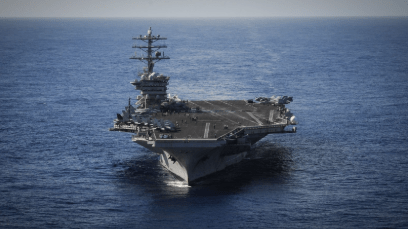
The USS Chester W. Nimitz (CVN-68) is the lead ship of the Nimitz-class nuclear powered aircraft carrier built by the United States Navy. Commissioned in 1975, the ship has a displacement of over 100,000 tons, making it the largest commissioned warship in the world at the time. During actions, the aircraft carrier becomes a moving airfield for around 80 aircraft and the home for more than 5,000 sailors. The naval air wing aboard contains multiple types of aircraft, including fighter jets, electronic warfare aircraft, airborne early warning aircraft, helicopters, and cargo planes. In operation, the carrier, along with the embarked air wing, is capable of multi-role missions in complicated contexts. In any given deployment, the ship, along with the other nine in its class, functions not just as a military platform. It is also a powerful and mobile symbol of American strategic reach and readiness, designed for the purpose of claiming ocean controls during great power competitions and regional conflicts in the Cold War context.
A regular deployment of USS Nimitz usually lasts around 6 months into regions where it is needed with a fleet of escort vessels and supply ships, forming a task force known as the “Carrier Strike Group” (CSG). The USS Nimitz has experienced 22 deployments spanning the 50-year long period of its operational life. It has participated in major U.S. military engagements across multiple regions, including the Iranian Hostage Crisis in 1979, the Gulf War in 1991, and sustained naval missions in support of the War on Terror throughout the 2000s and 2010s. It was also deployed into the West Pacific multiple times between 1988 and 2023, and the South China Sea in 2022. From the Middle East to the West Pacific, the USS Nimitz has served as a forward-deployed instrument of American military power, delivering both deterrence and combat capability where needed most.
Recent Events
On March 26, 2025, the USS Nimitz, leading its Carrier Strike Group, left San Diego for its 23rd deployment towards the Indo-Pacific region. This is expected to be the final active deployment of the 50-year old vessel. Following this seven-months period, the USS Nimitz is expected to move towards Norfolk, Virginia, for its planned deactivation and decommissioning in 2026.
In May 2025, coinciding with the Shangri-La dialogue, the carrier was reported to be sailing in the South China Sea. According to the U.S. Navy officials, the ship is “doing more than ever to strengthen peace, stability, and deterrence across the Indo-Pacific”.
Reacting to USS Nimitz’s final deployment in the Indo-Pacific Region, particularly its activity near the South China Sea where China has disputed claims with its neighbors, the Chinese government has responded with deep condemnation. On May 31, the People’s Liberation Army’s Southern Theater Command stated that the carrier’s actions have “seriously violated China’s sovereignty and security, undermined regional peace and stability, and violated international law and basic norms governing international relations”.
On June 16, the USS Nimitz canceled its previously scheduled port call to Vietnam and was redeployed to the Middle East in response to the escalating conflict between Israel and Iran.
Keep In Mind
The final deployment of USS Nimitz to the Indo-Pacific region marks a symbol for the U.S. military commitment in the region. The ship’s cruises in the contested waters such as the South China Sea have added more friction to the already strained U.S.-China relations. Especially given the context of such a deployment coincides with the 2025 Shangri-La dialogue where the debates between the U.S. and China over maritime security and ocean governing structures being a central theme. As the U.S. minister of defense Pete Hegseth said in his remarks, to maintain the regional status quo “requires strength”. The presence of USS Nimitz during the region’s most important strategic dialogue, in this case, has enhanced the U.S. military assertiveness along with its political attitude in the region through its combat capabilities.
On the other hand, the USS Nimitz’s redeployment to the Middle East should also be understood in the context of the United States’ long-standing political and military support for Israel. Redirecting the Nimitz—originally deployed to the Indo-Pacific—was a clear reflection of these priorities. The shift also illustrates how the U.S. continues to navigate competing strategic theaters, often recalibrating its deployments in response to crises involving its key regional interests.
Furthermore, it is noticeable that the USS Nimitz has reached the end of its intended 50-year service life and is scheduled for decommissioning following this final mission. Nevertheless, despite the ship’s age, its continued forward deployment reflects a broader context of the U.S. ‘s pressing need to maintain its military existence in multiple regions around the globe. Under such circumstances, the Nimitz remains engaged in the kind of operations it was originally designed for—exercising maritime presence and control amid great power competition and regional instability, even as the ship approaches the end of its service life.
This Spotlight was originally released with Volume 4, Issue 6 of the ICAS MAP Handbill, published on June 24, 2025.
This issue’s Spotlight was written by Letong Qian, Part time Research Assistant.

Maritime Affairs Program Spotlights are a short-form written background and analysis of a specific issue related to maritime affairs, which changes with each issue. The goal of the Spotlight is to help our readers quickly and accurately understand the basic background of a vital topic in maritime affairs and how that topic relates to ongoing developments today.
There is a new Spotlight released with each issue of the ICAS Maritime Affairs Program (MAP) Handbill – a regular newsletter released the last Tuesday of every month that highlights the major news stories, research products, analyses, and events occurring in or with regard to the global maritime domain during the past month.
ICAS Maritime Affairs Handbill (online ISSN 2837-3901, print ISSN 2837-3871) is published the last Tuesday of the month throughout the year at 1919 M St NW, Suite 310, Washington, DC 20036.
The online version of ICAS Maritime Affairs Handbill can be found at chinaus-icas.org/icas-maritime-affairs-program/map-handbill/.

The Institute for China-America Studies is an independent nonprofit, nonpartisan research organization dedicated to strengthening the understanding of U.S.-China relations through expert analysis and practical policy solutions.
1919 M St. NW Suite 310,
Washington, DC 20036
icas@chinaus-icas.org
(202) 968-0595
© 2026 INSTITUTE FOR CHINA-AMERICA STUDIES. ALL RIGHTS RESERVED.