

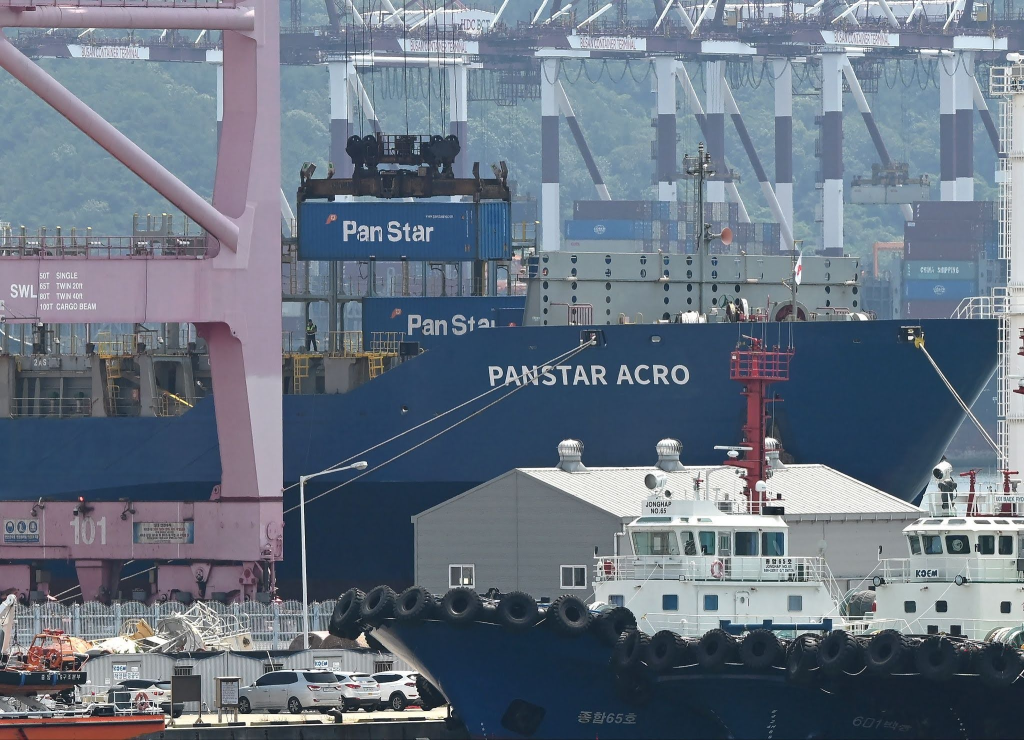
South Korea’s first Arctic container voyage was an operational success and a diplomatic test. The PanStar Acro left Busan on August 22, called at Felixstowe, Rotterdam, and Gdansk via Russia’s Northern Sea Route and returned 50 days later, the first round trip between Korea and Europe by a Korean carrier’s container ship on that route. The voyage also required Seoul to consult Moscow and obtain Russian permits, drawing objections from Western diplomats. Korea has proven Arctic shipbuilding expertise, yet the route Seoul can pursue independently runs through Russian waters.
Hanwha Ocean, formerly Daewoo Shipbuilding & Marine Engineering, has built 21 icebreaking LNG carriers, more than any other shipyard. Fifteen were constructed for Russia’s Yamal LNG project, with the last delivered in 2019. The other six, ordered for Russia’s Arctic LNG 2 project, remain stranded at Hanwha’s Geoje yard under the sanctions imposed after Russia’s invasion of Ukraine. Washington, for its part, seeks Korean capital. Seoul committed $150 billion of a $350 billion U.S. investment package to shipbuilding cooperation under the MASGA initiative.
Washington’s icebreaker rebuild ran through a club of three. The Icebreaker Collaboration Effort, or ICE Pact, a 2024 framework, links U.S., Canadian, and Finnish shipyards and casts other allies mainly as buyers of their icebreakers. When a presidential memorandum in October 2025 authorized up to four of the Coast Guard’s 11 Arctic Security Cutters to be built abroad, all four went to Finnish shipyards. Korea’s role in U.S. shipbuilding has centered instead on maintenance, special-purpose vessels, and warship concept design. The pact’s founding statement envisioned a mechanism to add allies and partners; none has been extended to Korea.
The September 22 agreement among the United States, Denmark, and Greenland writes alliance tiers into treaty text. It bars states and investors from outside NATO, NATO partners, and EU member states from gaining control, as well as significantly influencing or accessing sensitive non-public information in Greenland’s “Particularly Sensitive Sectors or Activities,” which include critical infrastructure and resource extraction, unless the three parties agree otherwise.
Korea is one of NATO’s four Indo-Pacific partners, yet the agreement’s definitions article does not define “NATO partner.” NATO maintains partner relations with 35 countries and organizations, including several authoritarian states. Implementation falls to Greenland, in close cooperation with Danish authorities, under “any of its current or future investment screening laws.” Eight days later, the Trump administration announced that Korea would invest $54 billion in the Alaska LNG project; Seoul has conditioned its participation on commercial viability. Korea is welcome in the Arctic as a financier and in U.S. shipbuilding as a partner. Its place as an allied Arctic builder is less settled.
Canada’s submarine decision in July showed what decides a close race. Prime Minister Mark Carney selected Germany’s TKMS over Hanwha Ocean for up to 12 under-ice capable submarines, calling it “a difficult, close decision.” Ottawa emphasized interoperability with the German and Norwegian navies as Carney sought closer trade ties with Europe. Hanwha attributed its loss to “the barrier posed by the NATO alliance.” Both readings suggest that when capability is close, alignment weighs heavily, whether through NATO or a broader turn toward Europe. Hanwha remains the reserve supplier should negotiations with TKMS fail.
The pattern has a structural source. The allied Arctic is being organized through Euro-Atlantic institutions: NATO, whose Arctic role the Greenland agreement explicitly endorses; an icebreaker pact among three NATO members; and investment rules keyed to NATO and EU membership. Korea’s connection to that architecture runs through a single label, NATO’s Indo-Pacific partnership, which brings Seoul to NATO ministerial meetings but, as the Greenland text shows, has no settled meaning in allied investment rules. Japan, which also pitched icebreaker cooperation to Washington, sits outside the pact as well. The result is an asymmetry. Korean capital enters the alliance through the bilateral channel, while Arctic work is allocated through the multilateral one. The architecture is also lopsided in design: it contains explicit rules for keeping non-members out and, so far, only a stated intention to bring partners in.
Seoul’s route policy answers to commercial pressure. War in the Middle East has rattled global shipping, and a PanStar official cited China’s push for first-mover advantage as a reason to move quickly. China has set the pace. Sea Legend Shipping completed eight weekly sailings between China and Europe this season, carrying more than 14,000 TEU. PanStar had sought about 1,300 TEU for its trial and left with 737 TEU plus empty containers.
The two tracks have separate origins but converge in consequence. The venue where Korea acts most independently in the Arctic is the one Western allies most want closed. Western diplomats have raised their objections directly with Korean officials, and CMA CGM, MSC and Hapag-Lloyd have pledged to avoid Arctic routes. Seoul consulted Moscow on whether the ship might need Russian assistance, the kind of help that could expose Korean operators to sanctions. There is a legal argument in Seoul’s favor: unlike UN sanctions, U.S. and EU measures are not international law. The practical exposure is another matter, as Hanwha’s six stranded carriers and the $1 billion arbitration claim now attached to three of them show. The implication extends beyond Seoul. A capable ally kept outside the allied Arctic may come to rely on a route that Russia administers and China is turning into a scheduled corridor.
This Spotlight was originally released with Volume 5, Issue 10 of the ICAS MAP Handbill, published on October 29, 2026.
This issue’s Spotlight was written by Youngseo Kim, Part Time Research Assistant Intern at ICAS.

Maritime Affairs Program Spotlights are a short-form written background and analysis of a specific issue related to maritime affairs, which changes with each issue. The goal of the Spotlight is to help our readers quickly and accurately understand the basic background of a vital topic in maritime affairs and how that topic relates to ongoing developments today.
There is a new Spotlight released with each issue of the ICAS Maritime Affairs Program (MAP) Handbill – a regular newsletter released the last Tuesday of every month that highlights the major news stories, research products, analyses, and events occurring in or with regard to the global maritime domain during the past month.
ICAS Maritime Affairs Handbill (online ISSN 2837-3901, print ISSN 2837-3871) is published the last Tuesday of the month throughout the year at 1919 M St NW, Suite 310, Washington, DC 20036.
The online version of ICAS Maritime Affairs Handbill can be found at chinaus-icas.org/icas-maritime-affairs-program/map-handbill/.