
Maritime Affairs Program (MAP) Handbill Spotlight
The IMO and Global Maritime Decarbonization

Zhangchen Wang
November 26, 2025
Issue Background
Maritime transportation is central to global commerce, carrying more than 80 percent of traded goods worldwide. To provide coherent and uniform oversight for this international system, the International Maritime Organization (IMO) was established under the United Nations framework to develop global rules for international shipping in 1958. The IMO now includes 175 member states and serves as the central venue where governments negotiate binding regulations on ship safety, pollution control, and maritime governance.
Because most commercial shipping operates across multiple jurisdictions, the IMO plays a critical international coordination role. Decisions adopted by IMO may attain legal binding forces upon acceptance by its member states, a feature that endows it with a rare and robust form of regulatory authority within the international system. Its rulemaking process allows states to harmonize standards globally, preventing fragmented national regulations and ensuring that vessels from different fleets operate under common technical and environmental requirements. The combination of legal capability, treaty-based authority, and near-universal participation has positioned the IMO as one of the few international organizations able to shape operational and commercial practices across an entire global industry.
The global maritime shipping industry is increasingly acknowledged as a critical challenge in combating climate change. It emits more than 0.86 gigatonnes of CO₂ per year and contributes to roughly 10% of transport-related emissions globally. Despite improvements in energy efficiency, absolute emissions have continued to rise due to increases in shipping demands, and the need for stronger emission reduction action is like never before. In 2018, the organization adopted its initial greenhouse gas emission reduction strategy, which called for reducing the sector’s carbon intensity by at least 40 percent by 2030 and set an ambition to cut total greenhouse gas emissions by 50 percent by 2050. The strategy also introduced the first mandatory energy-efficiency measures for ships, covering both new vessels and the existing fleet. This framework was significantly strengthened in 2023, when member states agreed to a revised GHG Strategy that set a net-zero target for international shipping “by or around 2050,” alongside indicative checkpoints of at least 20 percent emission reductions by 2030 and 70 percent by 2040, and a requirement that zero or near zero-emission fuels represent at least 5 percent of marine energy use by 2030. The 2023 Strategy also launched the development of mid-term measures combining a global fuel-intensity standard and a maritime GHG pricing mechanism.
Recent Events
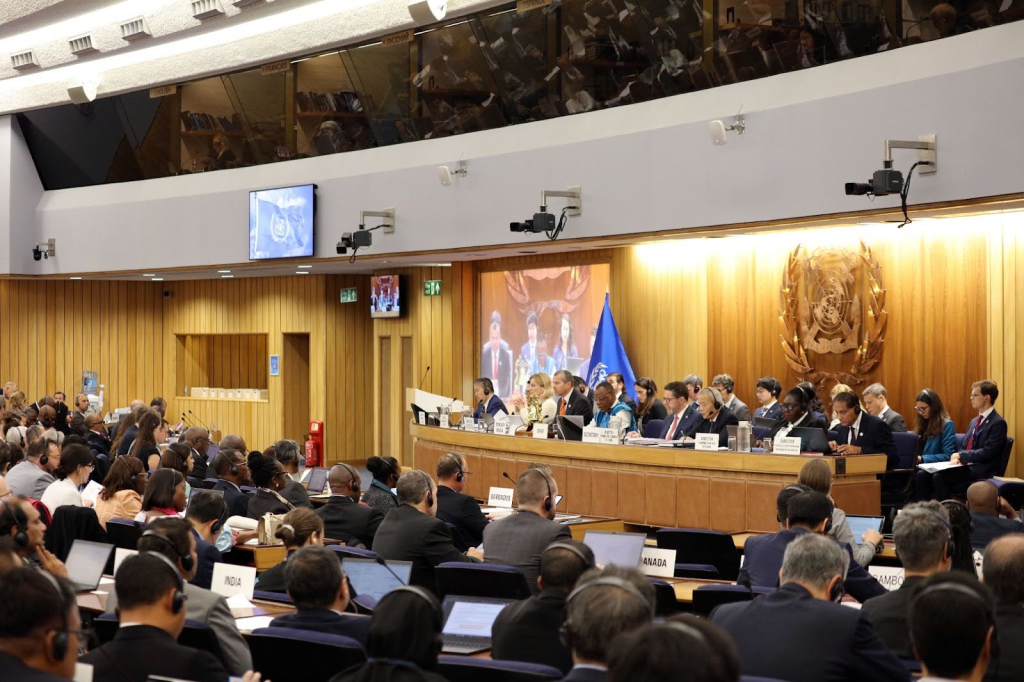
Building on the aforementioned commitments, the IMO advanced a more comprehensive regulatory package in April 2025—commonly referred to as the proposed Net-Zero Framework—which sought to combine a global fuel-intensity standard with a pricing mechanism and a dedicated decarbonization fund. The proposal combined a global marine fuel-intensity standard with a market-based compliance mechanism designed to curb emissions from ships of 5,000 gross tons and above. These vessels account for roughly 85 percent of global maritime emissions. Under the draft text, ships exceeding the annual emissions limit would purchase Remedial Units or pay a carbon fee, while more efficient vessels could earn compensation for emission reductions. Revenues were also slated to flow into a new IMO Net-Zero Fund projected to raise $11–12 billion annually between 2028 and 2030, supporting alternative-fuel infrastructure, vessel retrofits, and capacity-building in developing and small-island states.
However, despite broad expectations that approval would be a formality, delegates unexpectedly voted to defer adoption of the Net-Zero Framework by one year during the second extraordinary session of the Marine Environment Protection Committee in October 2025. The United States and Saudi Arabia led the opposition, following public statements by President Trump rejecting what he called a “global green new scam tax on shipping.”
Several maritime nations—including many EU member states and Pacific Island countries—expressed disappointment, and they noted that many countries had been ready to adopt the rules and the delay creates a sense of failure. Nevertheless, key leaders remain optimistic about the future of the emission package. IMO Secretary-General Arsenio Dominguez said at COP30 in Brazil that he is confident countries can still reach an agreement on a carbon fee for shipping and pledged to continue campaigning for the framework despite the temporary setback. He believes that IMO is learning from the failure and will not stop here. Dutch climate envoy Prince Jaime likewise underscored the importance of maintaining constructive engagement over the coming year to build consensus ahead of the next round of negotiations.
Keep In Mind
The one-year postponement of the Net-Zero Framework carries significant negative momentum for maritime decarbonization. The delay reintroduces uncertainty for the private sector by disrupting investment planning and slowing capital flows into alternative-fuel infrastructure. Companies that had already begun integrating carbon-pricing assumptions into charterparties, fuel-supply agreements, and ship-management contracts now face costly revisions, as provisions drafted around an expected 2027–2028 compliance timeline no longer align with regulatory reality and may need to be renegotiated again once the framework returns in 2026.
The postponement also compresses the IMO’s emissions-reduction timeline. Under the schedule envisioned when member states negotiated the package in April 2025, mid-term measures were expected to enter into force within two to three years of adoption, placing the first compliance period in the late 2020s. With the framework now unlikely to begin its first cycle before 2028 or 2029, both fuel-intensity limits and emissions-pricing obligations will come online later than planned, narrowing the available window for progress toward the framework’s mid-2030s milestones. Meanwhile, the deferred vote delays the allocation of the proposed IMO Net-Zero Fund—projected to raise $11–12 billion annually between 2028 and 2030—creating additional challenges for developing countries and small island states that rely on early assistance to manage transition costs and climate vulnerability. This funding was intended to support alternative-fuel bunkering infrastructure, energy-efficiency retrofits, and capacity-building programs; losing even a single year of financing slows these efforts and widens the gap between states with the means to transition and those without.
Nevertheless, although the delay underscores the uncertainty and political fragility surrounding global maritime climate governance, the broader direction of the transition remains unchanged. IMO leadership and supportive member states maintain that negotiations will resume in 2026, suggesting that while regulatory certainty has slipped, the long-term shift toward a global emissions framework for shipping remains firmly on the horizon.
This Spotlight was originally released with Volume 4, Issue 11 of the ICAS MAP Handbill, published on November 26, 2025.
This issue’s Spotlight was written by Zhangchen Wang, ICAS Research Associate.
Maritime Affairs Program Spotlights are a short-form written background and analysis of a specific issue related to maritime affairs, which changes with each issue. The goal of the Spotlight is to help our readers quickly and accurately understand the basic background of a vital topic in maritime affairs and how that topic relates to ongoing developments today.
There is a new Spotlight released with each issue of the ICAS Maritime Affairs Program (MAP) Handbill – a regular newsletter released the last Tuesday of every month that highlights the major news stories, research products, analyses, and events occurring in or with regard to the global maritime domain during the past month.
ICAS Maritime Affairs Handbill (online ISSN 2837-3901, print ISSN 2837-3871) is published the last Tuesday of the month throughout the year at 1919 M St NW, Suite 310, Washington, DC 20036.
The online version of ICAS Maritime Affairs Handbill can be found at chinaus-icas.org/icas-maritime-affairs-program/map-handbill/.