
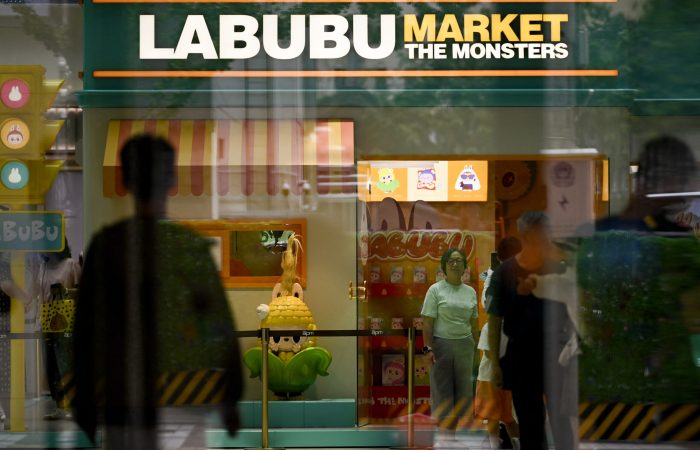
The term ‘Labubu’ may have been foreign to most a year ago, but now, you likely can’t go a week without hearing a child on the subway begging for one, a coworker proudly brandishing a newly acquired friend, seeing a recent Tsinghua graduate bringing hers for an honorary turning of the tassel, or even yourself starting to sway from ‘pointless toy’ to ‘…actually pretty cute’. Pop Mart, the Chinese toy giant behind Labubu, further popularized the Japanese cultural phenomenon of ‘blind boxes’ – buying a toy without knowing the specific character in the box – which often leads to consumers buying multiple boxes until they get the one they desire. With Labubu revenue soaring over 1,200% for Pop Mart and not enough ‘Bubus’ to go around, a large secondary market has emerged for resellers.
Pop Mart has employed several methods to sell Labubus. Due to bot activity, you can only purchase Labubus in the Pop Mart App by playing ‘Pop Now’, a more interactive web race to see who selects an available ‘box’ quickly enough. Consumers open the box virtually to see which model they receive before it’s shipped to their home. First, there are coordinated ‘drops’ for completely new series like the newest ‘Whacky Mart’ and ‘Big Into Energy’, typically 10:00PM on Thursdays. Then, at seemingly random early evenings-late nights during the week, Pop Mart restocks the series. Third, Pop Mart sells on Tiktok Live from their official account, restocking at random through the Tik Tok Shop. Last, Pop Mart deploys various vending machines, restocked at random as well. Labubus are no longer available in store locations due to such high demand, but can be bought online and picked up in store. While some articles claim Labubus have skyrocketed in price to hundreds of dollars, some limited editions even fetching $172,800, the average consumer is not dropping thousands or even hundreds on a furry friend.
However while some scroll social media, annoyed at the back to back unboxings of Labubus as they remain empty handed, another secondary market brews – the counterfeit market of Lafufus. Lafufus, ‘chafufus’ in Spanish – or even ‘Lazuzu’ for particularly demonic fakes – are just as popular. Due to the limited supply of Labubus and high demand, counterfitters have filled the need. These counterfeits are sometimes wholly unconvincing, but their warped appearance is all part of the fun. Having a counterfeit isn’t a mark of shame – it’s simply trying to get in on the fun.
The market for counterfeits is not new, with the industry expected to reach a trillion dollars by 2030. There are several markets for people who consume fake goods from China: people unaware that they are purchasing fake products and ones who actively seek out Chinese counterfeit products. These people further fall into categories of those who cannot afford the real thing and opt for a fake and those who can afford it, but choose not to because they don’t believe it’s worth the price. Many people who enjoy Labubus are a third, more economically scintillating option though. The point of uniqueness in the Labubu market is consumers oscillate between buying at Pop Mart price if they are able to beat the odds, on the resale market, and also on the counterfeit market. Many users on Tiktok and Instagram have vast collections, but most are mixes of reals and fakes.
When demand has grown so far past supply, China’s economy wins two fold. First, with the huge rise of Labubus and second, with the creation of Lafufus. 90% of all counterfeit goods seized by U.S. customs and border patrol in 2024 were from China, following similar trends since 2018. At the very beginning of the Trump Administrations announcement of tariffs, Chinese sellers flooded channels and feeds with counterfeit goods, hoping to offload some stock before tariffs went into effect. While in the U.S., retailers like Lululemon can easily file suit against those who make ‘dupes’ of their products, it’s significantly harder for U.S. retailers to get the same treatment in China. Filing a suit means very little if no representative will come to trial or even acknowledge that an infringement has taken place. Some pundits posit the threat of trade war itself is what may lead to China letting intellectual property fall further by the wayside. Despite some commitment to cracking down on IP laws and copyright infringement, most recently in a joint renewal between The National Copyright Administration of China and the British Intellectual Property Office, China does far less enforcement than many foreign corporations would like it to.
Luxury brands such as Hermes, Louis Vuitton, Gucci, and Chanel are the usual targets of counterfeiting. When something is $30, is there really a need for a dupe? Lafufus exorbitant popularity say yes! Pop Mart is making money hand over fist, but the site itself does warn that those who use its toys to ‘deceive’ anyone or make profit using their likeness would be prosecuted. In fact, Chinese copyright courts have already ruled in Pop Mart’s favor. Although Pop Mart only won about $1400 in damages and the defendant did not show, the case set the precedent that selling 3D printed versions of Labubus was also off limits. Pop Mart is surprisingly a rather litigious entity, having sued a Singaporean bakery and a Cantonese restaurant for selling sweet dumplings and dark chocolate buns decorated as ‘The Monsters’ in 2024. In a stark contrast to U.S. and European brands in Chinese copyright court, Pop Mart seems to be at the forefront of Chinese companies successfully protecting its intellectual property.
With the onslaught of fake goods brought out by the threat of tariffs, it was hard to see how the tides are turning. In 2019, Chinese law changed to force purely online retailers to register as a business and pay relevant taxes. The law further holds the merchants and apps that host them responsible for the sale of counterfeit goods. As Chinese companies make greater economic impact, Chinese authorities are working much harder than previously to block imports of goods that infringe the marks of domestic companies, rather than seize fakes heading overseas. China’s toy manufacturing center of Guangdong has many legitimate factories, but also a vast network of counterfeit supply chains. This network of counterfeits has extended overseas to Vietnam, Cambodia, and Bangladesh, producing fake goods that are shipped back into China. The same authorities that often looked the other way with non-Chinese companies are now motivated to protect domestic IP. Much to their and Pop Mart’s apparent chagrin, Labubu resellers have created a secondary market that is likely multi million dollars of revenue, and the Chinese retailers creating Lafufus are thriving too.
To examine the resale market, we look to StockX – a popular reseller hub that provides real time data of sales made. While possible, it’s exceeding hard to get a Labubu on the Pop Mart site. Bots often swoop in and buy large sums which then are put on resell sites like StockX for double the price. Despite relatively affordable prices in the U.S., many cannot afford to buy on the resale market. In turn, this fuels the counterfeit market. This secondary reseller market is not uncommon or unsurprising. Neither is the openness and willingness to purchase a fake product. The real Labubus are made in China, and so are the fakes. How different can they really be?
There are currently three lines of Labubus; a pastel ‘Exciting Macaron’ dessert themed, a tie dye ‘Big Into Energy’, and the ‘Have a Seat’ sitting model. Here is a snapshot of what the StockX market data looked like for the first 12 hours of July 4th.
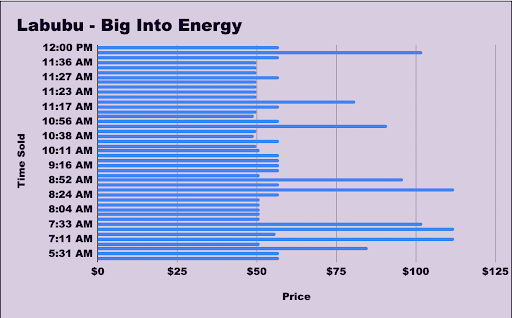
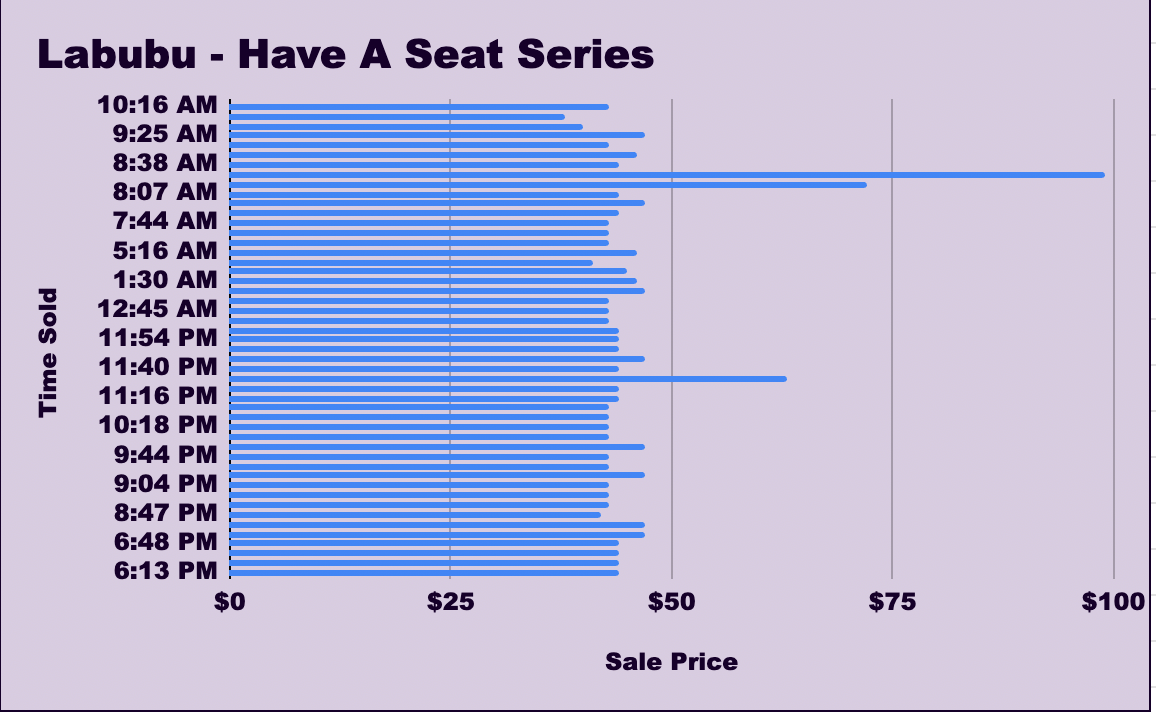
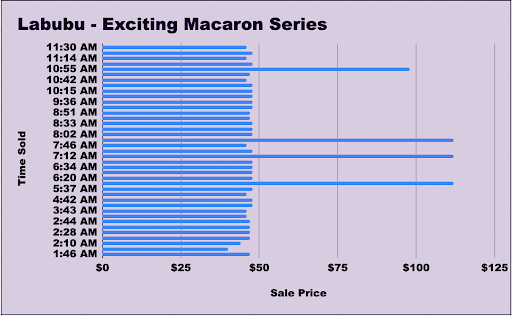
Although each line has spikes in price and tops out at $112, the majority of resold Labubus are sold for between $43-$57. When on the hunt for Labubus at in person merchants, this appears to be around the norm; at 4 non Pop Mart verified resellers, the average was $60, bringing the average price of a Labubu on the reseller market to $52. A Labubu right from the source is $27.99. The reseller market is therefore typically about double the price for a blind box.
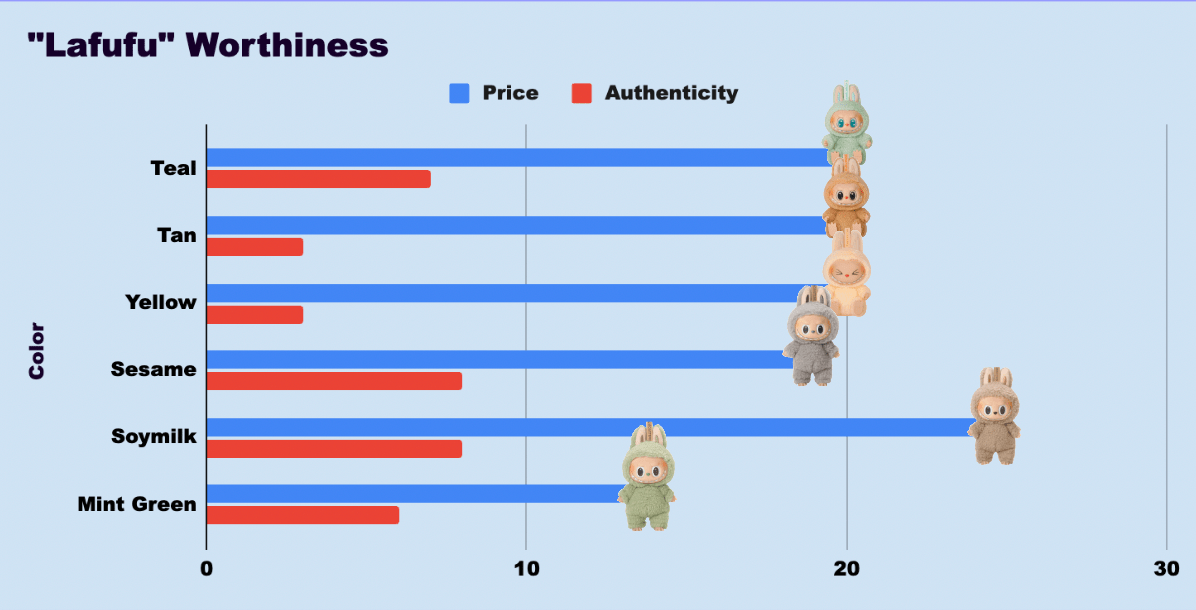
Although my personal collection is small, I rated the counterfeits on authenticity and price. No Lafufu cost more than a Labubu but none were a wholly convincing Labubu. Most Lafufus are circa $20. Points for authenticity, on a 0-10, scale were deducted if a Lafufu:
- Did not have a signature UV ‘Labubu’ foot symbol
- Misspelled or misprinted ‘The Monsters’ on key chain loop
- Had more/less than 9 teeth
- Did not have a black box on foot that said ‘Pop Mart’
- No tag with brown ‘Pop Mart’ label
- Had additional features inconsistent with real Labubus
- Had loose stitching/loose threads
- Was shockingly inaccurate in general (such as, being a ‘Lazuzu’)
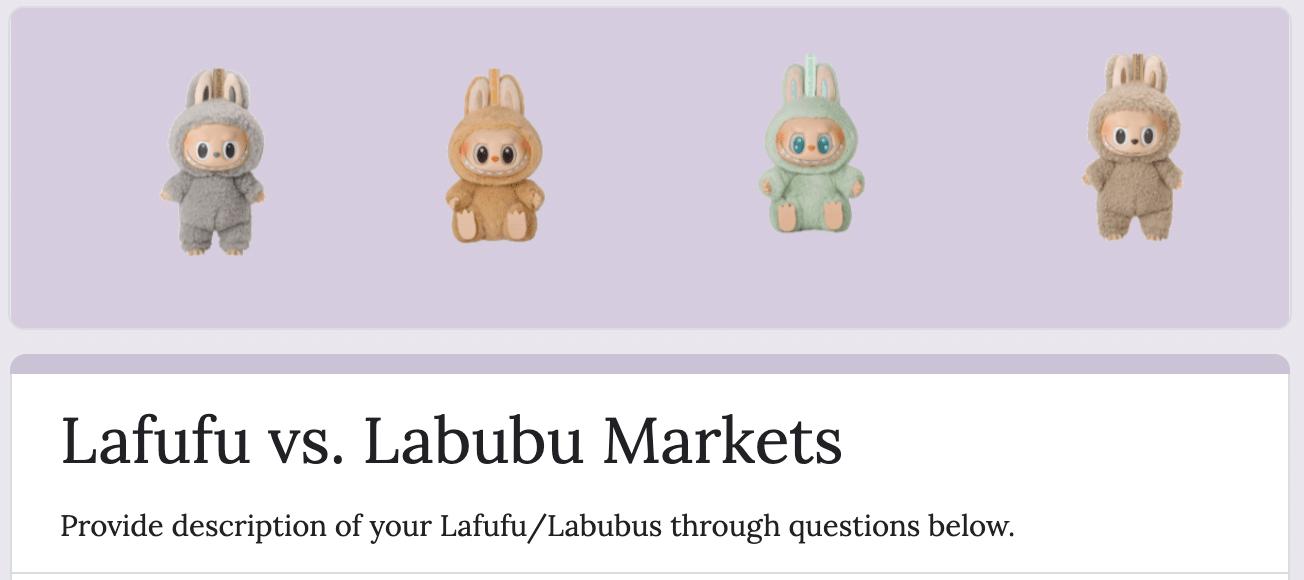
Every seller openly admitted they were counterfeits, sometimes unprompted, in Washington D.C., Pennsylvania, New York, and New Jersey. All Lafufus also had a ‘Made in China’ export tag. Labubus are generally more popular on the West Coast than the East, which may account for some regional difference in price. One Lafufu was bought already unboxed and purchased due to being a desirable color (Sesame), all others were bought blind. My total cost of participation for the experiment was $118, which could have gotten me approximately 4 real Labubus, or two on the reseller market. To better capture the market, I’ve created this questionairre for those who have Labubus and Lafufus to provide information, share with your most obsessed friends. The Lafufu market is vast and expanding and it’s of utmost importance to capture the counterfeit market in real time.
With China still home to the bulk of the almost trillion dollar counterfeit market and Pop Mart’s production, it’s difficult to tell where counterfeit crackdowns may go next. If China does protect Pop Mart and other domestic companies, the huge counterfeit market moves elsewhere in Asia while potentially not improving their international reputation. With plans to grow their almost 450 locations worldwide, open a theme park in Beijing, and enter the mobile gaming sector, Pop Mart has already made its litigious attitude known. Pop Mart’s explosive success may be what forces China to abide by and enforce new laws, but only time will tell. Until then, join in on the fun – get that blind box, and be sure to tell us what’s inside.
Related Terms
You May be Interested In
- Qiyun (James) Duan
- August 22, 2024
- U.S.
- Economics & Trade, US Domestic Politics
- Amanda (Yue) Jin
- March 14, 2024
- China, U.S.
- Economics & Trade, Global Politics, Security, US Domestic Politics