
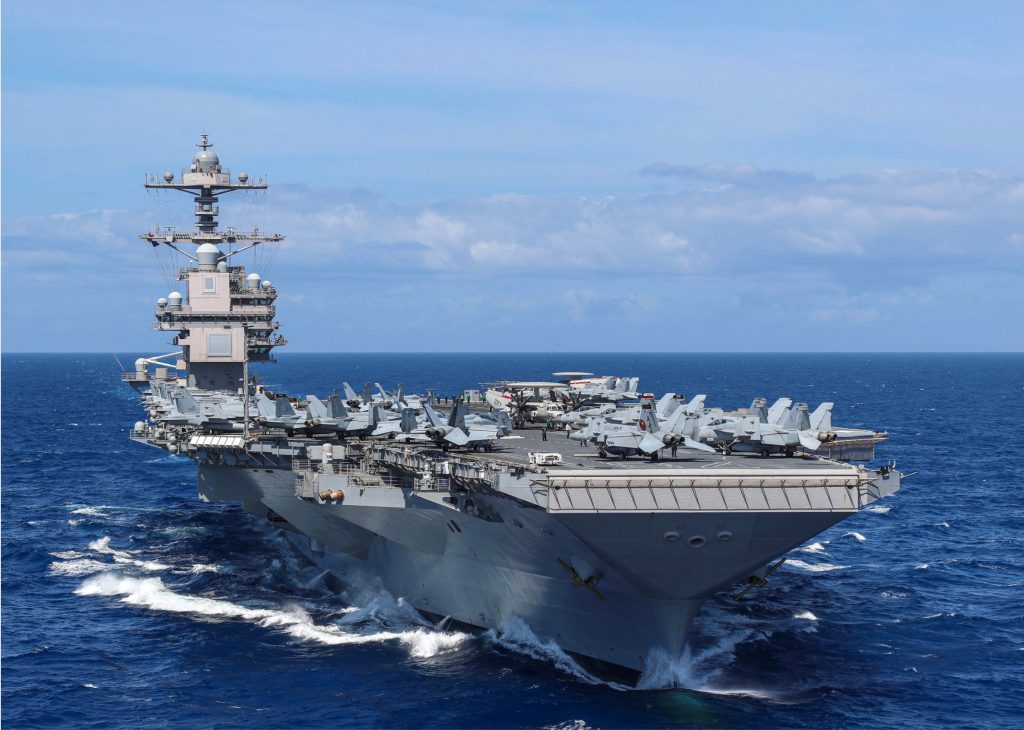

Cover Image Source: Aviation Machinist’s Mate 2nd Class Jaylance Delacruz, from Virginia, assigned to aircraft intermediate maintenance department, conducts routine maintenance on an F414 turbofan engine in the jet shop aboard Nimitz-class aircraft carrier USS George Washington (CVN 73) while underway in the Philippine Sea, July 20, 2026. (U.S. Navy photo by Mass Communication Specialist 3rd Class Estrella Velarde)
A strategic international strait may remain legally “open” while ships face military threats, attacks, higher insurance premiums, sanctions-related risks, forced re-routing or arbitrary conditions for passage. In such circumstances, the question is no longer simply whether the waterway is “open” or “closed”, but whether ships can pass through it safely, predictably and at a reasonable cost. This distinction matters significantly to both China and the United States.
The US is also deeply embedded in the global maritime system. Although its energy structure and trade patterns differ from China’s, disruptions to key international waterways impose economic costs too, while increasing the resources Washington must devote to protecting global maritime security.
For both China and the US, the continued availability of key international waterways is not merely a regional security issue. It is a basic condition for a functioning global economy.
The crisis in the Strait of Hormuz suggests that the traditional distinction between an “open” and a “closed” waterway may no longer be sufficient.
A key international waterway can remain formally “open” while becoming increasingly difficult or expensive to use. Military threats can deter commercial vessels. Armed attacks can force ships to seek alternative routes. Sanctions and compliance risks can make certain voyages commercially unattractive. Higher insurance premiums can have a similar effect.
Undoubtedly, China and the US have profound differences over security, geopolitics and the international order. Nevertheless, cooperation to ensure free passage in key international waterways does not require the two states to resolve these broader disputes.
There are areas in which their interests overlap: maritime safety, search and rescue, protection of commercial shipping, maritime information sharing, anti-piracy efforts and prevention of marine pollution. These are practical issues with relatively low political sensitivity.
In this regard, China’s experience in the Gulf of Aden is particularly relevant. This month, the navy dispatched its 49th escort task force to the Gulf of Aden and waters off Somalia. Since December 2008, Chinese naval forces have taken part in international anti-piracy operations and escorted thousands of commercial vessels. As a result, over the years, China has accumulated substantial experience in long-distance escort operations and maritime security cooperation.
For China and the US, strategic competition should not prevent cooperation where their fundamental interests coincide. Indeed, maintaining the free passage through key international waterways could become a concrete area where the two states can pursue practical cooperation while continuing to disagree on broader global issues.
In an increasingly fragmented international environment, keeping key international waterways open is a shared interest for both China and the US. These two major powers may not agree on many issues concerning the future of the international order, but both have a high stake in ensuring the world’s maritime arteries remain safe, predictable and accessible to commercial shipping.
Dr. Yinan BAO is an associate research fellow at Huayang Center for Maritime Cooperation and Ocean Governance, based in Haikou, China. He is also a non-resident fellow at the Institute for China American Studies, Washington DC, United States. This article was originally published in South China Morning Post on August 28, 2026.

Before Exploitation Begins: What the NORI and TOML Orders Mean for ISA Accountability