
September 19, 2025
Volume 5
Issue 19
ICAS Trade ‘n Tech Dispatch (online ISSN 2837-3863, print ISSN 2837-3855) is published about every two weeks throughout the year at 1919 M St NW, Suite 310, Washington, DC 20036.
The online version of ICAS Trade ‘n Tech Dispatch can be found at chinaus-icas.org/icas-trade-technology-program/tnt-dispatch/.
What's Been Happening
-1-
U.S.-China Madrid Talks Reach Framework Deal for TikTok Resolution; Trump Presses G7 to Sanction China and India over Russian Oil
-1-
In One Sentence
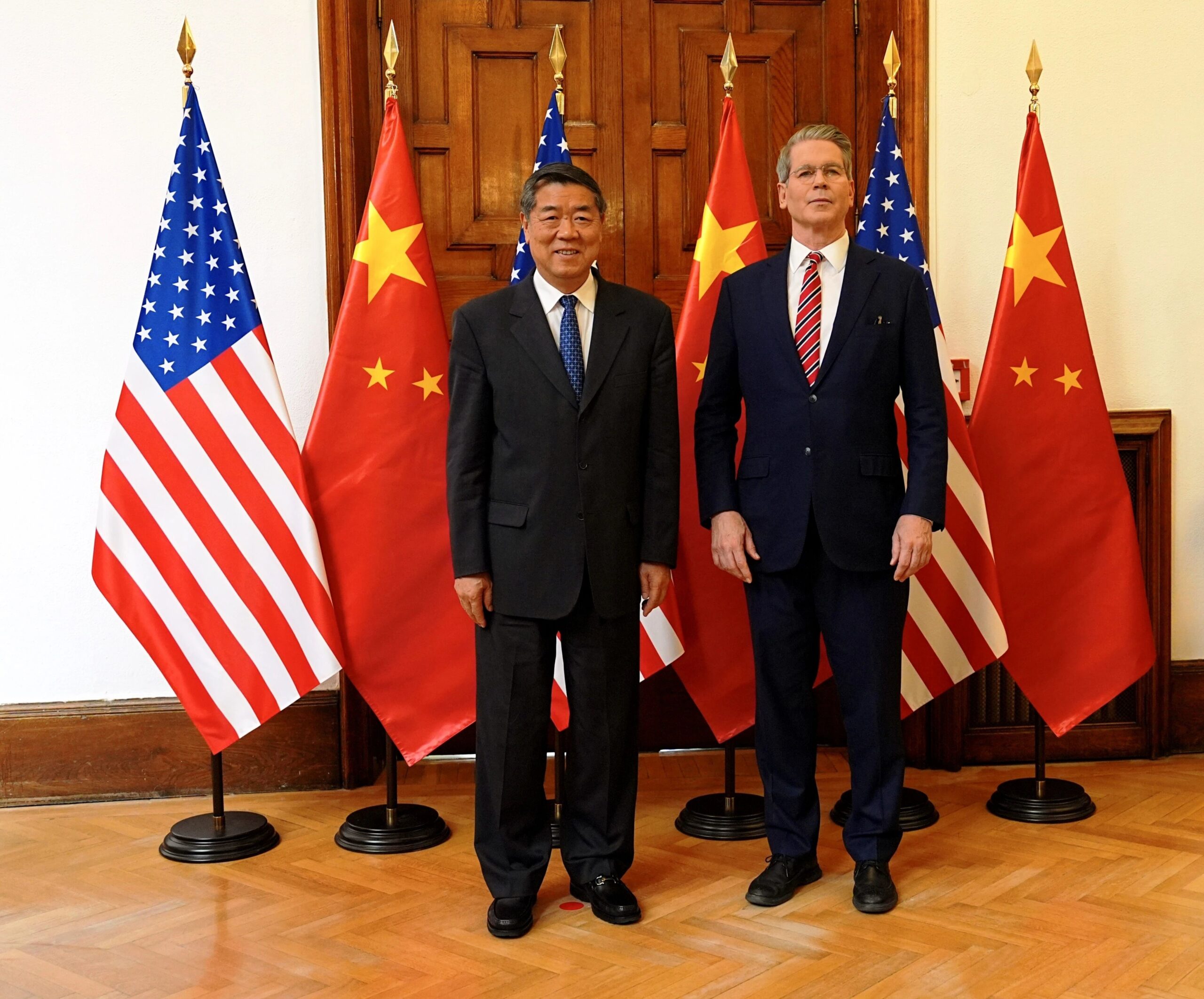
- The United States and China held trade talks in Madrid, Spain, on September 14-15, involving senior U.S. and Chinese officials U.S. Treasury Secretary Scott Bessent, U.S. Trade Representative Jamieson Greer, Chinese Vice Premier He Lifeng, and top trade negotiator Li Chenggang.
- The talk focused on tariffs, export controls, a preliminary framework for the divestiture of TikTok, and U.S. pressure on China to curb purchases of Russian oil.
- After the talks, Secretary Bessent announced that a preliminary framework deal was reached for TikTok’s divestiture from ByteDance, which would transfer the platform to U.S.-controlled ownership.
- President Trump said that he will have a call with Chinese President Xi Jinping to finalize the framework deal on September 19.
- Prior to the trade talks, the U.S. Department of Commerce added 32 entities to its trade blacklist on September 12 in order to restrict their access to U.S. technology, including two Chinese firms that served as buyers of U.S. chipmaking equipment for SMIC and Shanghai Fudan Microelectronics.
- Shortly after the U.S. blacklist, China’s Ministry of Commerce opened an anti-dumping investigation into American-made analog IC chips produced by Texas Instruments and Analog Devices, while also launching an anti-discrimination probe into U.S. restrictions on China’s chip sector.
- Separately, China’s State Administration for Market Regulation (SAMR) issued a preliminary finding that Nvidia had violated anti-monopoly rules related to its 2020 acquisition of Mellanox Technologies, a supplier of networking equipment.
- On September 13, Trump said he was ready to impose major sanctions on Russia, including secondary sanctions on China of 50-100% but only if NATO countries follow suit and stop buying Russian oil.
- A day before, the US pressed its G7 partners to adopt tougher measures against Russia in a phone call among the group’s Finance Ministers, calling for a “united front” to stop the conflict in Ukraine.
Mark the Essentials
- As a result of the framework arrangement in Madrid, the deadline for sale of TikTok – due by September 17 – has been extended for another 90 days, in order to address U.S. national security concerns stemming from potential Chinese data transfer and content manipulation.
- Although the Madrid talks have paved the way for a final resolution of the TikTok saga, there are still additional details concerning matters such as ByteDance’s technology transfer that remain unresolved; Congress’s reaction to the arrangement is also not known at this time.
- China’s Ministry of Commerce condemned the U.S. for adding Chinese firms to its export control list, accusing Washington of abusing national security to pursue unilateralism and vowing to take necessary measures.
- SAMR, which had conditionally approved the Nvidia-Mellanox acquisition in 2020 and later initiated the probe in December 2024, could impose fines that range between 1% and 10% of the company’s sales.
- During the call with G7 Finance Ministers, Bessent and Greer reiterated inclusion of all G7 partners in imposing secondary sanctions on China and India, saying only a “united effort that cuts off the revenues funding Putin’s war machine at the source” would work.
Keeping an Eye On…
What does President Donald Trump want more? A Nobel Peace Prize for bringing the Russia-Ukraine bloodletting to an end or a major market access agreement with China to overwhelmingly favor American agriculturalists, aircraft manufacturers and energy exporters? A shiny geopolitical win or a mouthwatering commercial deal? He will have to choose, for he cannot have both. Sanctioned Chinese oil purchases are to be wielded as a weapon to impoverish Russia’s oil and gas revenue stream and bring Moscow to the ceasefire table, or China and its market are to be treated as a gold mine to be exploited by U.S. exporters. By the seeming look of things, Donald ‘Art of the Deal’ Trump prefers the latter.
First, let’s roll the footage back. On the campaign trail, Trump famously quipped that he would end the Russia-Ukraine war on Day One of his presidency. It hasn’t quite worked out that way, 270 days-and-counting later. A first meeting in six years with Vladimir Putin notwithstanding, peace or a ceasefire is nowhere to be found. When that ceasefire arrives, perhaps at the end of the fighting season later this year, it will be on Putin’s timeline, not Trump’s. To relieve his frustration, Trump issued an executive order on August 6th “Addressing Threats to the United States by the Government of the Russian Federation,” which slapped secondary tariffs on … India. Although New Delhi is not quite the goody two shoes doing the most to support price stability in the global oil market as it pretends to be, why not punish Russia directly? What’s the hesitation?
Maybe Trump has a personal softness for Moscow. Maybe Moscow polls well with his base and he wants to keep it that way, or there are big post-sanctions deals to be made in Moscow. Let’s charitably assign statesmanship virtues and say Trump grasps the value of maintaining stable and substantive ties with the major powers, and that he might even have an eye on prising Moscow loose from its ‘no limits’ relationship with Beijing, à la reverse Kissinger style. Whatever the reason, having failed to find the spine to match deeds to words after having read the riot act to Moscow, Trump and his acolytes have now taken to threatening 100% secondary tariffs on China and India for their Russian oil imports … but only if the Europeans and Canadians go first. A tariff-happy administration now wants to hide behind the skirt of the Europeans when it comes to imposing tariffs, the skirt of those who sat deferentially on their chairs in the Oval Office a month ago. What gives?
The Europeans will, of course, never impose secondary tariffs because they are gorging on the same Russian hydrocarbon resources, at least in the short term — 21 of Russia’s 34 million metric tons of LNG exports in 2024 flowed to the EU. Besides, secondary tariffs are WTO-illegal and the Europeans are looking at asset freezes instead as part of their energy sanctions toolkit. How about freezing their own assets for gorging on Russian oil and gas? As for China and India, they are moving geopolitically closer rather than away from Moscow. The recent Russian-Chinese memorandum on the Power of Siberia 2 pipeline as well as Beijing’s willingness to re-open its renminbi ‘panda bond’ market to Russian energy companies for the first time since the Feb. 2022 invasion signals that the high watermark of keeping Moscow at arm’s length is a thing of the past. Ditto for New Delhi, which is preparing to host Putin in-person for the first time since his invasion later this year.
Meanwhile, in one European capital that has managed to retain its bearings (Madrid), Trump’s Treasury Secretary and U.S. Trade Representative met their Chinese counterparts to clear the underbrush for a possible late-October Trump visit to Beijing. No mention of 100% secondary tariff there, of course, for such an imposition will surely torpedo the delicately poised bilateral trade discussions. A number of Chinese advanced computing and chip manufacturing firms were dumped onto the Entity List just prior to the meeting; Beijing responded with its own chip-related investigations. The two sides seem to have come away satisfied from their Madrid meeting, with Secretary Bessent alluding to the high possibility of a trade deal before the expiry of the 90-day reciprocal tariff suspension deadline on November 10, which would conveniently fall within Trump’s Asia-Pacific travel calendar.
The highlight of the meeting though was a framework arrangement for the divestiture of Bytedance’s TikTok app to a consortium of U.S. buyers. Delicate dealmaking still needs to be concluded on this front. While Beijing has evinced a willingness to export TikTok’s recommendation algorithm, it plans to license the algorithm and related intellectual property to its new American owners. This would not sufficiently conform to the now U.S. Supreme Court-validated Protecting Americans from Foreign Adversary Controlled Applications Act, which requires a full cutting of the recommendation algorithm cord that ties TikTokUS to Bytedance and, by extension, any possible Chinese influence. This should not be an insurmountable obstacle; a U.S.-specific clone of the recommendation algorithm that is to be supervised by an American engineering team, much like a standalone version of TikTok is available exclusively on the Mainland in Chinese app Douyin, is probably good-to-go at this very moment. Presumably, the two presidents will hash this matter out when they speak later today.
The positive vibes from Madrid notwithstanding, Trump’s empty browbeating about a ceasefire and secondary tariffs have only served to confirm an unflattering truth: he will go to extreme lengths to avoid punishing Russia or forsake his dream of selling endless quantities of goods to the Chinese. For a dealmaker who revels in flaunting his leverage, it is transparently clear where his weakness resides. Putin and Xi, for one, have certainly taken note of it.
Expanded Reading
- US, China Reach Framework Deal on Tiktok; Trump and Xi To Speak on Friday, Reuters, September 15
- U.S. and China Conclude Talks With ‘Framework’ on TikTok Sale, The New York Times, September 15, 2025
- U.S. Reaches Outline of Deal With China Over TikTok, The Wall Street Journal, September 15
- Trump to Speak to Xi Friday With TikTok Framework Reached, Bloomberg, September 15, 2025
- China Says Nvidia Violated Anti-Monopoly Law after Preliminary Probe, CNBC, September 15, 2025
- China to take ‘all necessary measures’ to protect interests: MOFCOM on US call for G7, NATO tariffs over Russian oil imports, Global Times, September 15, 2025
- MOFCOM Condemns US Putting Chinese Firms on ‘Entity List’, Vows to Safeguards Enterprises’ Rights, Interests, Global Times, September 13, 2025
- US Penalizes Two Chinese Companies That Acquired Tools for Chipmaker SMIC, Reuters, September 12, 2025
- G7 finance ministers discuss possible sanctions, tariffs on supporters of Russia’s war, Reuters, September 12, 2025
On the Hill
Legislative Developments
- Lawmakers from both parties in both chambers of Congress are advancing amendments to the National Defense Authorization Act (NDAA) that would tighten export controls on advanced AI chips, including the GAIN AI Act and others that require chipmakers to certify priority access for U.S. customers before selling abroad.
- House Ways & Means Committee member Nathaniel Moran (R-TX) introduced the Tariff Revenue Used to Secure Tomorrow Act, which would create a Treasury trust fund beginning in FY2026 to direct tariff revenues above FY2025 levels solely toward reducing the national debt.
- House Republicans this week narrowly adopted H. Res 707 that will change procedures for the chamber to effectively nullify fast-track procedures for resolutions to terminate the emergency declarations President Trump has used as the basis for country-specific tariffs under the International Emergency Economic Powers Act (IEEPA).
Hearings and Statements
- On September 8, the House Select Committee on the Chinese Communist Party alleged that “suspected Chinese cyber-attackers impersonated Chairman John Moolenaar in emails” to deceive recipients and attempted to gain access to information on U.S. trade talks.
- On September 5, House Agriculture Committee Chair Glenn Thompson (R-PA) proposed that a “fraction” of the U.S. tariff revenue should be diverted to support farmers, adding that it would “keep them financially stable.”
- Democratic lawmakers urged Treasury Secretary Scott Bessent and other trade officials during the U.S.-China talks in Madrid to demand binding commitments from Beijing to curb industrial overcapacity, particularly in sectors like steel and solar panels, as part of any trade deal to protect U.S. jobs and industry.
- Fifteen House Democrats on the Ways & Means Committee wrote to President Trump on September 11, alleging that his plan to require U.S. chip exporters give the administration 15% of their China sales is “unlawful” and “an egregious abuse of national security protections.”
Expanded Reading
- House Republicans Just Voted To Give Even More Tariff Power Away to Trump, Reason, September 16, 2025
- Exclusive: US Democrats Press Trump for A Trade Deal That Curbs China’s Production, Reuters, September 15, 2025
- Trump draws backlash over deal to sell Nvidia export control license, Politico, September 11, 2025
- Congress Weighs AI Export Controls In NDAA Amid Clash over Supply Constraints, Inside U.S. Trade, September 9, 2025
- Committee Statement on Ongoing PRC Cyber-Espionage Targeting U.S. Trade Policy Stakeholders, The Select Committee on the CCP, September 8, 2025
- Agri-Pulse Newsmakers: Farm bill 2.0 & tariff-funded farm aid with Chairman Thompson, Agri-Pulse Communications, Inc., September 5, 2025