
May 15, 2026

Volume 6

Issue 10

ICAS Trade ‘n Tech Dispatch (online ISSN 2837-3863, print ISSN 2837-3855) is published about every two weeks throughout the year at 1919 M St NW, Suite 310, Washington, DC 20036.
The online version of ICAS Trade ‘n Tech Dispatch can be found at chinaus-icas.org/icas-trade-technology-program/tnt-dispatch/.
What's Been Happening

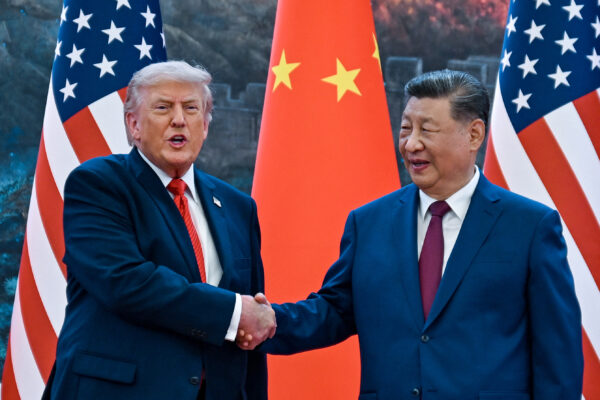
US President Donald Trump (R) shakes hands with China's President Xi Jinping at the Great Hall of the People in Beijing on May 14, 2026. (Photo by Kenny HOLSTON / POOL / AFP via Getty Images)

-1-

Trump visits China following Seoul Talks with hope for Thawing Relations and Trade Deals

-1-

In One Sentence

  • Chinese Vice Premier He Lifeng met with US Treasury Secretary Scott Bessent in South Korea from May 12-13 for “candid, in-depth and constructive exchanges” on economic and trade issues and further practical cooperation, right ahead of the Trump-Xi summit.
  • President Xi and President Trump discussed Iran, Taiwan, AI, and nuclear weapons with China announcing purchases of Boeing airplanes and U.S.  agricultural goods, and energy. 
  • Both sides also discussed establishing a “Board of Trade” and a “Board of Investment.”
  • Treasury Secretary Bessent and USTR Greer held “candid” video talks with Chinese Vice Premier He Lifeng on April 30, with Bessent telling He that China’s “recent provocative extraterritorial regulations have a chilling effect on global supply chains” while the Chinese side raised “serious concern” over U.S. restrictive trade measures.
  • Senator Steve Daines (R-MT) led a bipartisan congressional delegation to Beijing to meet with Chinese Foreign Minister Wang Yi and Premier Li Qiang on May 7, and the group voiced requests for possible trade deals and reciprocal trade. 
  • China’s Commerce Ministry invoked its 2021 blocking statute to formally order Chinese companies including private “teapot” refineries to disregard U.S. sanctions targeting Iranian oil purchases.

Mark the Essentials

  • President Trump invited 17 chief executives from companies including Nvidia, Apple, Boeing, Qualcomm, Blackstone, Citigroup, and Visa to join his state visit to China.
  • According to Secretary Bessent on May 14, the U.S. and China unveiled a protocol on AI best practices aimed at keeping advanced models from the hands of ill-intentioned non-state actors.
  • The two sides are also discussing a “Board of Investment” to fast-track some Chinese investment deals in non-sensitive areas without referral to CFIUS, along with removing tariffs on roughly $30 billion worth of non-critical goods.
  • China has agreed to purchase U.S. soybeans, oil, liquified natural gas, and 200 Boeing 737 jets. Boeing was previously negotiating for a deal of 500 planes, and the deal was also mentioned by the bipartisan congressional delegation during their visit to Beijing. 
  • It was reported on May 14 that the U.S. Commerce Department has approved around 10 Chinese companies, including Alibaba, Tencent, ByteDance, and JD.com, plus distributors Lenovo and Foxconn, to purchase Nvidia’s H200 AI chips, with each approved customer permitted to buy up to 75,000 chips under the U.S. licensing terms.
  • Sen. Daines thanked Minister Wang for Beijing’s efforts to de-escalate tensions and help reopen the Strait of Hormuz following Minister Wang’s meeting with the Iranian foreign minister, while Premier Li Qiang said China was ready to expand “practical cooperation” with the U.S.
  • The bipartisan U.S. Senate delegation also called for de-escalation and stability, as Li warned that Taiwan was “the first red line in China-U.S. relations that must not be crossed”.
  • A senior White House official said the proposed U.S.-China “Board of Trade” mechanism could cover “double-digit billions” of dollars in non-sensitive goods, with a “forward-leaning” announcement expected during Trump’s Beijing summit alongside discussions on a bilateral “Board of Investment” and potential agreements in aerospace, agriculture, and energy.
  • Treasury Secretary Scott Bessent on May 4 urged China to use diplomacy to pressure Iran, while accusing China of “funding the largest state sponsor of terrorism.”
  • The U.S. State Department on May 8 announced sanctions on 11 entities and three individuals based in Iran, China, Belarus, and the UAE for allegedly helping Iran’s war efforts, with Secretary Rubio specifically citing China-based entities that provided satellite imagery enabling Iranian military strikes against U.S. forces.
  • U.S. beef producers and the U.S. Cattlemen’s Association are pushing for the renewal of expired export licenses for over 400 U.S. beef plants to be on the agenda at the Trump-Xi summit, after China let registrations lapse in 2025 in violation of the 2020 Phase One trade agreement.
  • Chinese officials are in discussions with U.S. counterparts to buy American crops including corn, sorghum, distillers dried grains, and soybeans. A deal could be reached during President Trump’s visit.

Keeping an Eye On…

  • Like the Greek mythological figure Sisyphus, condemned to eternally roll a massive boulder up a steep hill, only for the boulder to roll back down every time it neared the top, Xi Jinping seems condemned to having to craft a strategic framework for U.S.-China ties as well as press his ‘red lines’ on Taiwan to an American president, only to have to relay the same message over and over again to a new incoming president. That there has been serial turnover in the U.S. presidency has not made his task any easier.

    On May 14, President Xi was once again rolling the U.S.-China strategic framework boulder up the hill, this time dressed up as a new vision of a U.S.-China relationship based on “constructive strategic stability”. As per this new vision of building a constructive U.S.-China relationship of strategic stability, the two sides would maintain a “positive stability with cooperation as the mainstay, a sound stability with moderate competition, a constant stability with manageable differences, and an enduring stability with promises of peace.” Said plainly, both sides should restrict their competitive tendencies within a framework of strategic cooperation, pursue common interests and minimize differences, and ensure peace and stability – a message communicated a thousand times already. This boulder is not too different either from the “peaceful coexistence, no conflict, no confrontation” one rolled up the hill during the Biden years (with Mr. Biden carving the need to establish “guardrails” on the boulder too). And much like that boulder rolled down the hill once Mr. Biden departed, so also this one will once Trump leaves office.

    Expect Mr. Xi to nevertheless assiduously roll this boulder up the steep U.S.-China relations hill for the next three years. And for good reason. The strategic consensus that Nixon, Mao and Kissinger had furnished to U.S.-China relations fifty years ago has long died, leaving a vacuum in the place of a strategic framework that needs to be filled, and which could guide relations forward. It is not axiomatic that because the Nixon-Mao-Kissinger inaugurated era of strategic cooperation has come to an end that the two sides are fated to succumb to conflict. An intermediate equilibrium of candid, clear-eyed cooperation is possible. And Mr. Xi presumably feels that the new vision laid out today could serve as a guiding basis to realize that intermediate equilibrium that could define and stabilize the relationship. What Mr. Trump thought of all this conceptual baloney is not known. He certainly nodded his head affirmatively (which the Chinese side immediately construed to be a “consensus”). But that was probably so that the conversation could move on from lofty ideals to immediate priorities – i.e., Chinese purchase orders of Boeing, beef and (soya)beans.

    Be that as it may, and although Donald Trump may appear at first blush to be an unlikely personage to co-author a new era of predictable and coexistent Sino-American ties, such a framing would be short-sighted. Mr. Trump views himself as an exponent of major power diplomacy, even harboring pretensions as a world-historical statesman. Unlike any previous U.S. administration in recent memory, the China Desk officer in this administration also happens to sit behind the Resolute Desk in the Oval Office. Along with Treasury Secretary Scott Bessent, the U.S. lead on the trade and tech negotiations, the two are the odd ducks in an administration stacked with anti-China voices. Rather than dwell on high conceptual principles, Beijing must highlight the potential role that the country can play in advancing the interests of American workers, farmers and families, as well as the role that Chinese firms could play in building out America’s industrial expansion. The framework of a win-win relationship over the next three years, with adequate leverage and safeguards at each side’s disposal, can be crafted on this foundation. A spring of hope rather than a winter of despair will then return to the bilateral relationship.

Expanded Reading

-2-

USTR Opens New 301 Investigations as CIT Strikes Down Trump’s Replacement Section 122 Tariffs

-2-

In One Sentence

  • USTR opened a second four-year review of President Trump’s first-term Section 301 tariffs on Chinese goods, beginning with a 60-day window for domestic industry representatives to request continuation of the measures, with comment periods between May 7 and July 5 for the $34 billion List 1 tariffs and between June 24 and Aug. 22 for the $16 billion List 2 tariffs.
  • On May 6, at USTR hearings on the Section 301 probe into structural excess capacity, stakeholders from the manufacturing, consumer goods and technology sectors raised concerns over China’s trade policies but questioned tariffs on US allies and partners. 
  • In another setback to Trump’s tariff agenda, a U.S. trade court on May 7 ruled that his temporary 10% global duties were unlawful under a 1970s trade law, though the decision currently shields only two importers and Washington state pending an appeal.

Mark the Essentials

  • During the USTR hearing on overcapacity, steel and aluminum producers asserted that existing trade remedies and national security tariffs have failed to curb China-driven overcapacity, but also blamed countries like India for “heavily” subsidizing its steel industry and urged tougher action under the Section 301 investigations. 
  • At a WTO meeting on April 30, the United States accused China of driving a “second China shock” through large-scale industrial subsidization and state-supported overcapacity, while China rejected the charges and asserted that the subject had “neither legal basis nor factual foundation” under the WTO framework. 
  • On April 29, major business groups and worker advocates told USTR that tariffs over forced-labor imports are counterproductive and the administration should rather focus on engagement with trade partners as the agency weighs a potential new tariff framework under Section 301 of the Trade Act of 1974
  • On May 5, White House National Economic Council Director Kevin Hassett defended a 4.4% rise in the overall trade deficit in March, pointing to record U.S. goods exports and saying the rise in imports will help “make future GDP in the U.S.”
  • U.S. Customs and Border Protection estimates that processing refund claims for tariffs imposed under the International Emergency Economic Powers Act (IEEPA) will require about 511,500 working hours on the part of importers and cost roughly $18.7 million, based on documents submitted to the White House Office of Management and Budget.

Keeping an Eye On…

  • China’s “overproduction” problem is back in the crosshairs of the Trump administration again. Last week, public hearings were held on the topic of “structural excess capacity,” pursuant to a Section 301 probe initiated by the US Trade Representative in early March. Needless to say, China’s industrial might was dumped on, regardless of whether that might, sectorally, arose or did not arise from a case of excess capacity. The fixation to decouple supply chains for strategic goods remains undimmed within the Beltway, regardless of the presence or absence of excess capacity, and can be reliably expected to inform USTR’s findings. Earlier, in late-March, in a communication on reform at the WTO in Geneva, the U.S. representative pilloried China’s excess capacity as well as more broadly its industrial policies. As a remedy, the U.S. argued, China’s most favored nation privilege should be adjusted or made conditional on fair competition practices. The WTO should allow member states to more easily adjust their tariffs on persistent and large trade surplus countries such as China. And should China fail to notify the body of an industrial policy measure or practice, as per its notification and transparency requirement, members should have immediate recourse to tariff and non-tariff measures to protect themselves from the measure.

    Excess capacity in key Chinese industrial sectors is an indisputable fact. The government spent a good part of 2025 taking production capacity out of circulation under the banner of eliminating “involutionary” race-to-the-bottom competition. Its ‘unified national market’ policy push is geared, too, to streaming and rationalizing provincial level industrial subsidies with a view to combat the local protectionism and market segmentation that adds to overcapacity. And at the WTO, it is also true that China has been deficient in its subsidy notification requirements. The WTO Secretariat had observed in its 2024 Trade Policy Review of China that it could not piece together or have a clear picture or sufficient visibility into China’s industrial support programs to be in a position to assess them rigorously.

    That said, there are a number of countervailing arguments to be made too. China’s large and persistent current account surplus is much less a function of China’s industrial support programs and has more to do with the lack of aggregate demand in the economy, stemming in part from the property meltdown, and a weak but market-determined exchange rate. Second, China’s large and persistent sectoral surplus in EVs, EV battery cells, polysilicon, wafers, etc. derive primarily from its red-hot competitive capabilities and have much less to do with non-market excess capacity or labor practices. Besides, their production and exports are integral to the global green transition. Third, there is no small irony in the U.S. pointing its finger at China’s industrial policy-linked overproduction. Just earlier this January, the WTO ruled against the U.S.’ own non-compliant industrial policy programs, notably the Biden-era Inflation Reduction Act (IRA)-linked tax credits. For its part, the Trump administration has been just as interventionist with its announced government stakes in private firms in the critical minerals, nuclear energy, semiconductor and steel sectors.  Finally, if the premise is that China’s excess capacity problem is a function of non-market industrial policy measures, the fact of the matter is that in many strategic goods sectors, markets are not being allowed to function efficiently in the first place or perform their clearing function due to a range of restrictive measures including tariffs, export controls, and suchlike.

    Perhaps the more important discussion to be had here is about the design of industrial policy rather than some of its negative externalities. China’s industrial policy succeeds (on occasion) spectacularly because it is premised on the production of sophisticated tradable goods by innovative domestic firms backed by an entrepreneurial state that possesses the resolve to stand behind and support the creation of such markets at scale. After larding subsidies on market participants initially, it ruthlessly winnows down the list of players using the disciplining function of the market such that the final survivors are primed for success in global markets. Importantly, the government does not pick winners or protect incumbents. To the contrary, it is only too willing to cut loose the weaker players by shutting off their subsidy tap. Can the same be said of the emerging outlines of the United States’ industrial policy?

Expanded Reading

On the Hill

Legislative Developments

  • Rep. Rich McCormick (R-GA) on April  29 introduced the Forestry Protection Act of 2026, which would require a 50 percent reduction in tariffs on foreign wood products containing only U.S.-originating wood and mandate 90 days’ advance notice with a 60-day public comment period before any new duties or import restrictions on forestry products take effect.
  • The House Appropriations Commerce, Justice, science subcommittee approved at the subcommittee level a fiscal year 2027 spending bill on a party-line vote that provides USTR with a $7 million increase to $95 million and nearly doubles BIS funding to $450 million, while cutting Commerce’s International Trade Administration budget by $146.8 million.
  • Rep. Brad Sherman (D-CA) introduced the Stop Oil Exports to Lower Gas Prices Act, which would temporarily ban U.S. exports of crude oil, gasoline, and diesel fuel until the president certifies that military operations against Iran have ceased and the Strait of Hormuz has fully reopened to global shipping.

Hearings and Statements

  • Senate Finance Committee member Catherine Cortez Masto (D-NV) on April 29 urged USTR Greer in a letter not to impose tariffs on oil imports from countries targeted by Section 301 manufacturing overcapacity investigations, arguing such tariffs would further drive up U.S. fuel prices already spiking from the Iran war and harm domestic oil refiners.
  • A report from Democrats on the Joint Economic Committee found that small U.S. manufacturers saw profit margins decline 11 percent in the nine months following Trump’s April 2025 “Liberation Day” tariffs, with small computer and electronics companies seeing margins plummet 179 percent and durable goods manufacturers facing a 24 percent decline due to rising input costs.
  • Sen. Edward Markey (D-MA) sent renewed letters to major retailers including Amazon, FedEx, Walmart, Costco, DHL, and UPS demanding by May 13 that they explain how they will pass on IEEPA tariff refunds to consumers and small businesses now that CBP’s refund processing portal is operational, echoing similar pressure from House Democrats.
  • House Select Committee on the CCP Chair John Moolenaar (R-MI) urged the Trump administration to use export controls to respond to industrial-scale Chinese AI model theft after a White House OSTP memo from Director Michael Kratsios said foreign entities “principally based in China” were using tens of thousands of proxy accounts to systematically extract capabilities from American AI models.
  • Sen. Thom Tillis (R-NC) said that any deals Trump reaches with Xi during his Beijing visit must be binding, include strong enforcement mechanisms, and be ratified by Congress to outlast the current administration.

Expanded Reading