
September 4, 2026

Volume 6

Issue 18

ICAS Trade ‘n Tech Dispatch (online ISSN 2837-3863, print ISSN 2837-3855) is published about every two weeks throughout the year at 1919 M St NW, Suite 310, Washington, DC 20036.
The online version of ICAS Trade ‘n Tech Dispatch can be found at chinaus-icas.org/icas-trade-technology-program/tnt-dispatch/.

TnT Spotlight

Editor's Note

The TnT Dispatch team is taking a break over the Labor Day weekend. In place of our regular issue, this edition features a special TnT Spotlight, written by Sourabh Gupta, Senior Fellow and Head of Trade ‘n Technology Program, taking stock of the current state of U.S.-China relations, with three weeks to go before the September 24 Xi-Trump White House summit. The Spotlight reviews where the bilateral relationship stands, the key issues that remain unresolved, and what to watch as Washington and Beijing prepare for the upcoming leaders’ meeting.
Xi-Trump September Summit: Taking Stock with 3 Weeks to Go

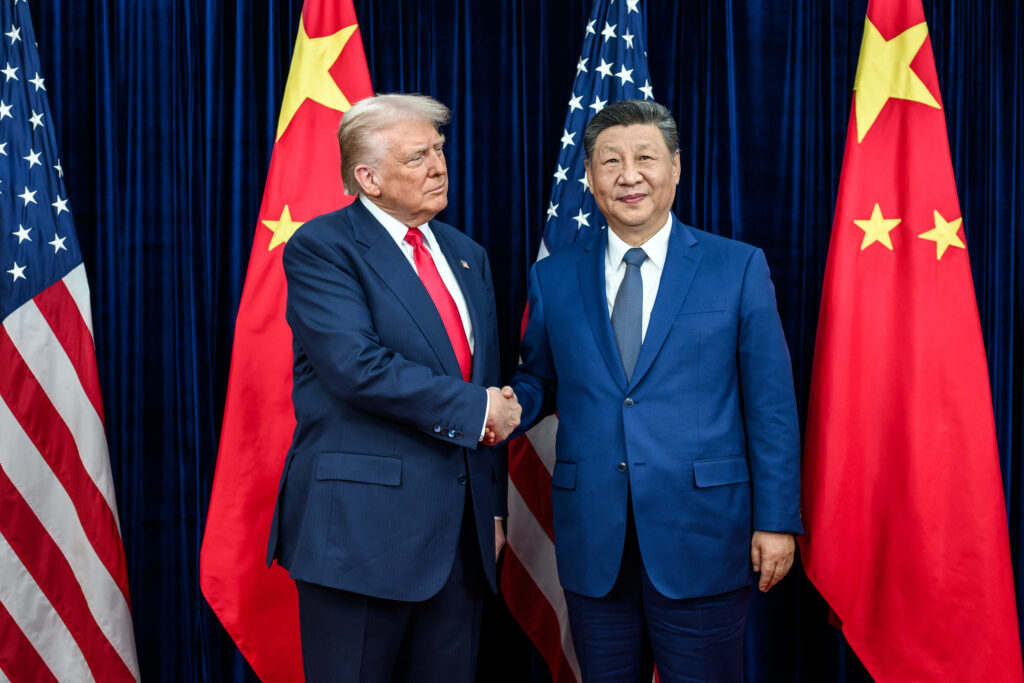
President Donald Trump greets Chinese President Xi Jinping before a bilateral meeting at the Gimhae International Airport terminal, Thursday, October 30, 2025, in Busan, South Korea.(Source: Official White House Photo by Daniel Torok via Flickr)

On September 24th, President Xi Jinping is scheduled to arrive at the White House for the first state visit by a Chinese president in eleven years. At this time, the U.S.-China political backdrop appears well-anchored in the short-term, with the relationship insulated at the highest levels from the daily push-and-pull of events in the Beltway. High-level consultations have been extensive since the last week of July, including:

  • Foreign Minister Wang Yi with SecState Rubio in Manila.
  • Foreign Minister Wang Yi with U.S. Ambassador to China David Perdue in Beijing.
  • Vice-Minister Ma Zhouxu with (a) Dy. SecState Landau, (b) Dept. of War Undersecretary for Policy Colby, and (c) White House NSC Asia senior director Kanapathy in Washington.
  • Vice-Premier He Lifeng with Treasury Sec. Bessent and USTR Greer (over video call).
  • Public Security Minister Wang Xiaohong with FBI Director Kash Patel in Beijing.

And on a separate non-governmental track, business delegations from the U.S.-China Business Council (USCBC) and the China Council for the Promotion of International Trade (CCPIT) met, too, in Washington.

The two sides have deepened post-Beijing summit functional cooperation by plucking the low-hanging fruit. These include:

  • Law enforcement cooperation, including joint enforcement operations, regarding fentanyl precursors, scam centers and fugitive rendition.
  • Trade and investment stocktaking, including on past commitments on agricultural purchases and rare earths flows.
  • Purchase of additional million metric tons of soybeans by Chinese buyers.
  • Purchase of meaningful volumes of Nvidia H200 chips by Chinese firms, including ByteDance and Tencent
  • Consultations on AI safety, including the scheduling of an expected meeting of a bilateral AI working group in early/mid-September.

That said, there are low expectations of any major breakthroughs or outcomes on September 24th. On the whole, the goal of the U.S. side appears to be to maintain stability, avoid escalation, and keep the relationship predictable. The Chinese are willing to play ball but would much prefer to elevate the substantive content of the relationship.

Boards of Trade and Investment

Populating their Board of Trade – which was chartered at the Trump-Xi meeting in May – with non-sensitive items eligible for tariff relief is expected to be one of the main outcomes of the visit. Lists have been exchanged but not much else is known. Another outcome is expected to be the rolling over – probably for a year – of the trade, export controls and critical minerals-related truce that the two sides struck up in Busan on the sidelines of APEC in November 2025.

Very little is known on the status of the proposed Board of Investment. The Chinese are eager, but the U.S. side seems divided. It remains to be seen if the two sides can work out a positive outcome – or at least a positive announcement – on this front.

One potentially consequential development: There is the possibility of a Chinese CEO delegation accompanying President Xi on his state visit. American CEOs accompanying U.S. presidents are a dime-a-dozen occurrence; the reverse does not hold true. Prominent brand name Chinese CEOs accompanying Xi would send an unmistakable signal that China is open for business, that China supports its private entrepreneurs and entrepreneurship, and furthermore, that China should be viewed as a commercial peer of the U.S. The delegation could be an important ‘soft power’ bonus for Xi in the American public eye. The development still needs to be confirmed though.

U.S. Tariffs, Other Sanctions and Decoupling-related Actions
  • Overcapacity and Forced Labor Tariffs – Per their economic and trade consultations, the U.S. and China have an agreement that the ‘substitution’ tariffs (Section 301 tariffs to replace the Supreme Court-killed IEEPA reciprocal tariffs plus Section 122 import surcharges) on Chinese goods would not exceed 20%. The 12.5% Section 301 forced labor tariff and the proposed 7.5% Section 301 industrial overcapacity tariff fall within this baseline – as such, they comport with the Busan Consensus and Beijing has no problem with the rate (although not their pretexts).

  • Iran Secondary SanctionsIt is telling that after announcing an Economic D-Day against Iran, the administration failed to list any Chinese oil refiner or bank on its sanctions list, which included more than 60 entities. It bears noting too that in late-April, the Treasury Department had sanctioned five Chinese refiners that handle Iranian crude, only to have MOFCOM invoke its 2021 Blocking Rules for the first time and order its state banks to disregard the sanctions.

    That said, both sides are treating the matter with utmost seriousness. The Obama and the first Trump administrations had scrutinized the case for sanctioning major Chinese banks in the context of Iran and North Korea sanctions, respectively, but had walked away – given that China was a major purchaser of U.S. debt and the subsequent economic disruptions triggered could reverberate as far as shaking the dollar’s reserve currency standing. The disturbances at the longer duration end of the Treasury market currently mean that the likelihood of imposing sanctions is even lesser today. For its part, Beijing is very attentive to secondary sanctions risks, given that it wants to globalize the rise of its financial sector within the plumbing of the existing international monetary and financial order (even as it builds out a parallel architecture for RMB internationalization). In early-May, after issuing its Blocking Order, MOFCOM provided guidance to banks to hold back on originating loans to the sanctioned refiners so as to avoid exposure to the U.S.’ secondary sanctions. Beijing is likely to be just as circumspect today and state-owned parties, the dominant players in the Iran oil trade, are expected to abide by Treasury’s Economic D-Day announcement against Iran, for the time being.

    The question that bears pondering though is this: In exchange for trading quiet on the Iran oil purchases front, will Beijing extract a similar geopolitically framed concession elsewhere … such as, the U.S. continuing to stay its hand/being non-disruptive on the Taiwan front, including on arms sales to Taipei.

  • Russia Graham Bill – The plain expectation is that the Graham bill’s tariff provisions will not be applied to China, and that presidential waiver authority will be exercised – even if the bill passes with veto-proof majorities. Tariffs based on the Graham bill would defeat the purpose of the trade-and-tech truce struck in Busan. Besides, the administration’s stance on Russia-Ukraine is itself in flux, with ‘peacemaker’ Trump angling to play the broker’s role at the trilateral high table, which was apparently part of the CIA chief Ratcliffe’s recent brief in Moscow.

  • FCC Decoupling Measures – The administration’s use of the FCC to bypass the Commerce Department’s export controls and impose import or sales bans on Chinese drones (December 2025), consumer-grade routers (March 2026), power inverters and advanced robotic devices (July 2026), and optical transceivers (forthcoming) has not gone unnoticed in Beijing. Nor too the recent (August 2026) Executive Order to bar purchases of Chinese bulk-power system equipment. But cumulatively, these are seen as recurring pinpricks, and the administration’s use of the FCC route itself as a means to stay beneath the threshold of provocation. The FCC orders will not upset the trade-and-tech truce applecart. Besides, China has repaid the compliment with its own set of beneath-the-threshold countermeasures. These included, on August 5th, a:
    • tightening of export controls on drones and drone components.
    • blacklisting of an FCC-recognized American testing lab.
    • addition of 6 U.S. entities to its countermeasures list for assisting on Xinjiang-related Uyghur Forced Labor Prevention Act (UFLPA) sanctions.
    • suspending the use of U.S. agencies for conducting factory inspections for China Compulsory Certification (CCC) product certifications.
    • opening a first-ever Foreign Trade Law-linked national security investigation of imported office equipment containing foreign software.

      Additionally, on August 6th, the Cyberspace Administration of China (CAC) opened a review of products sold by Palo Alto Networks under the National Security Law.

      These MOFCOM measures were in response to:
    • the June 2026 denial of permission to Chinese-owned EV brand Polestar to operate on U.S. roads starting March 2027, as per Biden administration’s Connected Vehicle Rule which requires automakers to strip out code written in China or by a Chinese company.   
    • the June 2026 updating of DoW 1260H Chinese Military Companies List, which enforces DoW procurement restrictions and creates Treasury and Commerce Dept. sanctions designation risk.  
    • the July 2026 updating of Dept. Homeland Security’s Uyghur Force Labor Prevention Law List.
Conclusion

Despite the build-up of negative undercurrents, the bilateral relationship appears to be stable and controllable at the highest reaches. The drip-feed of low-level U.S. decoupling measures will not deflect the trajectory of ties in the short-term. For President Xi to come away with a ‘W’ on September 24th, the Chinese side would however need to:

  • Renew their Joint Arrangement on Economics and Trade – stay on major export controls and suspension of additional tariffs in exchange for business-as-usual flows of critical minerals – that the two sides had struck up in Busan, ROK, beyond the expiring November 10, 2026, deadline. 
  • Formally populate and launch their U.S.-China Board of Trade.
  • Issue a meaningful announcement, at minimum, regarding their Board of Investment.
  • Make a splash on AI safety, including in the run-up to the APEC Summit in Shenzhen, preferably with U.S. support.
  • Obtain assurances of continued careful management of the Taiwan issue.
  • Find lowest denominator common ground on the Iran and Russia-Ukraine conflicts, as well as on restarting contacts on the Korean Peninsula.  

This issue’s Spotlight was written by Sourabh Gupta, Senior Fellow and Head, Trade ‘n Technology Program.