
ICAS Trade ‘n Tech Dispatch (online ISSN 2837-3863, print ISSN 2837-3855) is published about every two weeks throughout the year at 1919 M St NW, Suite 310, Washington, DC 20036.
The online version of ICAS Trade ‘n Tech Dispatch can be found at chinaus-icas.org/icas-trade-technology-program/tnt-dispatch/.
In One Sentence
Mark the Essentials
Keeping an Eye On…
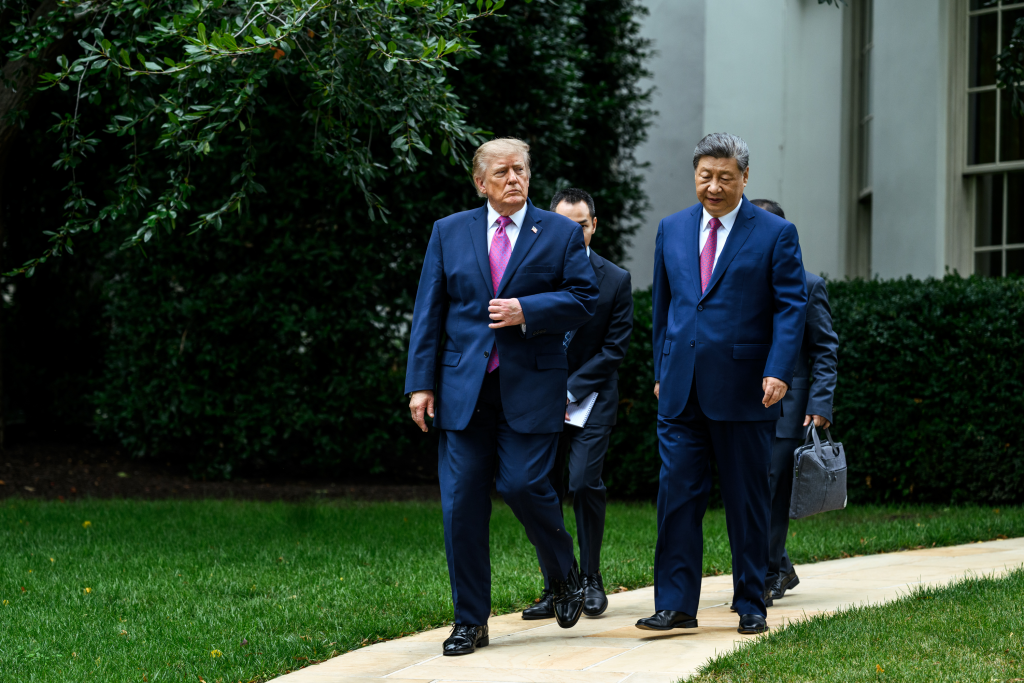
Call it the epitome of fake summitry. Much like empty vessels make the most noise, so also empty summitry makes for the most arresting images. And of which there were many, including the rare instance of the American president and his wife greeting their counterpart at Andrews Air Force Base.
Let’s start with the notable letdowns.
China is to be, as per the Board of Trade, a preferred exporter of items such as small appliances, toys, holidays decorations, and children’s car seats. How gratifying, although it would have been nice if underwear had been included in the list, too. But the protectionist garment lobby probably objects.
Regarding the Board of Investment, in Beijing in May the two sides had agreed to “charter” the mechanism. At the White House, they resolved to “operationalize” it. We’ll leave it to others to parse the difference but one element is clear to the naked eye: they “operationalized” a mechanism that contains no content, which seems pretty close to the definition of fake.
And oh! By the way, did one notice that there were precisely zero Chinese CEOs at the state dinner – which means, the Chinese negotiators not only failed to make inroads in opening-up U.S. sectors to Chinese investment but that the CEOs also likely failed to secure meetings, too, to press their cases with senior administration officials. The initial Chinese readout does not even mention the word ‘investment’. Worse, there was practically no Chinese-American representation at the state dinner, aside from the stray tech CEOs. Who knew? Maybe Chinese-Americans and Asian-Americans are all a bunch of underachievers with no standing to show in American society. Would the Committee of 100 like to chime in on their worthlessness?
On Artificial Intelligence, the two sides agreed to “establish a bilateral communication channel” – a supposed deliverable. Don’t fall for the characterization. That channel amounts to little more than two dudes (Scott Bessent and He Lifeng) and a telephone in-between serving as an incident notification line. What sort of incident, one might ask? “Some kind of an incident” Bessent had replied on the day of Xi’s arrival. And on that basis, AI or SI – super intelligence, as Trump hails it – will be tamed and become secure and controllable. Hallelujah.
The two sides clearly don’t see eye-to-eye on mil-mil crisis management matters. President Xi alluded to it in his White House arrival ceremony remarks, and the Chinese readout references a MOU that is to be concluded in this regard. The American readout, on the other hand, is blank on the matter, and informed U.S. sources challenge the Chinese account. Tellingly, the item sits outside the list of eight deliverables outlined by the Chinese side in its own readout. Meaning: the two sides may have had some preliminary discussions on this matter (theater commanders did meet in early September). They failed to come close to achieving something that resembles an agreement. Nevertheless, one side chose to pass it off as a (fake) outcome. Kinda par-for-the-course, given the current fragile state of U.S.-China relations.
There were no headline deliverables or understandings on the Taiwan matter. Which is reasonable to infer, given that both post-summit readouts fail to even reference Taiwan, and the U.S. president was plaintively left “advocat[ing] for trilateral arms control negotiations between the United States, Russia, and China.” Washington’s idea of a negotiation seems to mean obtaining something for nothing. That said, expect the $14 billion Taiwan arms sales package to remain ‘paused’ at least through the rest of this year. Nothing must be allowed to disturb the joys of two aged men nuzzling each other under the bright lights of Shenzhen and Miami.
Beijing’s attempt to use history as a cudgel against Tokyo appears to have fallen flat. The synchronized language of fighting as victorious allies in World War II is accompanied in the American readout with a reference to the ‘Free and Open Indo-Pacific’ (FOIP) and the American forward deployed presence’s preservation of the peace therein. FOIP, if one is not aware, is a Japanese construction. And worse, Abe Shinzo was its architect. The Chinese side, understandably, would prefer to focus elsewhere – on pandas and fentanyl control as well as the short extension of the November 2025 Busan arrangement.
Oh, but they did jointly agree to “build a constructive relationship of strategic stability on the basis of respect, fairness and reciprocity,” didn’t they? Well, yes and no. The U.S. readout of the May 2026 Beijing summit had called for the building of a “constructive relationship of strategic stability on the basis of fairness and reciprocity.” So, after four months of exertion, they’ve managed to inject the word ‘respect’ too. We tip our hats.
To conclude, more will surely be known about the exchanges between the two sides in the following days and weeks. And which might show the leaders’ meeting in a better light. But at this time of writing, let’s state the obvious: pomp did not just prevail over substance; it was the only substance. And the two presidents seem to have a lot of free time too on their hands. Good for them. On that cheerful note, let’s await the pomp and fakery in Shenzhen. XieXie and Good Night.
(But seriously speaking, U.S.-China relations are structurally weak, too dependent on heads-of-state diplomacy, and without concerted forward progress will inevitably tip over. At APEC Shenzhen in November, Xi will be hosting twenty other leaders; in Miami in December, Trump will host probably double that number. Neither will have the time or bandwidth to break important policy ground. The White House is where the two sides should have hammered out key outcomes that could have held them in good stead for the next 12-18 months, with Shenzhen and Miami providing opportunities to check-in on early progress and implementation. By this measure, the summit has been a major letdown.)
Expanded Reading
In One Sentence
Mark the Essentials
Keeping an Eye On…
After a summer lull, China and the European Union are headed back to the high table to kick-off a new season of high-wire trade, investment, industrial policy, and export control discussions. EU trade chief Maros Šefčovič is due in Beijing next week to renew conversations with Commerce Minister Wang Wentao. The two had last met in Brussels in late June. Following the meeting of the trade chiefs, the way forward on trade, investment and economic security relations with China is expected to be a key agenda item when EU heads meet at their leaders’ summit in mid-October. So, let’s set the table for the meetings.
China is currently on track to run an annual US$400 billion trade surplus with the EU, with significant surpluses in two particular product groups: (a) new energy products (EVs, plug-in hybrids, batteries, silicon wafers and PV cells) and (b) chemicals and certain other energy intensive products. European Commission President von der Leyen referred to the surpluses as “unsustainable” in her mid-September State of the European Union address, noting that it was leading to deindustrialization of Europe’s industrial heartlands.
The European Union is in the midst of intense deliberations on building out its industrial policy tools as well as trade defense instruments – most of which focus on China. These include its draft Industrial Accelerator Act, a draft public procurement regulation, a possible diversification instrument as well as other emergency trade powers. Active enforcement of its Foreign Subsidies Regime (FSR) is also ongoing. Crucially, Berlin appears to have thrown its weight on the side of EU resolve, with the German chancellor calling for a revaluation of the RMB too at a European Council summit in mid-June. Beijing has not been quiescent either. Earlier this year, it promulgated regulations on industrial and supply chain security, on outbound investment, and on countering improper extraterritorial jurisdiction – mainly with a view to responding to EU measures.
Both China and the European Union have initiated a structured dialogue, the Trade and Investment Consultations (TIC) process to address their mutual concerns related to fair market access and industrial subsidization and overcapacity, respectively. Of the four workstreams identified, the trade and investment balancing workstream and the export controls workstream (to ensure stable and predictable flow of rare earths and other critical minerals) will draw the greatest attention. The other two workstreams relate to reform of the WTO and discussions on intellectual property.
It remains to be seen how China will respond to the EU’s demands, which are wide-ranging and not necessarily all WTO-compliant. The EU wants China to agree to and abide by certain artificially-low sectoral voluntary export undertakings. The EU wants to set ceilings on a single supplier when its exports are concentrated beyond a certain level. The EU wants to elbow China out of certain critical infrastructure as well as public procurement markets. The EU wants China to agree to allow WTO members to impose higher countervailing tariffs on countries that heavily subsidize their industrial sectors. The EU wants a clearer and more transparent export control license application process. China, too, has its own set of asks which are mostly market access-related.
Clearly, there is much for the two sides to jaw-jaw over. That President von der Leyen did not announce a dedicated ‘diversification’ or ‘resilience’ instrument in her SOTEU address, as some had expected, suggests that the EU wishes to prioritize the bilateral dialogue process first before proceeding down the road of more fateful measures. One way or the other, China and the EU have a winter of consequential choices to make. Expect sparks to fly. But also expect serious proposals to be tabled so that both parties could walk away with a measure of success, leading to a more derisked yet engaged economic relationship. Don’t conflate China-EU trade and investment ties with China-U.S. trade and investment ties. One will hang tough and prosper relatively; the other will wither on the vine.
Expanded Reading
Legislative Developments
On Sept 24, Sen. Bernie Moreno (R-OH) and Sen. Elissa Slotkin (D-MI) said they would keep seeking a Senate vote on the Connected Vehicle Security Act, a bipartisan bill to ban imports of internet-connected vehicles from China and other countries of concern, after Sen. Rand Paul (R-KY) blocked fast-track passage, with final passage eyed for the lame-duck session.
Hearings and Statements
Expanded Reading