

April 3, 2026
Volume 6
Issue 7
ICAS Trade ‘n Tech Dispatch (online ISSN 2837-3863, print ISSN 2837-3855) is published about every two weeks throughout the year at 1919 M St NW, Suite 310, Washington, DC 20036.
The online version of ICAS Trade ‘n Tech Dispatch can be found at chinaus-icas.org/icas-trade-technology-program/tnt-dispatch/.
What's Been Happening
-1-
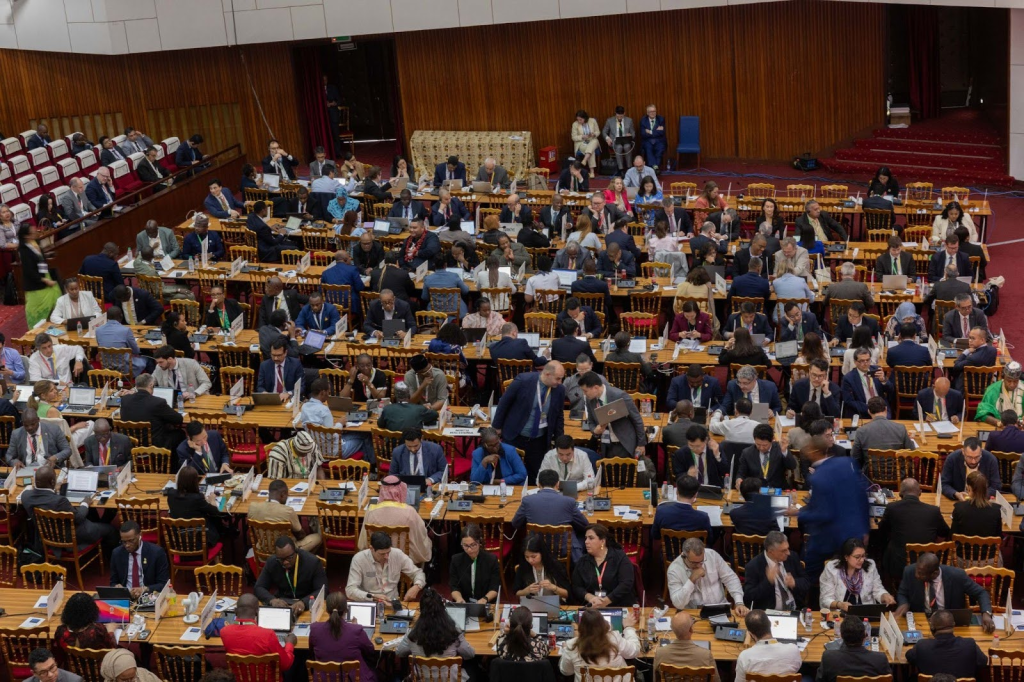
14th WTO Ministerial Meeting Concludes in Cameroon with No Concrete Breakthrough
-1-
In One Sentence
- On March 30, the World Trade Organization’s ministerial meeting in Cameroon concluded without a deal to extend a moratorium on e-commerce downloads and streaming tariffs as well as any agreement on a broader reform agenda.
- WTO Director-General Ngozi Okonjo Iweala issued a statement saying the body had “run out of time” but asserted that members were “very close” to an agreement and vowed to finalize it in further negotiations in Geneva soon.
- The moratorium on e-commerce tariffs, renewed regularly since it was first adopted in 1998, expired due to lack of consensus, with the U.S. singling out Turkey and Brazil for blocking the extension.
- U.S. Trade Representative Jamieson Greer, who participated in the ministerial, targeted other members for what he described as their “lack of seriousness,” and called the failure to renew the e-commerce moratorium “particularly frustrating.”
- Greer also highlighted the absence of many of his counterparts at the meeting while criticizing movement on a broader reform agenda, predicting that the WTO “will play only a limited role in future global trade policy efforts.”
- On March 28, on the sidelines of the ministerial, a group of 66 countries including Australia, Japan, and the UK agreed to an interim digital trade arrangement covering 70% of global trade, with major economies such as the U.S. and India declining to sign the pact.
Mark the Essentials
- The lack of consensus highlighted the gap between developing and developed nations on e-commerce tariffs, with the U.S. demanding a permanent extension, while Brazil offering a four-year plan.
- Developing countries oppose a lengthy extension as they view the tax as a potential revenue opportunity, while the U.S. backs its tech companies who favor exemptions.
- The USTR announced that it secured agreements from dozens of countries on U.S. digital transmissions and vowed to “work outside of the WTO with all interested partners to get it done.”
- On the reform agenda, the WTO Director-General said that progress was made on issues such as subsidies while the USTR expressed skepticism, saying that the organization has failed to address structural challenges like trade imbalances and currency issues.
- On March 27, Greer met China’s Commerce Minister Wang Wentao on the sidelines of the WTO ministerial, with Wang calling on both sides to “properly handle the relationship between competition and cooperation” and expressing “serious concern” regarding the Section 301 investigations.
- On March 27, China launched two investigations into U.S. trade practices, in response to two Section 301 probes by the U.S. against China and other countries.
- On March 31, Greer told Bloomberg that both Washington and Beijing seek stability in ties and predicted a “positive agenda with China going forward” ahead of President Trump’s planned visit to China in May.
- Taiwan’s delegation withdrew from the WTO conference in protest over the Cameroonian government’s decision to call it “Taiwan, Province of China” on visa documents, calling it an “unlawful deviation from the established practices of past Ministerial Conferences.”
Keeping an Eye On…
Surprise, surprise! Another WTO Ministerial Meeting has been consumed by matters such as closing gaps in the fisheries subsidies agreement or a ban on electronic transmission tariffs, even as major questions of reform hang over the future of the multilateral trading system. Perhaps, it is better that some of these major reform questions are left unaddressed for the time being. If what passes for ‘reform’ does come to fruition, the present-day multilateral system may retreat to the dark ages. Take the case of the ‘most favored nation’ (MFN) principle for example. It was a widely expressed sentiment at the Preparatory Committee gathered in October 1946 to frame the charter for the post-World War II global trading order that international trade should be abundant, multilateral, and non-discriminatory. The ‘national treatment’ principle and the MFN principle were the foundational pillars of this trading system. Over the next 75 years, the two principles were a powerful force for good, engendering unprecedented prosperity in the Global North while providing a ladder for development that allowed the Global South to break out of poverty traps and grow richer.
Now, not just the U.S. but the EU too comes with ‘reform’-linked proposals that paint a target on the back of the foundational pillars of the MFN principle. In late January, the EU submitted a proposal on WTO reform under the guise of ‘fairness’, seeking to open a discussion on the role of MFN in the world trading system within the broader context of reciprocity-based trade relationships although in fairness to the EU, there is much more texture to its overall reform proposal than just the MFN re-look. It proposes non-discriminatory access should now be linked to reciprocity and “fair” practices as well as to Members’ respective levels of openness. It further posits to loosen the MFN rule to allow adjustment of tariff levels to manage economic and economic security challenges to sectors or value chains. The U.S.’ December 2025 ‘reform’ proposal, which alleges that the MFN’s supposed ‘one-size-fits-all’ approach prevents countries from optimizing their trade relationships, would go even further. It would plainly allow a member to enter into agreements with a counterparty or counterparties which are not extended to the entire membership, like the Trump administration’s framework agreements that were individually negotiated following the discarding of the MFN principle during the course of Liberation Day tariffs.
There is a rich irony here.
The U.S. was among the first countries to benefit from the imposition of the then-novel MFN principle in the ‘unequal treaty’ of 1844 with the Chinese Empire. Having carefully studied the post-Opium War, British-imposed Treaty of Nanjing of 1842, the American side ensured in Article II of their bilateral treaty that “if any additional [tariff] advantages or privileges … [was]conceded hereafter by China to any other nation, the United States and the citizens thereof shall be entitled thereupon to a complete, equal, and impartial participation in the same.” MFN was proposed as a tool of colonial-era extraction. Fast forward to 1950, the U.S. had walked away from the International Trade Organization due to the Charter’s retention of tariff preferences and ample scope for discrimination against U.S. goods on current account adjustment grounds. Non-discrimination as embodied in the MFN principle could not, in the U.S.’ view, be up for negotiation. Today, the same U.S. hankers for managed trade and discrimination against foreign goods and imposes ‘reciprocal’, not MFN, tariffs.
In the 1970s, an earlier grievance had built up among wealthier nations on the MFN principle, dismayed as they were by the “free rider” problem in international trade negotiations. Poorer countries opted out of reducing their tariffs during successive rounds of GATT negotiations yet continued to benefit via MFN from rich country reductions of their tariff schedules. This is demonstrably not the case today. Having recognized the folly of their earlier ways, the poorer countries of the Global South made root-and-branch reductions in their tariff schedules in the Uruguay Round of negotiations concluded in 1994. The tariff-cutting imperative continues to this day within the framework of regional and other preferential trade agreements, of which there have been many. Today, the poorer countries of the Global South are the most vocal advocates of trade liberalization, having tasted the fruits of the difficult choices made back in the day. If ever there was a time to qualify the MFN principle within the multilateral trading system, that time was in the 1970s. It should be abundantly clear that time is not today.
The calling into question of the non-discrimination principle within the multilateral trading system in the 2020s shines a poor light on the inclinations as well as the will, or lack thereof, of the Global North to structurally reform their trade and trade-adjacent policy regimes. Protectionist shortcuts will not deliver beneficial, lasting results. They must practice today what was preached yesterday.
Expanded Reading
Joe Biden Forging Ahead With Efforts To Counter China As Donald Trump, Election Loom Large, South China Morning Post, June 24, 2024
Global Ban on Digital Duties Expires After Stalled Talks at W.T.O. Meeting, NYT, March 31, 2026
Trump-Xi Summit on Track Even as Iran War Drags On, Greer Says, Bloomberg, March 31, 2026
WTO meeting ends with no deal, Politico, March 30, 2026
WTO talks end in deadlock after Brazil blocks deal on e-commerce duties, Reuters, March 29, 2026
WTO members bypass opposition to introduce world’s first baseline digital trade rules, Reuters, March 28, 2026
UK and Singapore press ahead with digital deal as WTO remains deadlocked, Financial Times, March 28, 2026
China Commerce Minister Protests US Probes Ahead of Trump Visit, Bloomberg, March 26, 2026
Taiwan says Cameroon visas for WTO summit riddled with errors, will not attend, Reuters, March 26, 2026
On the Hill
Legislative Developments
- Sens. Amy Klobuchar (D-MN), John Thune (R-SD), and Roger Marshall (R-KS) introduced two bipartisan bills to stabilize fertilizer markets amid the Iran war, one establishing mandatory price reporting for farmers and another creating grants and loans to expand domestic fertilizer production, as urea prices have risen roughly 25% since late February due to the Strait of Hormuz closure.
- Sen. Martin Heinrich (D-NM) introduced the “Tariff Refunds for Working Families Act,” which would use IEEPA tariff revenue to provide tax rebates of up to $1,200 for joint filers earning under $180,000, co-sponsored by Sens. Ruben Gallego (D-AZ), Chris Van Hollen (D-MD), Cory Booker (D-NJ), and Tammy Duckworth (D-IL).
Hearings and Statements
- House Ways & Means Republicans, led by Rep. Lloyd Smucker (R-PA), introduced the “Protecting American Streaming and Innovation Act,” which would direct USTR to open a Section 301 investigation within 30 days into whether Canada’s Online Streaming Act, which requires foreign streaming services to contribute 5% of domestic revenue to support Canadian content, discriminates against U.S. commerce.
- Democrats on the House Ways & Means trade subcommittee defended the WTO and the MFN principle as valuable to U.S. businesses despite needing reform, while Republicans argued the administration’s unilateral approach was creating effective leverage for long-stalled WTO reforms ahead of the organization’s 14th Ministerial Conference.
- 21 Democratic senators, led by Sen. Sheldon Whitehouse (D-RI), urged USTR Jamieson Greer to use the upcoming USMCA review to create a rapid-response mechanism for environmental violations, eliminate investor-state dispute settlement provisions, and address “environmental arbitrage” that they say enables companies to offshore U.S. jobs to take advantage of lower environmental standards in Mexico.
- Top Democrats Richard Neal (D-MA) and Ron Wyden (D-OR) accused the Trump administration of abusing Section 301 investigations to restore tariffs struck down by the Supreme Court, while trade analysts questioned the breadth and rigor of the probes into “structural excess capacity” across 16 countries, noting that USTR’s own trade barriers report discussed overcapacity for only two of the 16 named trading partners.
Expanded Reading
- Senators ask for ‘fertilizer transparency’ as costs pile up for farmers amid Iran war, WCNC, March 24, 2026
- Klobuchar Introduces Bipartisan Legislation to Lower Fertilizer Costs, Agriculture, Nutrition, & Forestry, March 19, 2026
- Rep. Smucker Introduces the Protecting American Streaming and Innovation Act, Lloyd Smucker, March 19, 2026
- Trade Subcommittee Hearing on Advancing America’s Interests at the World Trade Organization’s 14th Ministerial Conference, United States House Committee on Ways & Means Chairman Jason Smith, March 17, 2026
- Whitehouse Leads 21 Senate Democrats in Demanding Strengthened Environmental Provisions, Enforcement in USMCA Joint Review, Sheldon Whitehouse, March 17, 2026
- Heinrich Leads Legislation to Refund Working Families for Trump’s Unlawful Tariffs, Martin Heinrich, March 12, 2026
- Neal Statement on Trump’s Latest Trade Abuse, Ways & Means Committee Ranking Member Richard E. Neal, March 12, 2026