

April 17, 2026
Volume 6
Issue 8
ICAS Trade ‘n Tech Dispatch (online ISSN 2837-3863, print ISSN 2837-3855) is published about every two weeks throughout the year at 1919 M St NW, Suite 310, Washington, DC 20036.
The online version of ICAS Trade ‘n Tech Dispatch can be found at chinaus-icas.org/icas-trade-technology-program/tnt-dispatch/.
What's Been Happening
-1-
Liberation Day Anniversary Arrives Without Liberation Day Tariffs
-1-
In One Sentence
- USTR Jamieson Greer on April 7 promoted the creation of a U.S.-China Board of Trade focused on non-sensitive goods while downplaying prospects for a broader investment mechanism, saying the relationship is not yet at that point, as preparations continue for the delayed Trump-Xi summit.
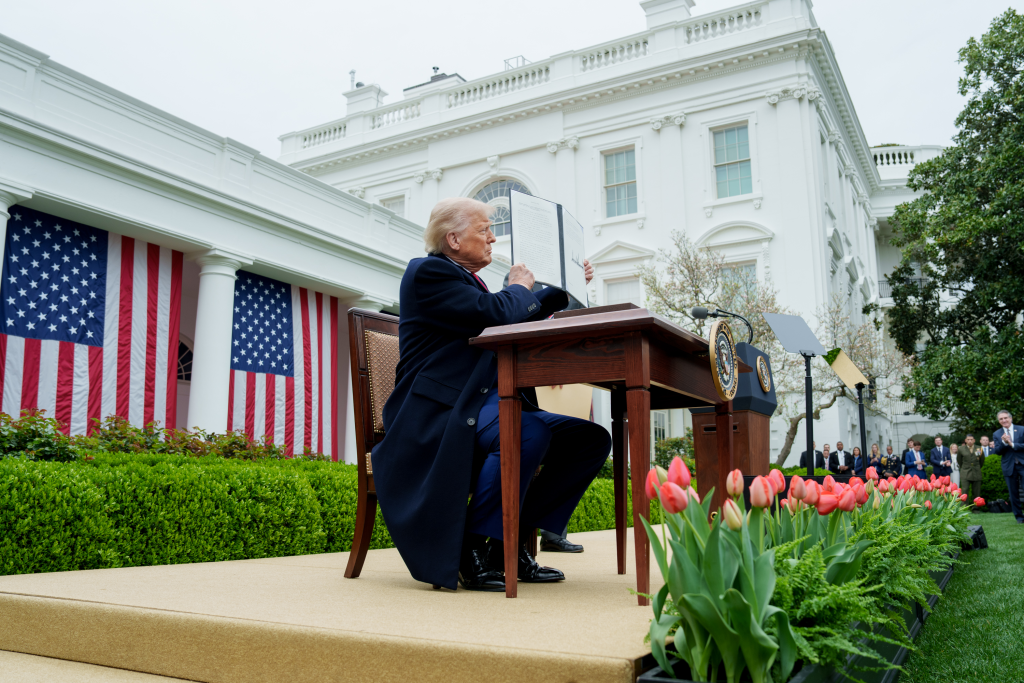
- One year after the 2025 “Liberation Day” tariffs, on April 2 President Trump ordered 100% tariffs on patented pharmaceutical imports from companies that do not cut drug prices and commit to moving production to the U.S.
- He further overhauled metals duties by halving rates on many derivative products to 25% and dropping them entirely on items with less than 15% metals content.
- President Trump on April 8 threatened a new 50% tariff with no exemptions on all goods from any country supplying military weapons to Iran.
- Later on April 13, President Trump specifically warned China of the 50% tariff if caught supplying military aid to Iran.
- After the U.S. imposed a blockade around the Strait of Hormuz by preventing ships from entering and exiting Iranian ports, China called Washington’s actions “dangerous and irresponsible,” warning they risk undermining an “already fragile ceasefire situation.”
Mark the Essentials
- The legal authority for President Trump’s new 50% tariff threat remains unclear after the Supreme Court’s striking down of the IEEPA-based tariffs. IEEPA-tariffs would be justifiable during wartime but the Trump administration has yet to declare the conflict a war to Congress.
- Top Trump economic advisers disagreed on how to implement the president’s threatened 50% tariff on countries supplying weapons to Iran, with NEC Director Hassett suggesting the use of IEEPA despite the Supreme Court ruling against it. While USTR Greer said it could be used for trade prohibitions like embargoes and “not so much for tariffs,” he clarified he is still reviewing options with President Trump.
- The Justice Department argued that the Supreme Court’s ruling against IEEPA tariffs does not apply to President Trump’s elimination of de minimis duty-free treatment for goods valued at $800 or less, contending that suspending the exemption merely subjects low-value imports to existing congressionally authorized duties rather than imposing new tariffs.
- China’s Ministry of Foreign Affairs spokesman Guo Jiakun said that only a full ceasefire can help ease the situation in the Strait of Hormuz, and urged “all parties to abide by the ceasefire arrangements” and “restore normal traffic in the strait as soon as possible.”
Keeping an Eye On…
The ‘Liberation Day’ reciprocal tariffs may have arrived with a bang 12 months ago, but they departed with a whimper. Within a week of their announcement, they were partly suspended following gyrations in the bond markets. After a few months of rollout, massive exceptions were built within their product coverages, ranging from specific critical minerals, energy products, fertilizers, agricultural products, pharmaceutical ingredients, aerospace products, goods entering duty free as part of the USMCA agreement and apparel products as part of the DR-CAFTA agreement. As such, the U.S. average effective tariff rate is still in the digestible 10% range – a far cry from the 1930s Great Depression-esque 20%-plus tariff range. China’s average effective tariff rate is in the six to seven percent range, so not much of a difference between these two major trade players and partners. Of course, the U.S.’ average effective tariff rate vis-à-vis China is much higher, and vice-versa.
The Trump administration’s claim that the reciprocal tariffs have ushered in a new trading order is also greatly exaggerated. Setting the U.S. aside, the global average effective tariff rate has come down, not gone up. In the 12 months since the announcement of reciprocal tariffs, the EU has finalized major trade deals with Mercosur, India, Australia, and China; ASEAN have upgraded their preferential trade agreement too. In a round about way, the Trump administration deserves credit for these developments. Having coerced its trade partners to run their goods tariffs down to zero or low single digits via the U.S., it inadvertently made it easier for some of these partners, especially high-tariff countries like India and Indonesia, to pluralize them to its other major trading partners. Call it the “Trump Round of Plurilateral Trade Liberalization”, where the only exception to these liberalizing ways has been the case of tariff levels in the U.S., which have gone up! In any event, the feared descent to beggar-thy-neighbor protectionism of the Great Depression 1930s has hardly come to pass. The U.S.’ tariff level has stayed well beneath its Great Depression levels.
As for U.S.-China tariffs, President Trump did not have to work himself into such a tizzy to obtain leverage in his trade dealings with President Xi. If he had only asked politely, he would have gotten his bilateral market purchases agreement with Beijing that he cherishes so dearly. China is no fan of managed trade but is happy to make an exception if it helps lock down the U.S. into a more stable relationship, especially so with a president as potentially disruptive as Trump. Besides, the scorecard following each round of the U.S.-China trade war that Trump started in 2018 shows a decrease in U.S. exports to China. So, what’s not to like in provisionally juicing trade flows and, in the process, endow stability to the wider bilateral relationship.
At the end of the day, the Trump administration’s reciprocal tariff rollout was one sorry episode in trade policy making. The reciprocal tariffs may have been cancelled by the Supreme Court but will live on later this year in the guise of Section 301 tariffs against goods exports linked to structural excess capacity and forced labor.
Expanded Reading
- China calls U.S. blockade of the Strait of Hormuz ‘dangerous and irresponsible’, CNBC, April 14, 2026
- Trump warns China of ‘staggering’ 50% tariff if caught supplying military aid to Iran, Fox News, April 13, 2026
- White House advisers send mixed messages on Trump’s latest tariff threat, Politico, April 9, 2026
- Trump threatens 50 percent tariffs on Iran arms supplies. His legal path is murky., Politico, April 8, 2026
- Trump threatens tariffs of 50% on countries ‘supplying military weapons to Iran’, CNBC, April 8, 2026
- Greer Stresses Trade Over Investment Before Trump-Xi Summit, Bloomberg, April 7, 2026
- A year after ‘Liberation Day,’ Trump sets new drug tariffs, adjusts metals duties, Reuters, April 2, 2026
-2-
Section 122 Tariffs Under the Legal Scanner
-2-
In One Sentence
- The U.S. Court of International Trade (CIT) heard oral arguments on April 10 on whether to overturn President Trump’s temporary Section 122 tariffs of 10%.
- The plaintiffs, including 24 U.S. states such as Oregon, California and New York, urged the court to block the 10% tariffs, arguing that a trade deficit is not the same as the balance of payments crisis in the 1970s which it claimed “does not exist today.”
- The Trump administration argued that Section 122 provides a legal basis to address “large and serious” trade deficits, while the petitioners contended that it does not apply to trade deficits but only to a balance of payments crisis.
- One judge, Mark Bennett, observed that a large trade deficit may not be alone “sufficient under 122,” but gave no indication of when the court would rule; the tariff measure will expire by July 24 unless Congress extends it.
Mark the Essentials
- Prior to the hearing, the Justice Department on April 3 argued that courts cannot review President Trump’s finding that a “serious balance-of-payments deficit” exists and must defer to his discretion in imposing 10% Section 122 tariffs, calling the challengers’ reading of the statute “absurd”, warning that overturning the duties would undermine ongoing trade negotiations.
- George Mason University law professor Ilya Somin filed an amicus brief on April 8 arguing that President Trump’s Section 122 tariffs violate the “major questions” and nondelegation doctrine, while importers and Democratic attorneys general filed reply briefs contending the administration illegally redefined “balance-of-payments deficit” to mean a trade deficit.
- The case hinges on whether the statute’s language covering “fundamental international payments problems” applies to trade deficits, complicated by contradictory positions from Trump’s own Justice Department, which previously argued Section 122 had no “obvious application” to trade deficits, and the trade court itself last year suggested the provision was available for that purpose.
Keeping an Eye On…
Here we go again on the tariff litigation front, although this time more absurdist than instructional. On the day after reciprocal tariffs were cancelled by the Supreme Court in February 2026, President Donald Trump once again imposed a slew of tariffs under slightly less dubious legal authorities. This iteration includes a universal but temporary 10% tariff under Section 122 of the Tariff Act of 1974. Section 122 affords the president limited tariff authority to impose tariffs of up to 15% for 150 days to deal with “large and serious balance of payments deficits” as well as address “fundamental international payments problems”.
An issue in the Court of International Trade (CIT) this week was the definition of a ‘balance of payments deficit’, given that the statute does not specify how it is to be calculated. Speaking from a strictly economic perspective, the petitioners argued that the balance of payments is made up of: (1) a nation’s “current account,” which is a record of net receipts or payments on goods, services, income, and unilateral current transfers ( such as U.S. government grants to foreign countries, private remittances, and other current transfers); (2) its “capital account,” which is a record of capital transfers between U.S. residents and foreign residents; (3) its “financial account,” which is a record of transactions between U.S. residents and foreign residents resulting in changes in the level of international claims or liabilities, such as in deposits, ownership of portfolio investment securities, and direct investment. As such, the balance of trade is just one component of the current account and of the balance of payments. Per this framing, the U.S.’ most recent year balance of payments deficit was a mere 0.2% of 2024 GDP. Arguably, it amounts to a rounding error.
The Trump administration rebutted this reading, arguing that a ‘balance of payments deficit’ refers to a shortfall in any of the individual accounts that make up the total deficit, including but not limited to the trade deficit in the current account. Besides, it was not so much the duty of the court to definitionally parse the term ‘balance of payments’ as much as it was its role to review whether the president had acted within his delegated authority or not. The government’s cherry-picked definition of a ‘balance of payments deficit’ stands on a weak footing. Nevertheless, the matter is compounded by an earlier statement by the CIT in its IEEPA-ruling last May, when it noted that Section 122 was a potentially a valid tariff tool in response to a trade deficit since it is meant to “deal with a large and serious U.S. balance of payments deficit.”
At the end of the day, does this counting of the number of angel-accounts that can dance on the head of the balance-of-payments pin matter? The answer is a resounding no. The Section 122 tariffs are a placeholder until the Section 301 investigations on excess capacity and forced labor that are under way duly confer a new tariff number that is equivalent to the now-cancelled reciprocal tariff levels. Which means that by the time the Section 122 matter comes to a head within the legal process, they will be jettisoned by USTR in any case. The to-and-fro at CIT this week was a mere sideshow.
Expanded Reading
- U.S. May Tighten Quantum Investment Restrictions On China, The Quantum Inside, June 26, 2024
- Trump’s tariff powers tested again as judges question ‘deficit’ justification, SCMP, April 11, 2026
- Trade court wrestles with Trump’s replacement tariffs, Politico, April 10, 2026
- Trump’s latest tariffs face a new test in federal court, NBC News, April 10, 2026
- Burlap and Barrel v. Trump, Cato Institute, April 9, 2026
- US DOJ says Section 122 tariffs legal, address core deficit, MLex, April 7, 2026
On the Hill
Legislative Developments
- Reps. Jimmy Panetta (D-CA), Linda Sánchez (D-CA), and Don Bacon (R-NE) introduced the bipartisan Stop Global Tariffs Act, which would nullify President Trump’s Section 122 tariffs, refund importers who paid them, and bar the president from imposing similar duties via presidential proclamation.
- On April 2, House Foreign Affairs Committee member Michael Baumgartner (R-WA) introduced the Multilateral Alignment of Technology Controls on Hardware (MATCH) Act, which would direct the U.S. government to force allied countries to impose export controls to cut off Chinese access to semiconductor manufacturing equipment.
- Rep. Ann Wagner (R-MO) introduced the Export Control Enforcement and Enhancement Act, which would allow any member agency of the End-User Review Committee to force a vote on Entity List changes within 30 days without requiring pre-approval from the Bureau of Industry and Security, addressing Republican concerns that BIS has used its role as chair to block additions to the list.
Hearings and Statements
- House Democrats led by Rep. Rosa DeLauro (D-CT) criticized the Trump administration for pursuing only limited changes to the USMCA ahead of its July review, calling for more aggressive reforms to strengthen labor protections, close loopholes that allow Chinese companies to ship goods through Mexico duty-free, and address the loss of 36,000 auto manufacturing jobs since the agreement took effect.
- Sens. Tammy Baldwin (D-WI), joined minority leader Chuck Schumer (D-NY) and Sen. Elissa Slotkin (D-MI) urged President Trump in an open letter on April 2 to address the “serious threat” on American jobs posed by Chinese vehicles manufactured or titled in Canada and Mexico entering the U.S. under the USMCA, after President Trump signaled openness for Chinese vehicles.
Expanded Reading
Brown introduces legislation to reinstate trade adjustment assistance, Office of Sen. Sherrod Brown (D-OH), June 18, 2024
Bacon, Panetta Introduce the Bipartisan Stop Global Tariffs Act, Don Bacon April 9, 2026
Dems Don’t Want to See USMCA Fall, But They’re Pushing for an Overhaul, Sourcing Journal, April 8, 2026
Slotkin, Schumer, Baldwin Demand Trump Take Action Against Chinese Automakers, American Workers and National Security at Risk, Elissa Slotkin, April 6, 2026
Baumgartner Introduces Bipartisan Bill to Tighten Controls on Sensitive Chipmaking Equipment, Michael Baumgartner’s Office, April 2, 2026
Wagner Introduces Bill to Confront China, Limit Its Influence, Ann Wagner, March 31, 2026