
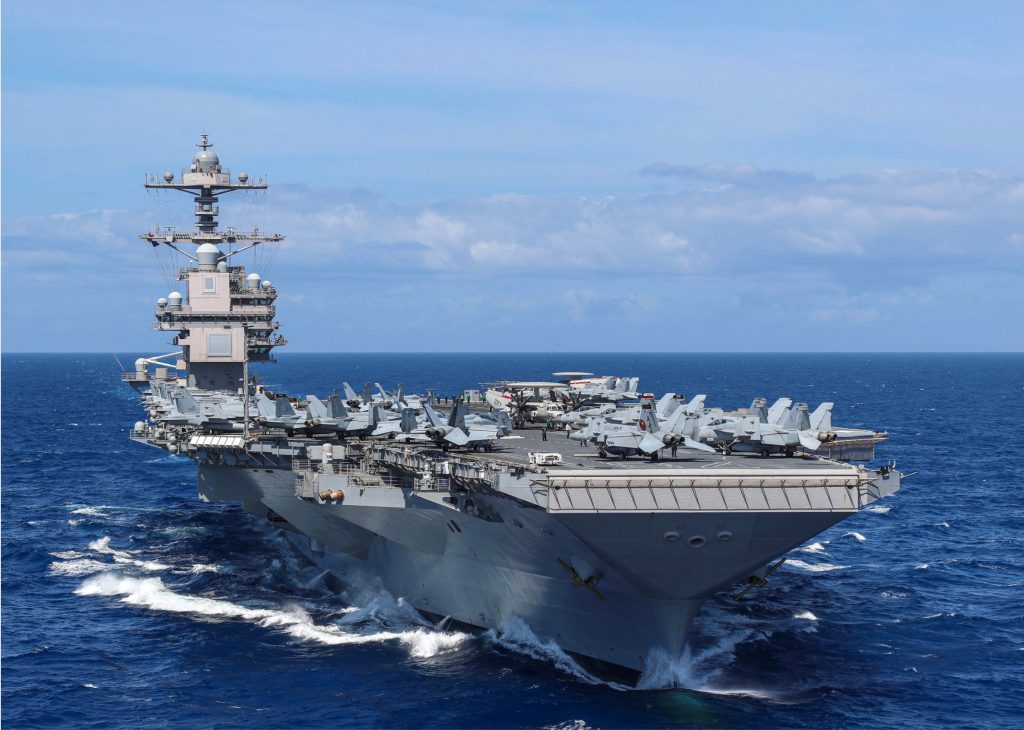
Cover Image Source: “180401-N-XC372-1135” by U.S. Department of Defense Current Photos, Public Domain Mark
Author’s Note: This article launches “Strategic Waterways Under Pressure”, a series of commentaries for the ICAS MAP Program examining international straits, sea lanes, and strategic maritime corridors at a time of mounting pressure. As geopolitical rivalry, security tensions, environmental stress, and more assertive forms of coastal-state control reshape the maritime domain, the legal and policy questions surrounding international passage have become increasingly urgent. Through cases such as the Strait of Hormuz, Strait of Malacca, Arctic routes, and other strategic chokepoints, the series explores how the rules and conditions governing international passage are being tested in practice, and what this may mean for the future of maritime order.
Are strategic maritime corridors moving from free passage to conditional passage? That, increasingly, is the larger question. The issue is not simply whether any particular strait will be formally closed. More often, the change is subtler and more consequential: a waterway remains legally open, yet passage through it is burdened by security risk, regulatory layering, political coercion, commercial rerouting, insurance costs, and exception-based governance. What is at issue, in other words, is not only the law of passage, but the practical usability of passage.
For decades, the baseline expectation of the modern maritime order was relatively clear. Under Part III of the United Nations Convention on the Law of the Sea (UNCLOS), many straits used for international navigation fall under the regime of transit passage, under which States bordering straits may not hamper such passage; other straits remain subject to non-suspendable innocent passage, and some key corridors are shaped by special treaty regimes. Even before UNCLOS codified the modern transit-passage framework, the Corfu Channel case affirmed a right of innocent passage through international straits in peacetime. The point of the postwar legal order was not to deny the interests of coastal States, but to keep strategically important maritime corridors continuously available to international navigation.
That legal baseline still matters. But it no longer captures the whole problem. The central issue today is not only whether passage remains lawful in principle, but whether it remains usable in practice. More than 80 per cent of world merchandise trade by volume is carried by sea, and the stability of a limited number of chokepoints therefore matters far beyond the States that border them. What UNCTAD warned about in January and again in February 2024 had, by the time of its Review of Maritime Transport 2025, hardened into a more persistent pattern of strain: maritime trade growth was projected to slow to 0.5 per cent in 2025 after 2.2 per cent in 2024, while traffic through the Suez Canal remained far below 2023 levels. The crucial issue is not only disruption as such, but the form it takes. Many strategic waterways today are not “closed” in the classic legal sense. They are open, but on increasingly strained, unequal, expensive, and contingent terms.
This development may be described as conditional passage. That does not mean that the traditional law of navigation has disappeared, nor that every new condition on navigation is unlawful or illegitimate. Some regulation is both necessary and appropriate. Safety rules, traffic separation schemes, anti-pollution standards, and environmental protections are integral to modern maritime governance. The IMO Polar Code, for example, illustrates why passage in sensitive waters cannot be reduced to a purely laissez-faire notion of openness. The problem lies elsewhere: access to strategic waterways is increasingly shaped by an accumulation of conditions that may be formally distinct but operationally convergent, including military threat, coercive signaling, coastal-state regulatory expansion, sanctions compliance, war-risk pricing, private rerouting, and prolonged emergency measures. These factors can narrow passage without any formal declaration of suspension.
This is why the old binary of “open or closed” has become inadequate. A waterway may remain open in law even as it becomes degraded in practice. Ships may still pass, but only at sharply higher insurance costs, under naval escort requirements, along altered routing patterns, amid crew-safety concerns, or subject to compliance burdens that render “free passage” more legal fiction than commercial reality. The IMF’s PortWatch initiative is useful precisely because it reflects this shift: chokepoints are no longer merely legal spaces, but measurable systems of traffic, disruption, vulnerability, and spillover. Passage today is assessed not only by doctrine, but by whether ships can move continuously, predictably, and at tolerable cost.
Four broader pressures appear to be driving this shift. First, geopolitical rivalry has turned maritime corridors into more explicitly strategic spaces. Strategic waterways are no longer treated merely as channels of global circulation; they have also become arenas for signaling, deterrence, proxy pressure, and crisis leverage. Once that occurs, passage ceases to be a purely legal entitlement and becomes entangled with military posture, sanctions, alliance commitments, and escalation management. The danger lies not only in the possibility that a State may threaten closure, but in the fact that the background level of insecurity may rise sufficiently to alter navigational behavior long before any formal closure occurs.
Second, coastal-state governance is becoming more assertive. This does not automatically amount to illegality. UNCLOS itself allows certain laws and regulations relating to navigational safety, pollution control, and related matters. The practical question, however, is whether the cumulative effect of coastal-state measures remains compatible with a passage regime whose central promise is continuity and non-impediment. In periods of heightened tension, governments have strong incentives to expand the range of measures they justify in the name of security, environmental protection, infrastructure protection, or emergency management. The legal language may remain unchanged; the operational environment may not.
Third, markets have become powerful agents in shaping maritime restriction.This is one of the most important, yet still underappreciated, shifts. A waterway may remain legally open while becoming commercially degraded if shipowners, charterers, insurers, and logistics firms collectively conclude that the route is no longer usable on acceptable terms. In that sense, de facto obstruction need not always stem from a formally prohibitive State act. It may instead arise from the interaction between insecurity and rational commercial avoidance. UNCTAD’s recent work on freight-rate volatility and chokepoint disruption underscores precisely this point: the consequences of stressed passage are transmitted through prices, timing, risk allocation, and supply-chain behavior.
Fourth, exceptional measures are becoming easier to normalize. Maritime law has always accommodated exceptions, special regimes, and context-sensitive rules. The problem lies not in the existence of such exceptions, but in their gradual shift from temporary response to routine governing technique. Once the language of emergency, crisis administration, ad hoc security practices, or prolonged risk alerts becomes semi-permanent, the distinction between ordinary passage and exceptional passage begins to erode. The legal architecture remains in place, but it comes to operate through an expanding set of caveats.
This matters because the core vulnerability of the maritime order rarely lies at the level of formal doctrine alone. Rules can survive textually while eroding functionally. A right of passage is weakest not only when it is openly denied, but when it remains officially intact while becoming progressively harder to exercise in a stable, low-cost, and non-discriminatory way. That is why the key question may no longer be whether freedom of navigation still exists as a principle. It is whether the practice of passage is being hollowed out by conditions that stop short of explicit prohibition.
Seen in that light, the global conversation about waterways needs to shift. Less attention should be paid to spectacular closure scenarios alone, and more to the layered mechanisms that make a route legally available yet strategically brittle. The central questions are no longer only whether ships may pass, but under what conditions, at what cost, with what degree of predictability, and under whose discretionary shadow. The issue, in other words, is no longer passage in the abstract, but passage under stress.
The argument, accordingly, is not confined to any single strait. The larger objective is to identify a broader pattern across different legal and strategic environments. Here, the series of “Strategic Waterways Under Pressure: From Free Passage to Conditional Passage?” functions as an umbrella term, not as a single legal category. The Strait of Hormuz raises the question of formal closure versus de facto obstruction. The Strait of Malacca offers a contrast case: a highly strategic corridor that has not collapsed into full conditionality, making it useful for studying institutional resilience. The Turkish Straits and the Black Sea introduce the role of special treaty regimes. The Arctic brings environmental governance, sovereignty claims, and security logics into direct interaction, especially in light of instruments such as the Polar Code. The Red Sea and other stressed sea lanes show how rapidly risk, shipping behavior, and legal expectations can diverge.
Across all of these cases, the inquiry may be organized around four questions: What is the legal character of the waterway? What passage regime applies? What is the main pressure now acting upon it? And is that pressure producing a form of conditional passage or de facto obstruction? If the answers begin to converge across otherwise different waterways, the result is no longer a set of isolated crises, but evidence of a structural shift in the governance of strategic maritime circulation.
This series should therefore not be read as a settled conclusion. It is a research question, but a pressing one. It asks whether the central challenge facing international passage today lies less in the dramatic moment of declared closure than in the slower transformation of open routes into increasingly conditional ones. If that is indeed the direction of travel, then one of the defining tasks for maritime law and maritime governance is to recognize the change early: not when passage disappears, but when it survives only in a thinner and more contingent form than before.


Greenland Deal Goes Beyond Defense