

Australia’s security posture is entering a period of recalibration as shifting global priorities reshape the strategic landscape of the Indo-Pacific. While the United States remains the region’s primary security provider, Washington’s growing focus on the Middle East—particularly amid ongoing conflict with Iran—has raised concerns among regional allies about a potential dilution of U.S. attention toward Asia.
This perception is reinforced by the relatively limited emphasis on the Indo-Pacific in the 2025 U.S. National Security Strategy and the evolving priorities outlined in the 2026 U.S. National Defense Strategy. Although U.S. military presence in the region remains intact, the combination of global commitments and resource constraints has led partners to question the reliability and immediacy of American support in high-intensity contingencies.
For Australia, this emerging “strategic vacuum” does not imply abandonment but rather uncertainty—an environment in which alliance assurances are still present but potentially less decisive. In response, Canberra has increasingly emphasized both self-reliance and diversified security partnerships, particularly with like-minded regional actors.
Japan has emerged as a central pillar in this adjustment. As Tokyo expands its defense industrial base and loosens longstanding constraints on military cooperation, Australia sees an opportunity to deepen bilateral ties beyond traditional alliance frameworks. At the same time, Australia must balance this shift against its parallel effort to stabilize relations with China, its largest trading partner, and maintain functional engagement with broader regional economies.
This evolving posture reflects a broader structural shift: from a U.S.-centric security architecture toward a more networked system in which middle powers play a greater role in shaping deterrence, industrial capacity, and regional order.
Recent developments underscore the extent to which Australia is operationalizing this strategic adjustment, particularly through intensified cooperation with Japan.
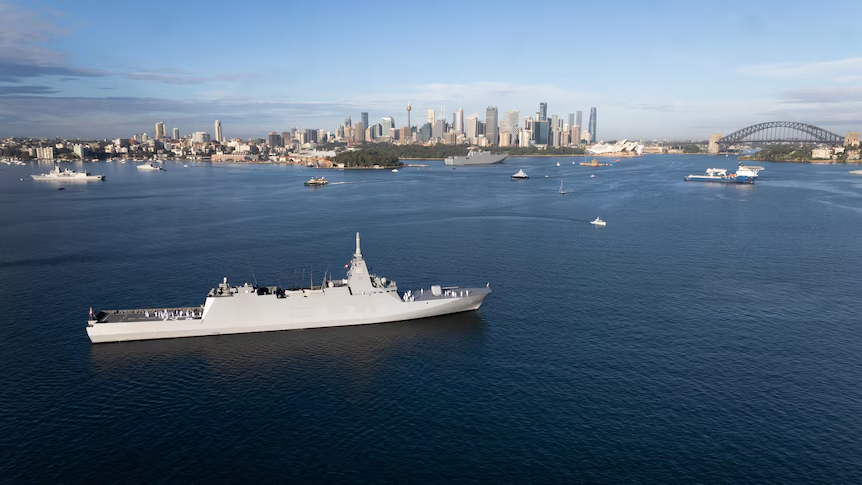
Most notably, Canberra and Tokyo have finalized contracts for the delivery of the first three Mogami-class frigates as part of a A$10 billion program, with Japan’s Mitsubishi Heavy Industries responsible for initial construction. The deal—expected to expand to 11 vessels, including domestically built ships in Western Australia—marks the largest defense export in Japan’s postwar history and represents a significant deepening of bilateral industrial integration.
Beyond procurement, the partnership is evolving toward co-development and co-production. Australian and Japanese officials have emphasized joint efforts in long-range missiles and autonomous systems, reflecting both the growing importance of these capabilities in modern warfare and mounting concerns over strained U.S. defense supply chains. High-intensity conflicts in Ukraine and the Middle East have exposed limitations in American stockpiles, prompting allies to explore more resilient and distributed industrial models.
This shift is not merely technical but structural. What was once a hub-and-spokes system centered on the United States is gradually transitioning into a more networked defense-industrial ecosystem. For Australia, integrating with Japan—widely viewed as an “industrial powerhouse”—offers a pathway to expand domestic capacity while reducing dependence on U.S. supply bottlenecks.
At the same time, Australia is expanding its defense commitments. Under its 2026 National Defense Strategy, Canberra plans to increase military spending by nearly $38 billion over the next decade, with a focus on long-range strike capabilities, maritime assets, and drone technologies. This buildup aligns closely with AUKUS objectives while reinforcing Australia’s role as a forward-operating security actor in the Indo-Pacific.
Yet this hardening security posture is accompanied by a parallel diplomatic track. The Albanese government has sought to repair relations with China, emphasizing economic stability and regional engagement. This week, Foreign Minister Penny Wong is on a trip to meet counterparts in Beijing, Tokyo, and Seoul on energy security and regional coordination, particularly in response to disruptions linked to Middle East instability.
These dual tracks—security integration and diplomatic stabilization—highlight Australia’s attempt to navigate a more complex and fragmented strategic environment.
First, Australia’s deepening defense ties with Japan are driven as much by structural necessity as by strategic alignment. As doubts emerge about the scalability of U.S. military support under conditions of simultaneous global crises, middle powers are increasingly compelled to build interoperable and autonomous capabilities. The Australia–Japan partnership thus reflects a broader shift toward distributed deterrence, rather than a simple strengthening of bilateral ties.
Second, this trajectory introduces new strategic tensions. Japan’s evolving defense posture—including deployments of long-range strike capabilities and a more explicit focus on China as a primary security concern—risks complicating Australia’s parallel effort to stabilize its relationship with Beijing. While Canberra frames its actions in terms of deterrence and resilience, deeper integration with Japan’s defense strategy may be interpreted by China as alignment within a broader containment framework, narrowing diplomatic flexibility.
Third, Australia’s balancing act is further complicated by shifting U.S. expectations. Despite calls for greater burden-sharing, Washington’s own global commitments—particularly in the Middle East—have exposed the limits of alliance coordination. Public criticism from Donald Trump over allied contributions to the Iran conflict underscores a growing transactional element in U.S. alliance management. This dynamic raises questions about how responsibilities will be distributed in future contingencies, particularly in the Indo-Pacific.
Australia’s current approach—simultaneously strengthening defense partnerships, expanding domestic capabilities, and maintaining diplomatic engagement with China—represents an attempt to hedge against multiple forms of uncertainty. However, this strategy is inherently fragile.
As the Indo-Pacific security environment becomes more fluid, Australia’s ability to manage these competing imperatives will not only shape its own strategic trajectory, but also influence the emerging balance between alliance cohesion and regional autonomy.
This Spotlight was originally released with Volume 5, Issue 4 of the ICAS MAP Handbill, published on April 29, 2026.
This issue’s Spotlight was written by Yilun Zhang, ICAS Research Associate at ICAS.

Maritime Affairs Program Spotlights are a short-form written background and analysis of a specific issue related to maritime affairs, which changes with each issue. The goal of the Spotlight is to help our readers quickly and accurately understand the basic background of a vital topic in maritime affairs and how that topic relates to ongoing developments today.
There is a new Spotlight released with each issue of the ICAS Maritime Affairs Program (MAP) Handbill – a regular newsletter released the last Tuesday of every month that highlights the major news stories, research products, analyses, and events occurring in or with regard to the global maritime domain during the past month.
ICAS Maritime Affairs Handbill (online ISSN 2837-3901, print ISSN 2837-3871) is published the last Tuesday of the month throughout the year at 1919 M St NW, Suite 310, Washington, DC 20036.
The online version of ICAS Maritime Affairs Handbill can be found at chinaus-icas.org/icas-maritime-affairs-program/map-handbill/.